Ten years after Ahlquist divided adrenergic receptors into alpha and beta, Powell and Slater found a compound that blocked the beta responses, and Moran and Perkins showed it blocked the heart's response to adrenaline; the compound was a research tool, and the clinical beta blockers came later.
Reading Library · Anesthesia Epochs · 中文版
Watch the education video (for clinicians)
1958: Dichloroisoproterenol — Blocking the Beta Receptor · Anesthesia Epochs Education Series
Every beta blocker in the anaesthetist's drawer rests on two earlier ideas: that adrenaline acts on more than one kind of receptor, and that one of those kinds can be blocked. The first was proposed in 1948. The second became possible in 1958, when C. E. Powell and I. H. Slater reported a compound that blocked the "beta" responses, and N. C. Moran and M. E. Perkins showed that it also blocked adrenaline's effects on the heart. The compound was dichloroisoproterenol, DCI. This article could not obtain the 1958 papers. It reads them through a 1961 review by Eugene E. Vogin and Walter W. Baker and a 1960 research paper by Peter E. Dresel, and says so throughout. [1][2]
Two receptors, one of them unblockable
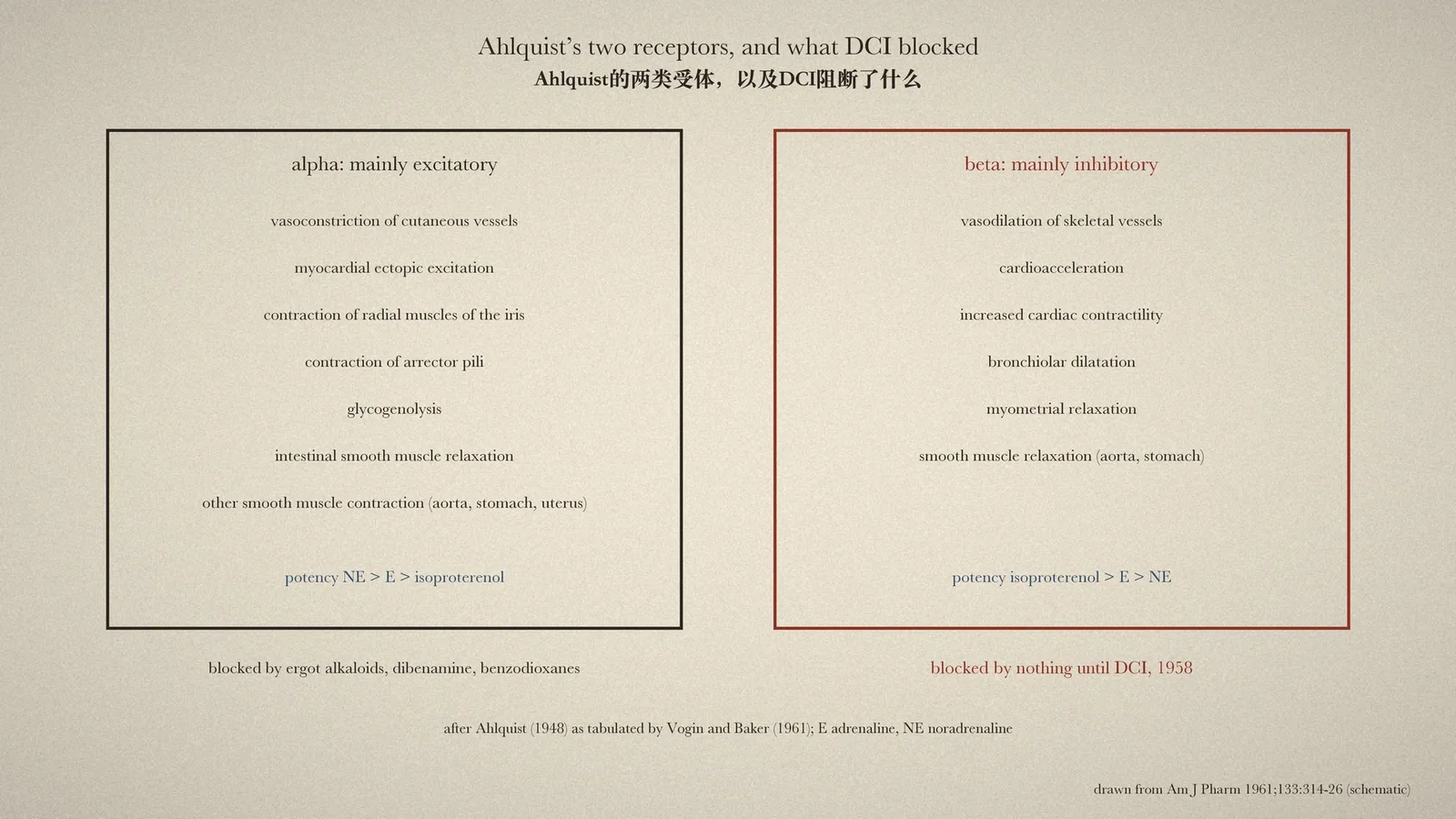
Vogin and Baker begin with Langley's "receptive substance" and then with R. P. Ahlquist, who in 1948 studied the actions of adrenaline, noradrenaline and isoproterenol on many tissues and concluded that there were two types of receptor. The alpha receptor was "mainly excitatory and usually blocked by the classical adrenergic blocking agents such as the ergot alkaloids, dibenamine, and benzodioxanes". The beta receptor was "mainly inhibitory, and until the advent of dichloroisoproterenol (DCI) could not be blocked by the use of adrenergic blocking agents". The orders of potency differed: noradrenaline was strongest on alpha receptors and isoproterenol on beta receptors. [1]
What Powell and Slater found
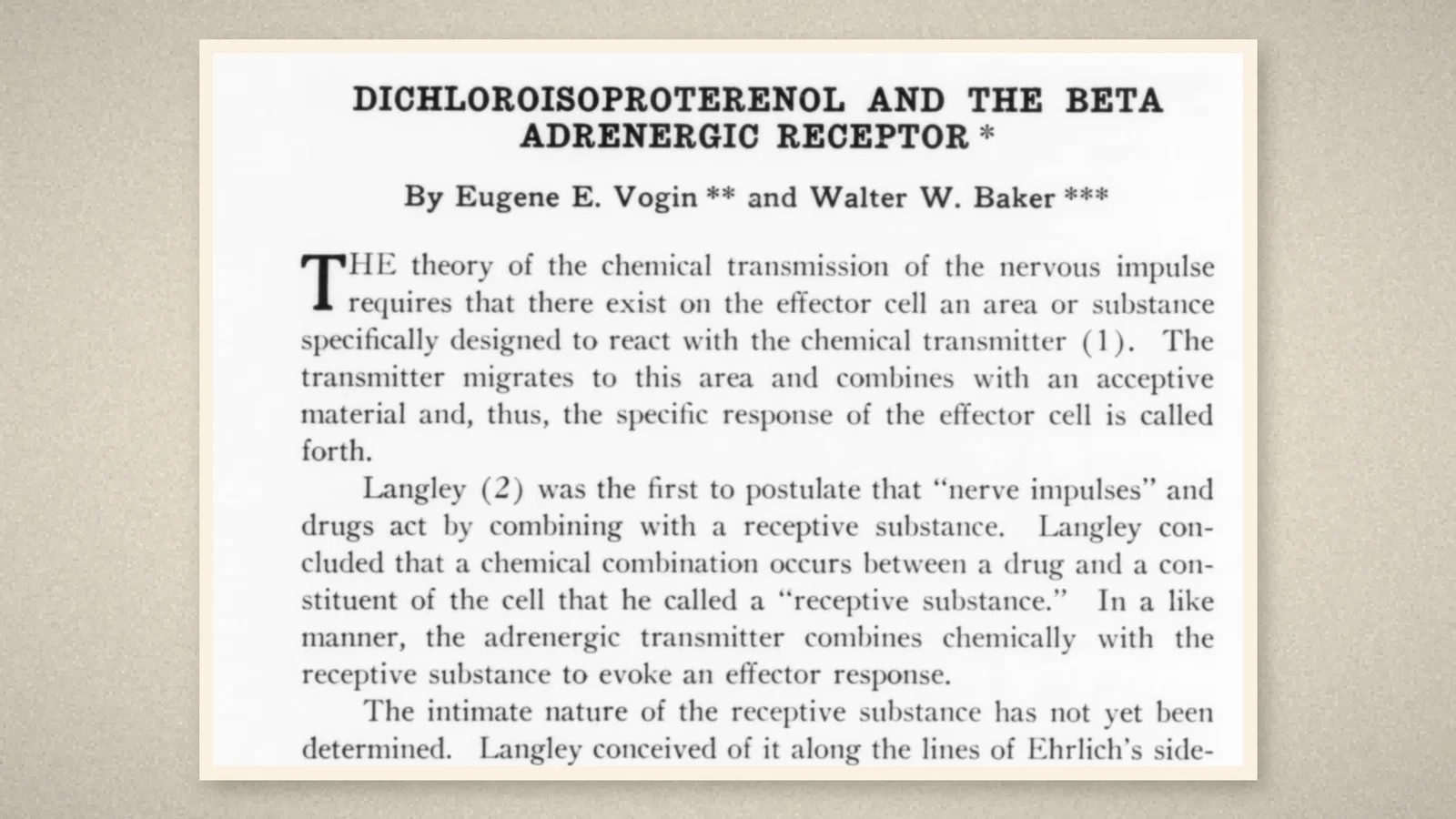
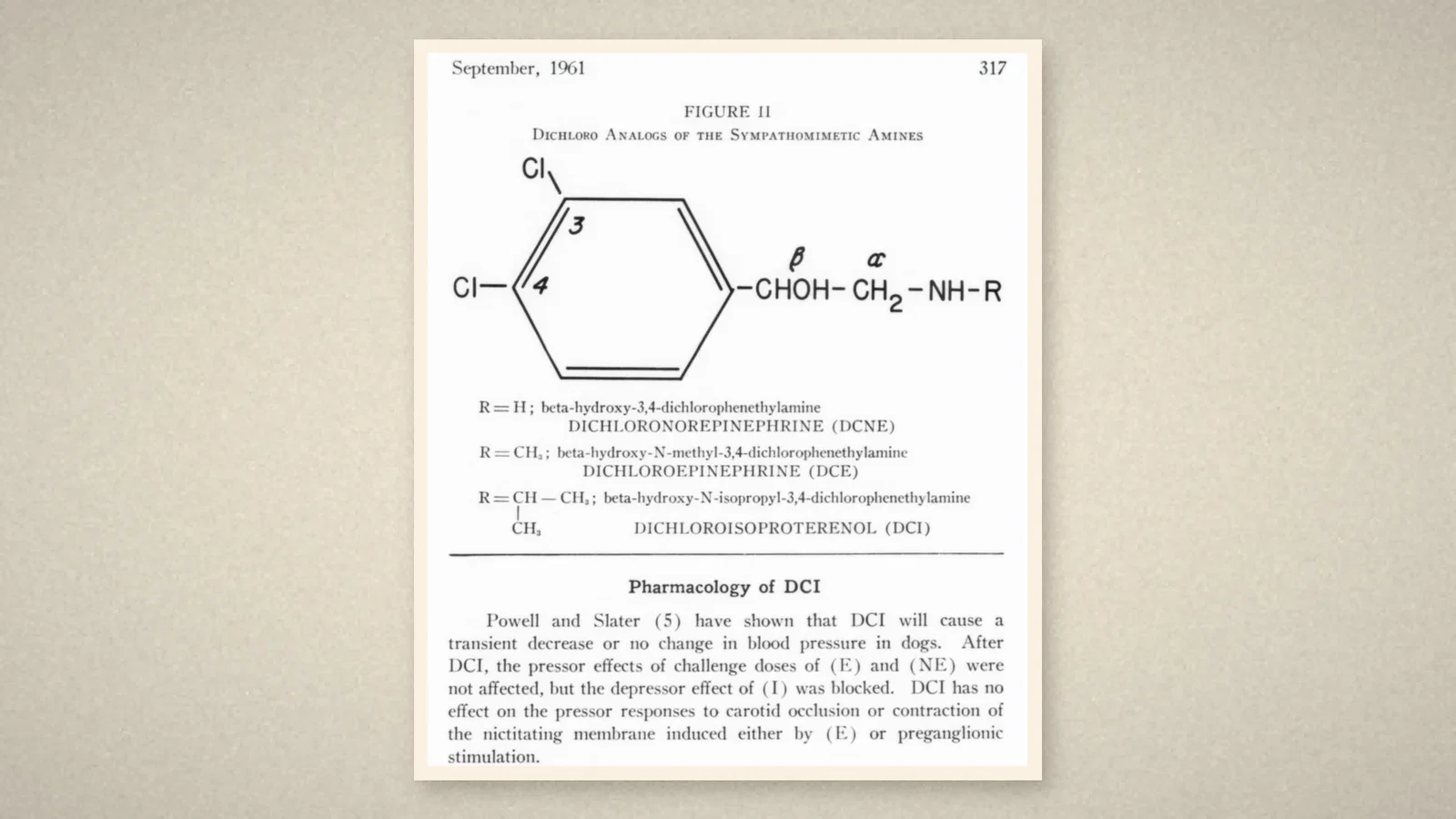
DCI is isoproterenol with its two ring hydroxyl groups replaced by chlorine atoms. According to the review, Powell and Slater found that in dogs DCI caused a transient fall or no change in blood pressure. After DCI, "the pressor effects of challenge doses of (E) and (NE) were not affected, but the depressor effect of (I) was blocked": the rise in pressure from adrenaline and noradrenaline survived, but the fall in pressure from isoproterenol did not. DCI had no effect on the contraction of the nictitating membrane, an alpha response. It left normal uterine movements alone, but uterine relaxation produced by adrenaline or isoproterenol "was inhibited or substantially reduced". "With the advent of DCI in 1958," the review says, "it is now possible to delineate and more fully explain the occurrence, nature, and action of the beta adrenergic receptors." [1]
The heart
The adrenergic receptors of the heart did not fit neatly into Ahlquist's scheme, because no blocking drug acted on them reliably; their status "had been in doubt". "Stimulated by the observations of Powell and Slater", Moran and Perkins tested DCI on the heart. In dogs and in isolated rabbit hearts, DCI selectively blocked the positive inotropic and chronotropic effects of adrenaline, noradrenaline, isoproterenol and cardiac sympathetic nerve stimulation, while the positive inotropic effects of digoxin, calcium chloride and theophylline were unchanged. From this they concluded that "the adrenergic receptors of mammalian hearts are functionally homologous to the adrenergic inhibitory receptors of other tissues": the heart's receptors were beta receptors. [1]
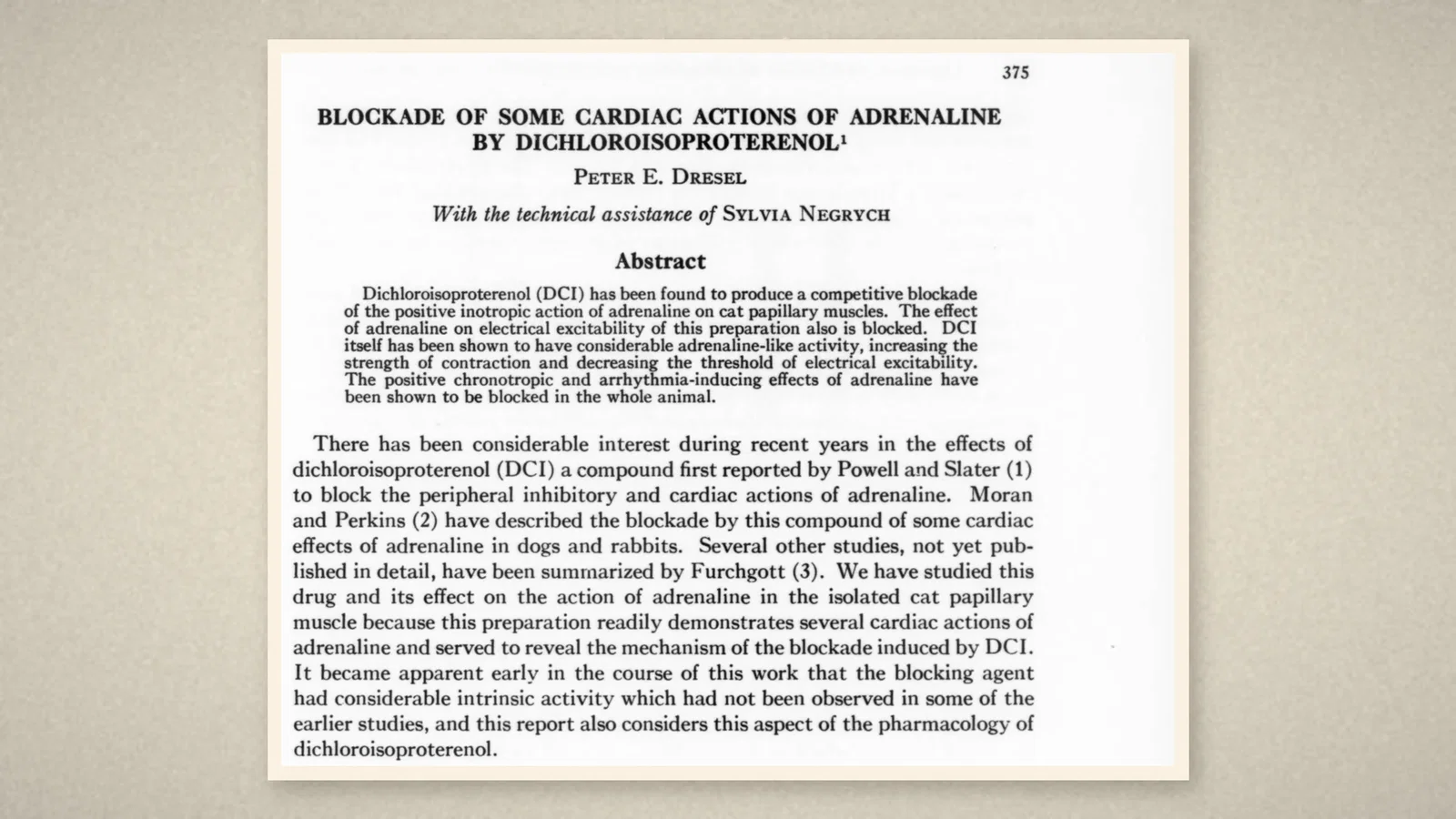
In 1960 Dresel, at the University of Manitoba, described DCI as "a compound first reported by Powell and Slater to block the peripheral inhibitory and cardiac actions of adrenaline", and found in cat papillary muscle that it produced "a competitive blockade" of adrenaline's positive inotropic action. Dresel also found that DCI "itself has been shown to have considerable adrenaline-like activity". The review notes the same double action: DCI first stimulated the heart, and subsequent doses depressed it. [1][2]
What the record shows
In 1958 the beta receptor stopped being only a classification and became something a drug could block, in blood vessels, the uterus and the heart. DCI itself, with its own stimulant action, was a laboratory tool, not a medicine; the beta blockers used in clinical practice came later and belong to later articles. What 1958 supplied was the proof that the heart's adrenergic receptors were beta receptors and that they could be blocked.
Sources and reading limits
Read: Vogin and Baker's 1961 review in full; the title page, abstract and introduction of Dresel's 1960 paper.
Not covered: Powell and Slater's 1958 paper (J Pharmacol Exp Ther 1958;122:480) and Moran and Perkins' 1958 papers, because the journal's site could not be accessed, and Ahlquist's 1948 paper. All statements about the 1958 experiments are the review's and Dresel's summaries. The clinical beta blockers are not covered.
Three illustrations are page crops from the 1961 review and the 1960 paper; one is drawn from the review.
- Vogin EE, Baker WW. Dichloroisoproterenol and the beta adrenergic receptor. Am J Pharm. 1961;133(9):314-26. Internet Archive
- Dresel PE. Blockade of some cardiac actions of adrenaline by dichloroisoproterenol. Can J Biochem Physiol. 1960;38(4):375 ff. Internet Archive
Continue exploring
Related reading connects shared questions and contexts; it does not by itself establish historical influence.
Anesthesia Epochs · The Source Room · About & Editorial Method
Published November 2, 2026. Sources and reading limits are stated above. Illustrations are labelled as original source images or AI-made. Historical accounts are educational; they are not current treatment instructions.