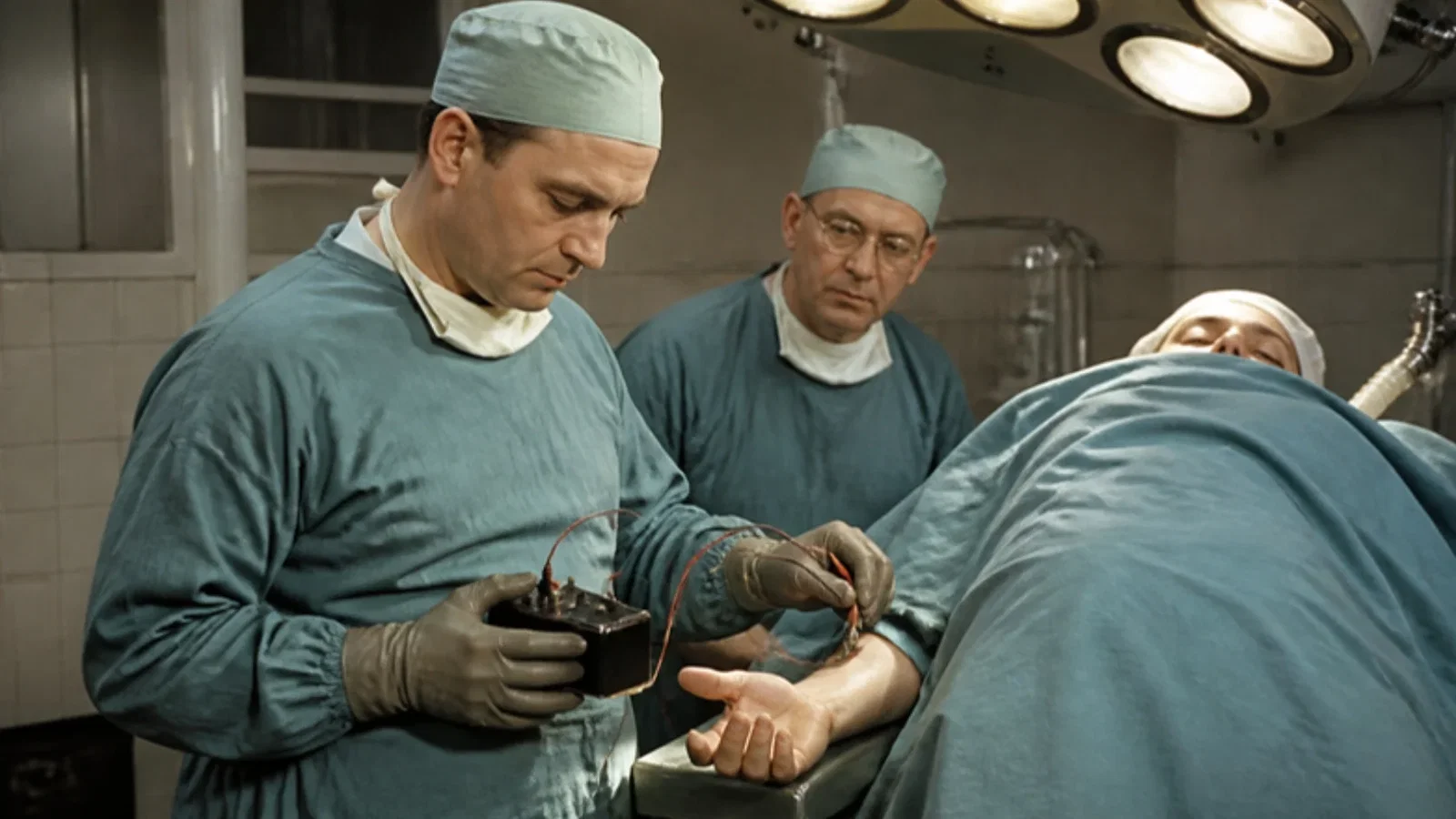
On 12 April 1958 The Lancet's New Inventions column printed 'The St. Thomas's Hospital nerve stimulator in the diagnosis of prolonged apnoea' by T. H. Christie and H. C. Churchill-Davidson of St Thomas's Hospital, London. When muscle power failed to return after a relaxant, the cause might be central, such as an analgesic, an anaesthetic or excess carbon dioxide, or a prolonged neuromuscular block, and no ordinary clinical examination could tell them apart; stimulating the ulnar nerve at the wrist or elbow would: with block present the fourth and fifth fingers would not move, with normal transmission the hand would form a claw. The machine was made by Medelec. The ASA timeline calls it the first neuromuscular monitor and credits the train-of-four of 1970 to Ali, Utting and Gray.
Reading Library · Anesthesia Epochs · 中文版
Watch the education video (for clinicians)
1958: The Nerve Stimulator — Christie and Churchill-Davidson · Anesthesia Epochs Education Series
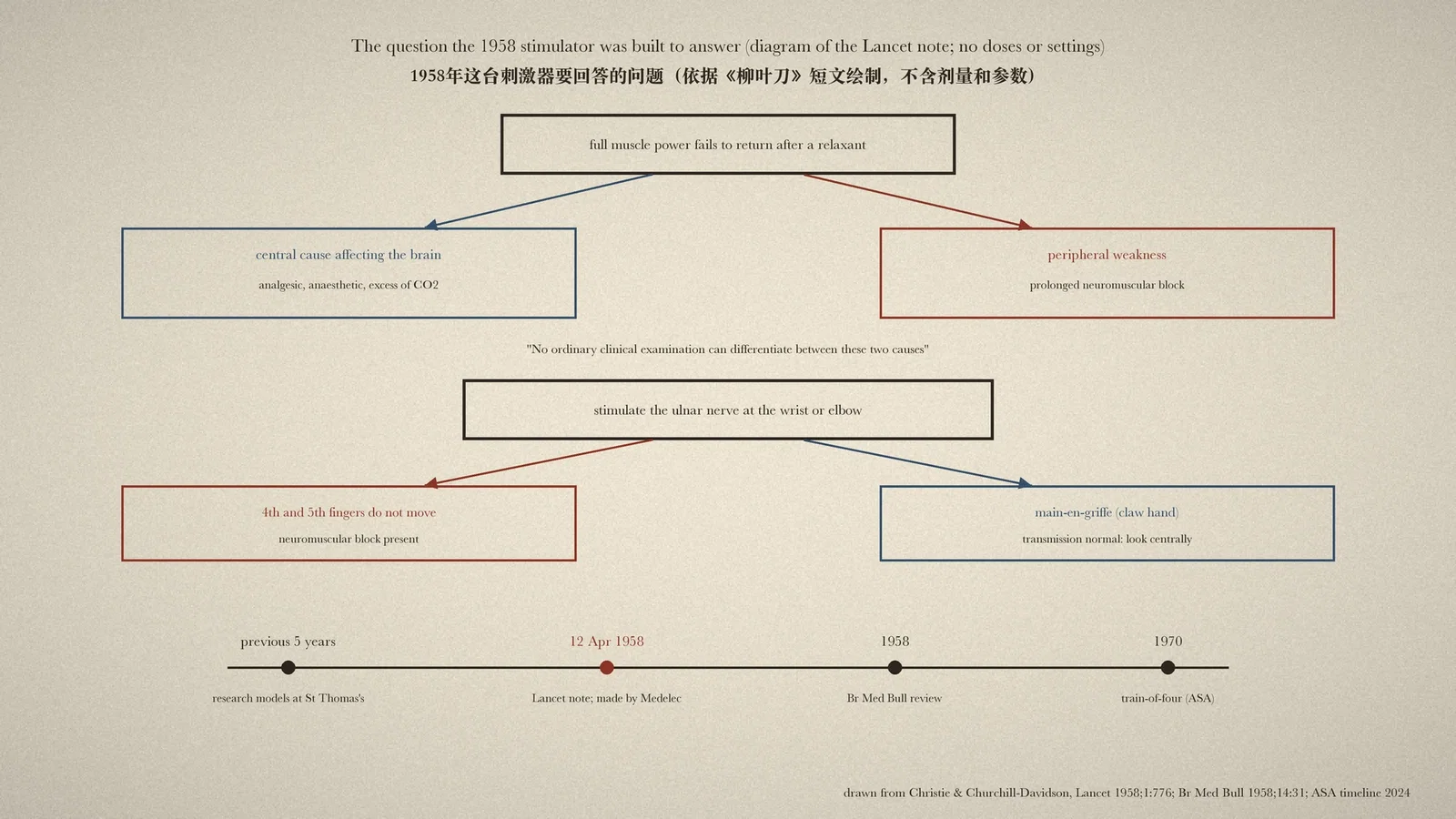
At the end of an operation a patient who has had a muscle relaxant should breathe again. Sometimes the patient does not. In the operating theatres of the time, the anaesthetist then faced a question that looking at the patient could not answer: was the brain failing to drive the breathing, or were the muscles still blocked? In April 1958 two anaesthetists at St Thomas's Hospital in London described a small box built to answer it. [1]
The problem
The note appeared in The Lancet of 12 April 1958 under "New Inventions": "The St. Thomas's Hospital Nerve Stimulator in the Diagnosis of Prolonged Apnoea", by T. H. Christie and H. C. Churchill-Davidson. "Unexpectedly prolonged response to muscle relaxants has been reported increasingly often in recent years", they began. One of the principal difficulties facing most anaesthetists was to determine whether the failure of return of full muscle power was due to "a central cause affecting the brain (e.g., analgesic, anaesthetic, or excess of carbon dioxide), or to peripheral weakness caused by prolongation of the neuromuscular block". [1, p. 776]
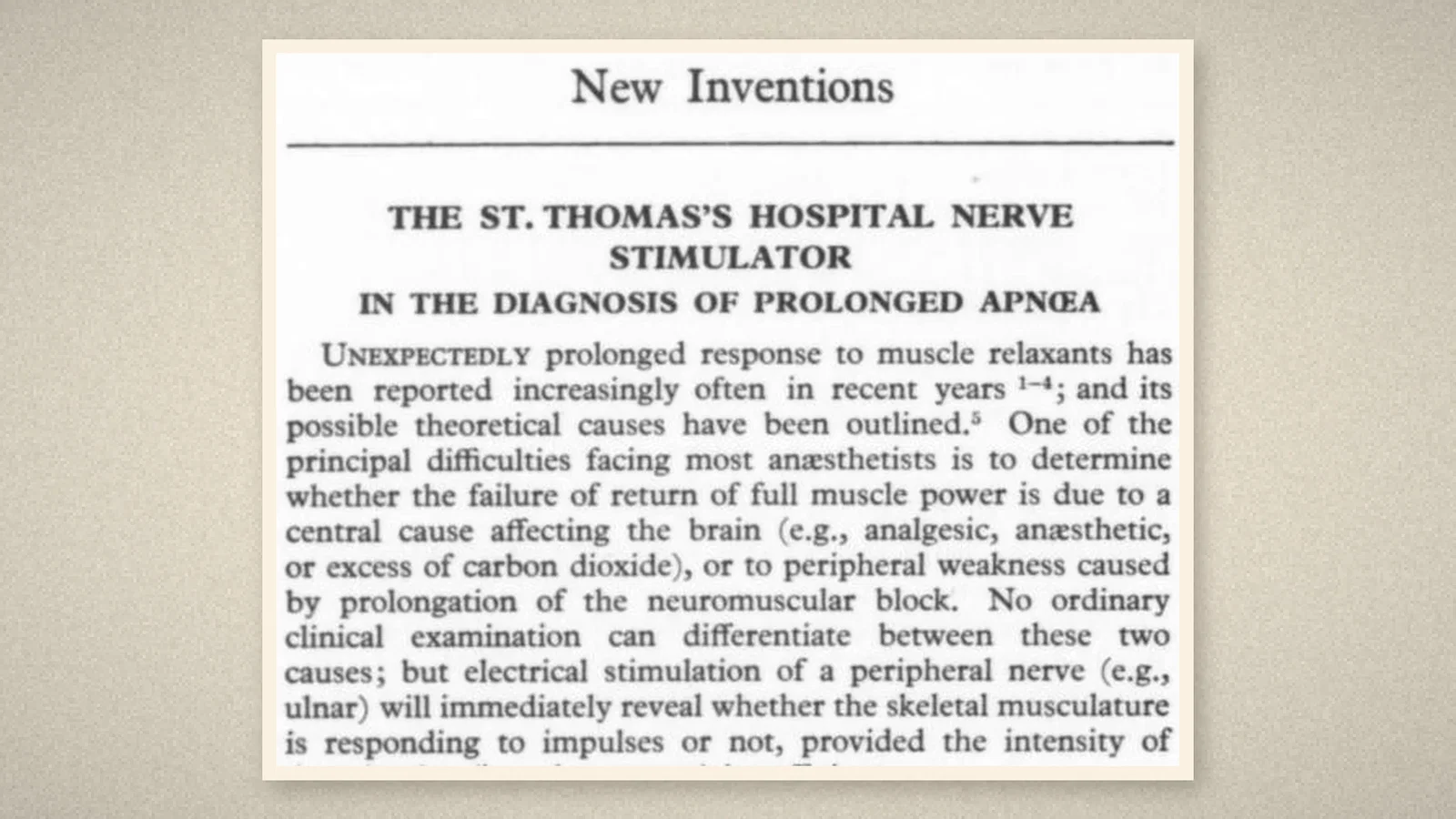
"No ordinary clinical examination can differentiate between these two causes; but electrical stimulation of a peripheral nerve (e.g., ulnar) will immediately reveal whether the skeletal musculature is responding to impulses or not, provided the intensity of the stimulus (i.e., the current) is sufficient." [1, p. 776]
The box
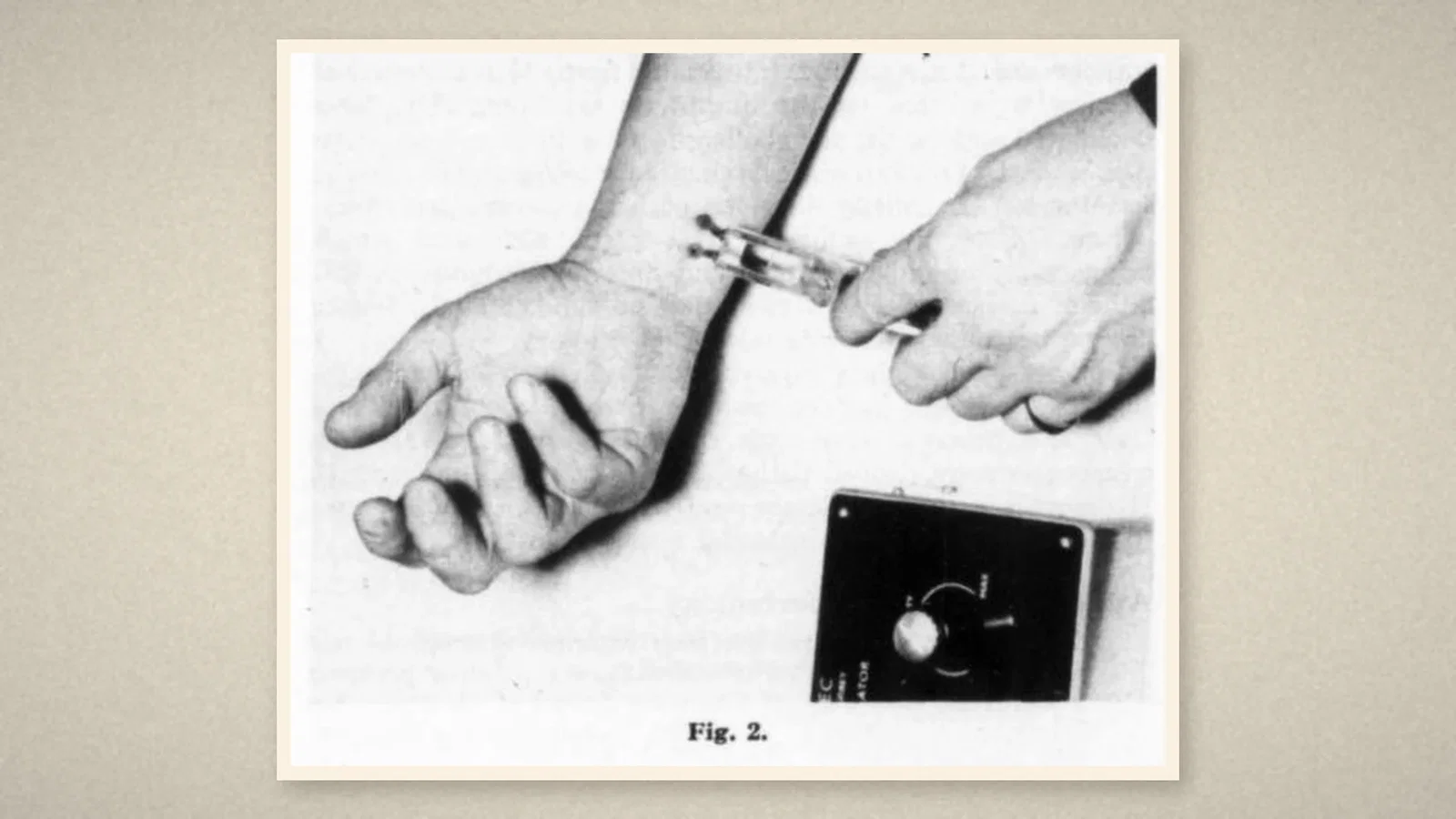
Electrical stimulators, the authors wrote, had not been readily available, "but during the last five years various models have been in use at this hospital for research purposes". The present apparatus had been designed for use in the operating theatre and was now produced commercially. It could stimulate at a slow rate, giving single twitches, or a fast rate, giving tetanus; the intensity could be altered, but in the unconscious patient it was advisable to use the maximum possible "to ensure that all the muscle-fibres served by that nerve will contract". [1, p. 776]
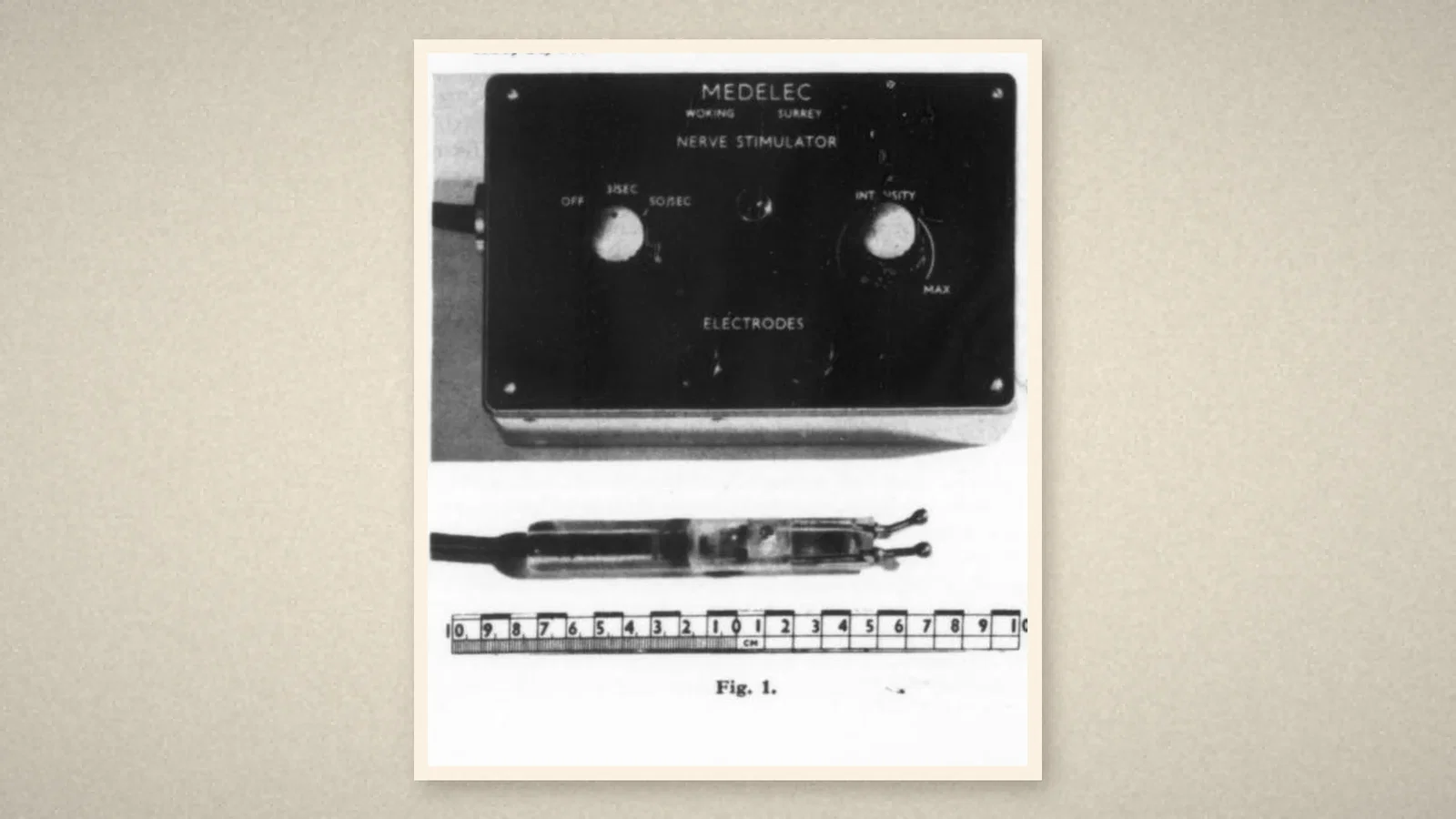
The test was simple. In an abnormal response to a relaxant, the machine could stimulate the ulnar nerve at the wrist or the elbow. "Then, if neuromuscular block is present, the 4th and 5th fingers will not move; on the other hand, if normal neuromuscular transmission is present, the typical picture of main-en-griffe will result." The authors believed the stimulator would "prove very useful to anaesthetists", for studying the action of relaxants during routine anaesthesia or, with other electrodes, for finding the facial nerve at operation. It could be obtained from Medelec Limited of Woking, Surrey. [1, p. 776]
The context
In the same year Churchill-Davidson, consultant anaesthetist at St Thomas's, reviewed "The Muscle Relaxants: Recent Developments" for the British Medical Bulletin. The review sorted the possible explanations of prolonged apnoea into two main groups, factors acting on the brain and spinal cord, which stop breathing centrally, and factors acting at the neuromuscular junction, and it discussed among the peripheral causes simple overdose and the effect of a cold limb with poor circulation, which might stay paralysed for hours. The stimulator was the bedside instrument for that distinction. [2]
The Australian Society of Anaesthetists (ASA) timeline lists the St Thomas' Hospital Nerve Stimulator under 1958 as "the first neuromuscular monitor devised", allowing "the assessment of prolonged apnoea following the use of muscle relaxant drugs", and records under 1970 the "train-of-four" test of Hassan H. Ali, John E. Utting and Thomas Cecil Gray at Liverpool. [3, pp. 65, 71]
What the record shows
The moment when the state of the neuromuscular junction stopped being a guess. Instead of inferring block from a patient's failure to breathe, the anaesthetist could ask a nerve directly and watch two fingers. The 1958 note offered a yes-or-no answer; measuring how much block remained would come later.
Sources and reading limits
Read: Christie and Churchill-Davidson, The Lancet 1958;1:776, in full; Churchill-Davidson, British Medical Bulletin 1958;14(1), the sections on types of block and on the abnormal response to relaxants; the ASA timeline 2024, pp. 65 and 71.
Not covered: Churchill-Davidson's paper on prolonged apnoea in Anesthesiology 1956; any description of the research stimulators used at St Thomas's before 1958; the manufacturer's literature; the train-of-four papers of 1970, which belong to a later article.
Limits: "the first neuromuscular monitor devised" is the ASA's description, not this article's claim; the Lancet note says only that research models had been in use at the hospital for five years. Stimulus frequencies, drug names and doses in the sources are not repeated. Quotations are from the English originals.
Three illustrations are crops of The Lancet (p. 776); one is drawn from the note.
- Christie TH, Churchill-Davidson HC. The St. Thomas's Hospital nerve stimulator in the diagnosis of prolonged apnoea. Lancet. 1958;1(7024):776. Internet Archive
- Churchill-Davidson HC. The muscle relaxants: recent developments. Br Med Bull. 1958;14(1):31. Internet Archive
- Australian Society of Anaesthetists. Anaesthesia history timeline. 2024:65, 71. ASA
Continue exploring
Related reading connects shared questions and contexts; it does not by itself establish historical influence.
Anesthesia Epochs · The Source Room · About & Editorial Method
Published November 3, 2026. Sources and reading limits are stated above. Illustrations are labelled as original source images or AI-made. Historical accounts are educational; they are not current treatment instructions.