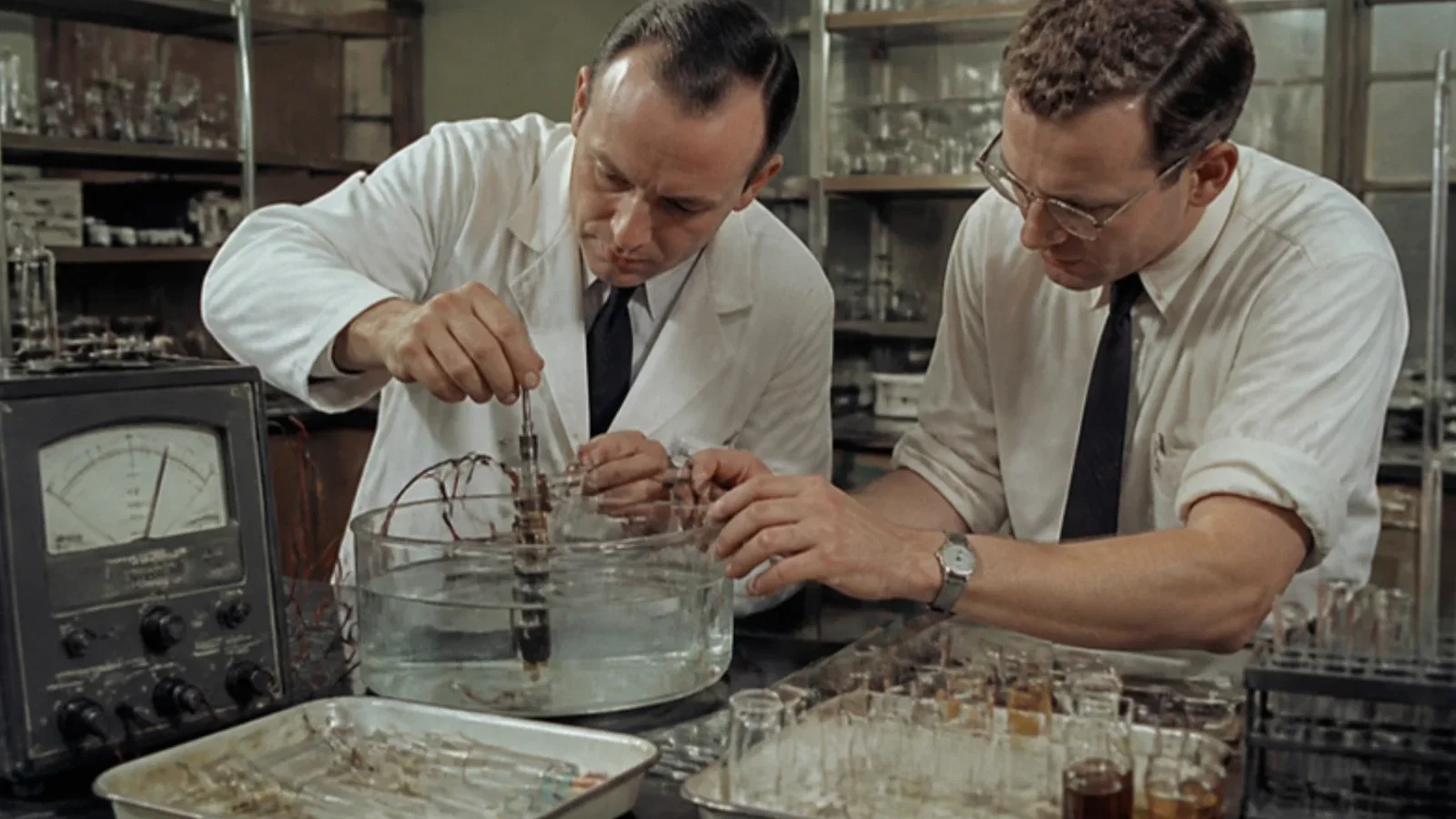
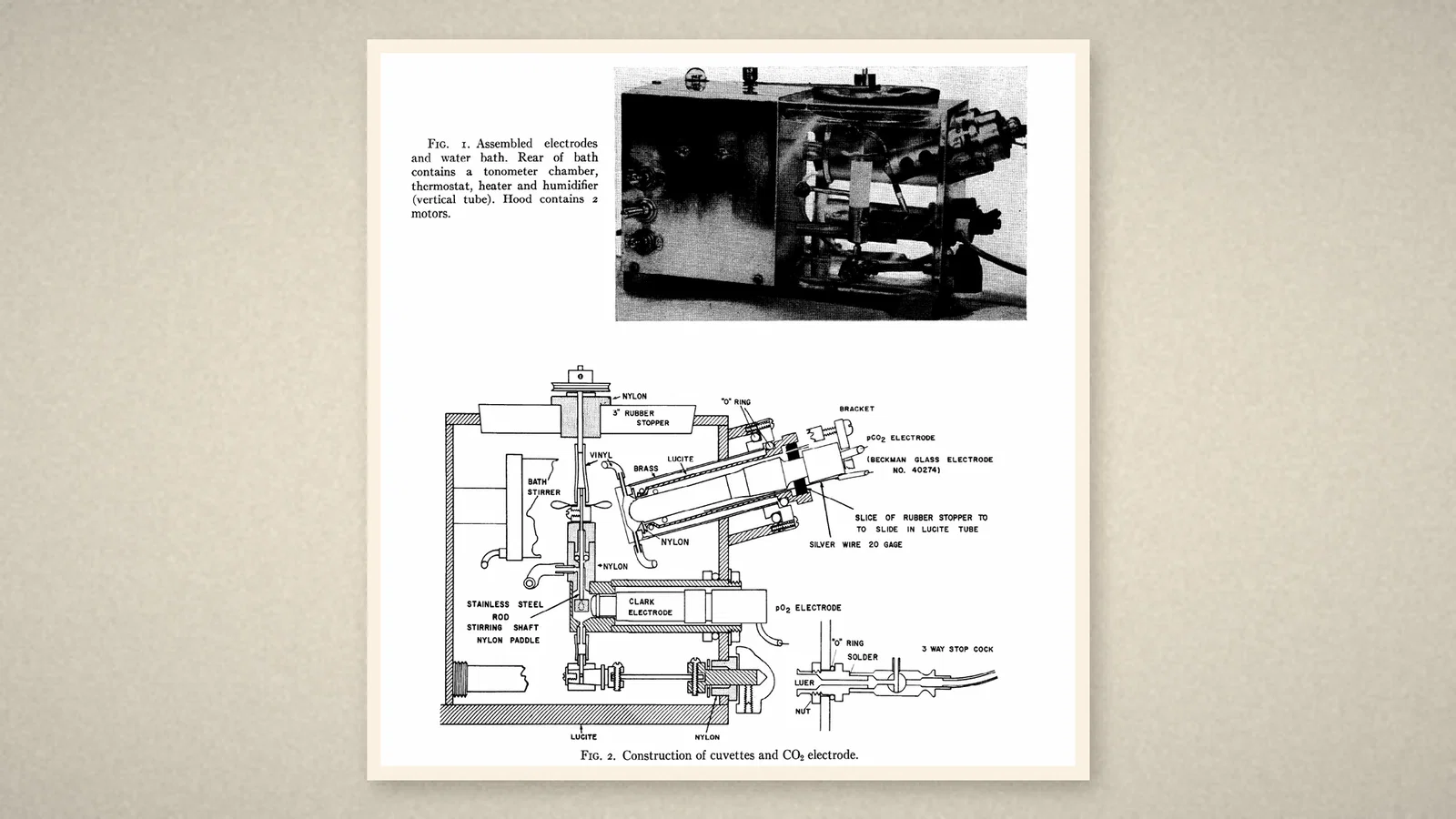
In November 1958 the Journal of Applied Physiology published 'Electrodes for blood pO2 and pCO2 determination' by John W. Severinghaus and A. Freeman Bradley of the Anesthesia Research Laboratory at the National Institutes of Health: the polarographic oxygen electrode designed by Leland Clark and a carbon dioxide electrode first described by Richard Stow, modified with a Teflon membrane, a cellophane spacer and a bicarbonate solution, mounted together in a small thermostated water bath. Stow's own paper of 1957 records the original rubber-membrane electrode, and Severinghaus's recollection of 2004 tells of the discussion in the autumn of 1954, the first blood gas system in 1957 and the three-function analyser of late 1958.
Reading Library · Anesthesia Epochs · 中文版
Watch the education video (for clinicians)
1958: Blood Gas Electrodes — Severinghaus and Bradley · Anesthesia Epochs Education Series
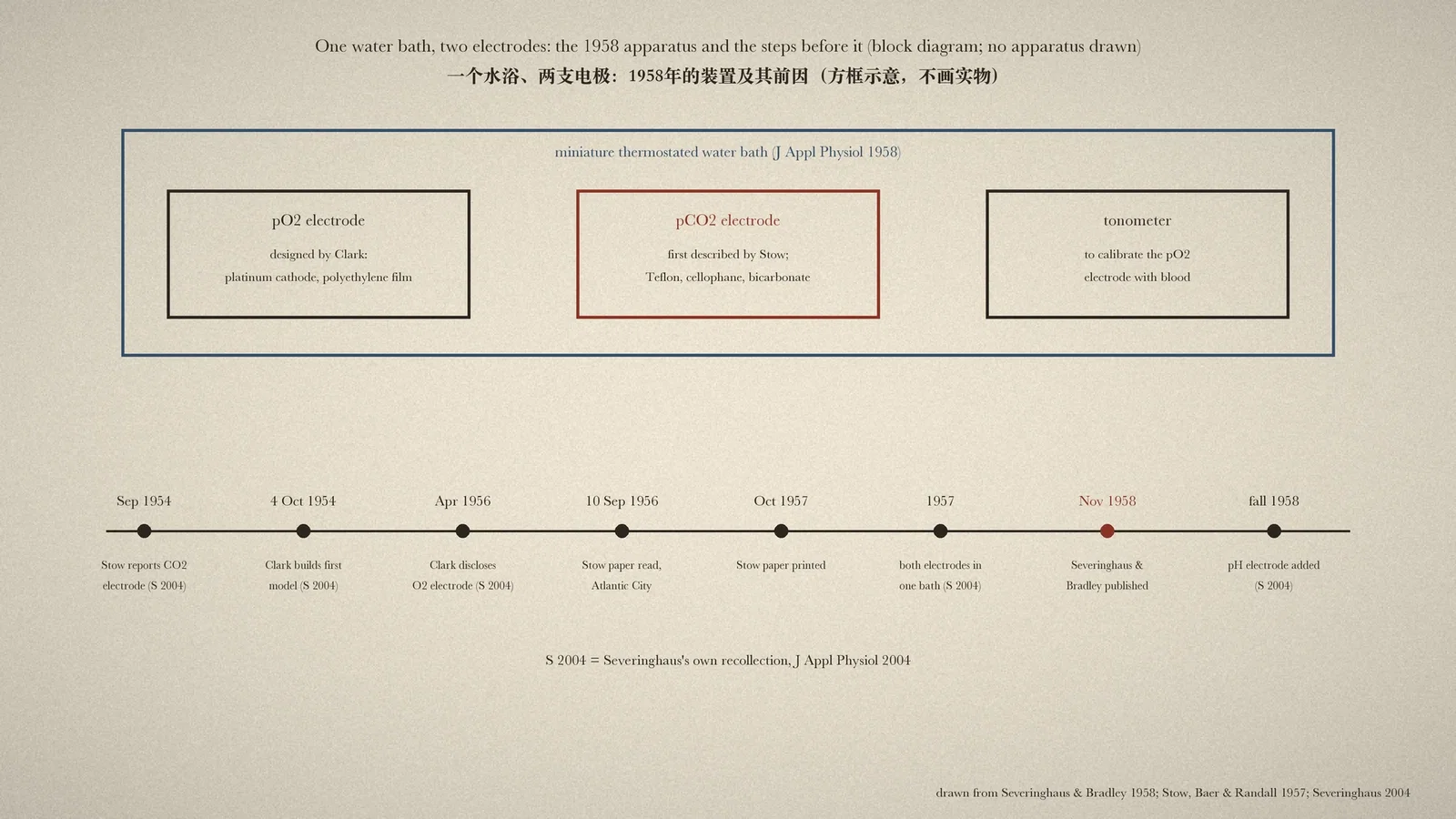
An arterial blood gas is now a few drops of blood and a minute's wait. Before electrodes, the oxygen and carbon dioxide tensions of blood had to be calculated from other measurements or teased out of a bubble of gas, and a single result took the better part of an hour. The apparatus that changed this was put together from two separate inventions, and the 1958 paper that described it named both inventors. [1][2]
The paper
"Electrodes for Blood pO2 and pCO2 Determination", by John W. Severinghaus and A. Freeman Bradley of the Anesthesia Research Laboratory, Clinical Center, National Institutes of Health, was received on 13 May 1958 and published in the Journal of Applied Physiology that November. The apparatus, they wrote, was "developed to permit rapid and accurate analysis of oxygen and carbon dioxide tensions in gas, blood or any liquid mixture". The two systems had no inherent connection "except for their need of accurate temperature control", so they were mounted together "in a miniature thermostated water bath". [1, p. 515]
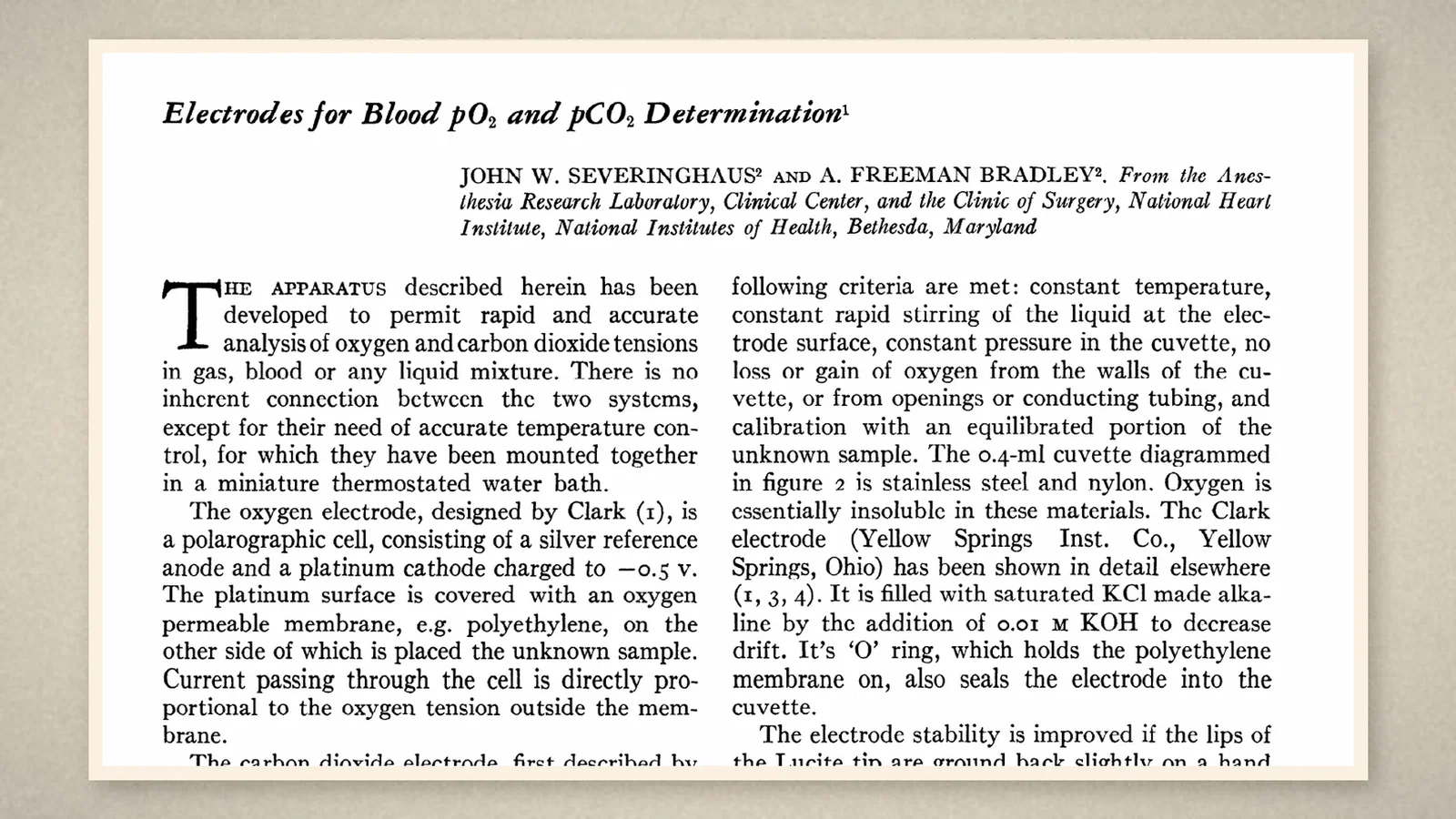
"The oxygen electrode, designed by Clark", was a polarographic cell: a platinum cathode covered by an oxygen-permeable membrane such as polyethylene, the current proportional to the oxygen tension outside it. "The carbon dioxide electrode, first described by Stow", used a membrane that let carbon dioxide pass from the sample into a thin layer of water on a pH glass electrode; the pH of that layer changed with the logarithm of the pCO2. [1, p. 515]
Stow's electrode
Richard W. Stow's own paper, with Richard F. Baer and Barbara F. Randall, was read at Atlantic City in September 1956 and printed in the Archives of Physical Medicine and Rehabilitation in October 1957. Existing methods, Stow wrote, were laborious; the faster Riley method "still requires approximately half an hour" for one measurement. Rubber, "well known among respiratory physiologists" for letting carbon dioxide through, could be used to "separate blood from a film of water", and the pCO2 of the blood read from the pH of the water film. It should be emphasised, the authors added, that the pH of the blood itself was not measured. They had in mind uses such as "adjusting the level of a respirator" and following respiration during surgery. [2, pp. 646-8]
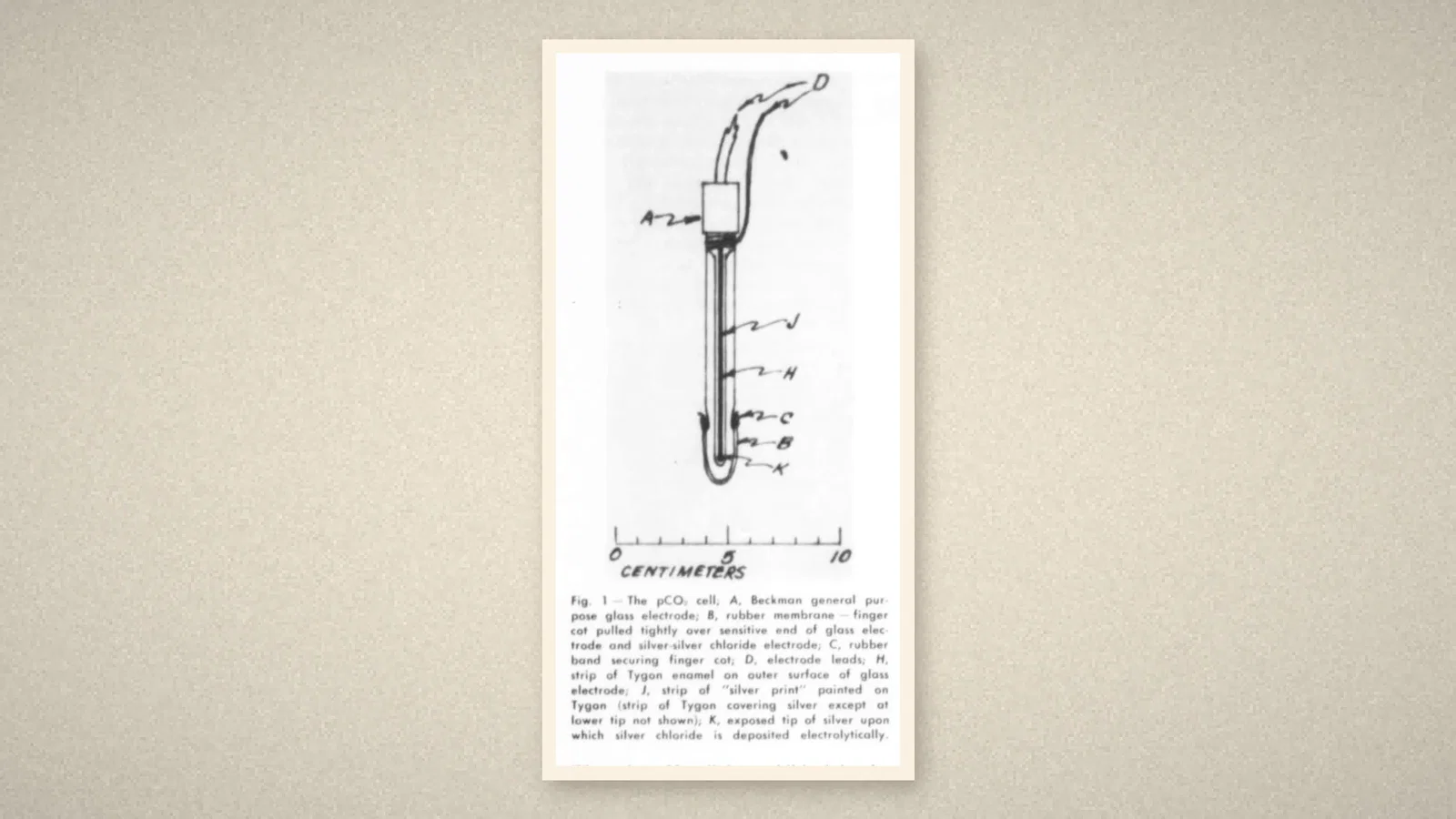
Severinghaus and Bradley described what they changed. "Stow's CO2 electrode consisted of a very thin rubber membrane" stretched over a glass electrode wetted with distilled water. They had "tried various modifications" and found the most satisfactory system to be a Teflon membrane, a layer of cellophane holding the water film, and a dilute solution of sodium bicarbonate and sodium chloride: "more stable, twice as sensitive, faster in response and drifts much less". [1, p. 518]
The recollection
Nearly fifty years later Severinghaus wrote down the sequence. "In September 1954, at the Fall Meeting of the American Physiological Society (APS) in Madison, WI, Richard Stow" described the carbon dioxide electrode; it drifted. "During the discussion period, I suggested adding bicarbonate to the film of water to stabilize it." Within a week Severinghaus built a Stow-type electrode and found that bicarbonate worked, "not only stabilizing the calibration but doubling" the sensitivity. "Freeman Bradley, my laboratory technician, and I constructed a cuvette"; for the spacer they chose "sheer nylon stocking, despite the refusal of the purchasing department to buy them", and Teflon proved "more dependable than rubber". [3]
In April 1956 Leland Clark, "a biochemist at Antioch College, Ohio", disclosed the "invention of a self-contained polarographic oxygen electrode" at a meeting on methods of blood oxygen analysis; the first model had been built on 4 October 1954, and Clark had arranged manufacture by the Yellow Springs Instrument Company. In 1957 Severinghaus and Bradley put both electrodes in one thermostat, which Severinghaus called "the first blood gas analysis system"; in the fall of 1958, at the University of California, San Francisco, they added a pH electrode, "making the first three-function blood gas analyzer". Severinghaus also noted that the idea of the carbon dioxide electrode was Stow's, and that Stow had decided not to patent it. [3]
What the record shows
The moment when the gases in a sample of blood could be read directly, in minutes, at a temperature-controlled bench. The parts came from three directions: a physiatrist's rubber-covered glass electrode, a biochemist's covered platinum cathode, and an anaesthetist and technician who stabilised one, calibrated the other and put both in the same bath. The 1958 paper is careful to give the electrodes to Stow and Clark.
Sources and reading limits
Read: Severinghaus and Bradley, Journal of Applied Physiology 1958;13:515-20, the introduction, methods and the design of the CO2 electrode; Stow, Baer and Randall, Archives of Physical Medicine and Rehabilitation 1957;38:646-50, the introduction and the pCO2 cell; Severinghaus, "First electrodes for blood PO2 and PCO2 determination", Journal of Applied Physiology 2004, in full.
Not covered: Clark's paper, Trans Am Soc Artif Intern Organs 1956;2:41-8; Stow and Randall's abstract of 1954 in the American Journal of Physiology; the Wood Library-Museum page on the Severinghaus analyser and the publisher's own pages, which could not be accessed.
Limits: the September 1954 meeting, the bicarbonate suggestion, the nylon stocking, the date of Clark's first model and the 1957 and late 1958 steps come from Severinghaus's recollection written almost fifty years later. "The first blood gas analysis system" and "the first three-function blood gas analyzer" are Severinghaus's words, not this article's claim. The patent dispute described in that essay is not repeated. Solution strengths and electrical values are not repeated. Quotations are from the English originals.
Three illustrations are crops of the 1958 and 1957 papers; one is drawn from them.
- Severinghaus JW, Bradley AF. Electrodes for blood pO2 and pCO2 determination. J Appl Physiol. 1958;13(3):515-20. DOI
- Stow RW, Baer RF, Randall BF. Rapid measurement of the tension of carbon dioxide in blood. Arch Phys Med Rehabil. 1957;38(10):646-50. Internet Archive
- Severinghaus JW. First electrodes for blood PO2 and PCO2 determination. J Appl Physiol. 2004;97(5):1599-600. DOI
Continue exploring
Related reading connects shared questions and contexts; it does not by itself establish historical influence.
Anesthesia Epochs · The Source Room · About & Editorial Method
Published November 3, 2026. Sources and reading limits are stated above. Illustrations are labelled as original source images or AI-made. Historical accounts are educational; they are not current treatment instructions.