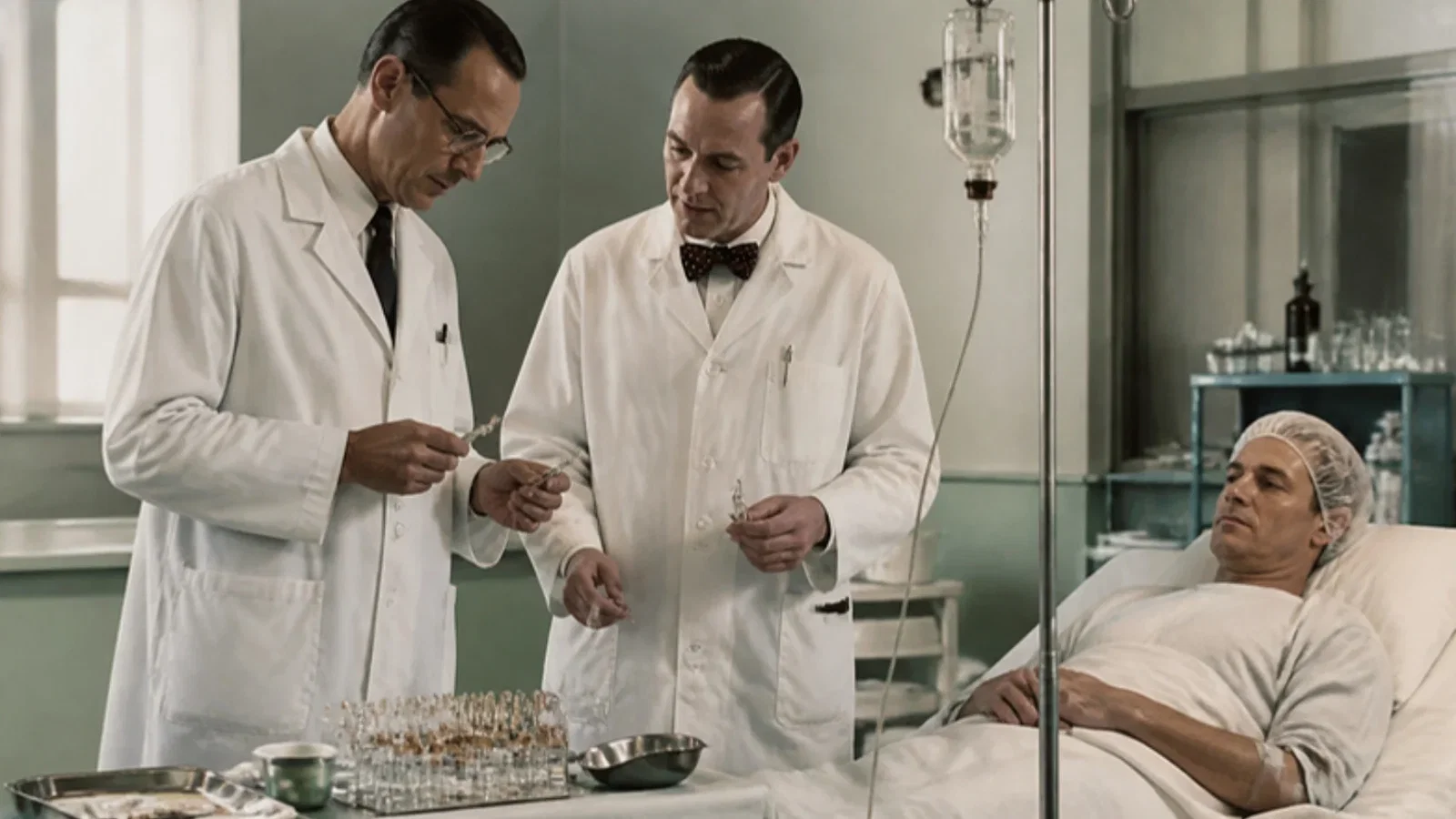
Two Brussels anaesthetists proposed an intravenous anaesthetic without barbiturates: a potent synthetic analgesic and the neuroleptic haloperidol from Janssen's laboratory, with procaine and Hydergine, giving complete analgesia and moderate detachment rather than sleep.
Reading Library · Anesthesia Epochs · 中文版
Watch the education video (for clinicians)
1959: De Castro and Mundeleer — Naming Neuroleptanalgesia · Anesthesia Epochs Education Series
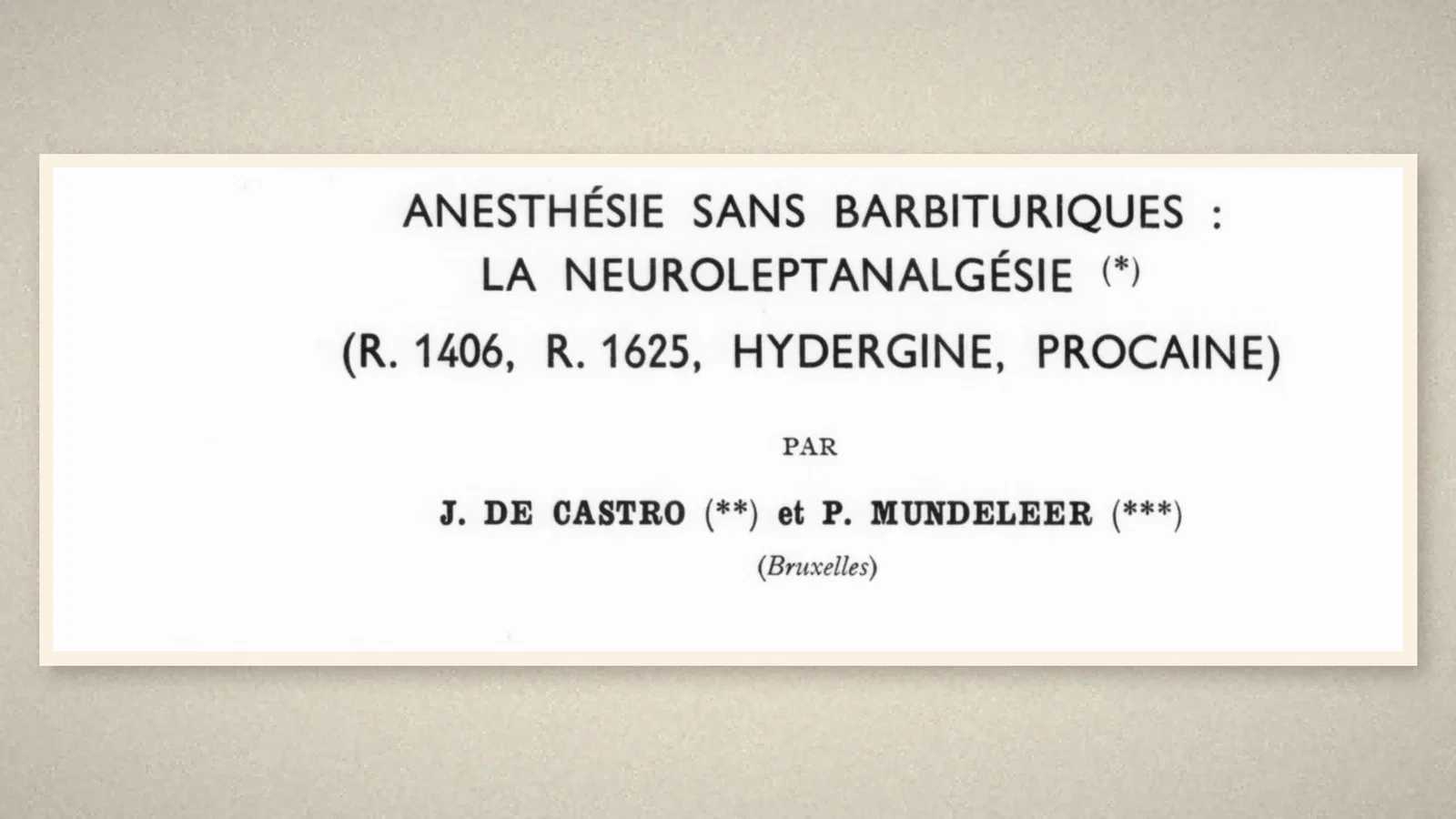
In 1959 intravenous anaesthesia still meant, above all, the thiobarbiturates. On 10 July 1959, at the tenth French congress of anaesthesiology in Lyon, two Brussels anaesthetists argued for doing without them. J. De Castro, of the Clinique Louis Caty, and P. Mundeleer, of the Hôpital Universitaire Saint-Pierre, described an intravenous technique built on a very potent synthetic analgesic and a new neuroleptic, and gave it a name: la neuroleptanalgésie. Their paper, "Anesthésie sans barbituriques", appeared in Anesthésie, Analgésie et Réanimation at the end of that year; this article reads it in full. [1]
The case against barbiturates
The authors began with what was wrong with thiopentone. It predisposed to laryngeal and bronchial spasm, reduced coronary flow and cardiac output, and was slowly metabolised. The quick waking after a dose was "not the result of biotransformation, but of its deposit in fat", so that elderly, obese or debilitated patients could stay drowsy long afterwards. Since there was no single drug with every property of an ideal intravenous anaesthetic, they argued, one had to use a balanced mixture of drugs acting at different levels: "anesthésie cocktail". [1]
A name and a definition
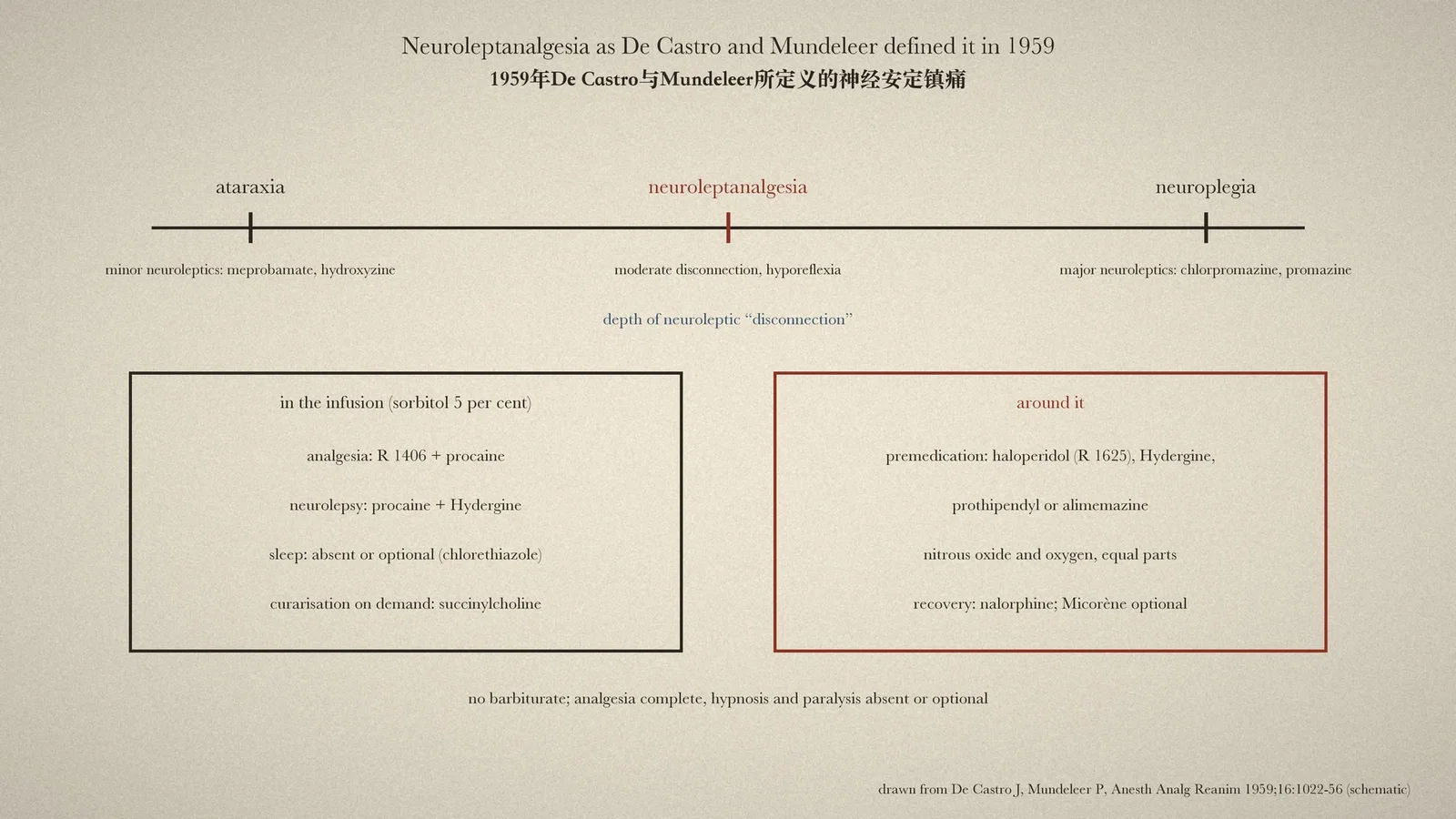
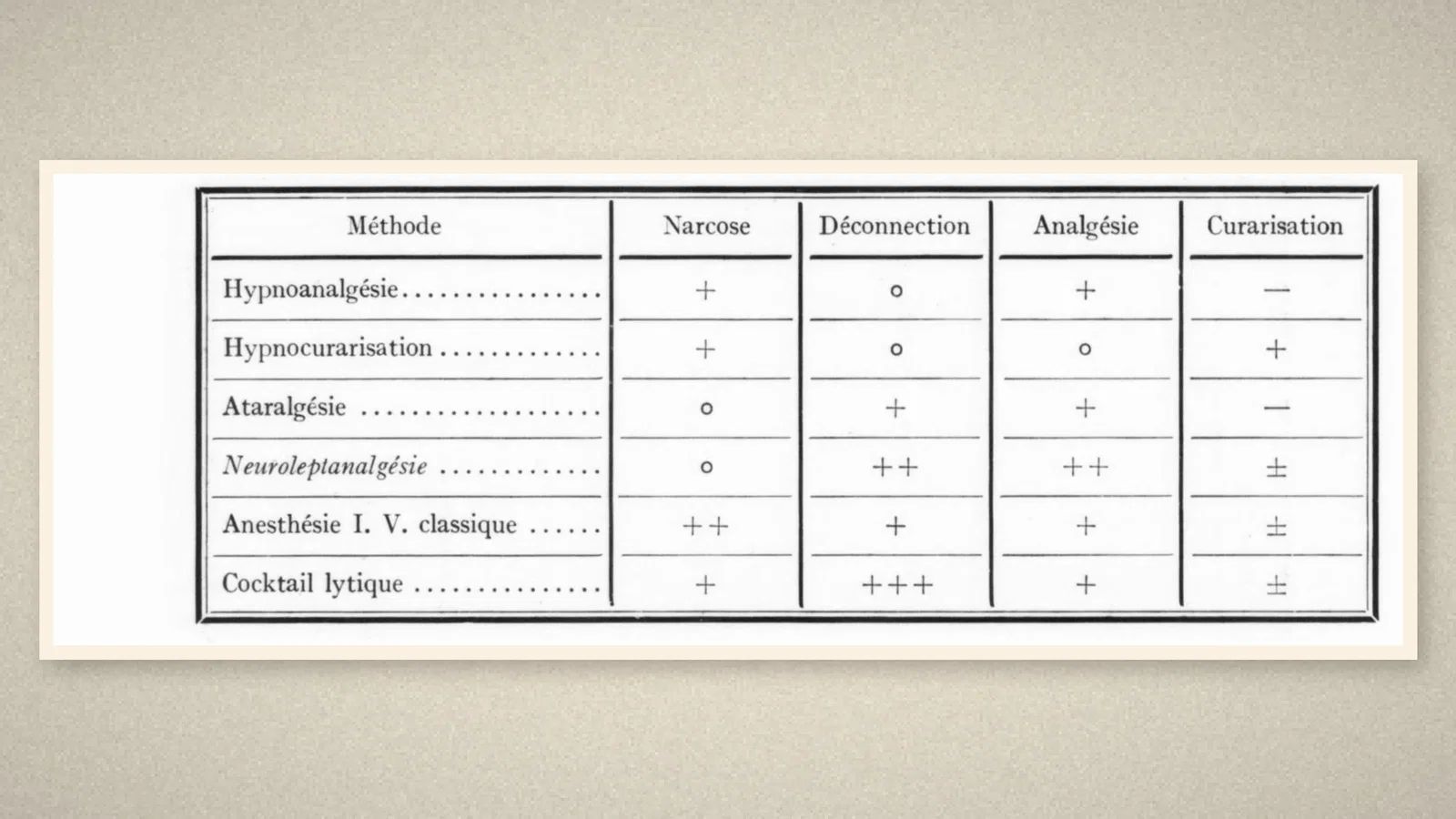
"We propose this name for a technique of non-barbiturate intravenous anaesthesia in which hypnosis and curarisation are absent or optional." Neuroleptanalgesia, they wrote, "consists of complete analgesia with moderate disconnection"; it produced hyporeflexia and autonomic stability while preserving a "harmonious defence" against surgical aggression. Its depth of neuroleptic "disconnection" lay between the ataraxia given by minor neuroleptics or tranquillisers such as meprobamate and hydroxyzine, and the full neuroplegia of major neuroleptics such as chlorpromazine. Analgesia came from procaine and a powerful synthetic analgesic; the neuroleptic effect from procaine and Hydergine. Their Table II set the method beside hypnoanalgesia, hypnocurarisation, ataralgesia, classical intravenous anaesthesia and the French "lytic cocktail". [1]
The drugs
The paper is frank about the search. Pethidine in large doses caused hypotension, bradycardia and bronchial spasm; carbetidine kept patients awake with their eyes open; another analgesic, R 951, worked in hundreds of anaesthetics but had to be abandoned when the laboratory reported it unstable. The analgesic they kept was R 1406, from P. A. J. Janssen's laboratory, which they rated "1 mg = ± 50 mg of pethidine", fast and long-acting, and valued because it gave analgesia together with marked tranquillisation. Its unwanted effects alone (extrapyramidal stimulation, bronchospasm, vomiting, respiratory depression) they said they could neutralise with the rest of the cocktail and mechanical ventilation. The neuroleptic was R 1625, haloperidol, "the most powerful neuroleptic known to date". [1]
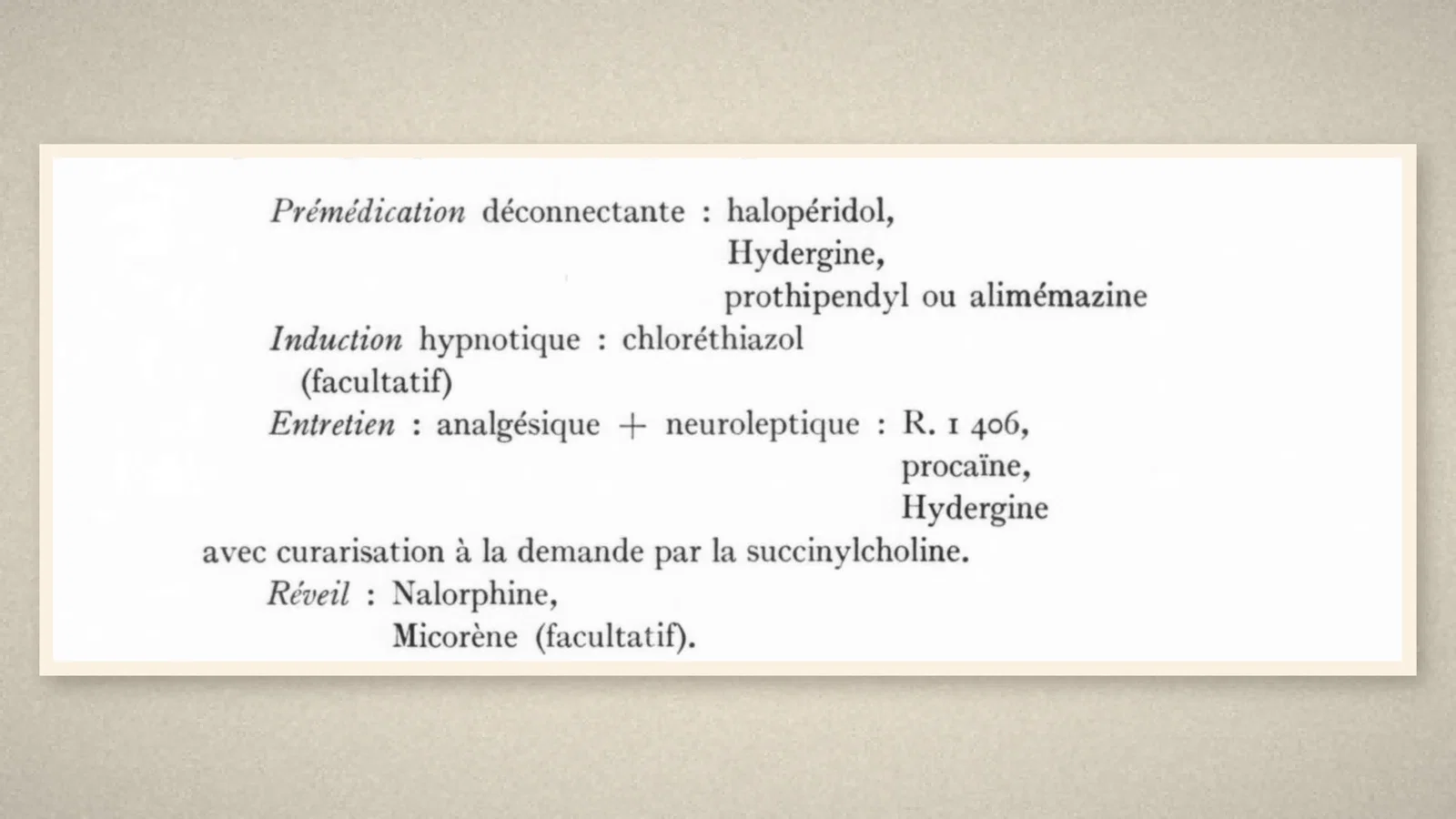
The final scheme, summarised in their Table XII, was: premedication with haloperidol, Hydergine and prothipendyl or alimemazine; an optional hypnotic induction with chlorethiazole; maintenance by an infusion of R 1406, procaine and Hydergine in 5 per cent sorbitol, with nitrous oxide and oxygen and succinylcholine on demand; and recovery with nalorphine. Once they gave haloperidol in the premedication or during the anaesthetic, post-operative nausea and vomiting "practically disappeared". [1]
The results they claimed
They had used the method for about 1600 operations of all kinds, except neurosurgery, over a year and a half, which places the start of the work around early 1958. In those cases they reported no accidents or complications attributable to the method or the drugs. Compared with the lytic cocktail, they wrote, it left the patient "not in areflexia, but only in hyporeflexia", caused neither hypotension nor tachycardia, and was more easily reversed. [1]
What the record shows
In 1959 De Castro and Mundeleer put a name to an approach: separate the components of anaesthesia, and supply analgesia and detachment with specific drugs instead of deepening sleep. Their version used a Janssen analgesic and haloperidol, an infusion and the patient's own reflexes kept partly intact. The results are the authors' own series and claims. The later forms of neuroleptanaesthesia belong to later articles.
Sources and reading limits
Read: De Castro and Mundeleer's 1959 paper in full.
Not covered: the authors' companion paper in Acta Chirurgica Belgica; Janssen's pharmacological reports; later accounts of neuroleptanaesthesia. The paper is from July 1959 and reports work over the preceding year and a half. R 1406 is given by its code number, as in the paper. The safety record is the authors' claim for their own series. French quotations are translated; doses are as printed.
Three illustrations are page crops from the 1959 paper; one is drawn from it.
- De Castro J, Mundeleer P. Anesthésie sans barbituriques : la neuroleptanalgésie (R. 1406, R. 1625, Hydergine, procaine). Anesth Analg Reanim. 1959;16(5):1022-56. Internet Archive
Continue exploring
Related reading connects shared questions and contexts; it does not by itself establish historical influence.
Anesthesia Epochs · The Source Room · About & Editorial Method
Published November 2, 2026. Sources and reading limits are stated above. Illustrations are labelled as original source images or AI-made. Historical accounts are educational; they are not current treatment instructions.