Two Boots chemists in Nottingham claimed a family of phenylacetic and phenylpropionic acids for pain, fever and inflammation without the drawbacks of aspirin, phenylbutazone and steroids; the US patent that followed ended with a single claim to 2-(4-isobutylphenyl)propionic acid.
Reading Library · Anesthesia Epochs · 中文版
Watch the education video (for clinicians)
1961: Boots' Phenylpropionic Acids Patent — Toward Ibuprofen · Anesthesia Epochs Education Series
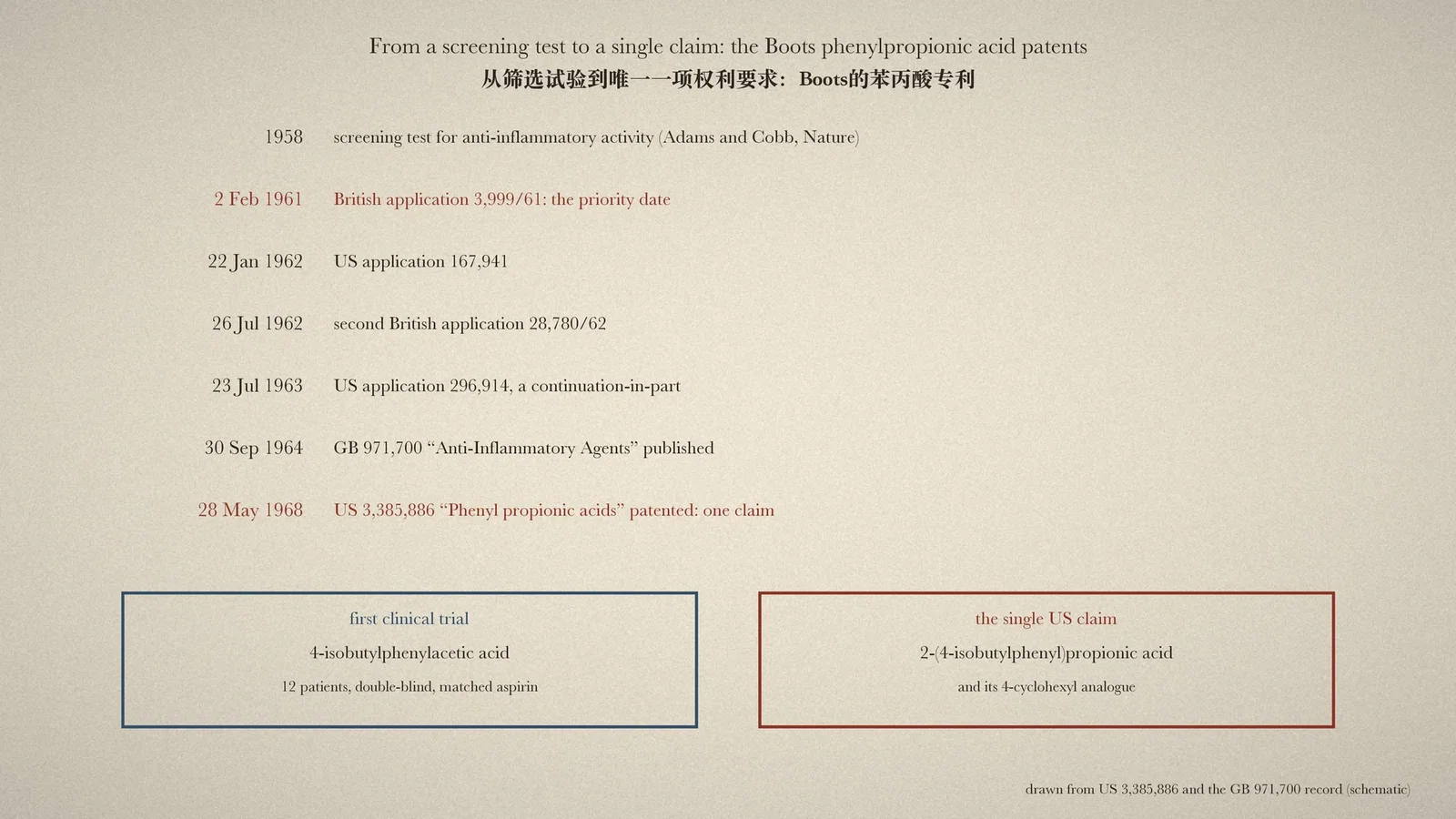
Many multimodal analgesic plans after surgery now include a non-steroidal anti-inflammatory drug, and ibuprofen is among the most familiar of them. Its paper trail begins in Nottingham. On 2 February 1961 the Boots Pure Drug Company filed a British application for a family of "anti-inflammatory agents". The Australian Society of Anaesthetists' history timeline marks 1961 with the words "Ibuprofen developed and patented". This article reads the patent itself: the American version, granted in 1968, in full, and the record of the British one. [1][2][3]
What the chemists claimed
The US patent, number 3,385,886, is titled "Phenyl propionic acids". Its inventors are "John Stuart Nicholson and Stewart Sanders Adams, Nottingham, England, assignors to Boots Pure Drug Company Limited". It claims priority from the British application of 2 February 1961 and a second British application of July 1962; the US filings were made in January 1962 and July 1963. The British patent, GB 971,700, "Anti-Inflammatory Agents", was published in September 1964. [1][2]
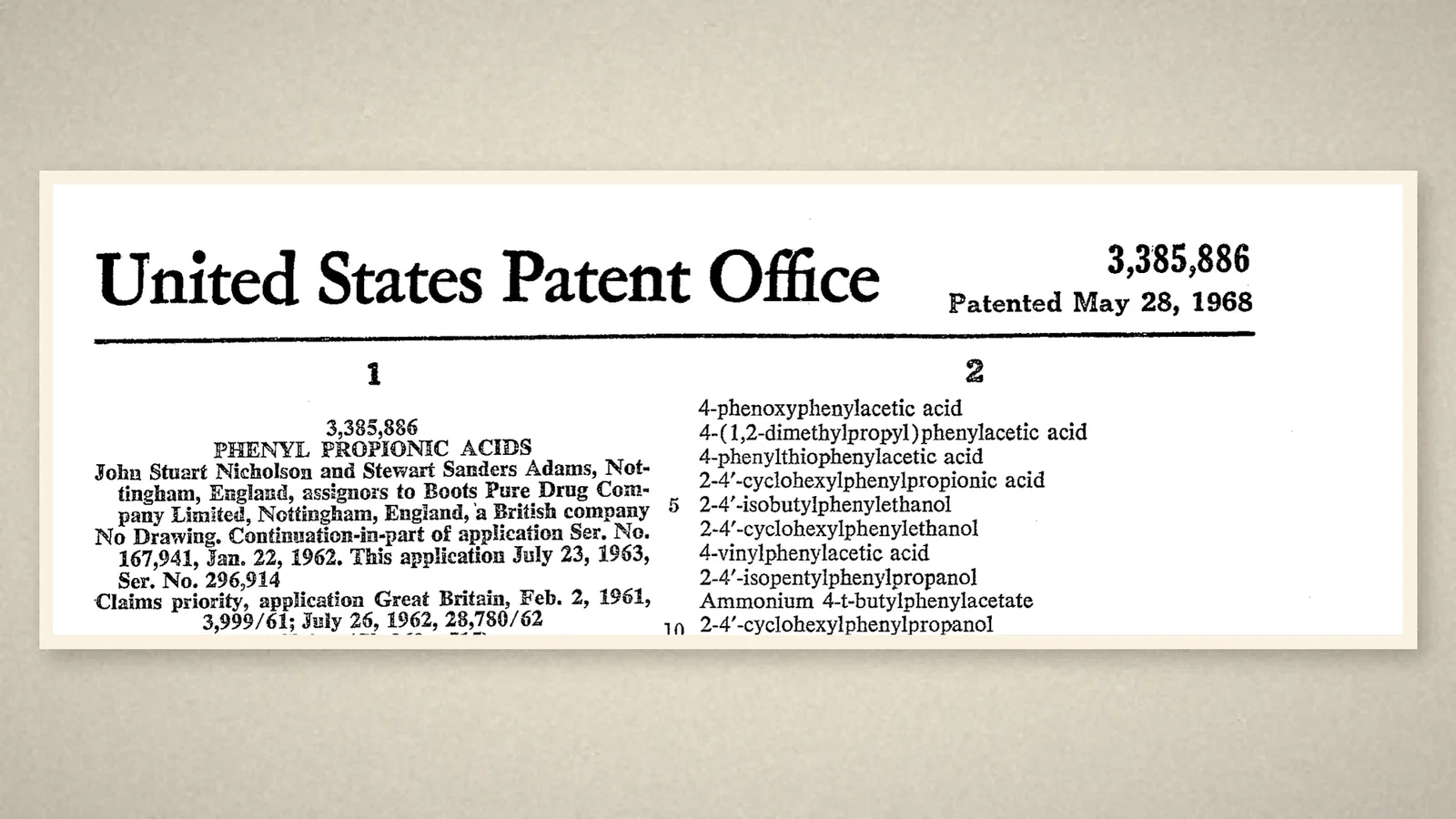
The stated aim is broad: "to provide therapeutic compositions for the relief of pain, fever and inflammation in man and animals which do not suffer from the disadvantages of similar therapeutic compositions based on aspirin, phenylbutazone or adrenocorticosteroids." The inventors had found that a family of phenylacetic and phenylpropionic acids "have valuable anti-inflammatory and/or analgesic and/or antipyretic properties", with low toxicity and stability in water. The specification lists dozens of them and gives their melting points and analyses. [1]
How they were tested
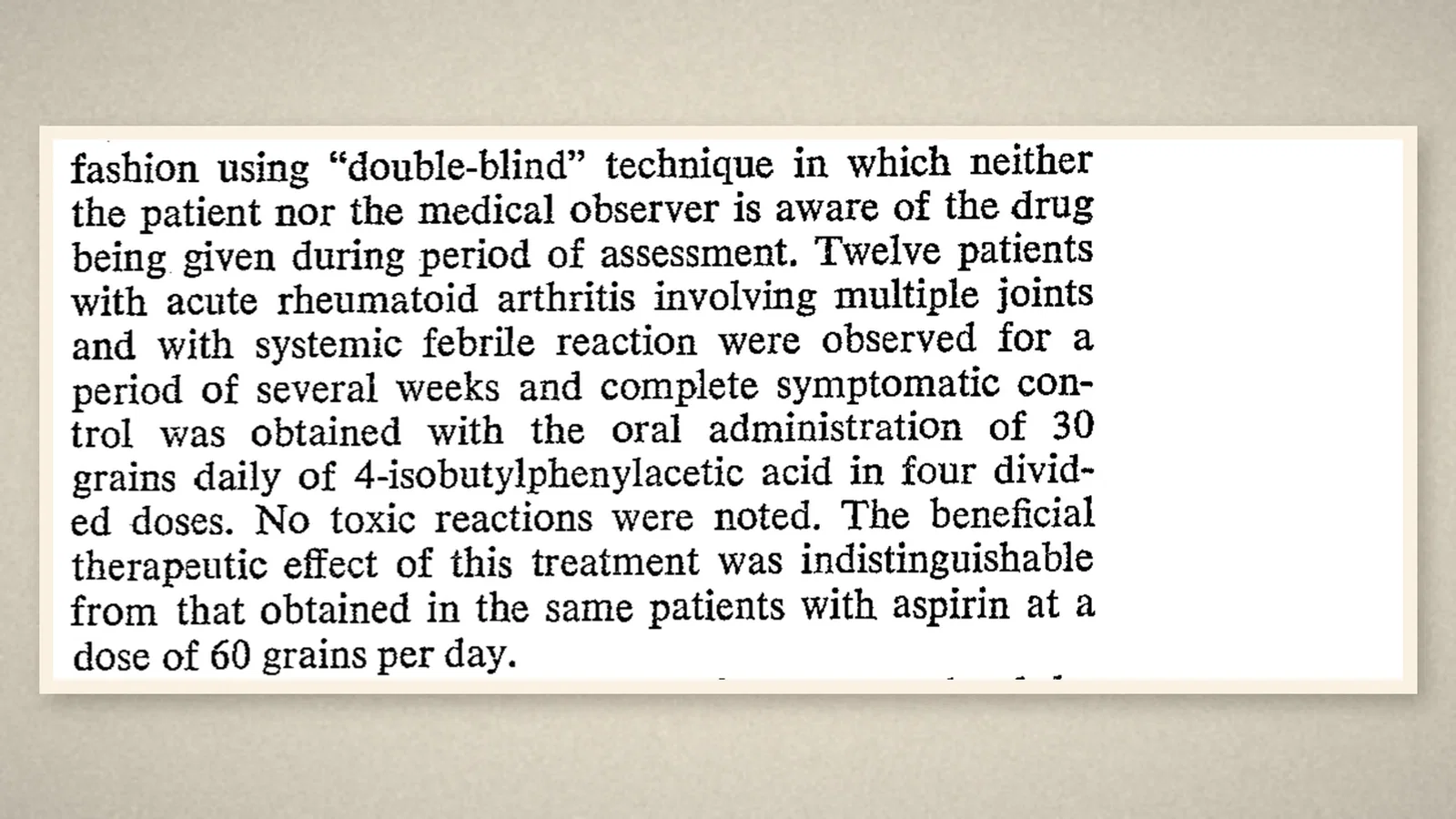
Anti-inflammatory activity was screened by the test "described by Adams and Cobb, Nature, 1958". Analgesic and antipyretic properties and toxicity were assessed in mice, rats, guinea pigs, cats and dogs. For the first clinical trial the inventors chose "a compound having good all-round activity with low toxicity", and that compound was not the propionic acid later called ibuprofen. It was 4-isobutylphenylacetic acid. In a double-blind trial, twelve patients with acute rheumatoid arthritis were followed for several weeks; 30 grains a day in four divided doses gave complete symptomatic control, with no toxic reactions, and the effect "was indistinguishable from that obtained in the same patients with aspirin at a dose of 60 grains per day". The authors also claimed that their compounds were superior to aspirin in several ways, including lower toxicity, and that tablets of their salts "generally do not set up gastric irritation". [1]
One claim
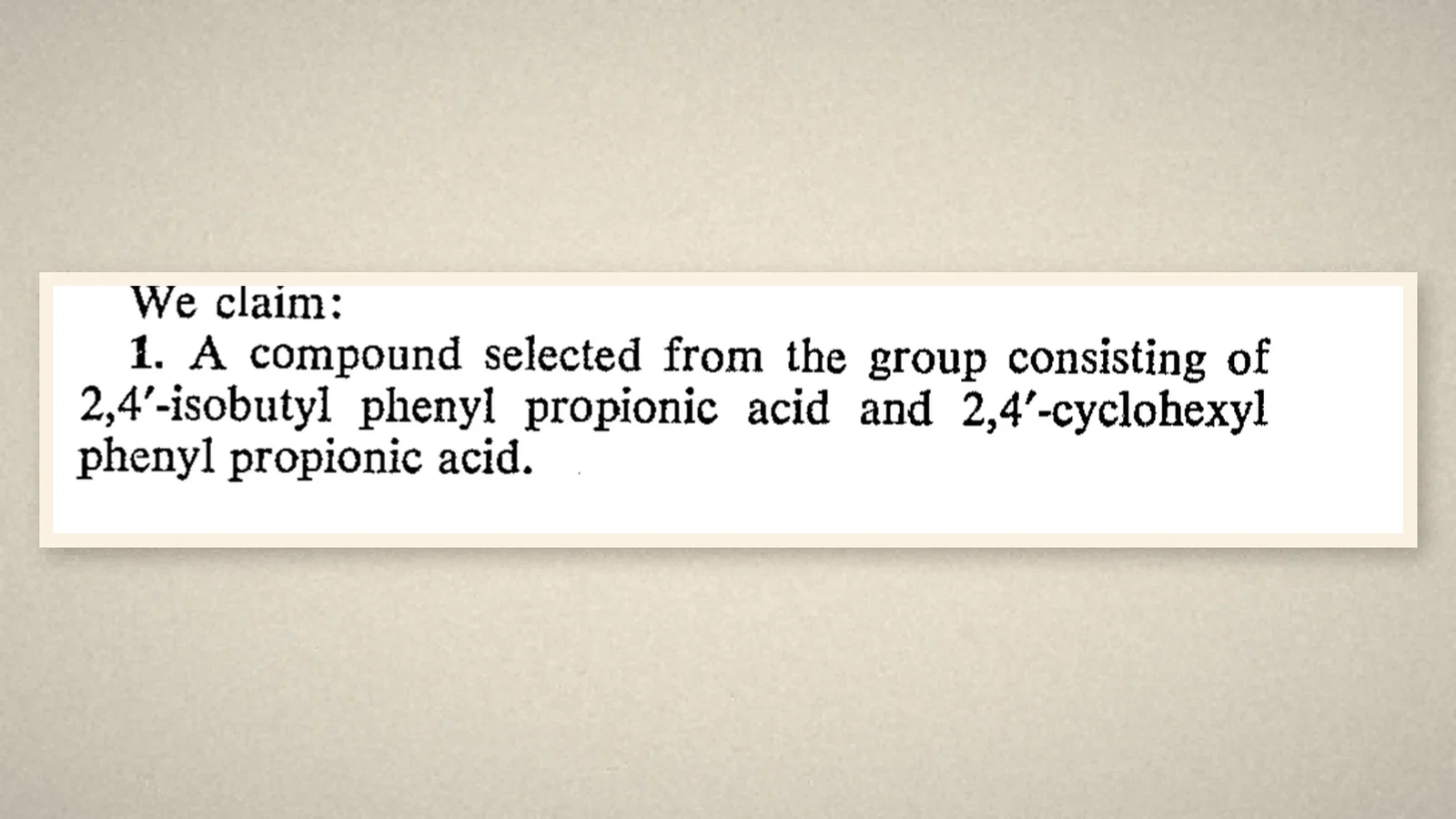
Among the many compounds prepared, Example 4 lists "2,4'-isobutylphenylpropionic acid, M.P. 75-77.5 °C". For all the breadth of the description, the US patent ended with a single claim: "A compound selected from the group consisting of 2,4'-isobutyl phenyl propionic acid and 2,4'-cyclohexyl phenyl propionic acid." The first of these, 2-(4-isobutylphenyl)propionic acid, is the compound the world came to know as ibuprofen. The patent itself never uses that name. [1]
Who discovered it
The ASA timeline names "Andrew Dunlop et al (working at Boots Group)" as the discoverers. The patent names John Stuart Nicholson and Stewart Sanders Adams as inventors. This article reports both, and treats the patent as the primary record of who filed what and when. [1][3]
What the record shows
In 1961 a British company filed for a family of compounds meant to do what aspirin did, with less harm. The first patient trial used a different member of the family, and the compound that survived as ibuprofen appears in the record as one entry in a long list and then as half of a single claim. Its later history as an analgesic, and the wider growth of non-steroidal anti-inflammatory drugs in perioperative care, belong to later articles.
Sources and reading limits
Read: US Patent 3,385,886 in full (Google Patents text and the original PDF, with images of pages 1, 3 and 6); the Google Patents record of GB 971,700; the 2024 ASA timeline entry for 1961.
Not covered: the full British specification of GB 971,700; the parent US patent; Adams and Cobb's 1958 paper; Boots' own accounts of the discovery; clinical papers on ibuprofen. The identity of 2-(4-isobutylphenyl)propionic acid as ibuprofen is given as general identification, not from the patent. Doses are as printed. The article makes no claim of first.
Three illustrations are crops from the US patent; one is drawn from the patent record.
- Nicholson JS, Adams SS, inventors; Boots Pure Drug Co Ltd, assignee. Phenyl propionic acids. US Patent 3,385,886. 1968 May 28. Google Patents
- Boots Pure Drug Co Ltd. Anti-inflammatory agents. GB Patent 971,700. 1964 Sep 30. Google Patents
- Australian Society of Anaesthetists. Anaesthesia history timeline. 2024. ASA
Continue exploring
Related reading connects shared questions and contexts; it does not by itself establish historical influence.
Anesthesia Epochs · The Source Room · About & Editorial Method
Published November 2, 2026. Sources and reading limits are stated above. Illustrations are labelled as original source images or AI-made. Historical accounts are educational; they are not current treatment instructions.