
In April 1961 A. R. Hunter of the Manchester Royal Infirmary argued in Anaesthesia that classifying ventilators as pressure cycled, volume cycled and time cycled was unsatisfactory, and that clinically they should be classed as volume preset or pressure preset, according to whether they could compensate automatically for a fall in compliance or for a leak. In October 1961 W. W. Mapleson of Cardiff replied that nearly all ventilators could be so classed, but that the classes did not always match the two behaviours, listed three groups of exceptions from an analysis of 1959, and concluded that a ventilator's response to a leak or to changed lung characteristics could only be deduced from a full functional specification. The ASA timeline dates 'Mapleson's classification of ventilators' to 1961.
Reading Library · Anesthesia Epochs · 中文版
Watch the education video (for clinicians)
1961: Mapleson's Ventilator Classification — Volume or Pressure · Anesthesia Epochs Education Series
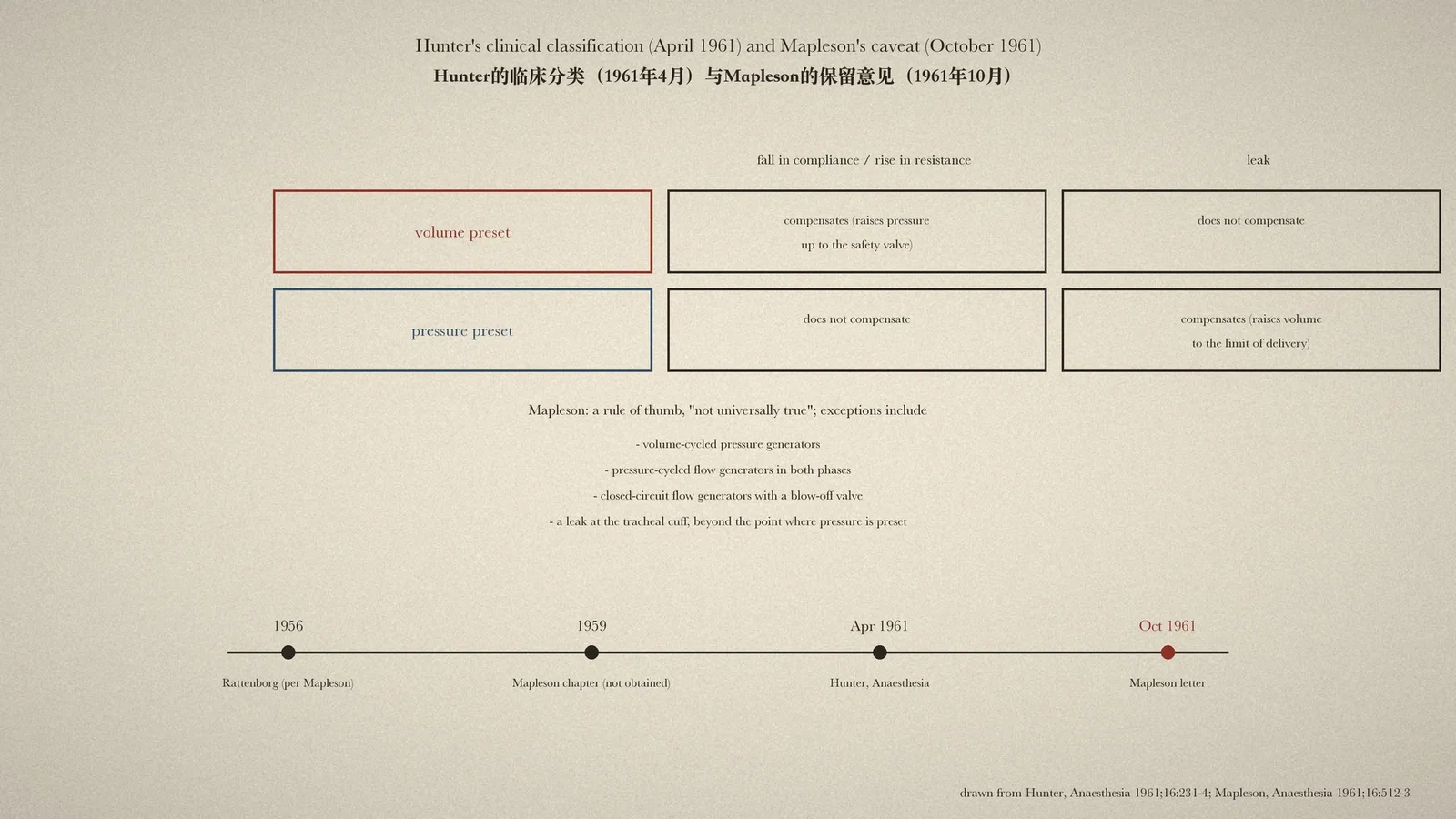
By 1961 British hospitals had a crowd of machines for ventilating patients' lungs, from polio respirators to anaesthetic ventilators, and they were usually described by how they switched from inspiration to expiration: pressure cycled, volume cycled, time cycled. Two articles in the journal Anaesthesia that year asked a more practical question. What does the machine do when something goes wrong? [1][2]
Hunter's proposal
In April 1961 A. R. Hunter of the Royal Infirmary, Manchester, published "The classification of respirators". Machines could be classified by any mechanical characteristic, the wave form, the cycling mechanism or even the basic drive, but "such mechanical details, however, give little information about the performance of the machine in actual use, where the minute to minute care of patients will often be left to nurses who cannot be expected to understand the significance of minor alterations in ventilation". What mattered most was "the ability of the apparatus to cope automatically with changes in the resistance of the system into which it is working". [1, p. 231]
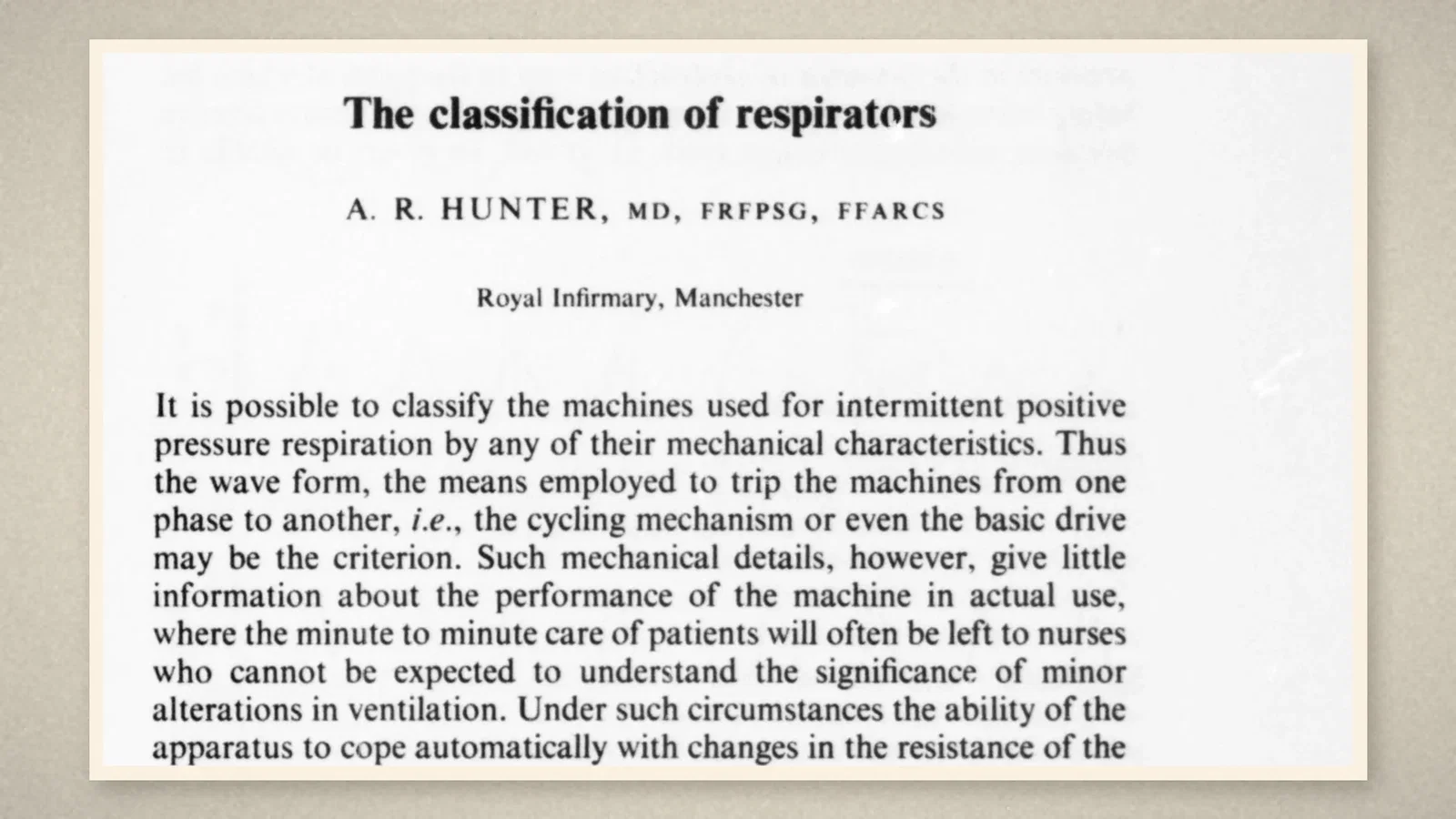
Two things were likely to go wrong. The compliance of the system could fall suddenly, from changes in the lungs, sputum, kinked tubing or a misplaced tracheostomy tube; or a leak could appear, most likely a cuff not properly reinflated. The remedy for the first was more pressure; for the second, more volume. "All ventilators are constructed either to inflate to a preset pressure or to deliver a preset volume." A pressure-preset machine could deliver more volume to make up a leak, but could not muster more pressure against obstruction; a volume-preset machine could raise its pressure, up to its safety valve, but could not make good a leak. [1, pp. 231-2]
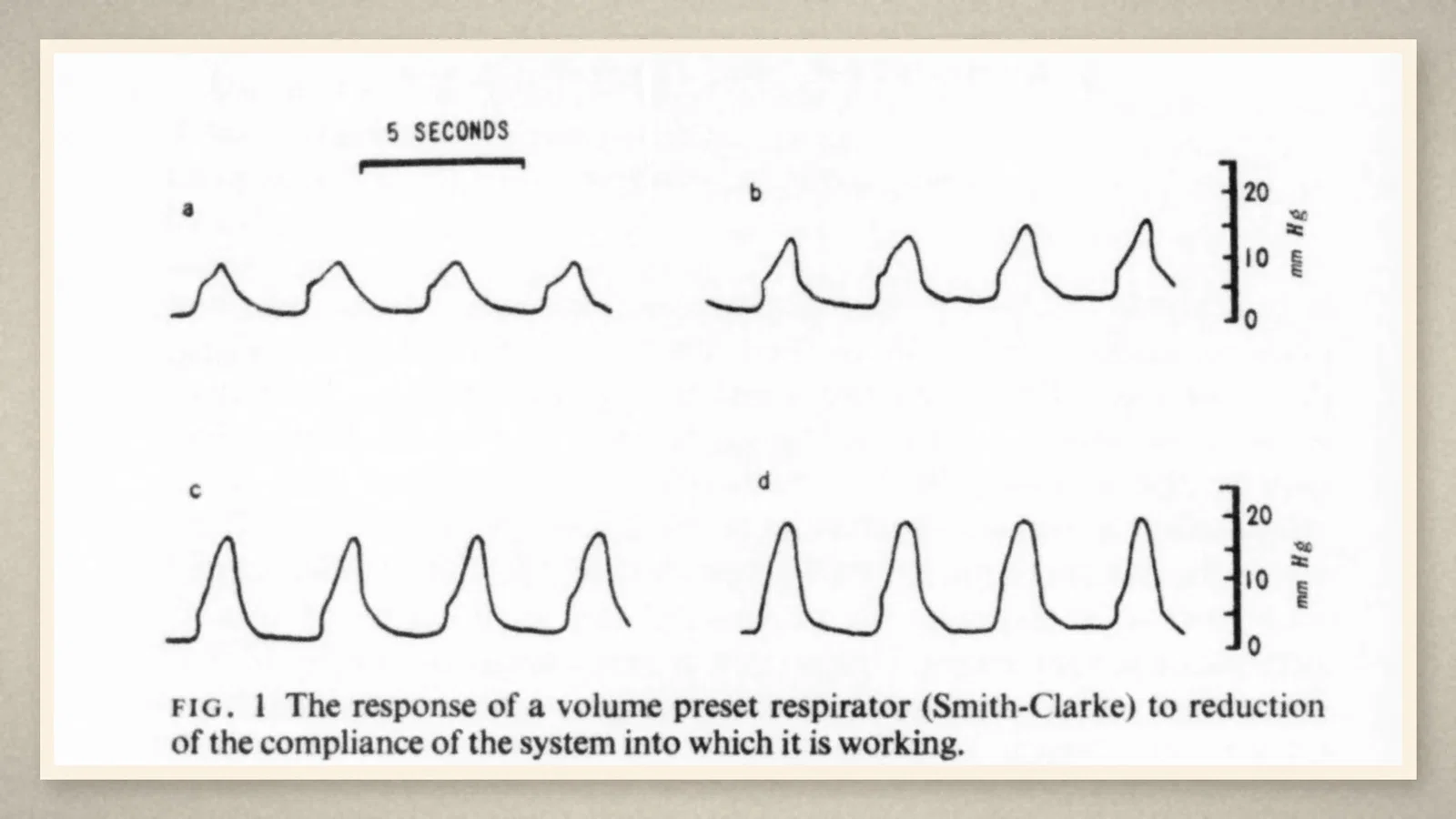
"It is suggested that these properties of machines should be the basis of their clinical classification and that they be described in future either as pressure preset or volume preset." The cycling mechanism would no longer decide the class: the Radcliffe respirator, time cycled by current definition, was pressure preset, and "the totally unsatisfactory group of the volume cycled apparatus" would disappear, since most such machines were in fact volume preset and time cycled. Hunter's figures were pressure tracings, taken with a capacitance manometer, as the compliance of the system was reduced step by step. [1, pp. 232-4]
Mapleson's reply
In October 1961 the correspondence columns carried a letter from W. W. Mapleson of Cardiff, "The classification of ventilators". Mapleson restated Hunter's two groups: those which could compensate for a change in compliance or resistance but not for a leak, and those which could compensate for a leak but not for a change in compliance or resistance. "This distinction was, of course, first made by Rattenborg in 1956", Mapleson wrote, at a time when the two groups were equated with volume-cycled and pressure-cycled machines. [2, p. 512]
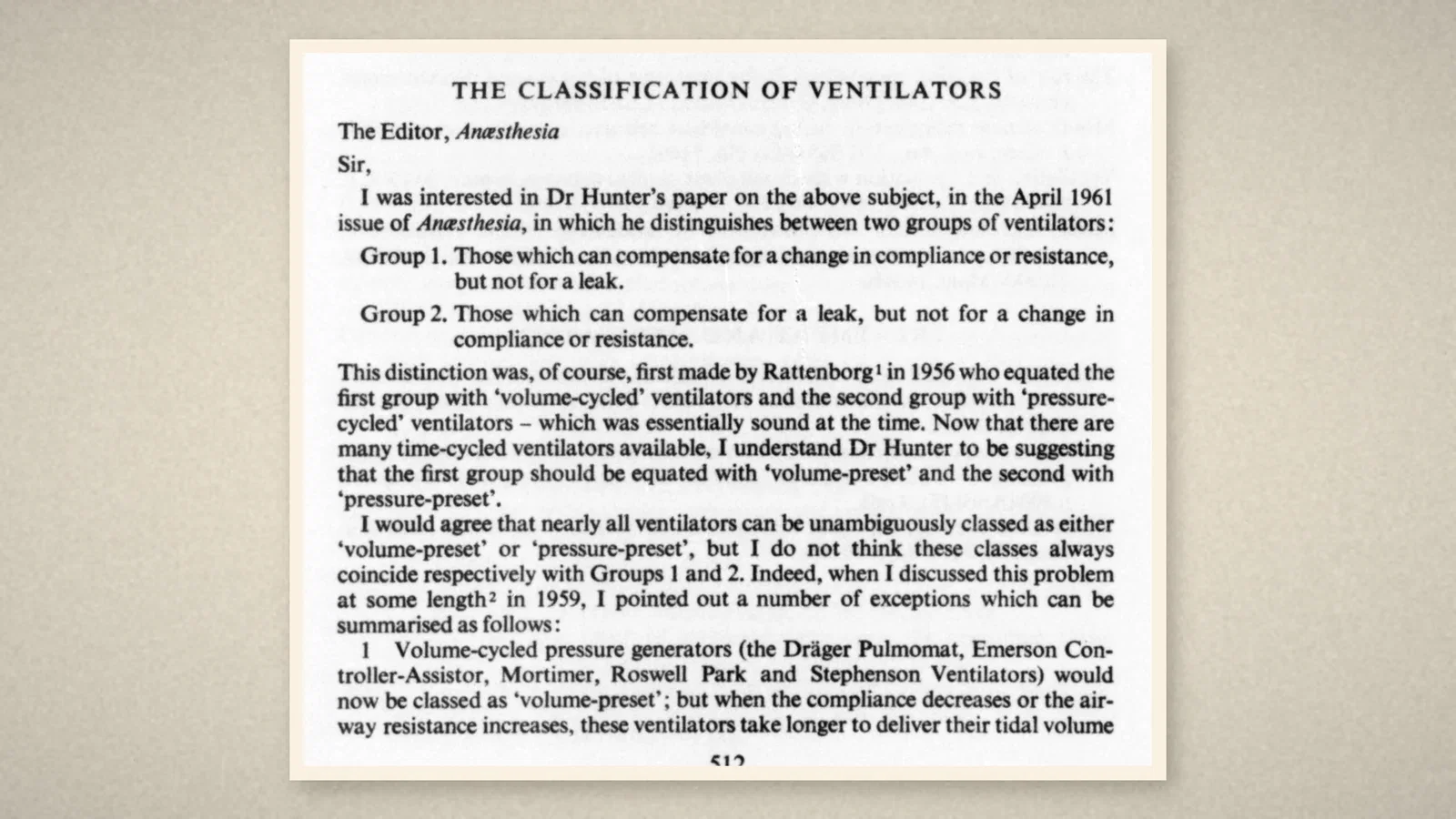
"I would agree that nearly all ventilators can be unambiguously classed as either 'volume-preset' or 'pressure-preset', but I do not think these classes always coincide respectively with Groups 1 and 2." In a discussion published in 1959, Mapleson had listed the exceptions: volume-cycled pressure generators, which slowed down as compliance fell; a machine working as a pressure-cycled flow generator in both phases, which lost tidal volume but gained rate; and closed-circuit flow generators with a blow-off valve, where a moderate leak simply took over the valve's job. And in a pressure-preset machine the pressure was set somewhere inside the ventilator, so a leak at the tracheal cuff could waste much of it. [2, pp. 512-3]
The letter ended with a rule and a warning. It might be "a useful rule of thumb for the time being" to treat volume-preset ventilators as compensating for changes in the lungs but not for leaks, and pressure-preset ones the reverse. But this was "not universally true", and the effect of a leak or of changed lungs on a particular ventilator "cannot be accurately deduced except from a full functional specification of the ventilator". [2, p. 513]
The Australian Society of Anaesthetists (ASA) timeline lists "Mapleson's classification of ventilators" under 1961, credited to William W. Mapleson of Cardiff. [3, p. 68]
What the record shows
The moment ventilators began to be described by what they would do to a patient rather than by how they were built. Hunter gave the clinician two words that predicted behaviour; Mapleson accepted the words and showed where the prediction failed. Both point to the same lesson: a ventilator setting is a promise only about one quantity, and the other one depends on the patient.
Sources and reading limits
Read: Hunter, Anaesthesia 1961;16:231-4, in full; Mapleson, Anaesthesia 1961;16:512-3, in full; the ASA timeline 2024, p. 68.
Not covered: Mapleson's 1959 chapter in Mushin, Rendell-Baker and Thompson's Automatic Ventilation of the Lungs (the Internet Archive copies are lending-restricted and were not opened); Rattenborg's 1956 discussion in Lassen's book on poliomyelitis; Mapleson's later papers on ventilator function.
Limits: the ASA dates "Mapleson's classification of ventilators" to 1961; the 1961 record is a letter building on Hunter's paper and on Mapleson's own 1959 analysis, which was not read. "First made by Rattenborg" is Mapleson's statement, not this article's claim. Compliances, pressures and ratios given in the figures are not repeated. Quotations are from the English originals.
Three illustrations are crops of Anaesthesia (April 1961, pp. 231-2; October 1961, p. 512); one is drawn from them.
- Hunter AR. The classification of respirators. Anaesthesia. 1961;16(2):231-4. Internet Archive
- Mapleson WW. The classification of ventilators [letter]. Anaesthesia. 1961;16(4):512-3. Internet Archive
- Australian Society of Anaesthetists. Anaesthesia history timeline. 2024:68. ASA
Continue exploring
Related reading connects shared questions and contexts; it does not by itself establish historical influence.
Anesthesia Epochs · The Source Room · About & Editorial Method
Published November 3, 2026. Sources and reading limits are stated above. Illustrations are labelled as original source images or AI-made. Historical accounts are educational; they are not current treatment instructions.