In January-February 1962 Anesthesiology (vol. 23, no. 1) printed 'Prevention of accidental breathing of anoxic gas mixtures during anesthesia' by Robert M. Epstein, Herbert Rackow, Arnold St. J. Lee and E. M. Papper of the Department of Anesthesiology, Columbia University College of Physicians and Surgeons, and the Presbyterian Hospital, New York. Pin indexing had removed the danger of a wrong cylinder on the oxygen yoke, but oxygen supply could still fail: an exhausted cylinder, one opened too little, lost pipeline pressure, a pipeline valve left shut. The authors described three cases, two deaths and a child left brain-damaged after cardiac arrest. Alarms, they argued, give false signals and are learned to be ignored; a safeguard must be foolproof, independent of the anaesthetist's action, and fail-safe. Arnold S. J. Lee's 'master-slave' proportioning regulator used oxygen pressure in place of the spring in the delivery regulators for every gas: if oxygen pressure changed, all flows changed in proportion; if it fell to zero, every slave regulator closed and gas flow ceased. In use for a year and a half, it was demonstrated hundreds of times without a malfunction. The Wood Library-Museum's catalogue page calls the prototype the first such device and says such functions were required from 1979.
Reading Library · Anesthesia Epochs · 中文版
Watch the education video (for clinicians)
1962: Oxygen Failure Safety Device — Oxygen as the Master · Anesthesia Epochs Education Series
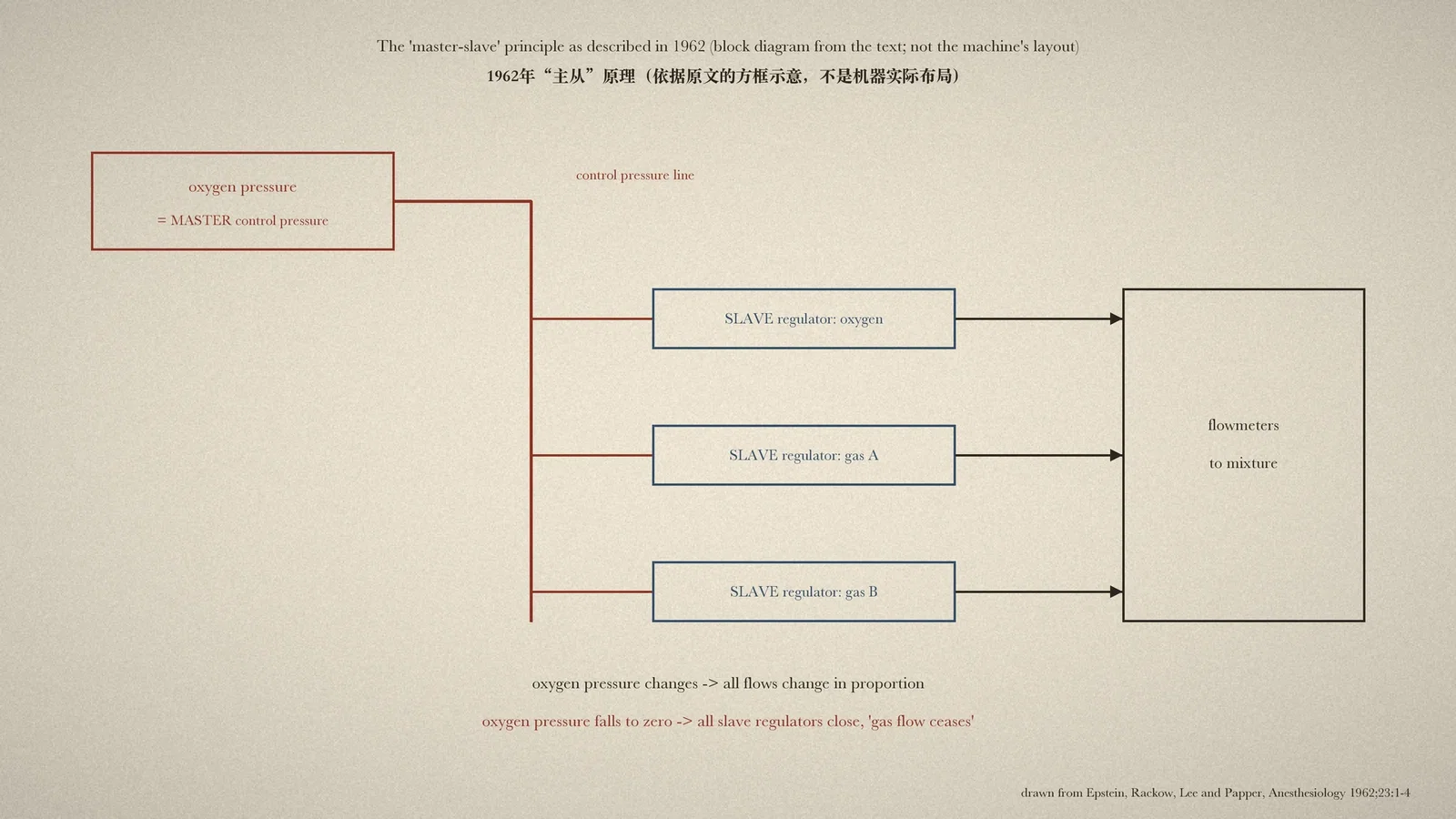
If the oxygen on an anaesthesia machine fails while the other gases keep flowing, the patient breathes a mixture with no oxygen in it. A four-page paper in early 1962 first told three such tragedies and then proposed a remedy: let the oxygen itself govern the other gases. [1, p. 1][1, p. 3]
Three cases
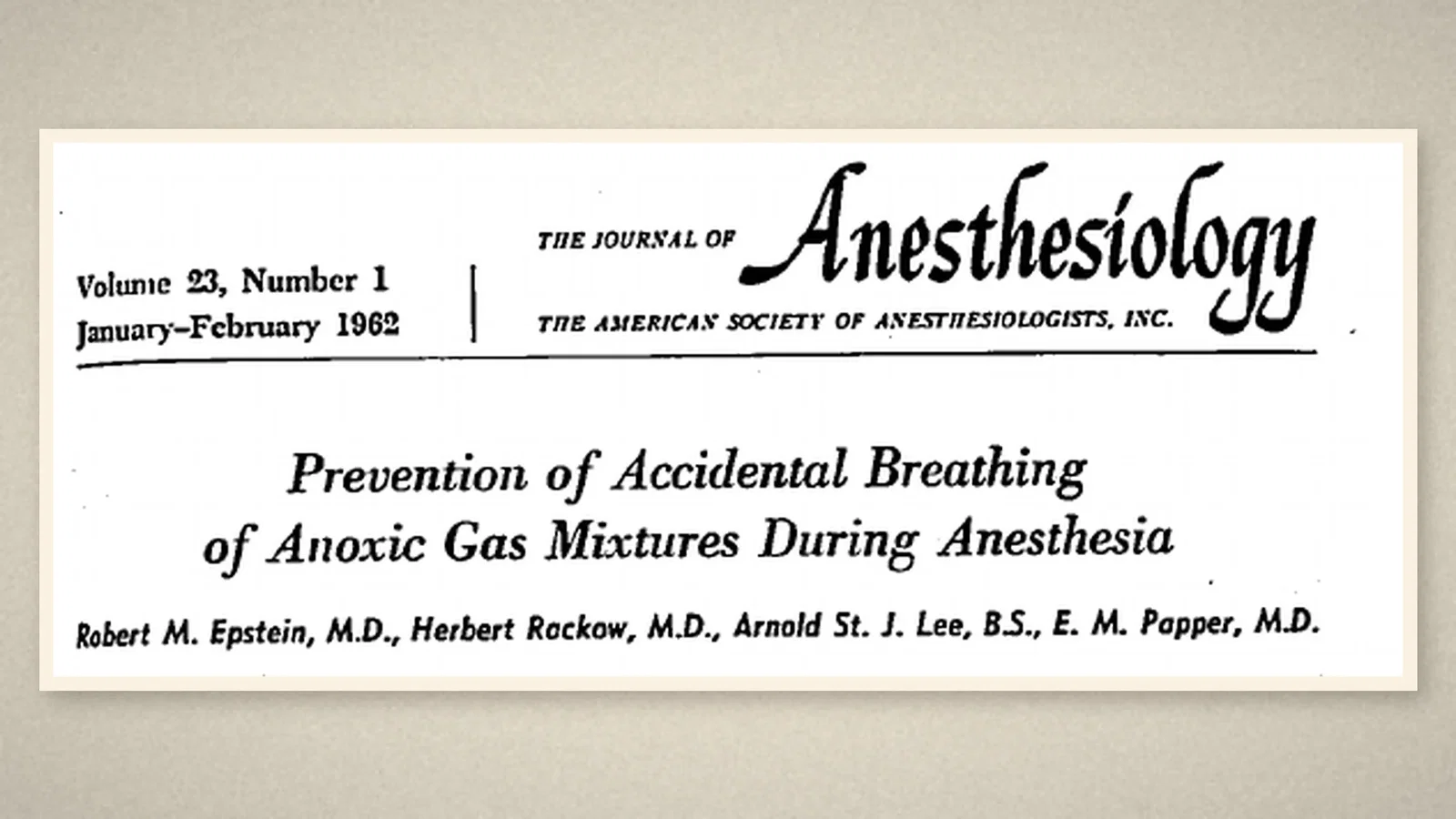
The authors were Robert M. Epstein, Herbert Rackow, Arnold St. J. Lee and E. M. Papper of the Department of Anesthesiology, Columbia University College of Physicians and Surgeons, and the Presbyterian Hospital, New York; the paper was accepted on 24 August 1961. Anoxia, they began, is always a hazard when an anaesthesia gas machine is used. Pin indexing had removed the danger of a wrong cylinder on the oxygen yoke, but failure of the oxygen supply from other causes had not been eliminated: an exhausted cylinder, a cylinder opened too little to keep flowing as its pressure fell, lost pipeline pressure, a pipeline valve left shut, a loose connection, a faulty reducing valve, or a flowmeter knocked out of place. The authors had seen most of these over eleven years, and presumably they occurred in all hospitals. [1, p. 1]
They reported three cases. In one, the oxygen cylinder ran out and the patient breathed pure ethylene; the heart stopped, open-chest massage restored it, but the patient never woke and died two days later. In another, a partly opened cylinder stopped delivering once its pressure fell, and the patient breathed pure nitrous oxide; there was no cardiac arrest, but the patient never regained consciousness and died months later. In the third, a child was moved from the induction room to the theatre and the machine connected to wall oxygen with the cylinder turned off, but the wall supply had failed; the heart stopped, open-chest resuscitation succeeded, but intellectual impairment remained. [1, pp. 1-3]
Alarms are not enough
The discussion accepts that preventing such accidents is first the anaesthetist's responsibility, but notes that human control "may be inadequate under the pressures of multiple responsibilities". Oxygen-flow alarms might help, yet they are necessarily subject to frequent false alarms, so that users may learn to ignore them, and they still need the right response from the operator. A suitable system, the authors concluded, "must be foolproof, independent of the active intervention of the anesthetist, and must operate in a 'fail-safe' manner". [1, p. 3]
Oxygen as the master
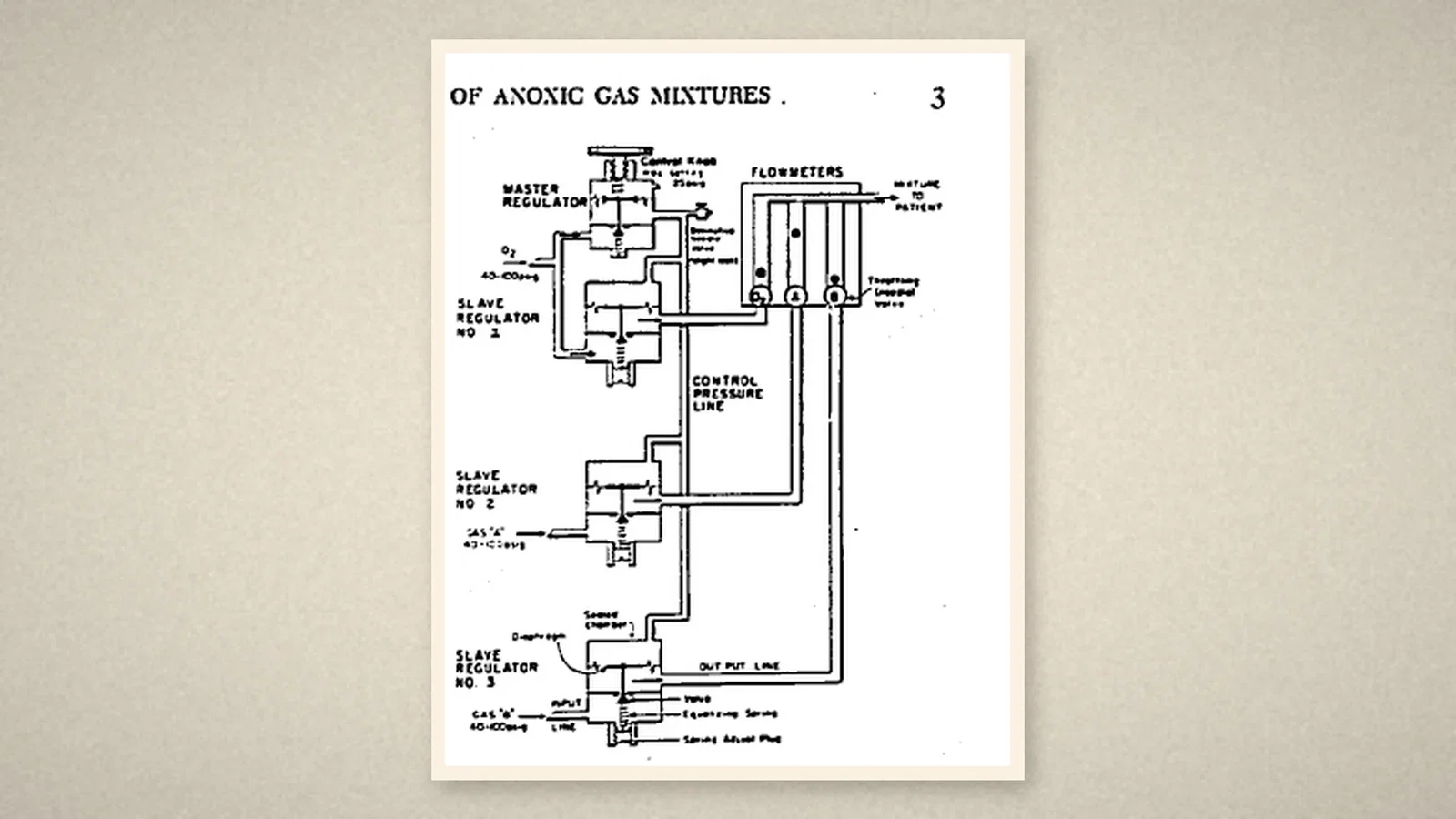
A device developed by the engineer Arnold S. J. Lee met these criteria. The flows of all the gases to be mixed were controlled at once by a single "master" control pressure. Because the proportion of oxygen matters most, oxygen pressure was used as that control pressure, in place of the usual spring in the delivery ("slave") regulators for every gas, oxygen included. If oxygen pressure changed, the flows of all the gases changed in the same proportion and the mixture stayed nearly constant. "Should the oxygen input pressure fall to zero, the diaphragms of all slave regulators close and gas flow ceases." A single knob also set the total flow for non-rebreathing systems. [1, p. 3]
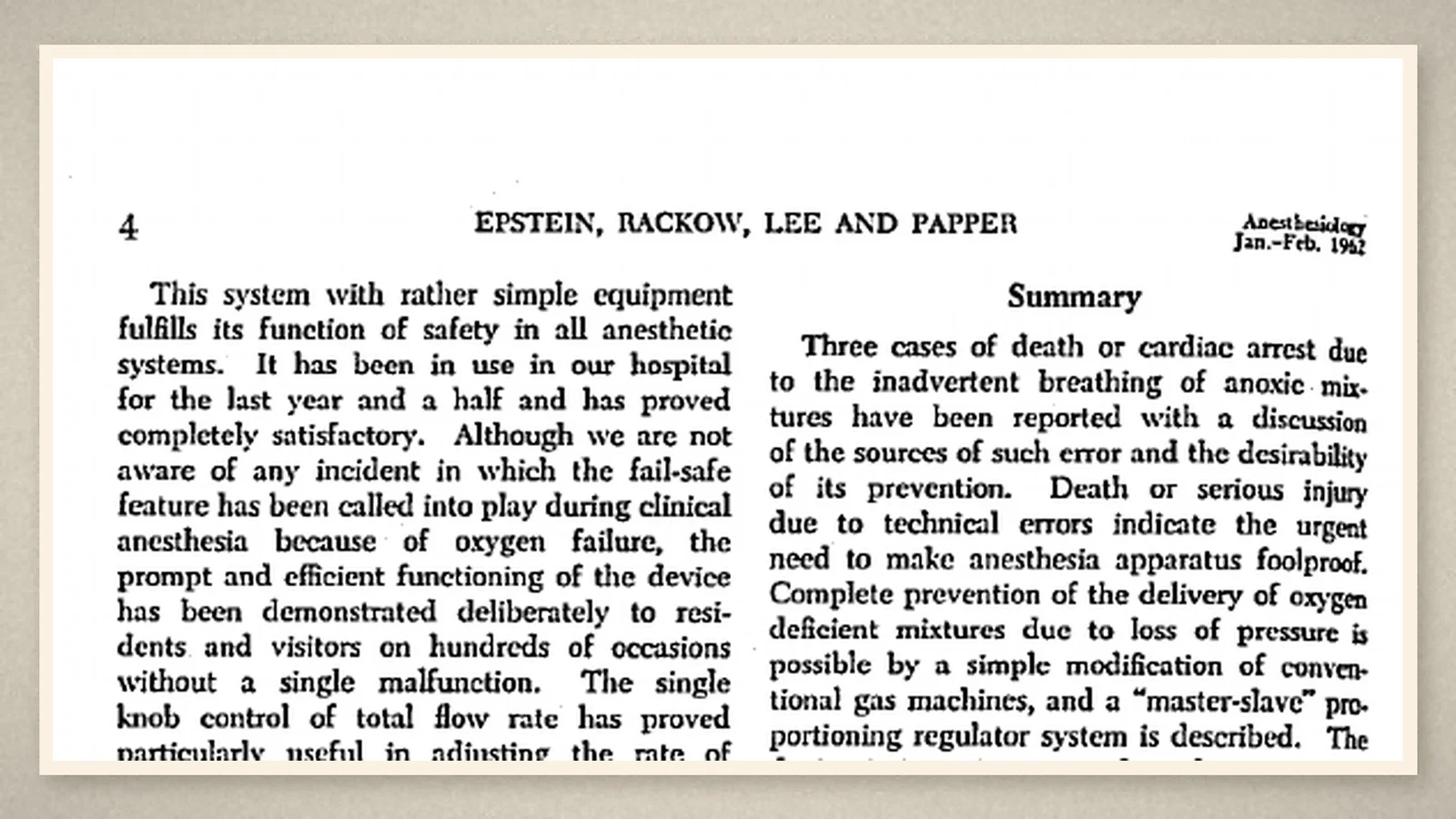
The system had been in use in the authors' hospital for a year and a half and had proved completely satisfactory. The authors knew of no clinical incident in which the fail-safe feature had actually operated because of oxygen failure, but it had been demonstrated deliberately to residents and visitors on hundreds of occasions "without a single malfunction". The summary ends by saying that death or serious injury from technical errors showed an urgent need to make anaesthesia apparatus foolproof. [1, p. 4]
The prototype in the museum
The Wood Library-Museum's catalogue page describes the prototype. In the museum's account, Arnold St. Jacques Lee (1921-2001) was a medical engineer and designer who worked with anesthesiologists at the Presbyterian Hospital and Columbia University. The museum calls the prototype the first device to protect patients from being given anaesthetic gas without oxygen, dates the article announcing it to 1962, and says that such oxygen safety functions have been required in continuous-flow anaesthesia machines since 1979. The prototype was donated in Lee's honour by Robert Epstein. [2]
What the record shows
The paper moved safety from human vigilance into the structure of the machine. It did not warn the anaesthetist that oxygen had failed; it made the other gases stop with it. Three tragedies and eighteen months of use were the whole of the authors' case; how later standards took up the idea was not checked here.
Sources and reading limits
Read: Epstein, Rackow, Lee and Papper, Anesthesiology 1962;23:1-4 (the whole paper: introduction, three case reports, discussion of the device with Fig. 1, experience and summary); the Wood Library-Museum catalogue page "Lee Fail-Safe Device", consulted on 3 November 2026. Copies of both were obtained for this article.
Not covered: any patent by Lee; manufacturers' later oxygen-failure devices; the standard behind the museum's 1979 date; the Holmdahl communication cited in the paper. The video on the catalogue page was not viewed.
Limits: "the first device" and "required since 1979" are the museum's statements, reported as such and not checked. The authors themselves knew of no clinical incident in which the device had operated because of oxygen failure. Case details are kept general: doses, cylinder pressures and patients' identities are not repeated, and page crops stop before them.
Three illustrations are crops of Anesthesiology 1962 pp. 1, 3 and 4 (p. 3 is the paper's Fig. 1). One is a block diagram drawn from the text, not the machine's actual layout.
- Epstein RM, Rackow H, Lee AS, Papper EM. Prevention of accidental breathing of anoxic gas mixtures during anesthesia. Anesthesiology. 1962;23:1-4. DOI
- Wood Library-Museum of Anesthesiology. Lee Fail-Safe Device (catalogue page, WLMD ID aihb). Accessed 3 Nov 2026. WLM · Archived copy
Continue exploring
Related reading connects shared questions and contexts; it does not by itself establish historical influence.
Anesthesia Epochs · The Source Room · About & Editorial Method
Published November 3, 2026. Sources and reading limits are stated above. Illustrations are labelled as original source images or AI-made. Historical accounts are educational; they are not current treatment instructions.