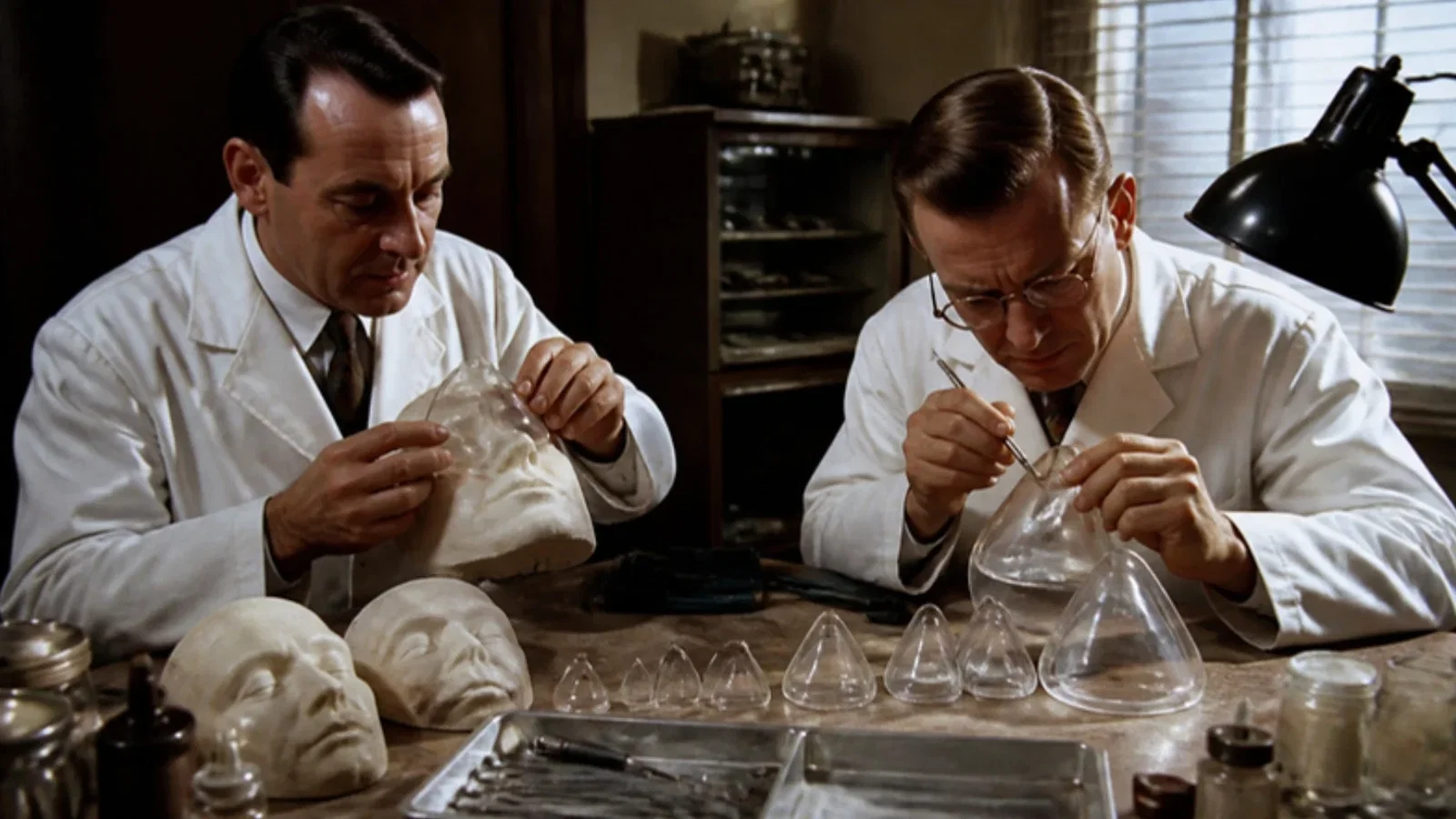
On 16 June 1962 the New Appliances column of the British Medical Journal printed 'New paediatric face masks and anaesthetic equipment' by the anaesthetist Leslie Rendell-Baker and the dentist Donald H. Soucek of Western Reserve University School of Medicine, Cleveland: with halothane and the eclipse of open-drop methods, equipment for semi-closed anaesthesia in babies had proved deficient, the best masks adding considerable dead space and fitting poorly; the new masks, designed on dental principles so that the mask 'fits the face as a denture fits the palate', sealed without a pneumatic cuff and, with a partitioned adapter, made it feasible to anaesthetise quite small babies without intubation. The ASA timeline dates the masks to 1961.
Reading Library · Anesthesia Epochs · 中文版
Watch the education video (for clinicians)
1962: The Rendell-Baker-Soucek Mask — Paediatric Airway · Anesthesia Epochs Education Series
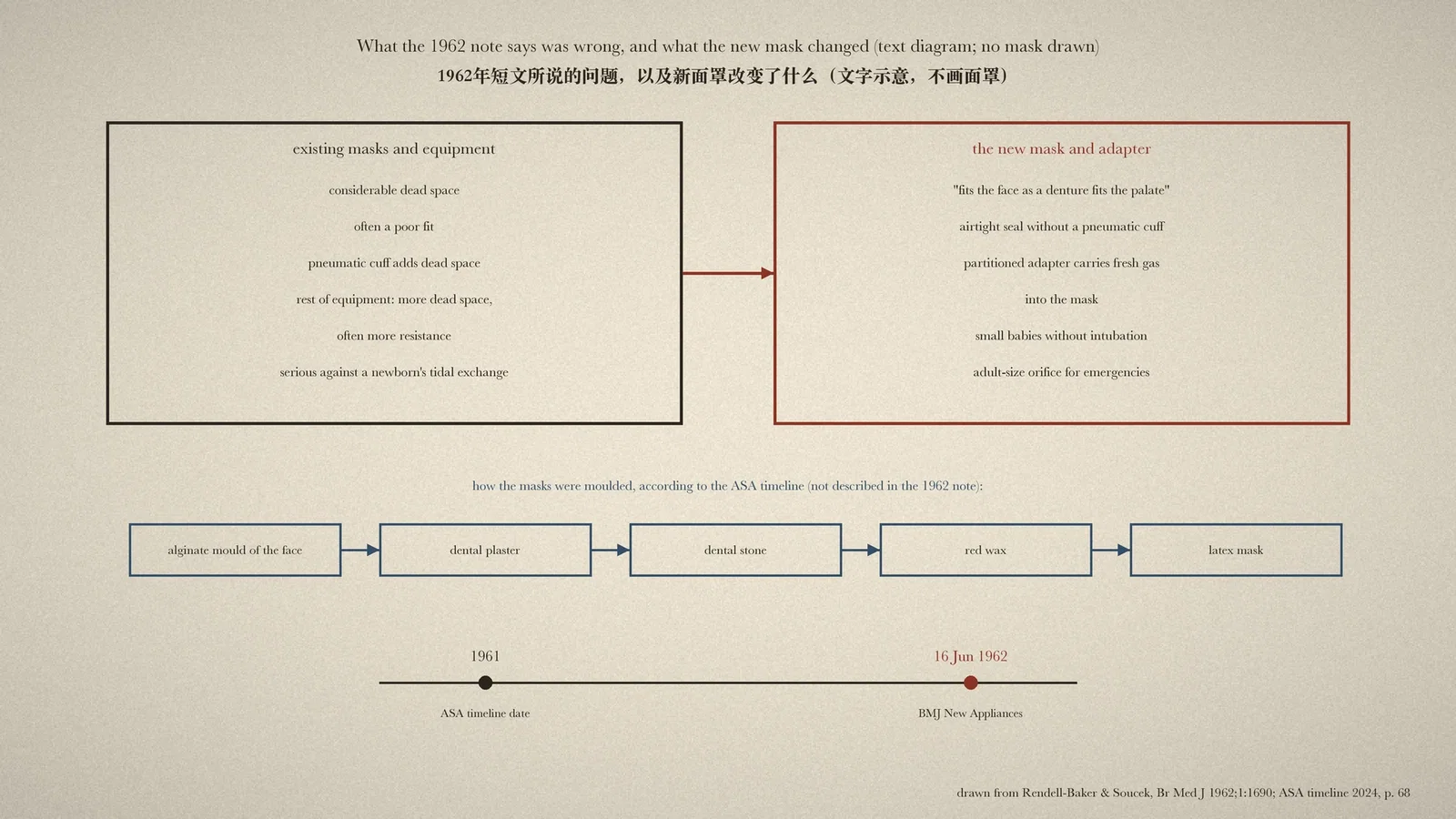
A face mask for an adult can be a little too big without much harm. For a newborn it cannot. Every millilitre of space between the mask and the face is gas the baby must breathe back in, and a newborn's breath is small. In June 1962 an anaesthetist and a dentist from Cleveland, Ohio, described in the British Medical Journal a mask built for that problem, using the methods dentists used to fit a plate to a mouth. [1]
The problem
The note appeared in the New Appliances column of 16 June 1962: "New paediatric face masks and anaesthetic equipment", by Dr Leslie Rendell-Baker and Dr Donald H. Soucek of Western Reserve University School of Medicine, Cleveland. "With the great increase in elective paediatric surgery the baby is no longer a rarity to be anaesthetized with makeshift apparatus and methods long since discarded for adult patients." [1]
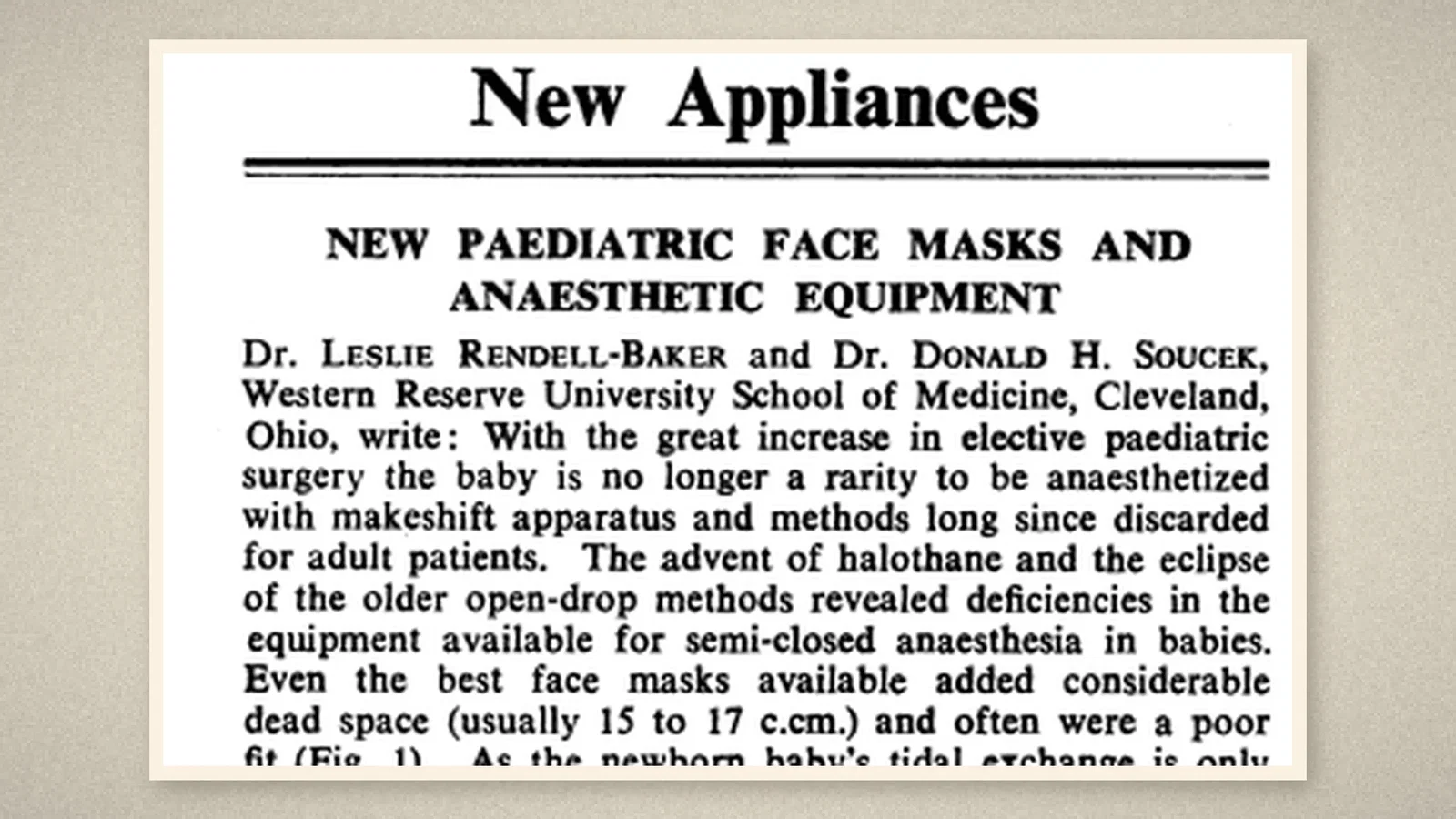
What had changed was the drug. "The advent of halothane and the eclipse of the older open-drop methods revealed deficiencies in the equipment available for semi-closed anaesthesia in babies." Even the best face masks available added considerable dead space, and often fitted poorly. Since a newborn's tidal exchange was small, the authors wrote, "this increase in dead space is quite serious", and the rest of the equipment "not only added more dead space but often increased resistance to respiration as well". [1]
The mask
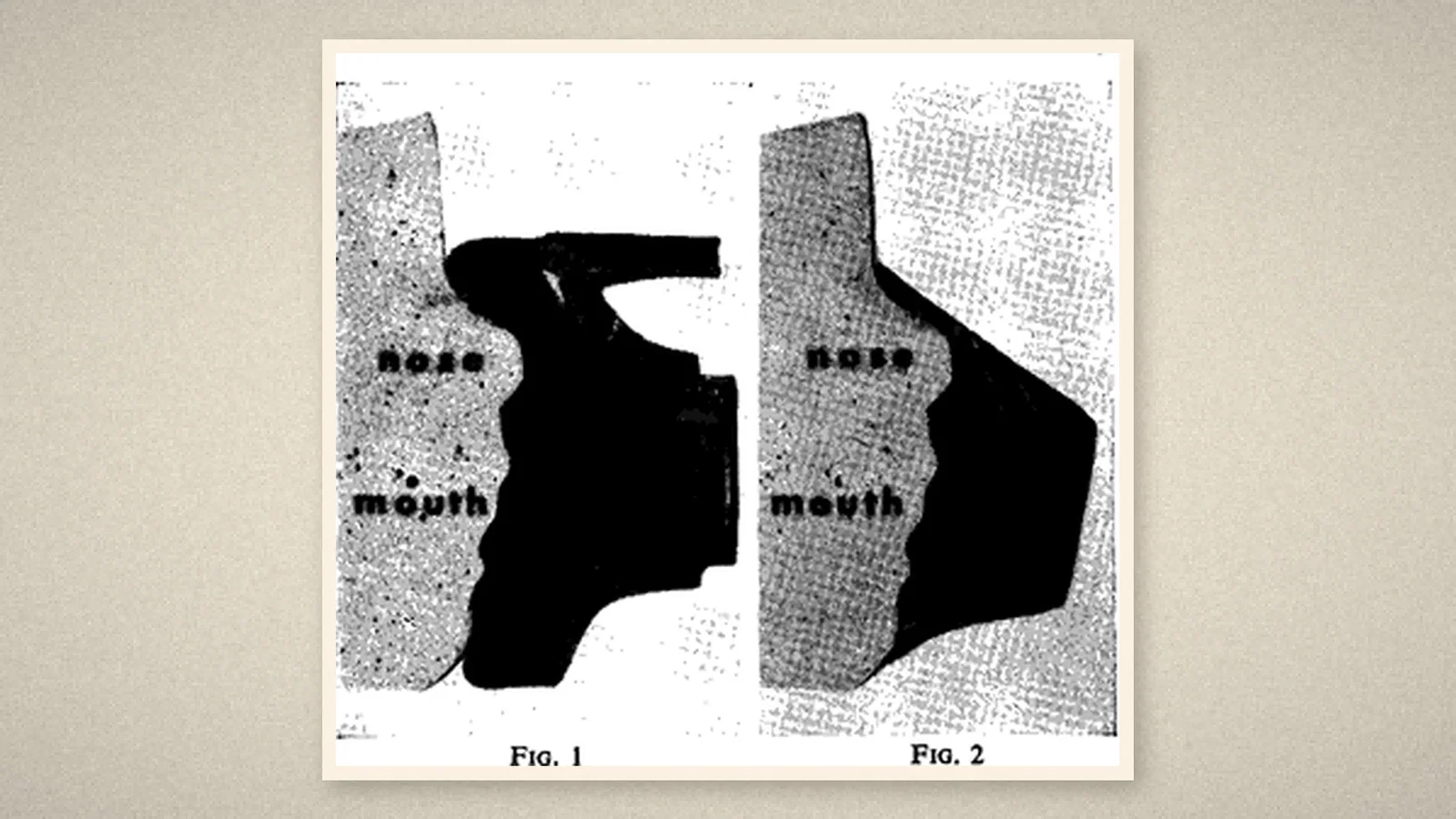
"New face masks were designed, using well-known dental principles, so that the mask fits the face as a denture fits the palate." There was clearance over the lips and nostrils for free breathing, and the fit gave "an airtight seal without the need for a pneumatic cuff, which always increases the dead space". The note's first two figures are sagittal sections through plaster models of a baby's face, one with an existing mask and one with the new mask, showing how much less space the new shape left. [1]
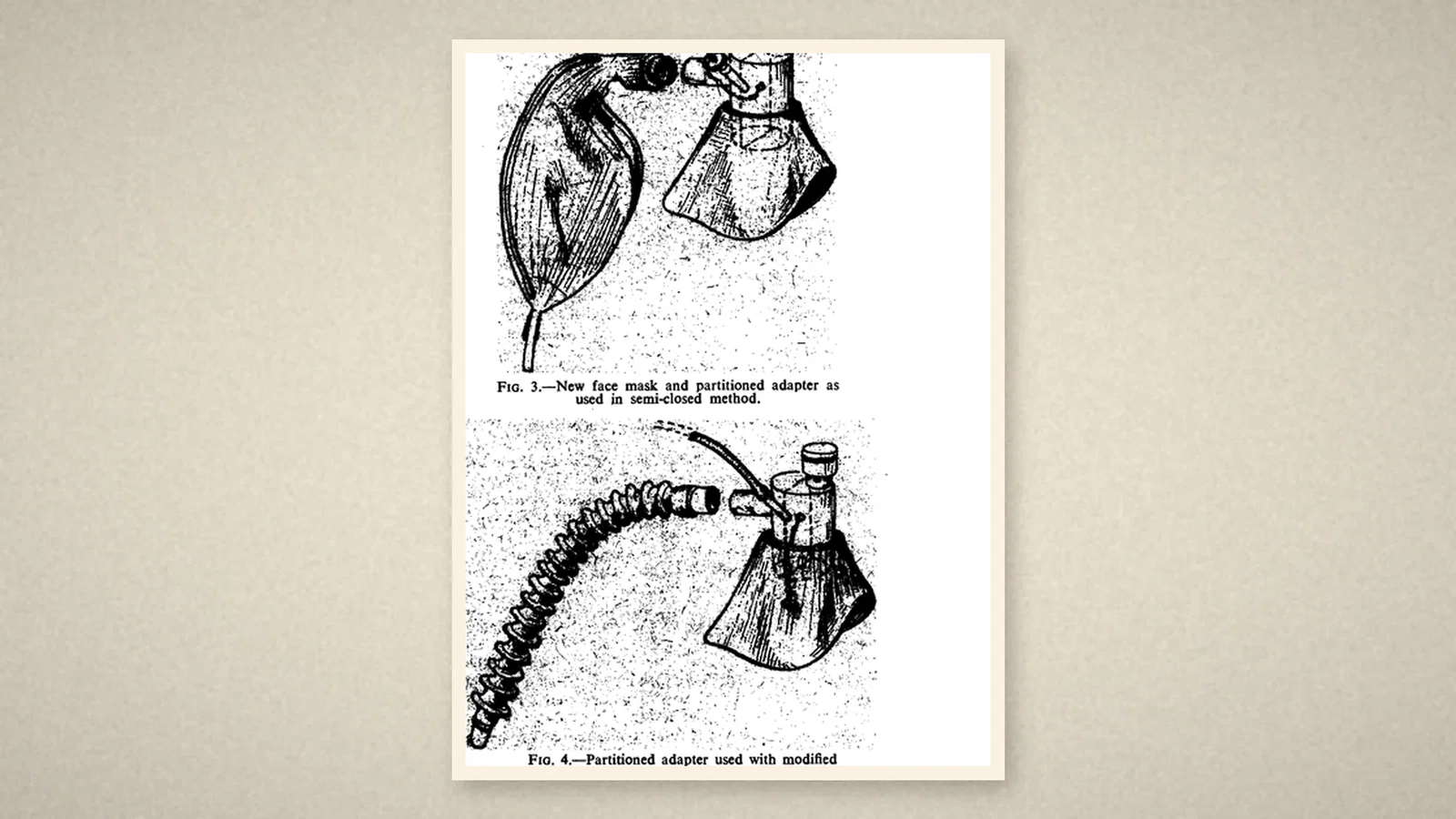
The mask came with a new partitioned adapter. With it, the small dead space made it "feasible to anaesthetize quite small babies without the need for intubation"; the partition inside the adapter carried the fresh gas down into the mask and helped remove carbon dioxide. A modified Ayre's T-piece could be used instead. An adult-size orifice in the mask meant that in an emergency it could be connected to any adult equipment. Two sizes were available, one from birth to about a year and one from a year to about three and a half years, with smaller and larger sizes in preparation. The masks were made in the United Kingdom by J. G. Franklin & Sons, and the apparatus could be had from Medical Industrial Equipment Ltd in London. [1]
The timeline's account
The Australian Society of Anaesthetists (ASA) timeline lists "Modern paediatric anaesthetic masks developed (Rendell-Baker/Soucek masks)" under 1961. It describes Rendell-Baker as a British anaesthetist who emigrated to the USA and Soucek as an American dental surgeon, and says the masks were made to fit the contours of children's faces in stages: starting with anaesthetised, intubated children, "an initial alginate face mould was made and then dental Plaster of Paris, dental stone and red wax were all used in stages" to arrive at the shape of the latex mask. [2, p. 68]
What the record shows
The moment a piece of anaesthetic equipment was scaled to a baby by measuring babies, rather than by shrinking an adult design. The idea came from dentistry, the problem from a new drug that made closed systems matter, and the measure of success was a quantity too small to see: the gas left between the mask and the face.
Sources and reading limits
Read: Rendell-Baker and Soucek, British Medical Journal 16 June 1962, p. 1690, the whole note with its four figures; the ASA timeline 2024, p. 68.
Not covered: the PubMed Central PDF (not accessible) and the Internet Archive copy of the BMJ issue (lending-restricted, not opened); any American publication of the masks by the same authors; the maker's or distributor's literature. The History of Anaesthesia Society timeline item, which dates the mask to 1962, was not re-read.
Limits: the ASA dates the masks to 1961; the BMJ note is of June 1962. The moulding sequence is the ASA's account; the BMJ note itself shows only sections through plaster models. The scan is of low resolution. Dead-space volumes are not repeated. Quotations are from the English original.
Three illustrations are crops of the British Medical Journal (p. 1690); one is drawn from the note.
- Rendell-Baker L, Soucek DH. New paediatric face masks and anaesthetic equipment. Br Med J. 1962;1(5293):1690. PMC
- Australian Society of Anaesthetists. Anaesthesia history timeline. 2024:68. ASA
Continue exploring
Related reading connects shared questions and contexts; it does not by itself establish historical influence.
Anesthesia Epochs · The Source Room · About & Editorial Method
Published November 3, 2026. Sources and reading limits are stated above. Illustrations are labelled as original source images or AI-made. Historical accounts are educational; they are not current treatment instructions.