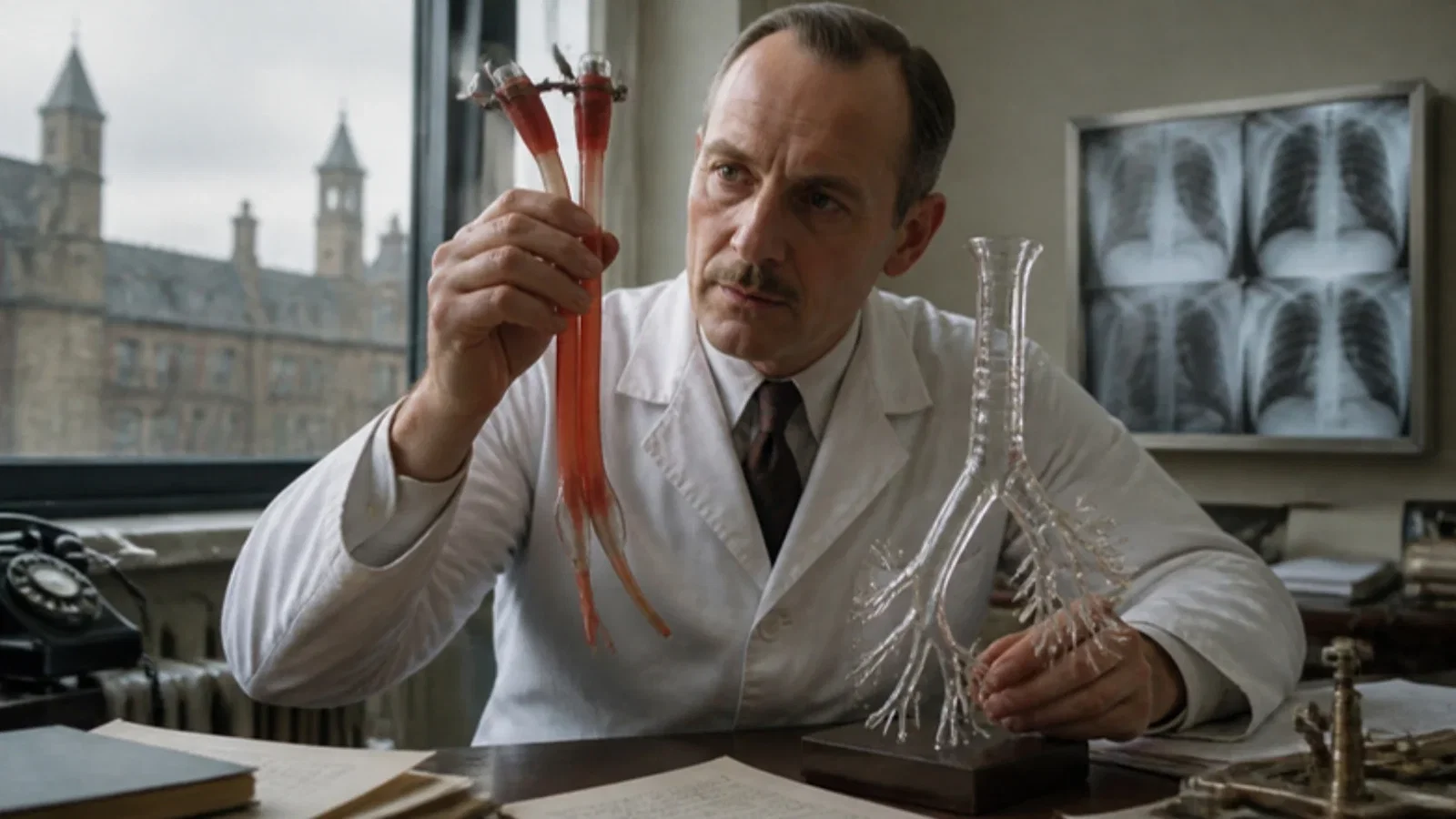
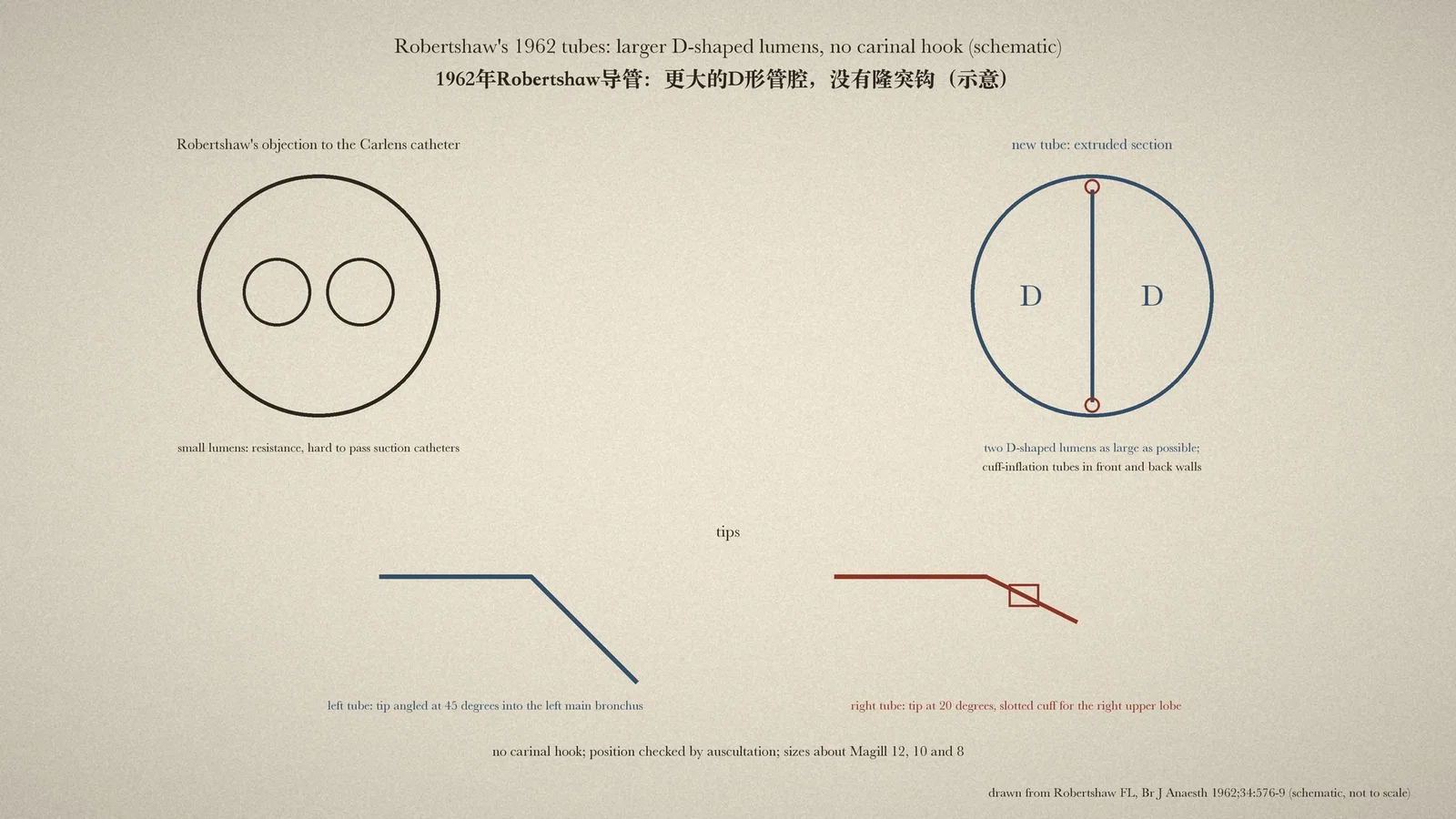
Frank L. Robertshaw of Park Hospital, Davyhulme, Manchester, described in the British Journal of Anaesthesia a double-lumen tube extruded with two D-shaped lumens as large as possible, for low resistance and easy suction; it had no carinal hook, making intubation easier; the left tube's tip was angled at 45 degrees into the left main bronchus, the right tube's at 20 degrees with a slotted cuff for the right upper lobe; under simulated conditions its resistance was lower than that of any Carlens tube usable in the same patient.
Reading Library · Anesthesia Epochs · 中文版
Watch the education video (for clinicians)
1962: Robertshaw's Double-Lumen Tubes — Manchester · Anesthesia Epochs Education Series
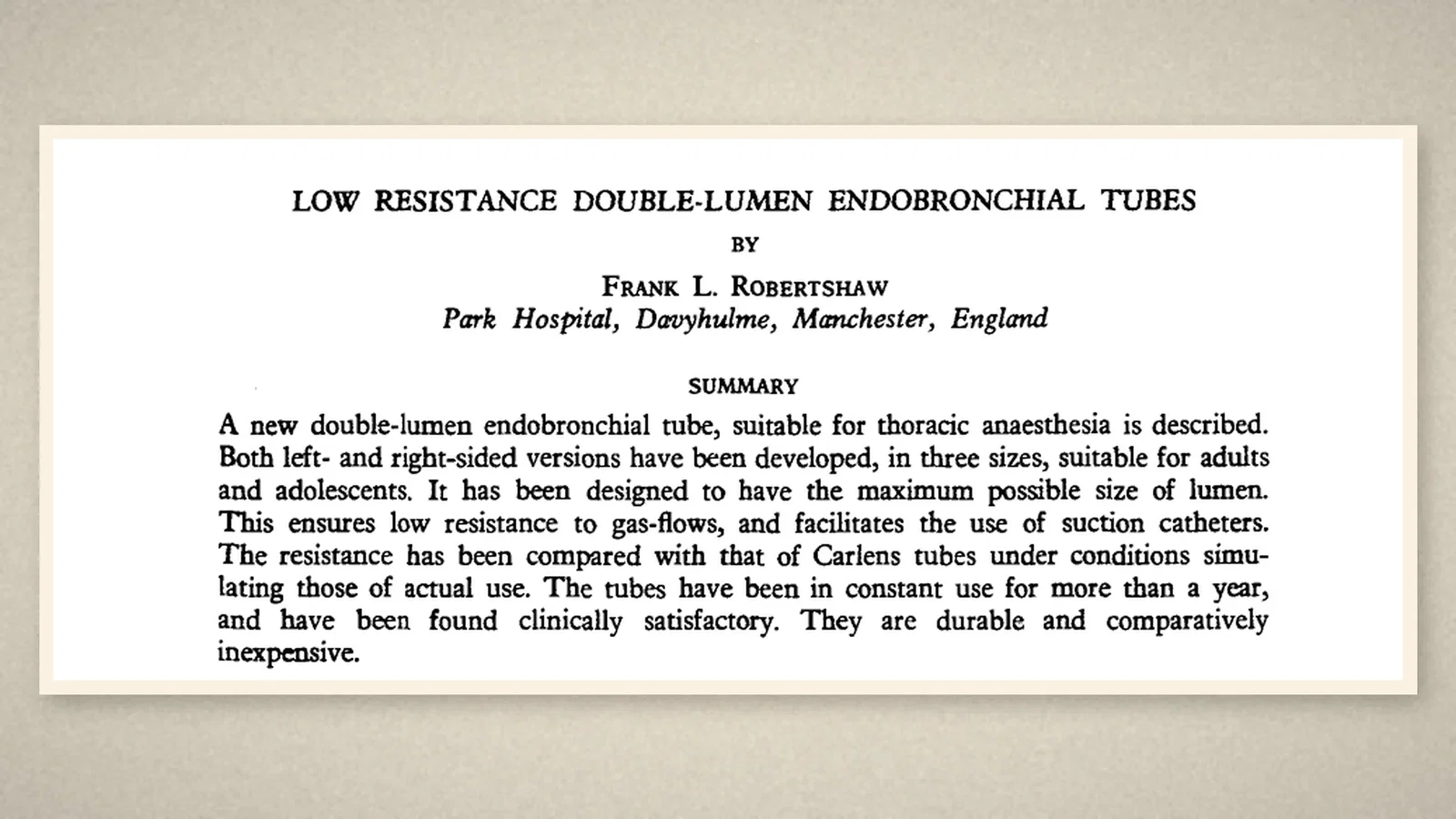
The double-lumen tube let thoracic anaesthetists ventilate and suction each lung separately, but early designs had narrow channels. The Australian Society of Anaesthetists (ASA) timeline records under 1962 that Frank L. Robertshaw designed and described versions of the double-lumen endobronchial tube, made by the Leyland and Birmingham Rubber Company, in left- and right-sided forms and three sizes. This article reads Robertshaw's paper, "Low resistance double-lumen endobronchial tubes", in the British Journal of Anaesthesia of 1962. [1][2]
What was wrong with the Carlens catheter
Robertshaw, of Park Hospital, Davyhulme, Manchester, began with history. Frenckner had introduced a double-lumen bronchoscope with inflatable cuffs in 1934, and Zavod a latex double-lumen catheter in 1940, both for bronchospirometry. In Robertshaw's account, Carlens then "introduced the first double-lumen tube suitable for this purpose", originally intended for bronchospirometry in 1949, and Björk and Carlens soon reported its use in twenty lung resections. [1]
"Despite its many advantages, Carlens' catheter has not found universal acceptance among thoracic surgeons and anaesthetists." Placement difficulties could be overcome; "a more serious objection is the smallness of each lumen". Controlled respiration largely overcame the resistance, but increased resistance to expiration might be a contraindication in gross emphysema, and suction catheters large enough for thick purulent secretions were hard to pass. [1]
The design
The new tube was "an extruded section", with twin lumens "roughly semicircular or D-shaped", made as large as possible. The cuff-inflation tubes ran inside the front and back walls, an arrangement "least liable to kinking". The cuffs followed the standard British Magill pattern but used a new, slightly firmer rubber compound that resisted overdistension and boiling. The pilot tubes were coloured "red, as usual, for the tracheal cuff, and blue for bronchus". [1]
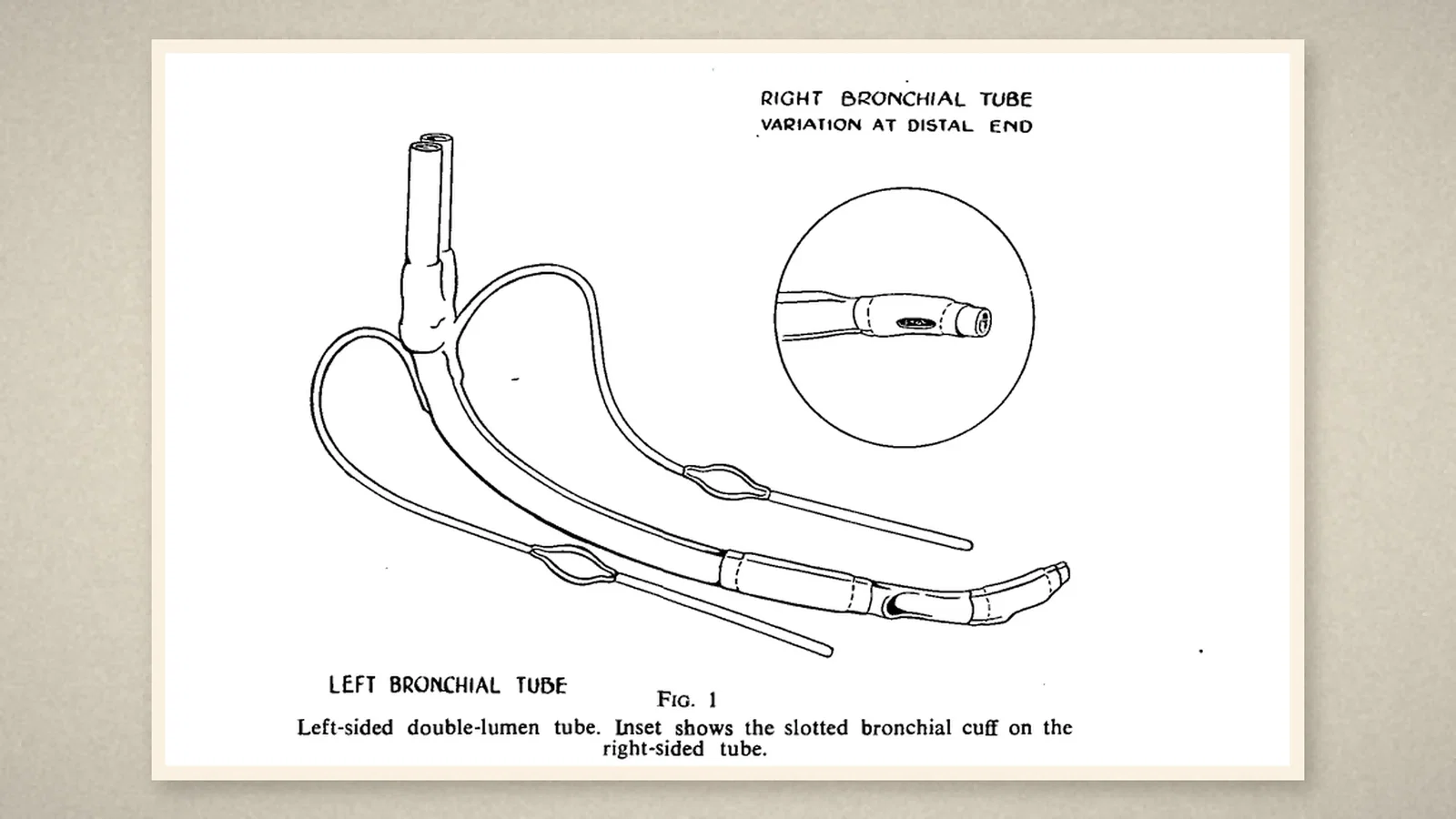
The left-sided tube, the one most often used, had a tip "angled at 45°" to enter the left main bronchus, while the right lumen ended above the carina. The right-sided tube had a tip angled at 20° and, following Green and Gordon, a slotted bronchial cuff so that the right upper lobe could be ventilated; Green and Gordon had found that the distance from carina to right upper lobe bronchus varied from 1 cm to 4 cm. Large, medium and small sizes corresponded roughly to Magill sizes 12, 10 and 8; the two larger suited most men and women, and the small size had been used in children of about 14 with bronchiectasis. [1]
"Neither tube has a carinal hook." Robertshaw found this no disadvantage and said it made intubation easier, preferably with a laryngoscope that left more room in the mouth. Once the bronchial cuff was inflated, auscultation over the upper lobe showed whether the tube was correctly placed; pushed too far, the left tube could obstruct the left upper lobe, "hence auscultation should not be omitted". For suction, the largest usable catheter did not fully occlude the D-shaped lumen. [1]
Resistance
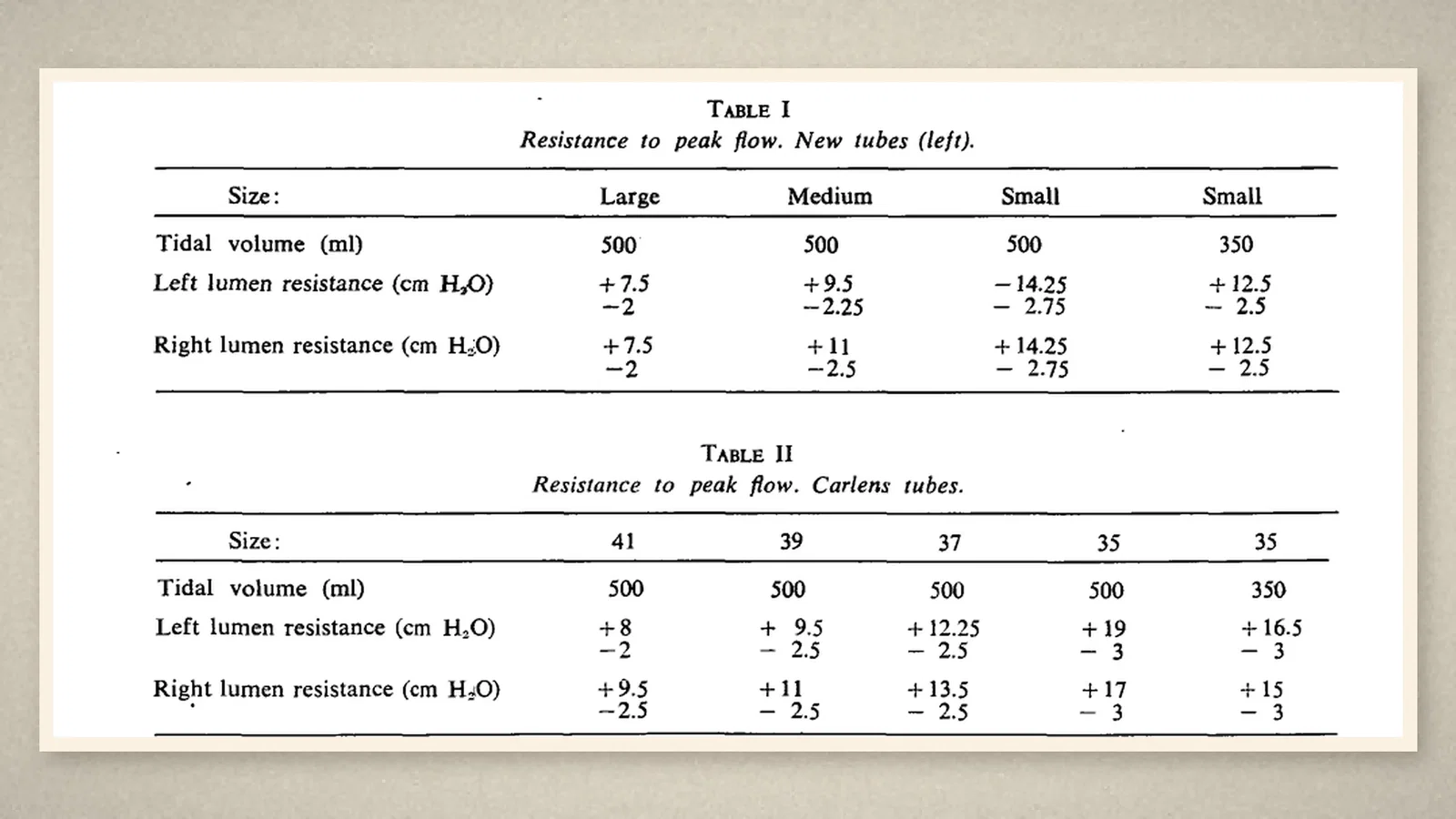
To compare resistance, the tubes were connected to a Blease Pulmoflator delivering a fixed tidal volume, with the bronchial ends open to air, and the figures for the new tubes (Table I) were set beside those for Carlens tubes (Table II). Robertshaw concluded that their resistance "is lower than that of the Carlens tube which could be used in any given patient". The tubes had been in constant use for more than a year and were "durable and comparatively inexpensive". The acknowledgements thank Eric Carlens for a "kindly interest". [1]
What the record shows
Robertshaw's paper shows how a working idea was refined in a second design. The principle came from Carlens's catheter, but Robertshaw enlarged the lumens, matched the shape to each bronchus, added a slot for the right upper lobe, removed the hook, and checked position by listening rather than by feel. The paper ties each change to a stated problem and measures the most important one, resistance, on the bench.
Sources and reading limits
Read: Robertshaw FL, Br J Anaesth 1962;34:576-9, in full from the PDF, with page images of pp. 576-8, including Fig. 1 and Tables I-II; the ASA timeline entry for 1962.
Not covered: the papers Robertshaw cites (Frenckner, Zavod, Green and Gordon, Jenkins and Clarke, White, Hunter); the ASA timeline entries for 1960 and 1978 on other double-lumen tubes; later disposable versions. The statement that Carlens introduced "the first" suitable tube is Robertshaw's and is quoted as such. Resistance figures are bench measurements and are not repeated. Quotations are from the English original.
Three illustrations are crops of pp. 576-8, including Fig. 1 and Tables I-II; one is drawn from the text.
- Robertshaw FL. Low resistance double-lumen endobronchial tubes. Br J Anaesth. 1962;34(8):576-9. BJA
- Australian Society of Anaesthetists. Anaesthesia history timeline. 2024. ASA
Continue exploring
Related reading connects shared questions and contexts; it does not by itself establish historical influence.
Anesthesia Epochs · The Source Room · About & Editorial Method
Published November 2, 2026. Sources and reading limits are stated above. Illustrations are labelled as original source images or AI-made. Historical accounts are educational; they are not current treatment instructions.