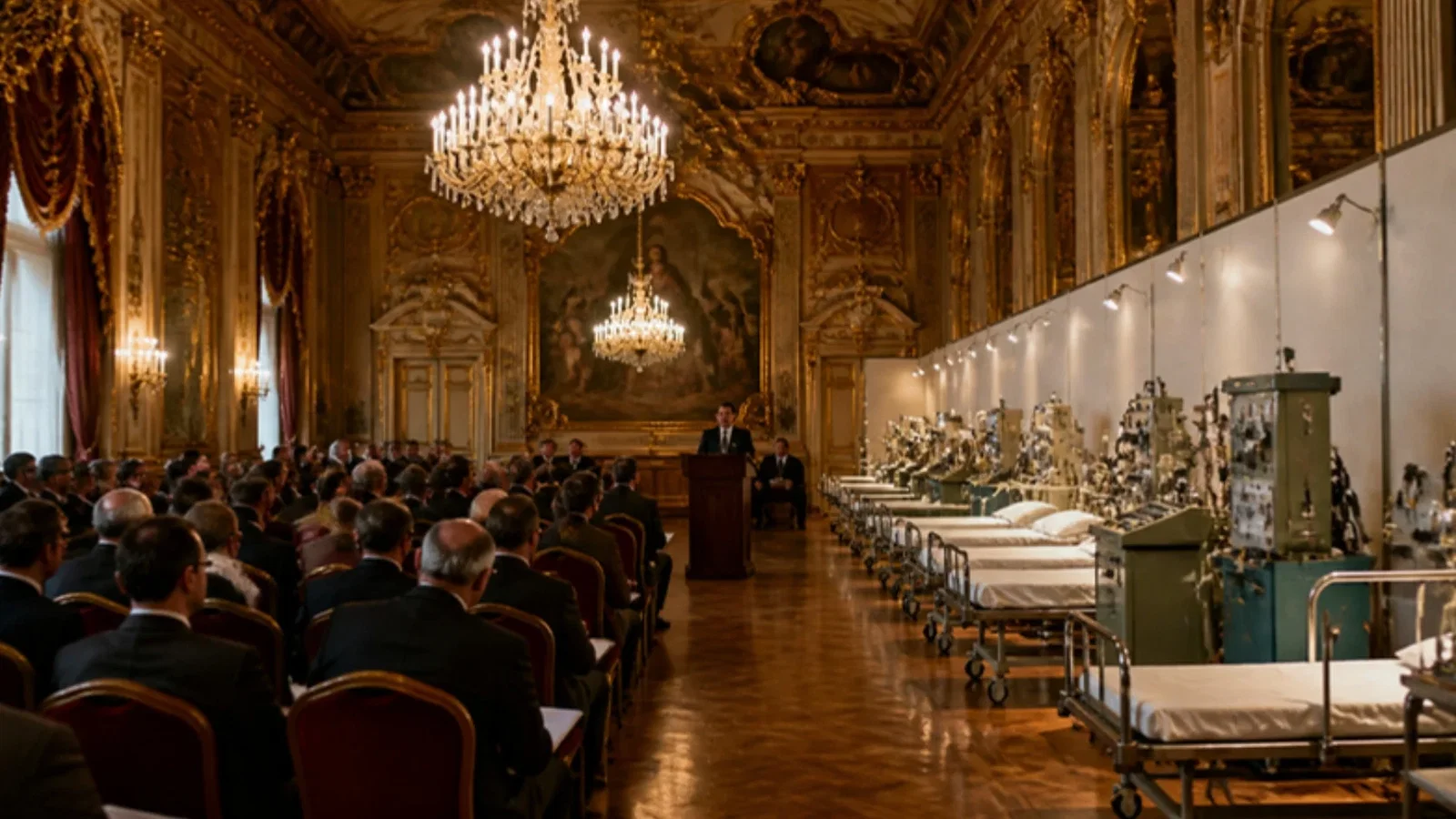
In 1961 Anaesthesia and the South African Medical Journal announced that the Austrian Society of Anaesthesiology would hold the First European Congress of Anaesthesiology in the former Imperial Palace in Vienna in September 1962, with 'recovery stations and special care units' as the first of its main subjects. The Australian Society of Anaesthetists' timeline records that a symposium on respiratory units at the congress drew up the first formal guidelines for what became intensive care units. In the same issue of Anaesthesia, D. J. Pearce of Southampton described a respiratory unit that began with two beds and pleaded for such units in every busy general hospital. The congress proceedings could not be obtained.
Reading Library · Anesthesia Epochs · 中文版
Watch the education video (for clinicians)
1962: The Vienna Congress — Special Care Units First · Anesthesia Epochs Education Series
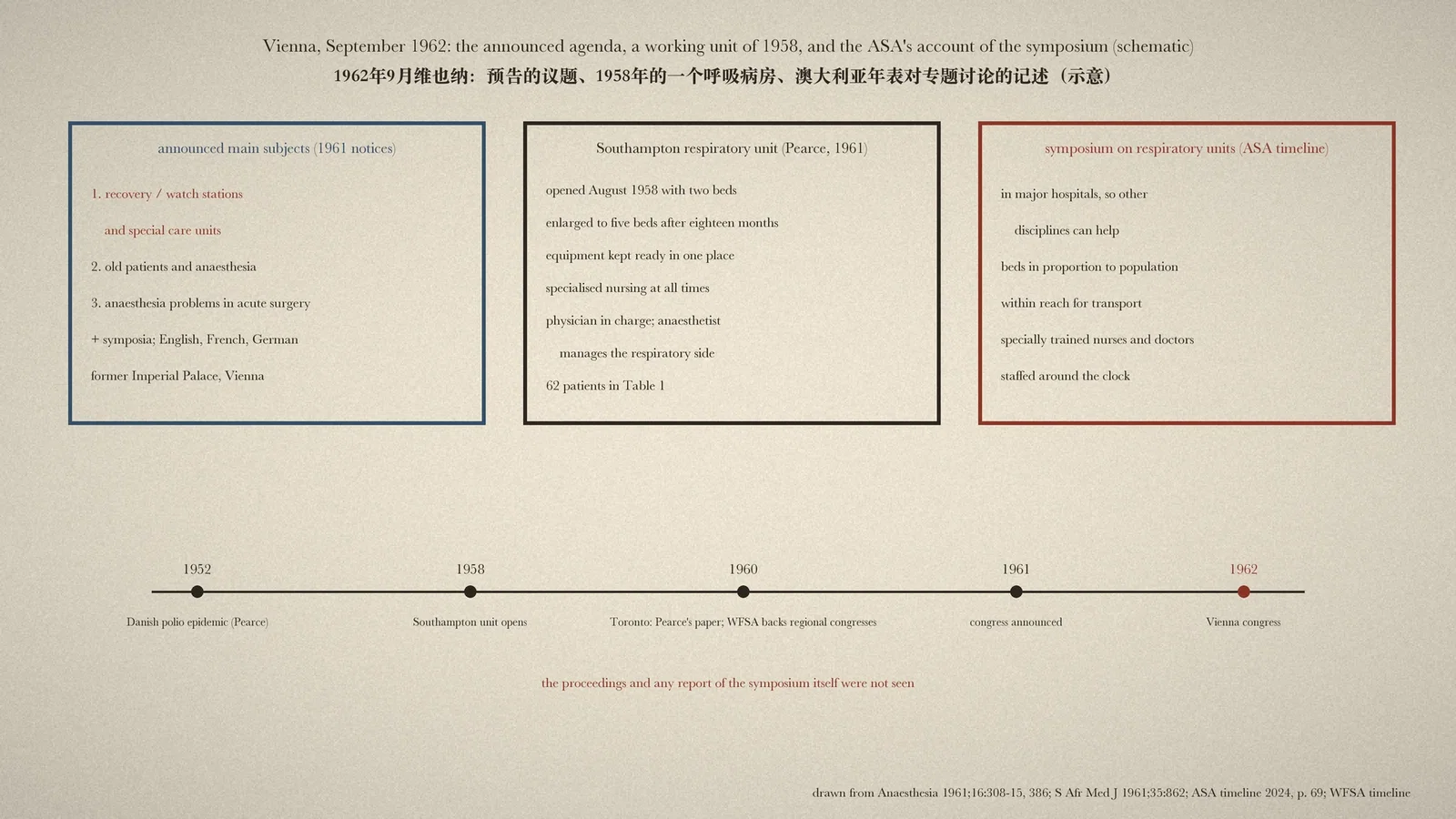
Intensive care units grew out of a simple observation: patients who cannot breathe for themselves do better when the machines, the nurses and the doctors who understand ventilation are gathered in one place. When anaesthetists from across Europe met in Vienna in September 1962, at what its organisers called the First European Congress of Anaesthesiology, that idea headed their programme. The Australian Society of Anaesthetists (ASA) timeline goes further, crediting a symposium at that congress with the "first formal guidelines" for what were then called respiratory units. [3, p. 69]
This article could not obtain the congress proceedings. What it reads instead is what was printed before the congress, in two journals, and a paper from the same months that shows what a respiratory unit looked like in practice.
The announcement
The World Federation of Societies of Anaesthesiologists (WFSA) had agreed in 1960 "to promote regional congresses" between its World Congresses, and records the Vienna meeting of 1962 as the first European one, held under its auspices. [4]
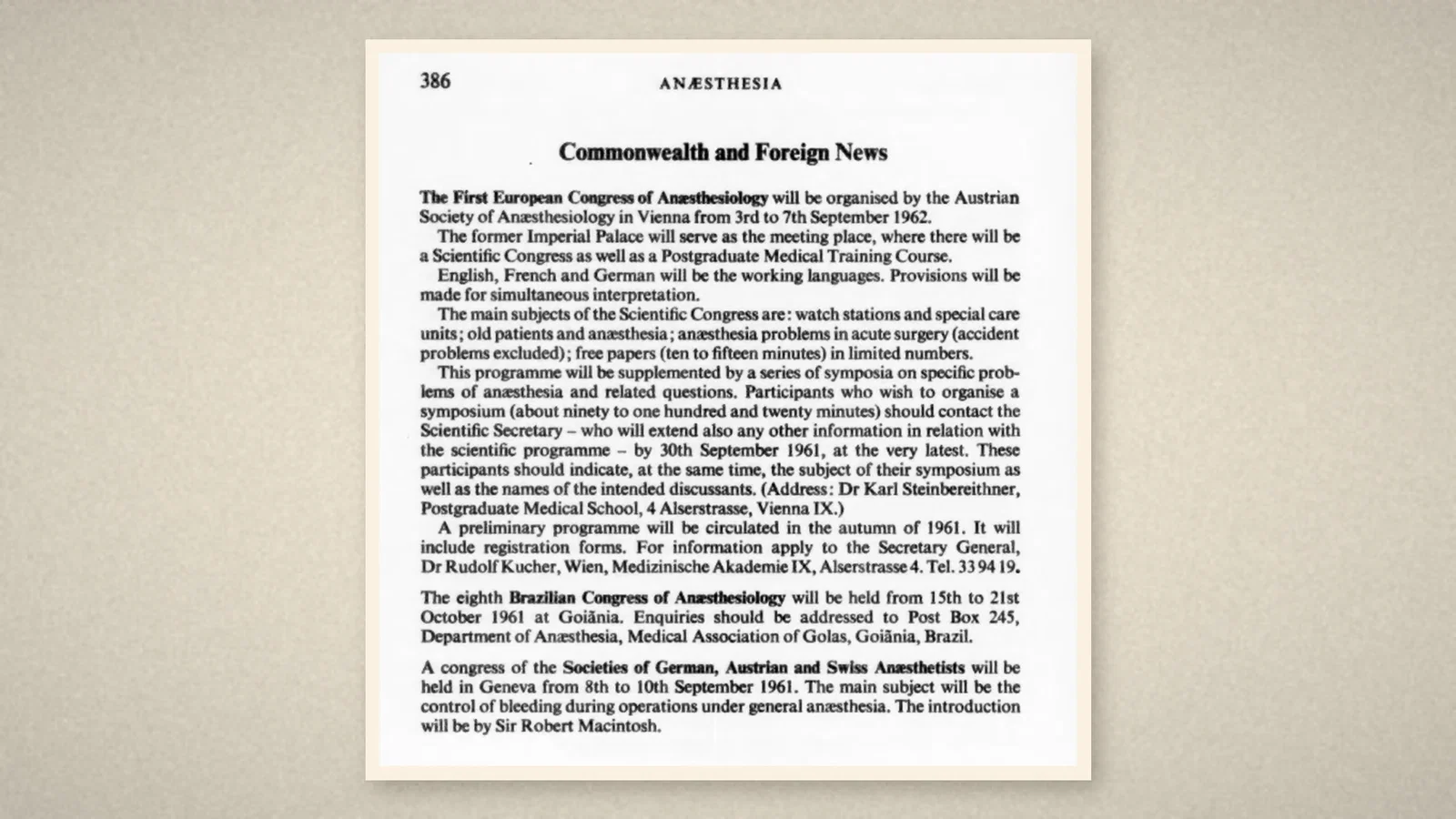
In July 1961 the journal Anaesthesia carried the notice in its "Commonwealth and Foreign News". The congress would be "organised by the Austrian Society of Anesthesiology in Vienna from 3rd to 7th September 1962"; "The former Imperial Palace will serve as the meeting place", with a scientific congress and a postgraduate course, and English, French and German as working languages, with simultaneous interpretation. Then the agenda: "The main subjects of the Scientific Congress are: watch stations and special care units; old patients and anesthesia; anesthesia problems in acute surgery". Symposia would be added on request, through the scientific secretary, Karl Steinbereithner; the secretary general was Rudolf Kucher. [1, p. 386]
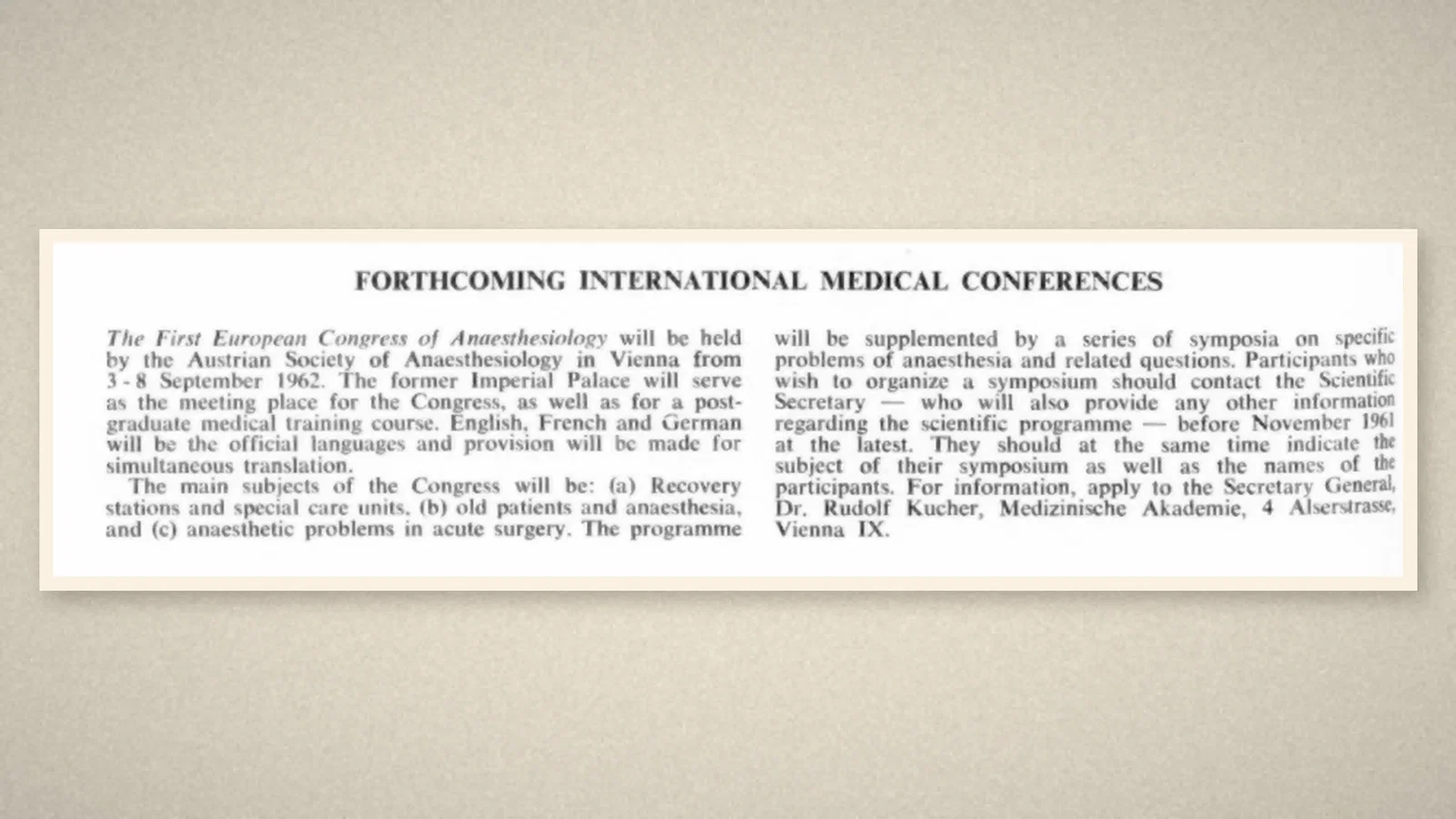
The South African Medical Journal printed a near-identical notice in October 1961, with two small differences: the dates were "3-8 September 1962", and the first subject was given as "Recovery stations and special care units". [2, p. 862]
What a respiratory unit was
The same issue of Anaesthesia shows why such units had become a subject for a congress. D. J. Pearce of Southampton General Hospital, in a paper first read at the Second World Congress of Anaesthesiologists in Toronto in September 1960, began with the Danish poliomyelitis epidemic of 1952, after which tracheostomy and intermittent positive-pressure respiration "established its niche", and anaesthetists saw how many other patients could be saved by avoiding anoxia and ventilating them. [1, p. 308]
Treating such patients on large wards had been "one of frustration"; equipment was hard to mobilise and the nursing and supervision of machines were difficult. So a small two-bedded unit was equipped, sponsored by the Wessex Regional Hospital Board, and opened in August 1958; when patients came from elsewhere, a trained anaesthetist travelled with them in the ambulance. After eighteen months it was enlarged to five beds. Its advantages were the "concentration of equipment", kept ready at all times, and specialised nursing that did not disturb other patients; a physician supervised, "with an anaesthetist to manage the respiratory aspects of the case". By the time of writing it had taken 62 patients, among them cases of tetanus, neurological disease, poisoning and post-operative patients. Pearce closed with "a special plea" for "the introduction of respiratory units in all busy general hospitals". [1, pp. 308-9, 315]
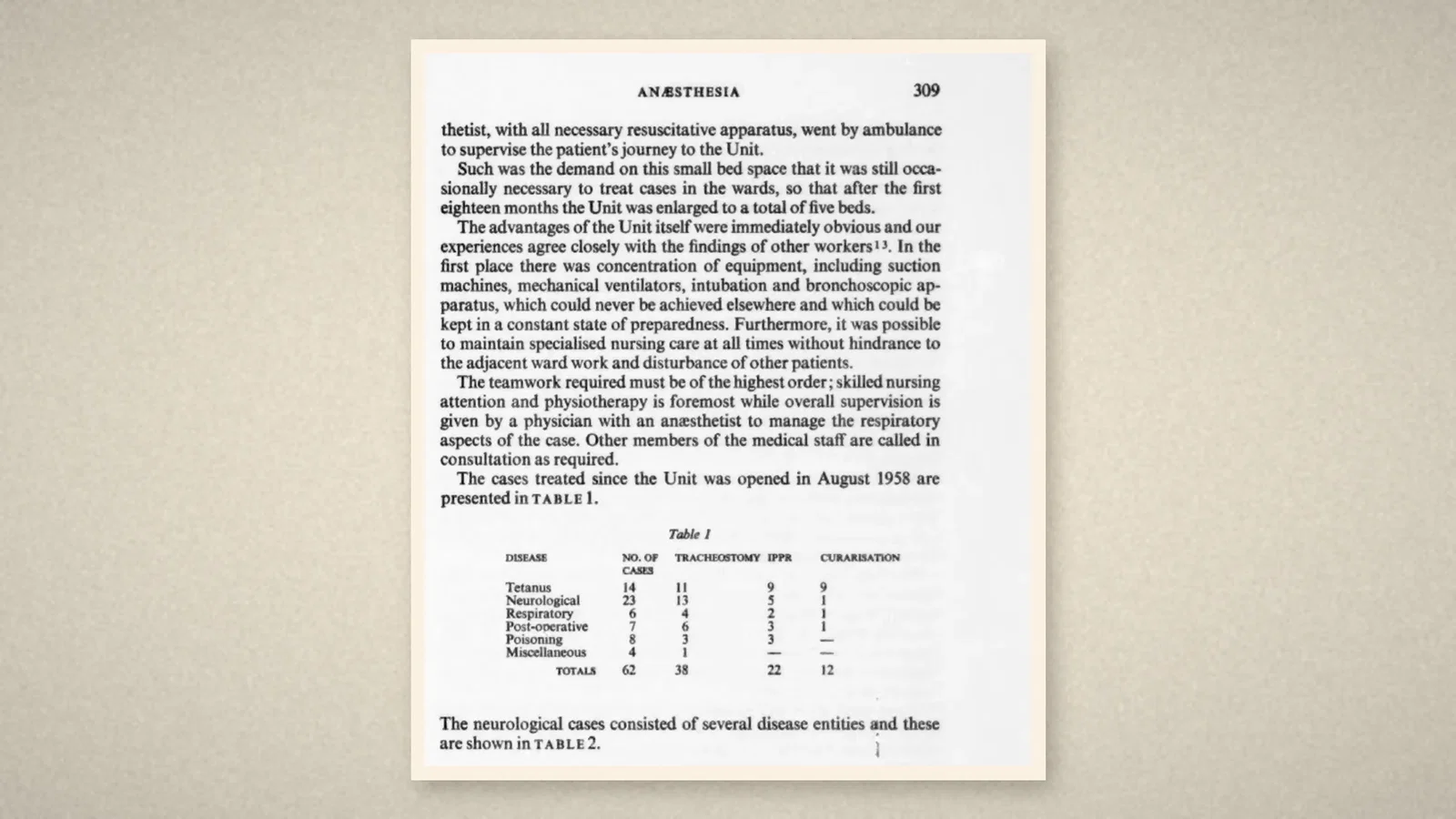
The symposium, as later recorded
According to the ASA timeline, the guidelines "were drawn up during a symposium on respiratory units" at the Vienna congress. In its summary, the suggestions were that units should be placed in major hospitals so that other disciplines could join in treatment, provided in proportion to the population, spaced so that patients could be transported to them, and staffed by specially trained nurses and doctors around the clock. [3, p. 69]
What the record shows
A professional congress that chose, a year in advance, to put special care units first among its subjects, at a time when individual hospitals were still arguing the case for two or five beds. The announcements and Pearce's paper are contemporary; the content of the Vienna symposium reaches us only through a later timeline.
Sources and reading limits
Read: in Anaesthesia 1961;16(3), the congress notice (p. 386) and Pearce's paper (pp. 308-9 and the conclusions on p. 315), with page images; the notice in the South African Medical Journal 1961;35(41):862, with page image; the ASA timeline (p. 69); the WFSA timeline entries for 1960 and 1962.
Not covered: the Proceedings of the First European Congress of Anaesthesiology, including the respiratory units symposium, which could not be obtained; reports of the congress in Anaesthesia, which are lending-restricted on the Internet Archive and were not opened; any other account of the symposium.
Limits: the two notices give different end dates (7 or 8 September). Neither shows what was said at the symposium. The guidelines, their content and the word "first" are the ASA's; its planning figures for beds and distance are paraphrased here, not repeated. Pearce's Southampton unit is contemporary context, not part of the congress. Later critical care and pain milestones are not covered here.
Three illustrations are crops of Anaesthesia (pp. 386 and 309) and the South African Medical Journal (p. 862); one is a schematic drawn from these sources.
- Anaesthesia. Vol. 16, no. 3 (July 1961): Commonwealth and Foreign News, p. 386; and Pearce DJ. Experiences in a small respiratory unit of a general hospital, pp. 308-15. Internet Archive
- Forthcoming international medical conferences. S Afr Med J. 1961;35(41):862. Internet Archive
- Australian Society of Anaesthetists. Anaesthesia history timeline. 2024. ASA
- World Federation of Societies of Anaesthesiologists. WFSA history timeline. WFSA
Continue exploring
Related reading connects shared questions and contexts; it does not by itself establish historical influence.
Anesthesia Epochs · The Source Room · About & Editorial Method
Published November 3, 2026. Sources and reading limits are stated above. Illustrations are labelled as original source images or AI-made. Historical accounts are educational; they are not current treatment instructions.