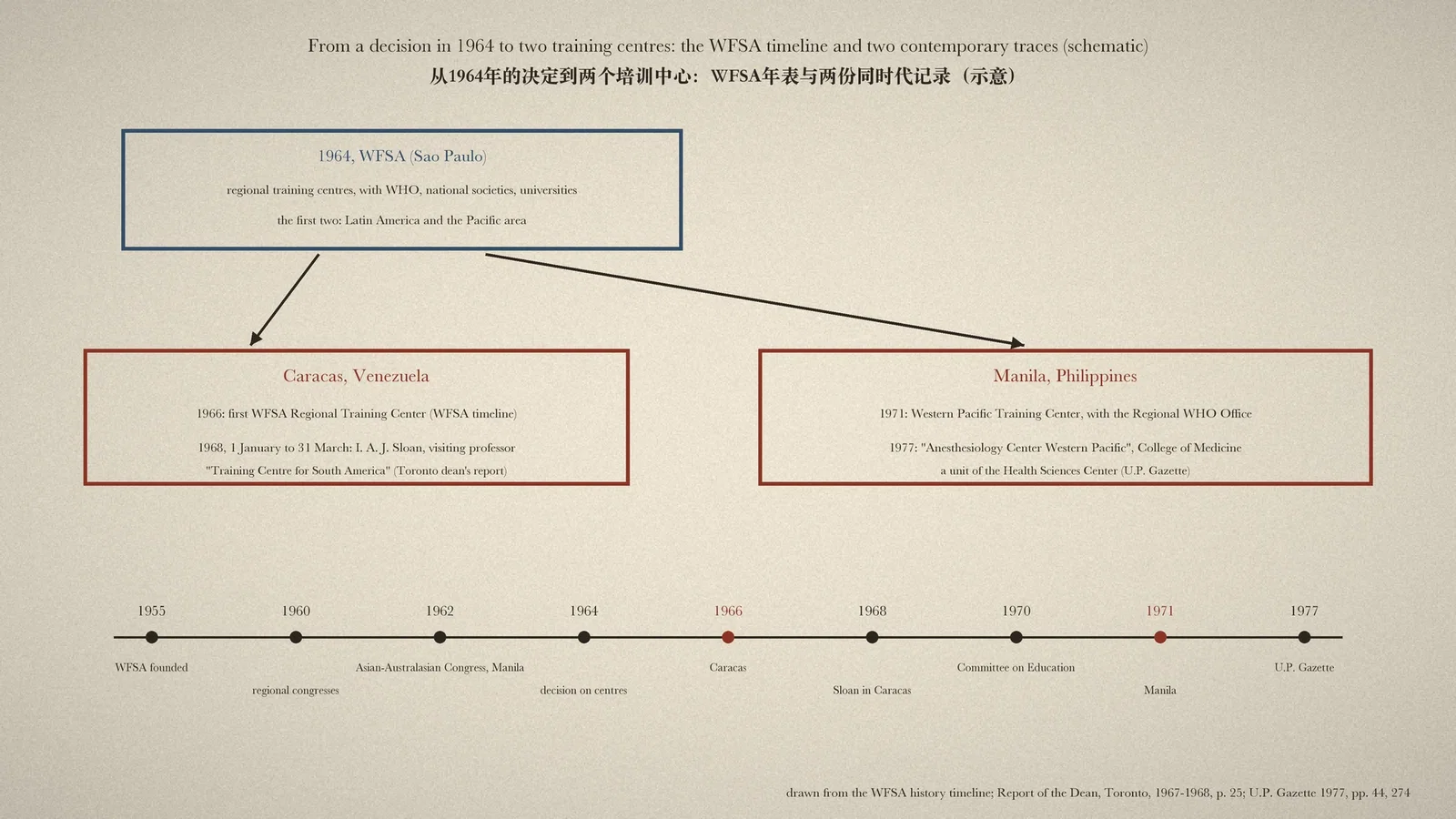
The WFSA history timeline records that in 1964 the Federation decided to work towards regional training centres with WHO, national societies and universities, the first two in Latin America and the Pacific area; that the first regional training centre opened in Caracas, Venezuela, in 1966; and that the Western Pacific Training Center opened in Manila in 1971 with assistance from the Regional WHO Office. Two contemporary documents add traces: the University of Toronto dean's report for 1967-1968 records I. A. J. Sloan as visiting professor 'at the Training Centre for South America of the World Federation of Societies of Anaesthesiologists' in Caracas from 1 January to 31 March 1968, and the University of the Philippines Gazette of 1977 lists the 'Anesthesiology Center Western Pacific' among the units of its Health Sciences Center and records appointments to it.
Reading Library · Anesthesia Epochs · 中文版
Watch the education video (for clinicians)
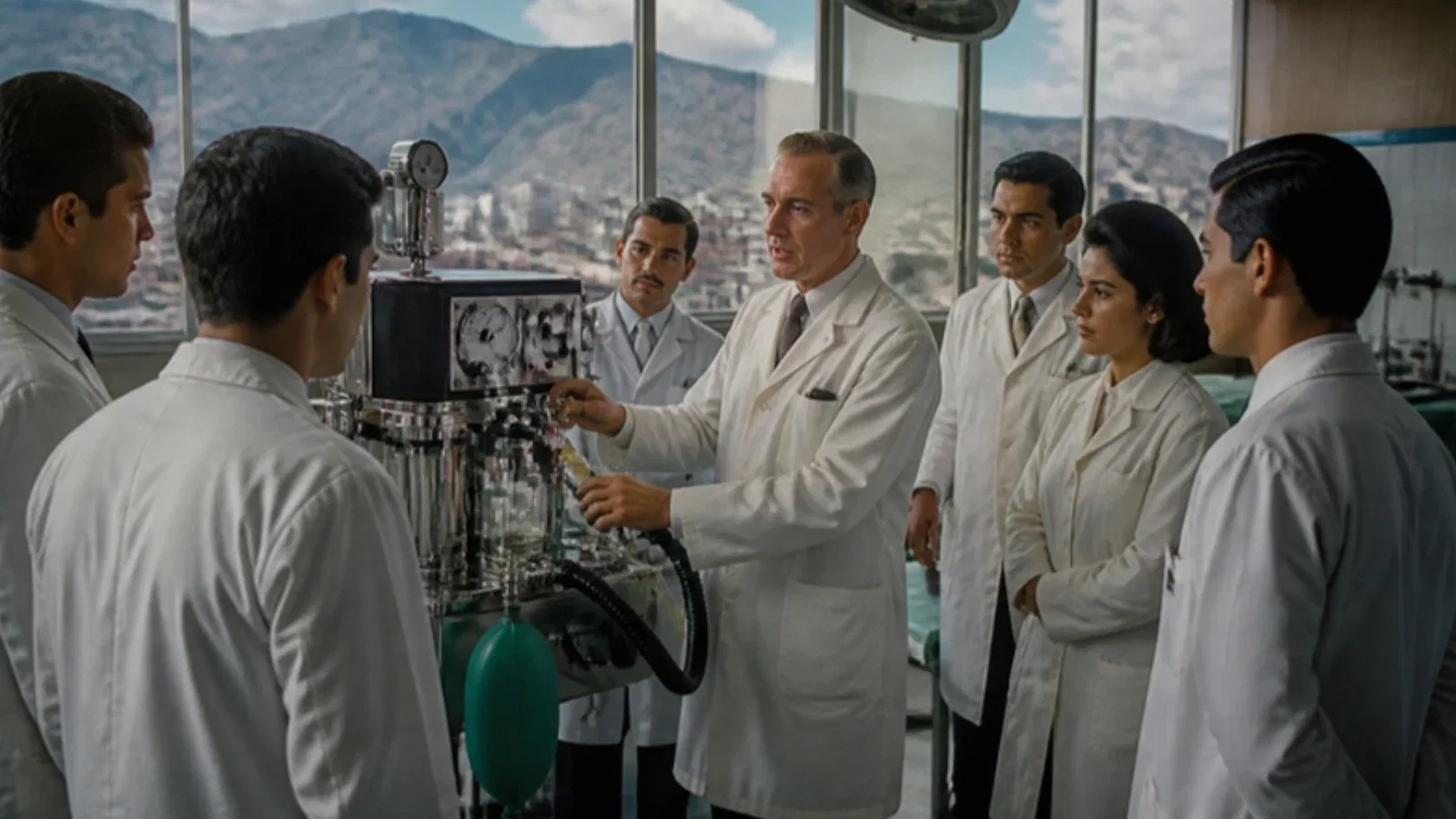
1966: WFSA Training Centres — Caracas and Manila · Anesthesia Epochs Education Series
A federation of national societies can hold congresses, but teaching people to give anaesthetics needs a place: operating theatres, teachers who stay for months, trainees who come and go. The World Federation of Societies of Anaesthesiologists (WFSA), founded in 1955, records in its history timeline the moment when it set out to build such places, and the two cities where the first ones opened. [1]
This article reads that timeline alongside two documents written at the time, which show the two centres from the outside: a Canadian university reporting that one of its anaesthetists had gone to teach in Caracas, and a Philippine university listing an anaesthesiology centre among its units in Manila.
From congresses to centres
The WFSA timeline sets out the steps. In 1960 the Executive Committee "agreed to promote regional congresses" between the World Congresses. In 1962 the first Asian-Australasian Congress of Anaesthesiology was held in Manila. In 1964, the year of the third World Congress in Sao Paulo, the Federation "decided to work towards establishing regional training centres in co-operation with WHO, national societies, and universities", "with the first two being in Latin America and the Pacific area", and an affiliated Anaesthesia Education and Relief Foundation was set up to raise money for educational projects. [1]
Two dates follow. Under 1966: "First WFSA Regional Training Center opened in Caracas, Venezuela." Under 1971: "Opening of the WFSA Western Pacific Training Center in Manila, Philippines with assistance from the Regional WHO Office." Between them, in 1970, the Federation set up a Committee on Education in Anaesthesiology. [1]
"Regional" here means a region of the world, not regional anaesthesia: each centre was meant to serve a continent or an ocean's rim rather than a single country.
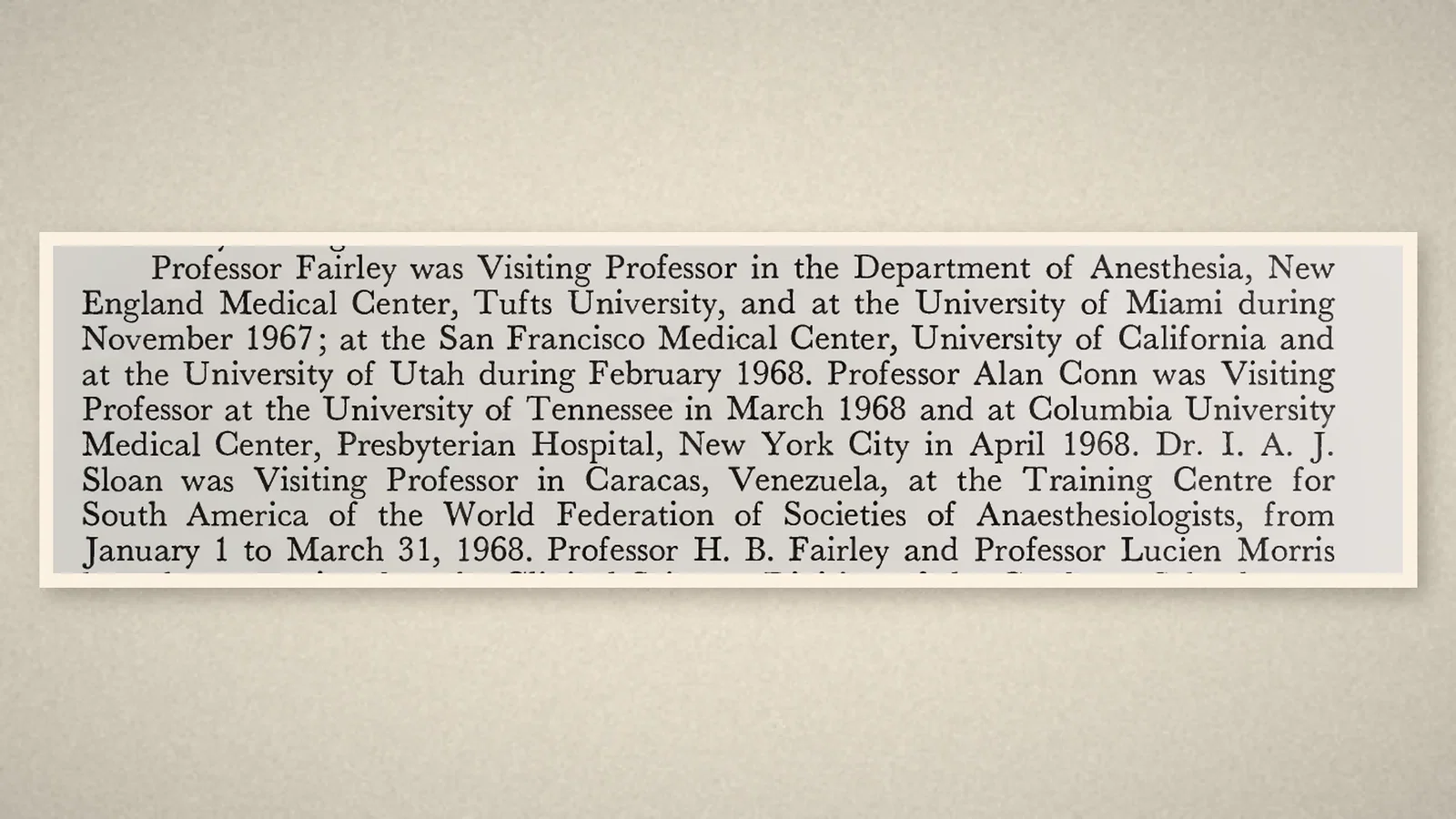
Caracas, early 1968
The timeline gives an opening year but says nothing about how the Caracas centre worked. A trace of it survives in an annual report from Toronto. The University of Toronto's Report of the Dean of the Faculty of Medicine for the session 1967-1968, in the section on the Department of Anaesthesia, then "under the direction of Professor R. A. Gordon", lists the department's visiting professorships abroad. Among them: "Dr. I. A. J. Sloan was Visiting Professor in Caracas, Venezuela, at the Training Centre for South America of the World Federation of Societies of Anaesthesiologists, from January 1 to March 31, 1968." [2, p. 25]
The entry is short, but it shows the model in practice: an anaesthetist from an established department spending three months at the centre as a visiting teacher. The same page records the department's programme of assistance to the medical school in Lagos, so the Toronto department was sending teachers abroad in more than one direction at the time. [2, p. 25]
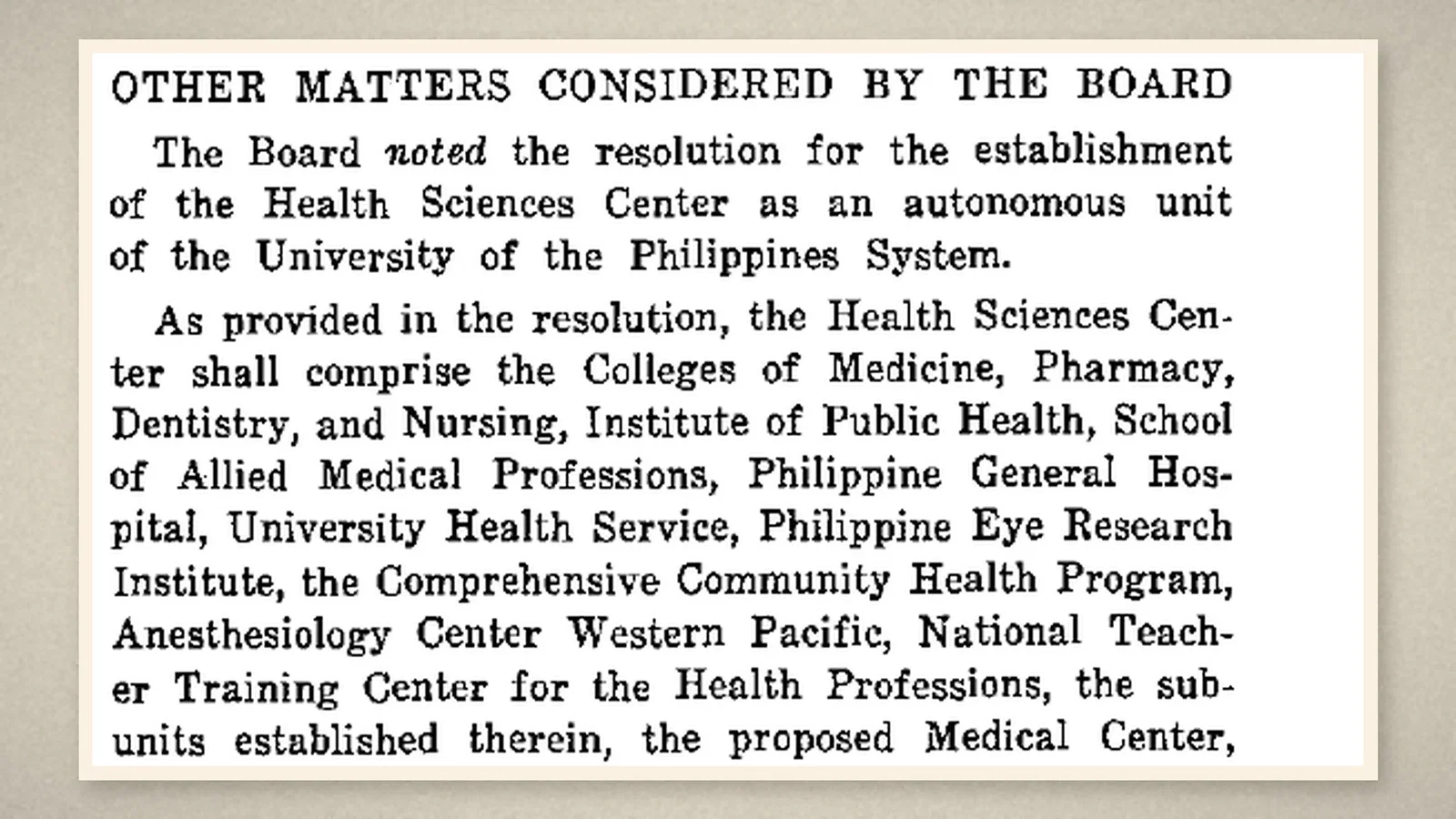
Manila, 1977
For Manila, the University of the Philippines Gazette for 1977 records an "Anesthesiology Center Western Pacific" at the College of Medicine. One issue lists the additional assignment of a deputy director of the centre from January to December 1977; later issues renew the appointments of several lecturer-preceptors there. On p. 274 the Board of Regents noted the resolution establishing the Health Sciences Center as an autonomous unit of the university, comprising the colleges of medicine, pharmacy, dentistry and nursing, the Philippine General Hospital and other units, among them the "Anesthesiology Center Western Pacific". [3, pp. 44, 274]
The Gazette does not mention the WFSA. The link between this university unit and the Federation's Western Pacific centre rests on the name and on two later accounts. [3]
How the centres are remembered
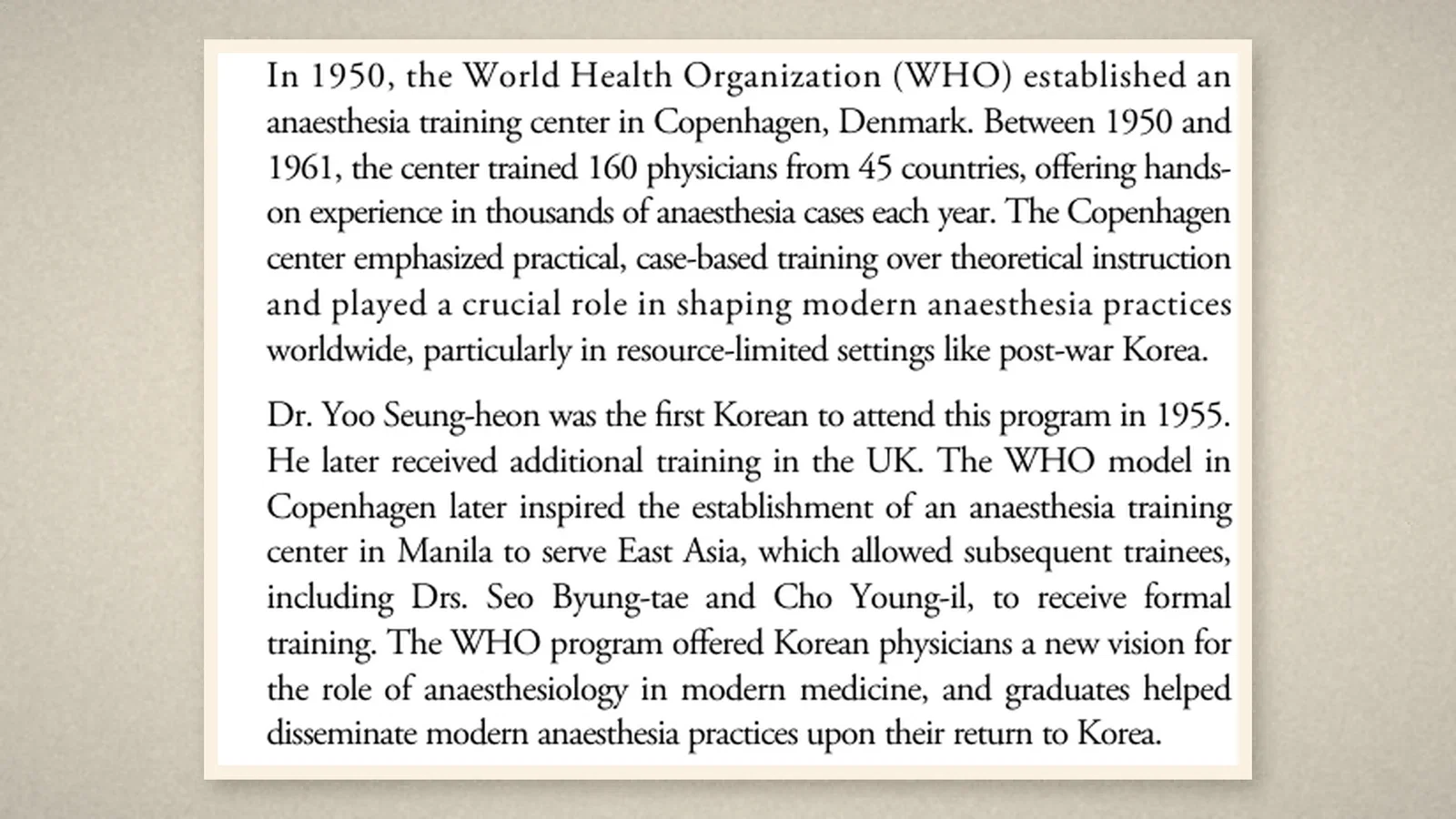
The WFSA's 2025 history issue of Update in Anaesthesia adds two views from the Pacific side. Seokyung Shin's chapter on Korea describes the anaesthesia training centre that the World Health Organization set up in Copenhagen in 1950, and writes that this WHO model "later inspired the establishment of an anaesthesia training center in Manila to serve East Asia", where Korean doctors, two of whom the chapter names, received formal training. [4, p. 36] Michael Cooper's chapter on Australia records that the Australian Society of Anaesthetists supported the WFSA anaesthesiology centre in the Philippines and started an Action Fund in 1971 for support within the region. [5, p. 19]
What the record shows
A decision made at a congress in 1964 that turned into two places where anaesthesia was taught, and two small marks those places left in other institutions' records: three months of a Toronto anaesthetist's time in Caracas in 1968, and a line in a Manila university's list of its units in 1977. The record says who went and where the centres sat. It says little about what was taught or how many people trained there.
Sources and reading limits
Read: the WFSA history timeline, entries from 1955 to 1971; the University of Toronto Report of the Dean for 1967-1968, title page and the Department of Anaesthesia section (pp. 24-5), with page images; the U.P. Gazette for 1977, searched in full for the centre, with page images of pp. 44 and 274; and in Update in Anaesthesia 2025;40, the Korea chapter (pp. 33-6) and the WFSA section of the Australia chapter (p. 19).
Not covered: the WFSA's early newsletters or annual reports recording the opening of the two centres, which could not be obtained; any record from the Caracas centre itself (its host hospital or university, director, courses, trainees); the WHO Western Pacific Regional Office's records on the Manila centre; the text of the 1964 decision.
Limits: the opening years 1966 and 1971 are the WFSA's; no document read here gives an opening date. The Toronto report shows only that a centre for South America in Caracas was running in early 1968. The identification of the U.P. unit with the WFSA centre is inferred from the name and the later accounts. No numbers of trainees or outcomes are claimed.
Three illustrations are crops of the Toronto report (p. 25), the U.P. Gazette (p. 274) and Update in Anaesthesia (p. 36); one is a schematic drawn from these sources.
- World Federation of Societies of Anaesthesiologists. WFSA history timeline. WFSA
- University of Toronto, Faculty of Medicine. Report of the Dean, session 1967-1968. Internet Archive
- University of the Philippines. U.P. Gazette. 1977;8(2):44 and 8(9):274. Internet Archive
- Shin S. The development of anaesthesia in Korea: a historical review. Update in Anaesthesia. 2025;40:33-6 (pages read). WFSA
- Cooper MG. The development and heritage of anaesthesia in Australia. Update in Anaesthesia. 2025;40:16-19 (pages read). WFSA
Continue exploring
Related reading connects shared questions and contexts; it does not by itself establish historical influence.
Anesthesia Epochs · The Source Room · About & Editorial Method
Published November 2, 2026. Sources and reading limits are stated above. Illustrations are labelled as original source images or AI-made. Historical accounts are educational; they are not current treatment instructions.