
In 1891, according to a 2025 history of anaesthesiology in Colombia, the Bogotá medical student Teodoro Castrillón calculated the partial pressure of oxygen in the city and argued in a thesis that, at close to 8000 feet, ether and chloroform should be given mixed with air or oxygen.
Reading Library · Anesthesia Epochs · 中文版
Watch the education video (for clinicians)
1891: Castrillón in Bogotá — Anaesthesia at Altitude · Anesthesia Epochs Education Series
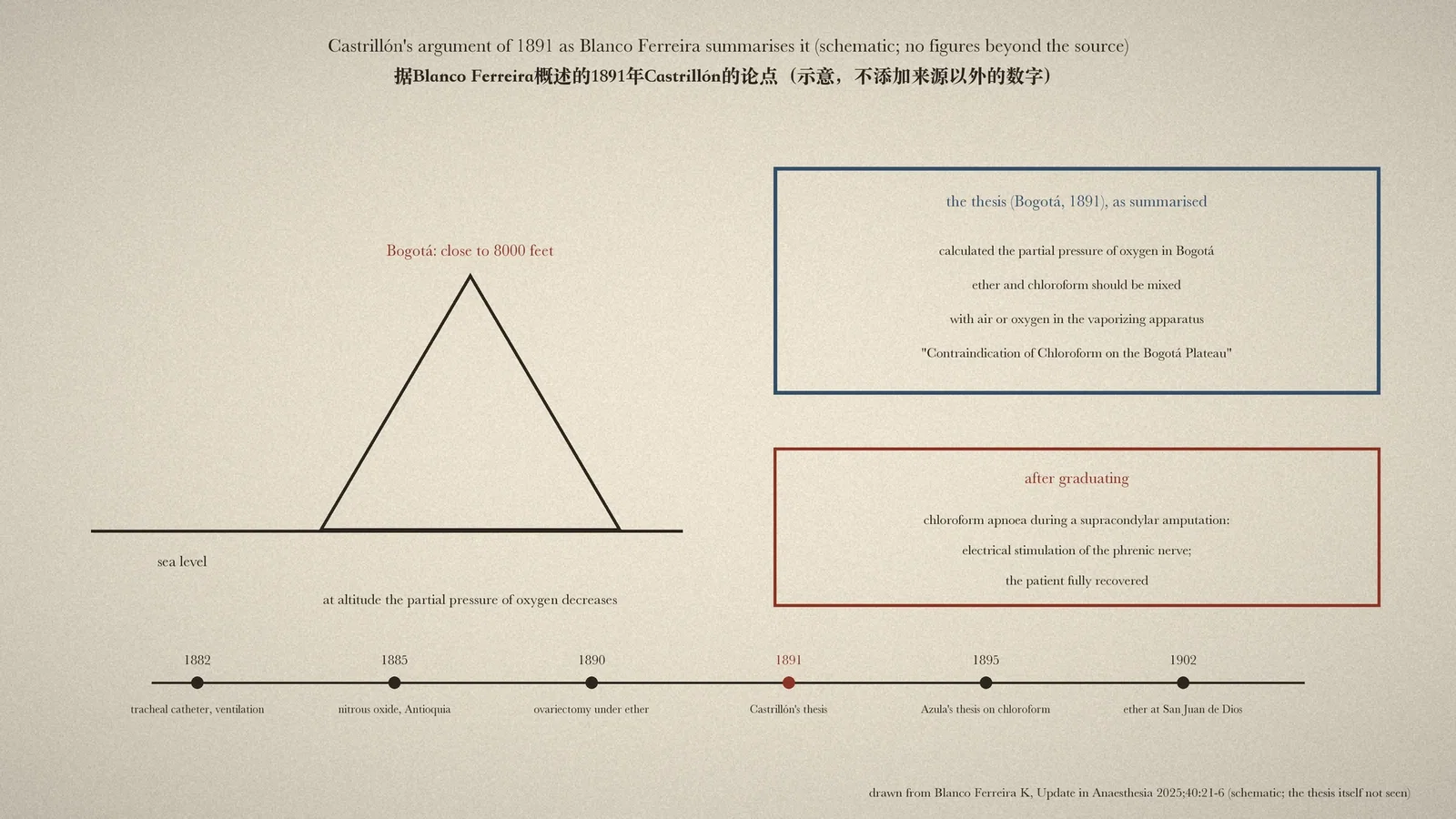
Bogotá sits on a high plateau in the Andes. A city at that height raises a question that a sea-level textbook of the time did not need to ask: if the air itself carries less oxygen, how should a patient breathe a volatile anaesthetic? According to a recent history of anaesthesiology in Colombia, a medical student put that question into a graduation thesis in 1891. [1, p. 22]
The account comes from Karolyna Blanco Ferreira's chapter "History of Anaesthesiology in Colombia", published in October 2025 in volume 40 of Update in Anaesthesia, the history issue that the World Federation of Societies of Anaesthesiologists (WFSA) prepared for its 70th anniversary. Castrillón’s thesis is not quoted directly here; everything said about it is the chapter’s summary. [1, pp. 21-2]
A thesis on the Bogotá plateau
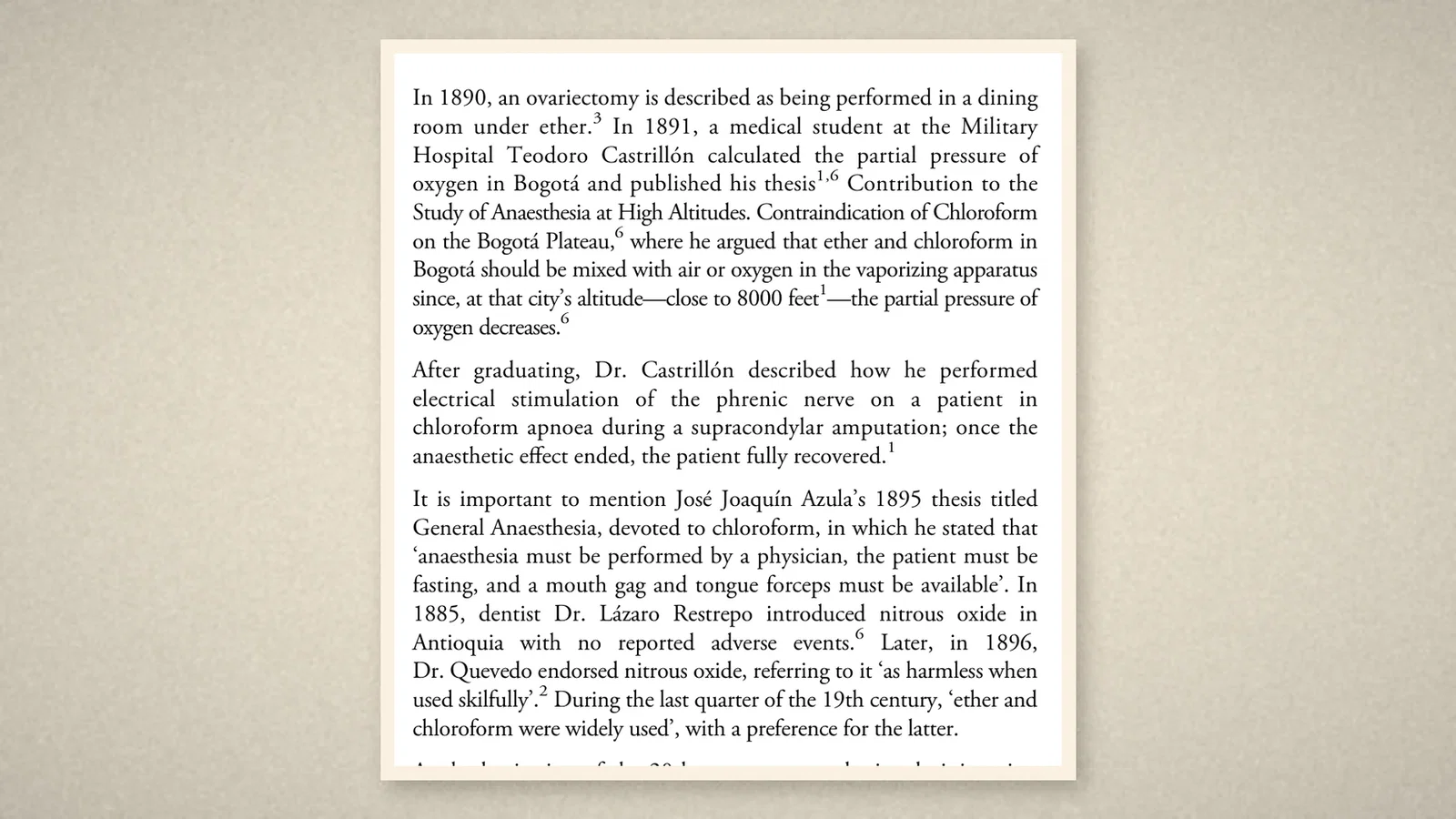
Blanco Ferreira writes that in 1891 "a medical student at the Military Hospital Teodoro Castrillón calculated the partial pressure of oxygen in Bogotá" and published a thesis titled, in the chapter's English, "Contribution to the Study of Anaesthesia at High Altitudes. Contraindication of Chloroform on the Bogotá Plateau". The argument, as summarised, was that in Bogotá ether and chloroform "should be mixed with air or oxygen in the vaporizing apparatus", because at the city's altitude, "close to 8000 feet", the partial pressure of oxygen decreases. [1, p. 22]
Two things in that summary are worth keeping apart. One is a calculation: a figure for the oxygen available in the city's air, worked out by a student. The other is a practical conclusion for the vaporizer: the anaesthetic vapour should reach the patient together with air or oxygen. The chapter does not reproduce the calculation, the apparatus or any proportions, and this article does not supply them. The thesis title, with its word "contraindication", suggests that chloroform was the agent under most suspicion; the chapter's summary, however, speaks of ether and chloroform together. [1, p. 22]
A case after graduation
The chapter adds a clinical episode. "After graduating, Dr. Castrillón described" electrical stimulation of the phrenic nerve "on a patient in chloroform apnoea during a supracondylar amputation; once the anaesthetic effect ended, the patient fully recovered." The chapter gives no date for this case and no details of the apparatus. It stands here as the chapter reports it: an attempt to drive the diaphragm when breathing had stopped under chloroform. [1, p. 22]
The period around it
Blanco Ferreira divides Colombian anaesthetic history into six periods, of which the second, "the first steps", runs from 1846 to 1913. The author also notes that contributions from Spanish-speaking countries were often "neither visible nor recognized", and that the main limitation for the history of more recent times was scant written records. [1, p. 21]
Within that period the chapter sets Castrillón among other dated episodes. In 1882, in Medellín, Antonio Restrepo, faced with a patient apnoeic under chloroform, introduced a rubber catheter into the trachea and alternated mouth-to-device ventilation with chest compression, and the patient recovered. In 1885 the dentist Lázaro Restrepo introduced nitrous oxide in Antioquia. In 1890 an ovariectomy was described as being performed in a dining room under ether. In 1895 José Joaquín Azula's thesis on chloroform stated that "anaesthesia must be performed by a physician, the patient must be fasting, and a mouth gag and tongue forceps must be available". During the last quarter of the century, "ether and chloroform were widely used", chloroform more. And in 1902 the Hospital San Juan de Dios in Bogotá took up ether, the chapter says, because it cost less than chloroform. [1, p. 22]
Read together, these episodes show a setting where chloroform was the common agent, apnoea under it was a known emergency, and the people writing theses were trying to set conditions for its use: who should give it, how the patient should be prepared, and, in Castrillón's case, what the thin air of a high city meant for it.
What the record shows
A student thesis from a high-altitude capital, as a later historian summarises it: a calculation of the oxygen in Bogotá's air and a conclusion that anaesthetic vapour should be given with air or oxygen there. It is a reminder that the physics of the place where anaesthesia is given was a subject of argument from early on, and that some of that argument was written far from the centres that the standard histories describe.
Sources and reading limits
Read: Blanco Ferreira’s chapter in Update in Anaesthesia 2025;40:21-6 in full, in the WFSA PDF.
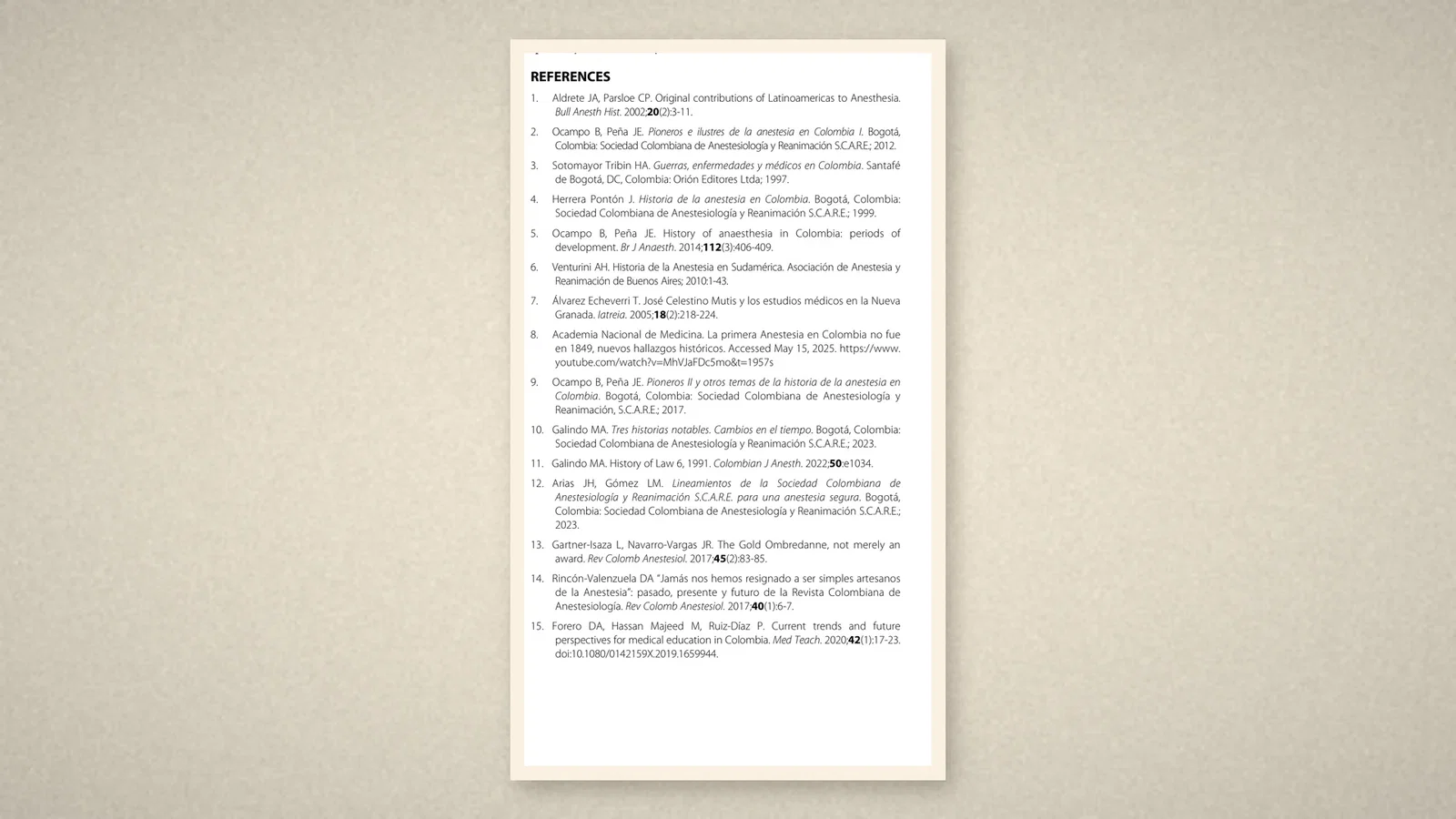
Not covered: Teodoro Castrillón’s thesis of 1891 and Castrillón’s own account of the phrenic nerve case; the chapter’s sources for these passages, Aldrete and Parsloe in the Bulletin of Anesthesia History (2002) and Venturini’s history of anaesthesia in South America (2010); Herrera Pontón’s history of anaesthesia in Colombia (1999); and Ocampo and Peña in the British Journal of Anaesthesia (2014). [1, p. 26]
Limits: everything about Castrillón here rests on a single secondary account written more than a century later, which itself relies on earlier secondary works. The thesis title is given in the chapter's English translation. The altitude figure is the chapter's. The phrenic nerve case is undated. No doses or gas proportions appear in the source, and none are stated here.
Three illustrations are crops of the chapter (pp. 22, 21 and 26; the author's contact line is left out); one is a schematic drawn from the chapter.
- Blanco Ferreira K. History of anaesthesiology in Colombia. Update in Anaesthesia. 2025;40:21-6. WFSA
Continue exploring
Related reading connects shared questions and contexts; it does not by itself establish historical influence.
Anesthesia Epochs · The Source Room · About & Editorial Method
Published November 2, 2026. Sources and reading limits are stated above. Illustrations are labelled as original source images or AI-made. Historical accounts are educational; they are not current treatment instructions.