
In 1963, comparing two fluorinated hydrocarbon anaesthetics in Anesthesiology, Merkel and Eger observed that any comparative study needs an index of comparison, and defined one as the lowest alveolar concentration at which a dog no longer responds to a painful stimulus with gross movement, written MAC 1.0, with depth expressed as the ratio of alveolar concentration to that value. In 1965 Eger, Saidman and Brandstater published 'Minimum Alveolar Anesthetic Concentration: A Standard of Anesthetic Potency' in the same journal, testing the index: alveolar rather than inspired concentration, a defined movement end point, and a stimulus beyond which further intensity did not raise the value. The index proved stable within a dog, between dogs and over time, so potency could be defined as its reciprocal and the respiratory and circulatory effects of different agents compared at equipotent doses; the paper also set out the limits, that the index records only movement or its absence and that these tests used a single agent.
Reading Library · Anesthesia Epochs · 中文版
Watch the education video (for clinicians)
1963 and 1965: Minimum Alveolar Concentration — Merkel and Eger · Anesthesia Epochs Education Series
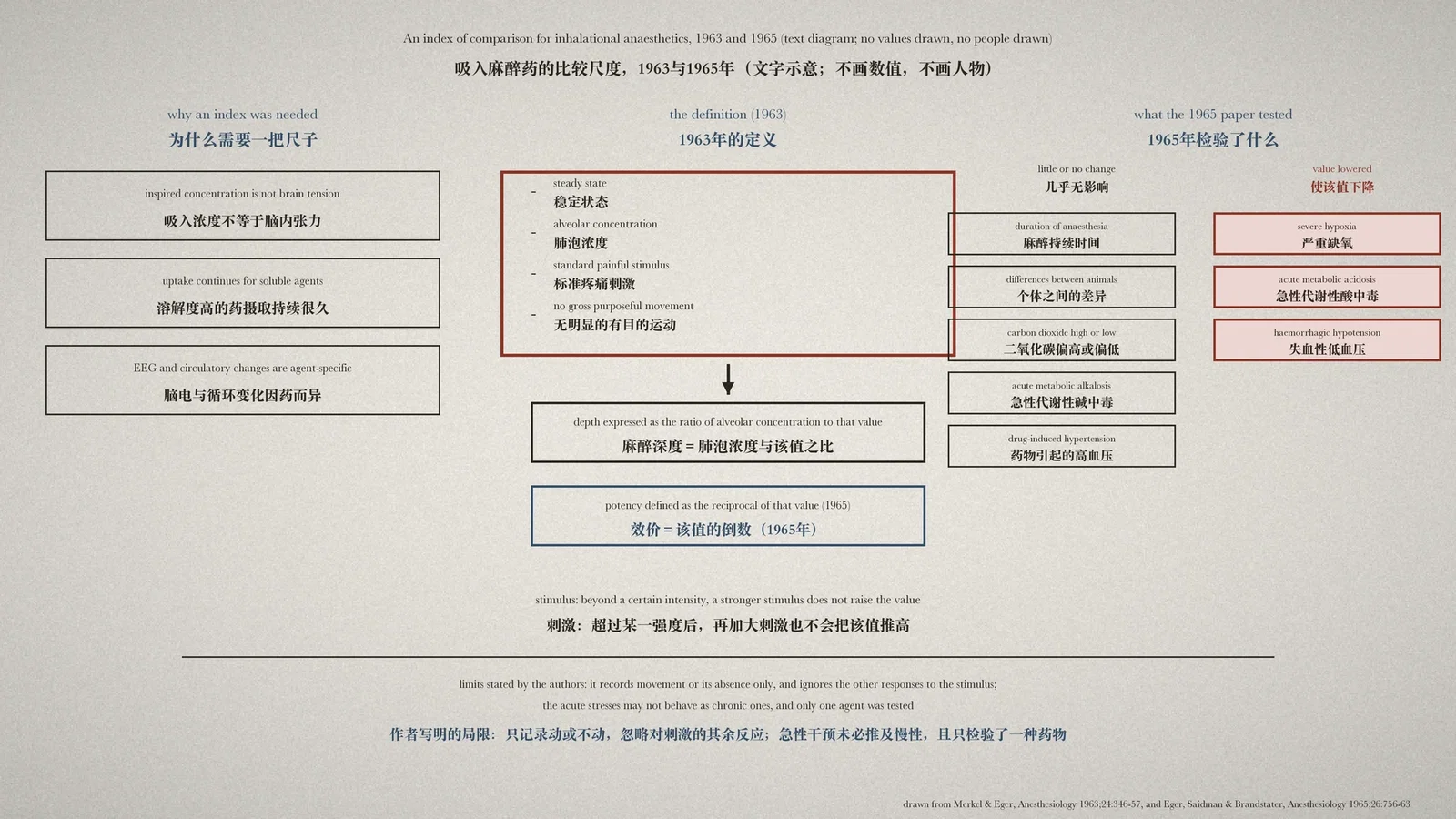
Of two inhalational anaesthetics, which is the stronger? Before these two papers the question had no settled answer. Inspired concentration was the usual basis of comparison, yet what is inspired is not what reaches the brain; others judged depth from the electroencephalogram or from circulatory depression, but those changes are specific to each agent and cannot be converted into one another. In 1963, comparing two fluorinated hydrocarbon anaesthetics in Anesthesiology, Giles Merkel and Edmond I. Eger II of the Department of Anesthesia at the University of California Medical Center in San Francisco offered a way out almost in passing. In 1965 Eger, with Lawrence J. Saidman and Bernard Brandstater, devoted a whole paper in the same journal to testing it. This article reads both originals. [1, p. 346][2, p. 756]
First, a measuring stick
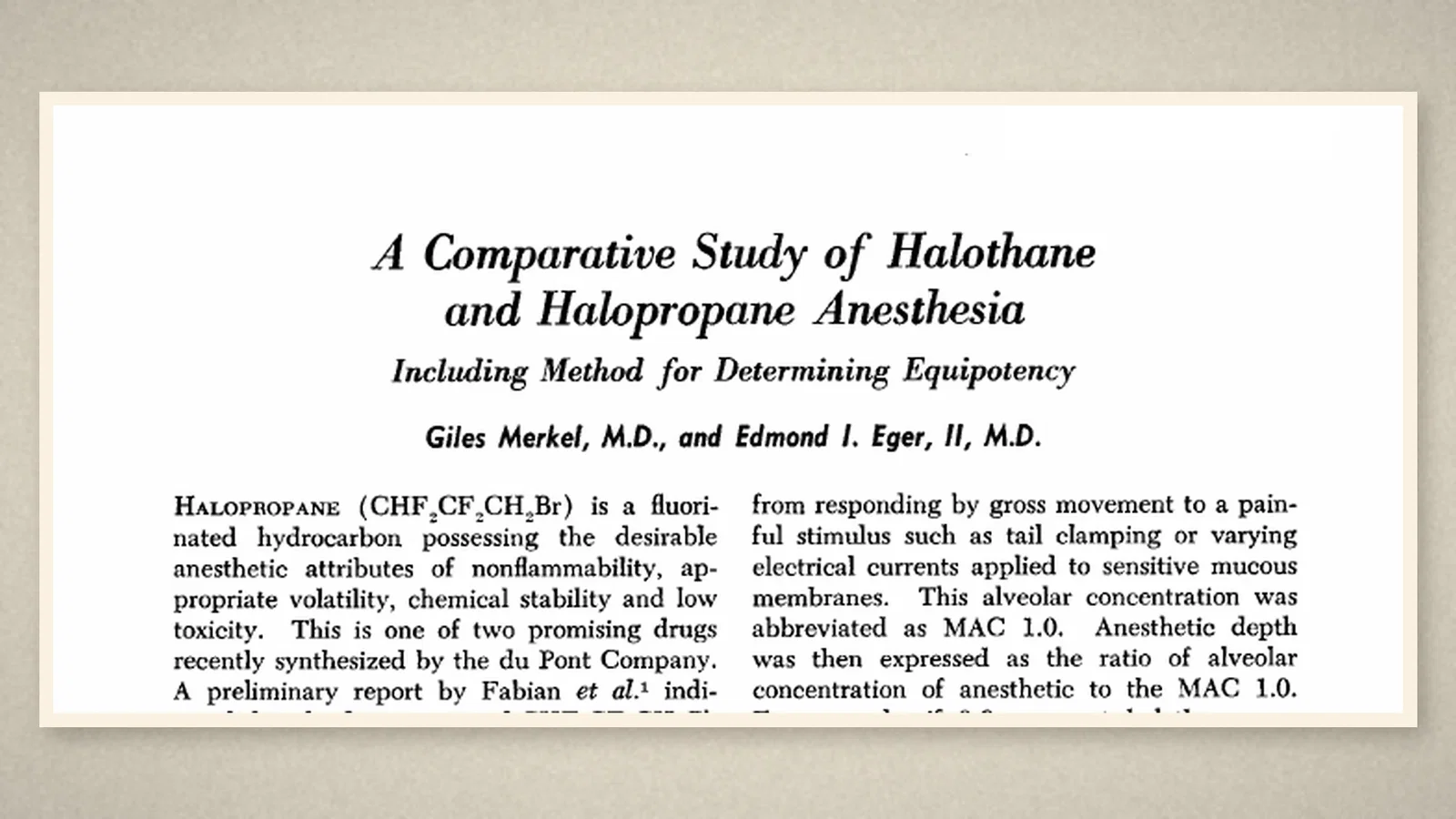
One plain sentence carries the 1963 paper: in any comparative study, there must be an index of comparison. The authors then gave their own. In the steady state, it is the lowest alveolar concentration of anaesthetic at which a dog no longer responds to a painful stimulus with gross movement. That concentration was written MAC 1.0, and depth was thereafter expressed as the ratio of alveolar concentration to it, so that a ratio of 2.0 meant twice that value of the same agent. The authors were careful to add that they made no attempt to call levels of depth comparable in any sense other than as multiples of this value. [1, p. 346]
Taking the alveolar rather than the inspired concentration is what makes the method work. The partial pressure in the alveoli is essentially in equilibrium with that in arterial blood and in the brain, so it is the most readily measured index of the anaesthetic tension the brain sees. Many workers, the paper notes, had held the inspired concentration constant for a period and assumed equilibration; for agents more soluble in blood, uptake continues and equilibration is far from complete, so studies that equated a constant inspired tension with the alveolar one must be read with that reservation. Using the alveolar concentration, the authors concluded, greatly improves the estimation of potency. [1, p. 355]
1965: measuring the measuring stick
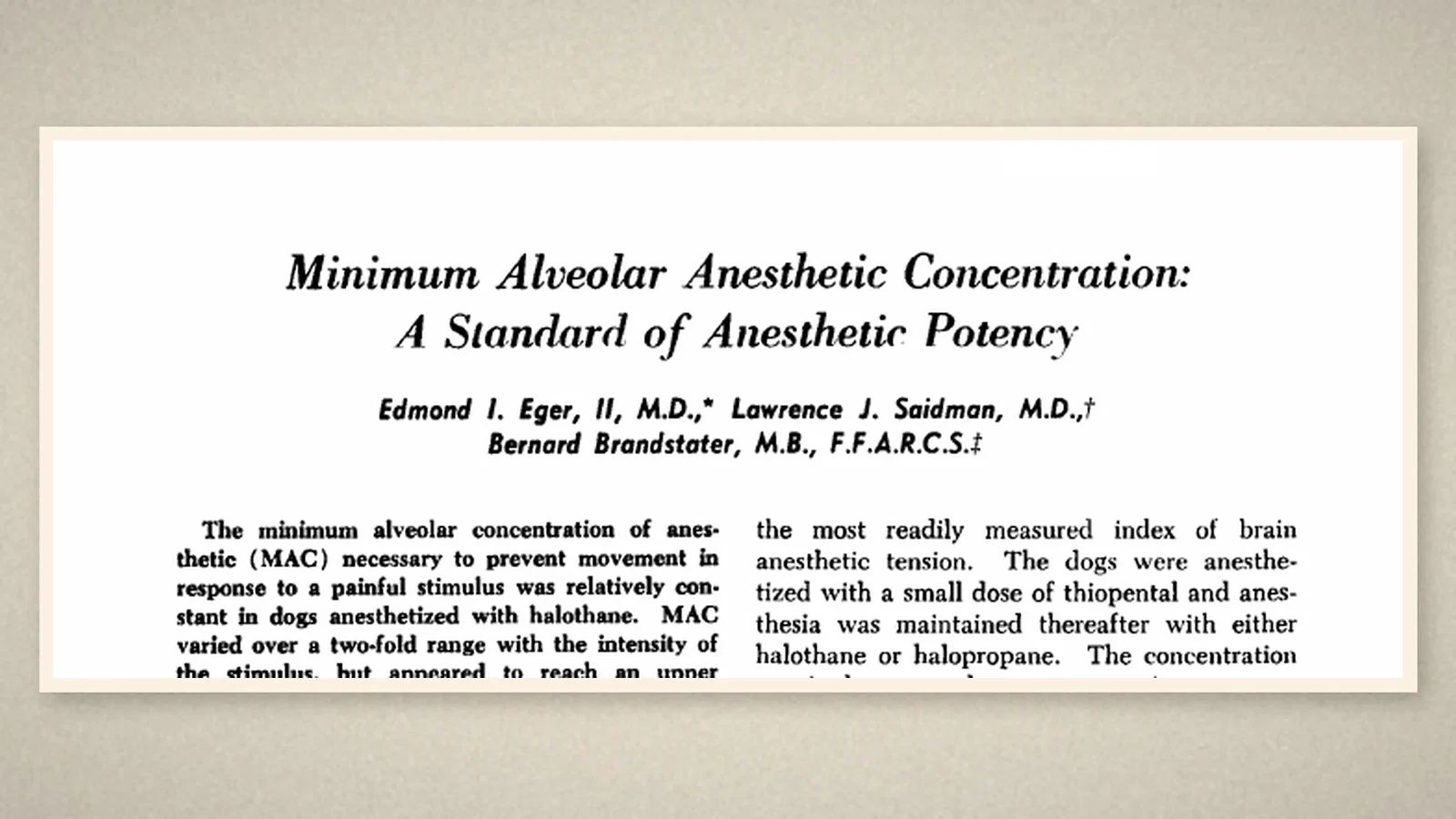
The 1965 paper opens by recalling that in 1963 Merkel and Eger described the technique, that the value proved fairly constant in any one dog regardless of the duration of anaesthesia, and that this apparent reproducibility suggested it might serve as a standard of potency. Before it could be used generally, however, the limits of that reproducibility had to be known, along with whether the value was affected by the intensity of the stimulus, the duration of anaesthesia, high or low carbon dioxide, high or low blood pressure, hypoxia or metabolic acidosis. The paper sets out to answer exactly those questions. [2, p. 756]
Several points of method were tightened. A positive response was defined as a gross purposeful muscular movement, usually a jerking or twisting of the head or a running or clawing of the limbs; coughing, swallowing and chewing were not counted. The stimulus was applied for longer, because a negative response over a short application could turn positive when continued. The alveolar concentration was held steady before each test so that arterial and brain tensions came close to equilibrium, and the value taken was the midpoint between the lowest concentration that allowed movement and the highest that prevented it. [2, p. 757]
The authors also compared stimuli: a tail clamp, electrical stimulation, movement of the tracheal tube, a surgical incision, a paw clamp, and no stimulus at all. Different stimuli did give somewhat different values, but the differences were modest, and, more importantly, beyond a certain point a stronger stimulus did not raise the value. The tail clamp appeared to be such a maximal stimulus and was therefore chosen as the standard for the remaining experiments; applying two stimuli together did not raise the concentration needed either. [2, pp. 757-8]
Stable, but not immune
The most striking finding of these studies, the paper says, is the stability of the value: different dogs were close to one another, and the same dog was close to itself at different times and on different days. The authors noticed that this seems to contradict the clinical impression of wide variation in susceptibility between patients, and explained that the two are not in conflict. A patient with a large cardiac output or reduced ventilation takes up a greater share of the inhaled agent, so the amount the machine must deliver differs, while the partial pressure in the lungs and brain may be identical. By the same reasoning, the clinical sense that less agent is needed as anaesthesia continues reflects falling uptake and so a smaller delivery from the machine, while the dose, in this sense, stays constant. [2, pp. 760-1]
Not every condition left the value untouched. By the 1965 summary, the duration of anaesthesia, differences between dogs, raised or lowered carbon dioxide, acute metabolic alkalosis and hypertension induced with a vasopressor had little or no effect, whereas severe hypoxia, acute metabolic acidosis induced with ammonium chloride, and haemorrhagic hypotension all lowered it. On the acidosis the authors offered a speculation of their own: the fall might owe less to the change in pH than to a raised blood ammonia, since correcting the acidosis did not return the value to where it had been. [2, pp. 759-61]
The limits the authors wrote down
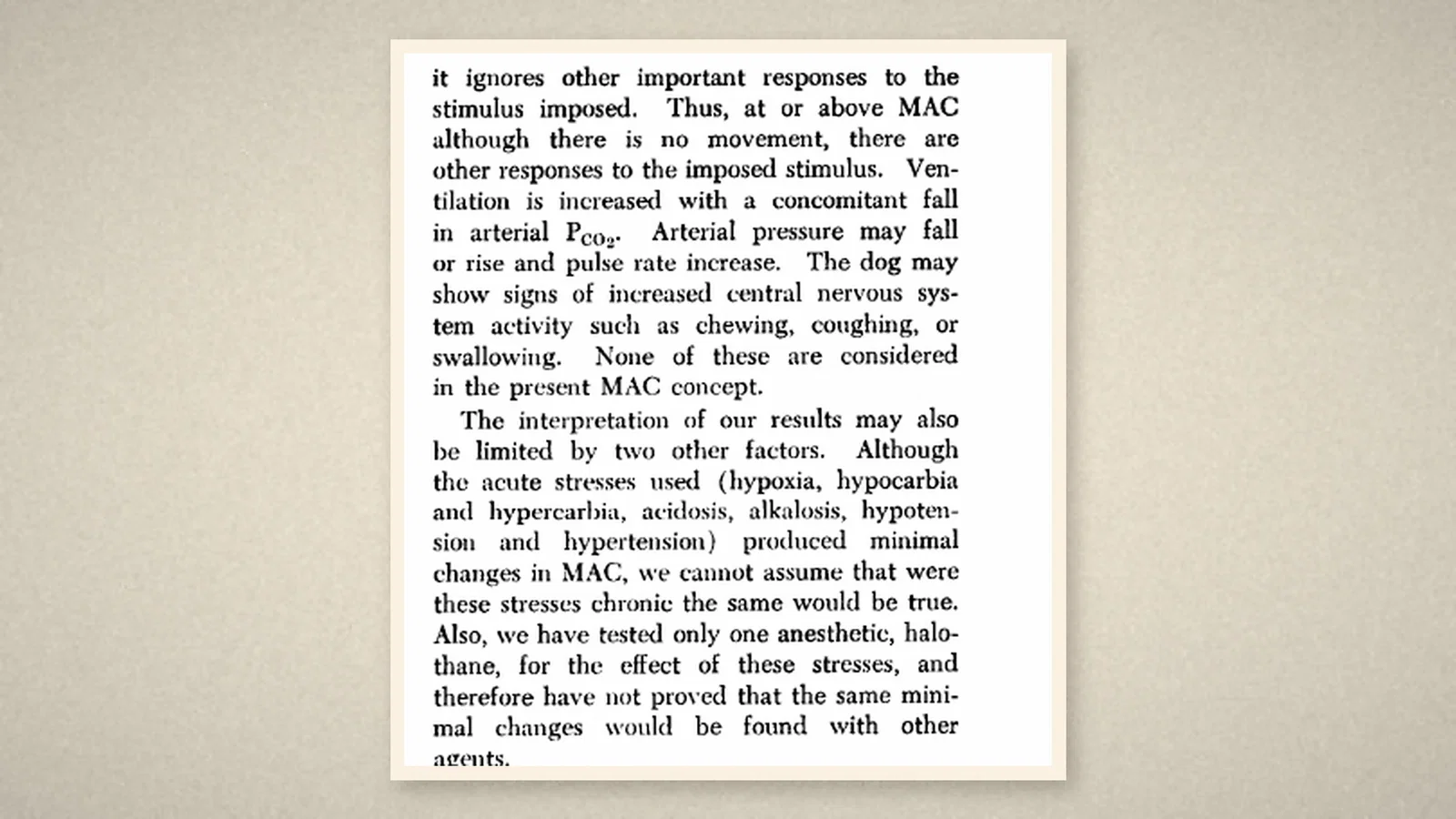
The 1965 paper states the limitations plainly. Only two things are measured, the alveolar concentration and the presence or absence of gross movement, so other responses to the stimulus are ignored: at or above this concentration ventilation still increases, arterial pressure and pulse still change, and the animal may still chew, cough or swallow, none of which the concept takes in. The acute stresses used cannot be assumed to behave as chronic ones would, and only one anaesthetic was tested for their effect, so the same small changes are not proved for other agents. [2, p. 762]
The 1963 paper left a theoretical question unanswered as well. Anaesthetic potency is usually correlated with the oil/gas partition coefficient, yet between these two agents the order came out the reverse of what that would predict. The authors wrote the question down without offering an explanation. [1, p. 356]
What the record shows
These two papers do something that looks unremarkable: they give an operational definition to a vague word. With it, potency can be written as the reciprocal of the value; the respiratory and circulatory effects of different inhalational agents can be compared at equipotent doses; and "depth of anaesthesia" acquires a reference point that any laboratory can reproduce. The same authors set out, in the same papers, both what the measure covers and what it leaves out.
Sources and reading limits
Read: Merkel G, Eger EI II, "A comparative study of halothane and halopropane anesthesia, including method for determining equipotency", Anesthesiology 1963, vol. 24, no. 3, pp. 346-57 (accepted 13 February 1963), in full; and Eger EI II, Saidman LJ, Brandstater B, "Minimum alveolar anesthetic concentration: a standard of anesthetic potency", Anesthesiology 1965, vol. 26, no. 6, pp. 756-63, in full.
Not covered: the companion paper on equipotent concentrations of several agents (Anesthesiology 1965;26:771) and Saidman and Eger's 1964 study in man, both cited in the 1965 paper; later work extending the index to other species and ages.
Limits: no doses, no alveolar concentration values, no partition coefficients and no measurement tables are reproduced here; the effect of each condition is given in direction only. The animal experiments are not recounted step by step. The 1963 method comes from a paper whose main subject was a comparison of two agents, and only its section on the index of comparison is used here.
Three illustrations are taken from the two papers (1963, p. 346; 1965, pp. 756 and 762). One is a diagram drawn from the texts, with no people drawn and no numerical values shown.
- Merkel G, Eger EI II. A comparative study of halothane and halopropane anesthesia, including method for determining equipotency. Anesthesiology. 1963;24(3):346-57. doi:10.1097/00000542-196305000-00016
- Eger EI II, Saidman LJ, Brandstater B. Minimum alveolar anesthetic concentration: a standard of anesthetic potency. Anesthesiology. 1965;26(6):756-63. doi:10.1097/00000542-196511000-00010
Continue exploring
Related reading connects shared questions and contexts; it does not by itself establish historical influence.
Anesthesia Epochs · The Source Room · About & Editorial Method
Published November 4, 2026. Sources and reading limits are stated above. Illustrations are labelled as original source images or AI-made. Historical accounts are educational; they are not current treatment instructions.