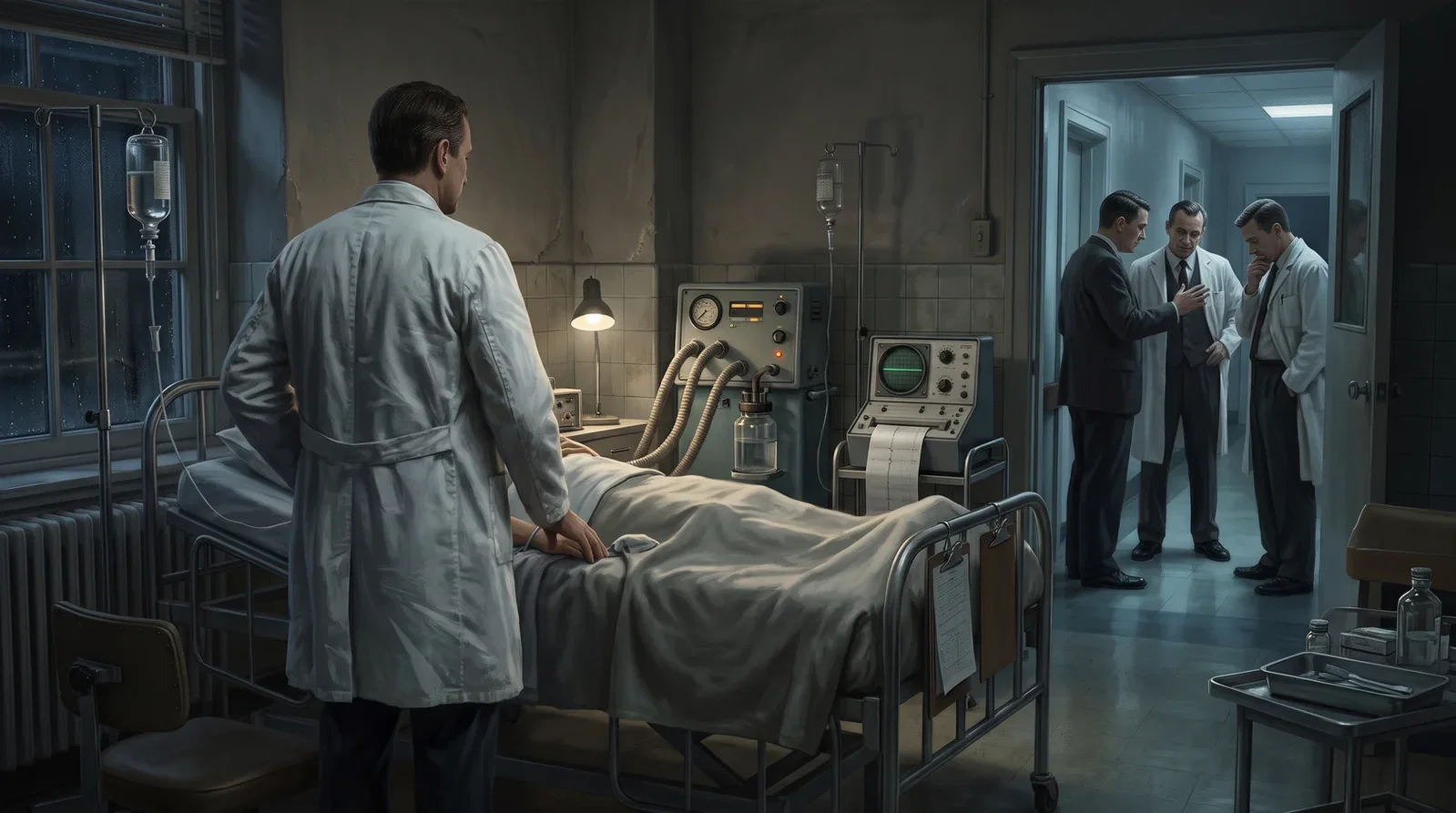
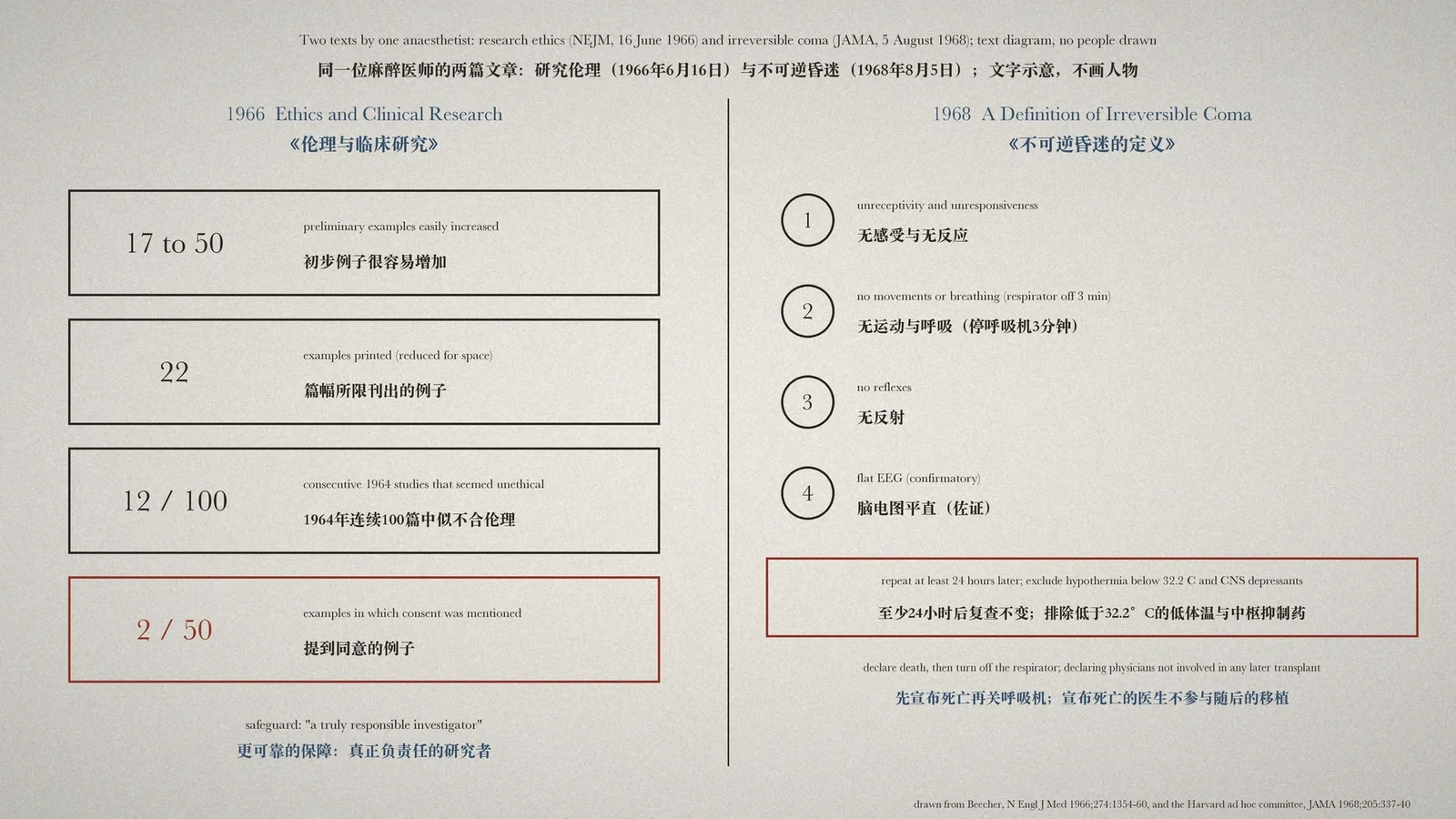
On 16 June 1966 Henry K. Beecher, signing as Dorr Professor of Research in Anaesthesia at Harvard Medical School, published 'Ethics and Clinical Research' in the New England Journal of Medicine: 17 preliminary examples grew easily to 50, of which 22 were printed; 12 of 100 consecutive human studies published in 1964 in an excellent journal seemed unethical; consent was mentioned in only 2 of the 50; a responsible investigator was a more dependable safeguard than consent, and improperly obtained data should not be published. On 5 August 1968 the Harvard ad hoc committee Beecher chaired published 'A Definition of Irreversible Coma' in JAMA: four clinical and EEG criteria, repeated after 24 hours, with hypothermia and central nervous system depressants excluded; death to be declared before the respirator is turned off, and the declaring physicians not to be involved in any later transplant.
Reading Library · Anesthesia Epochs · 中文版
Watch the education video (for clinicians)
1966–1968: Henry Beecher — Research Ethics and Brain Death · Anesthesia Epochs Education Series
Within two years the anaesthetist Henry K. Beecher signed two articles that are still widely cited. On 16 June 1966 the New England Journal of Medicine published "Ethics and Clinical Research", signed by Beecher as Dorr Professor of Research in Anaesthesia, Harvard Medical School, from the Anaesthesia Laboratory of the Harvard Medical School at the Massachusetts General Hospital. On 5 August 1968 JAMA published "A Definition of Irreversible Coma", the report of an ad hoc committee of the Harvard Medical School with Beecher as chairman. One asks about consent and responsibility in human experimentation; the other asks how death should be determined once respirators can keep a heart beating. This article reads both originals. [1, p. 1354][2, p. 337]
A "Special Article"
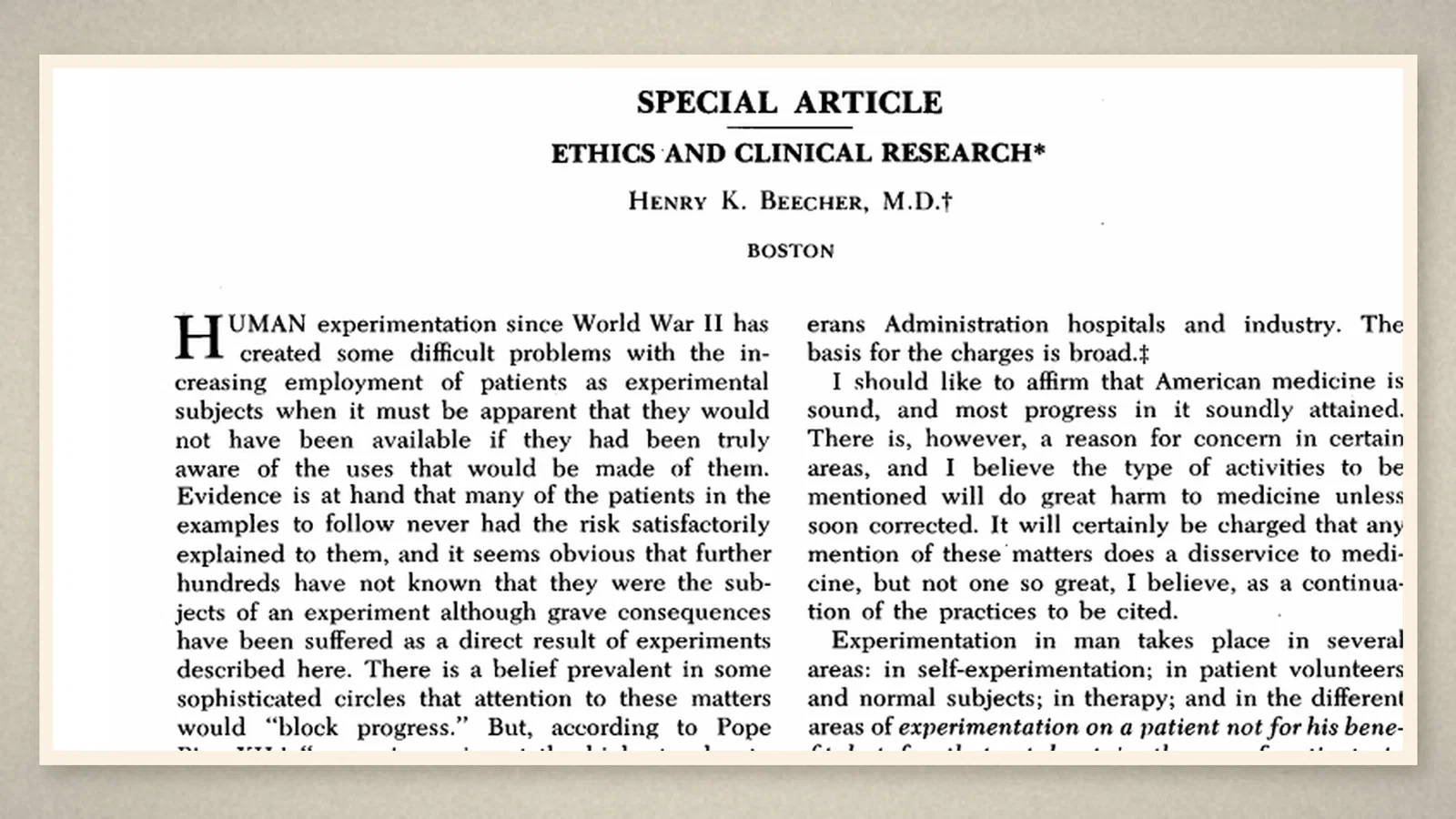
The article opens by saying that human experimentation since the Second World War had created difficult problems with the increasing use of patients as experimental subjects who would probably not have been available had they been truly aware of the uses to be made of them. Beecher conceded that these were troubling charges, but said they had grown out of troubling practices and could be documented by examples from leading medical schools, university hospitals, private hospitals, the Army, Navy and Air Force, the National Institutes of Health, Veterans Administration hospitals and industry. [1, p. 1354]
The study was limited to one category: experimentation on a patient not for the patient's own benefit but, at least in theory, for patients in general. A footnote explained that an earlier remark at a conference, that breaches of ethical conduct were "almost, one fears, universal", had meant only that examples could be found wherever human research was done on any scale, and that the press had misread it. [1, p. 1354]
Money, promotion and the count of examples
Why was the matter urgent? Since the war, annual research spending at the Massachusetts General Hospital had risen 17-fold and at the National Institutes of Health 624-fold. Medical schools were increasingly dominated by investigators, and a young doctor could not expect promotion without proving ability in research. Put together, the money and the pressure raised the fear that the demand for clinical research might outstrip the supply of responsible investigators. [1, p. 1355]
How common was the problem? A preliminary collection of 17 examples was easily increased to 50, and those 50 papers pointed to 186 further likely examples. Of 100 consecutive human studies published in 1964 in an excellent journal, 12 seemed to be unethical; even if only a quarter of them were truly unethical, Beecher wrote, the situation was serious. [1, p. 1355]
The problem of consent
Codes, Beecher argued, rest on the bland assumption that meaningful or informed consent is readily available for the asking, and very often it is not; yet, except in trivial situations, it remains a goal that must be pursued. Consent was mentioned in only 2 of the 50 examples. A far more dependable safeguard than consent, the article said, is "the presence of a truly responsible investigator". [1, p. 1355]
For reasons of space the published list was reduced to 22 examples. No names or references were given, because the intention was to call attention to widespread practices rather than to individuals, but every example was documented to the satisfaction of the editors. After ten years of study, Beecher concluded that thoughtlessness and carelessness, not a wilful disregard of the patient's rights, accounted for most cases. [1, pp. 1355-6]
Example 7: cyclopropane and carbon dioxide
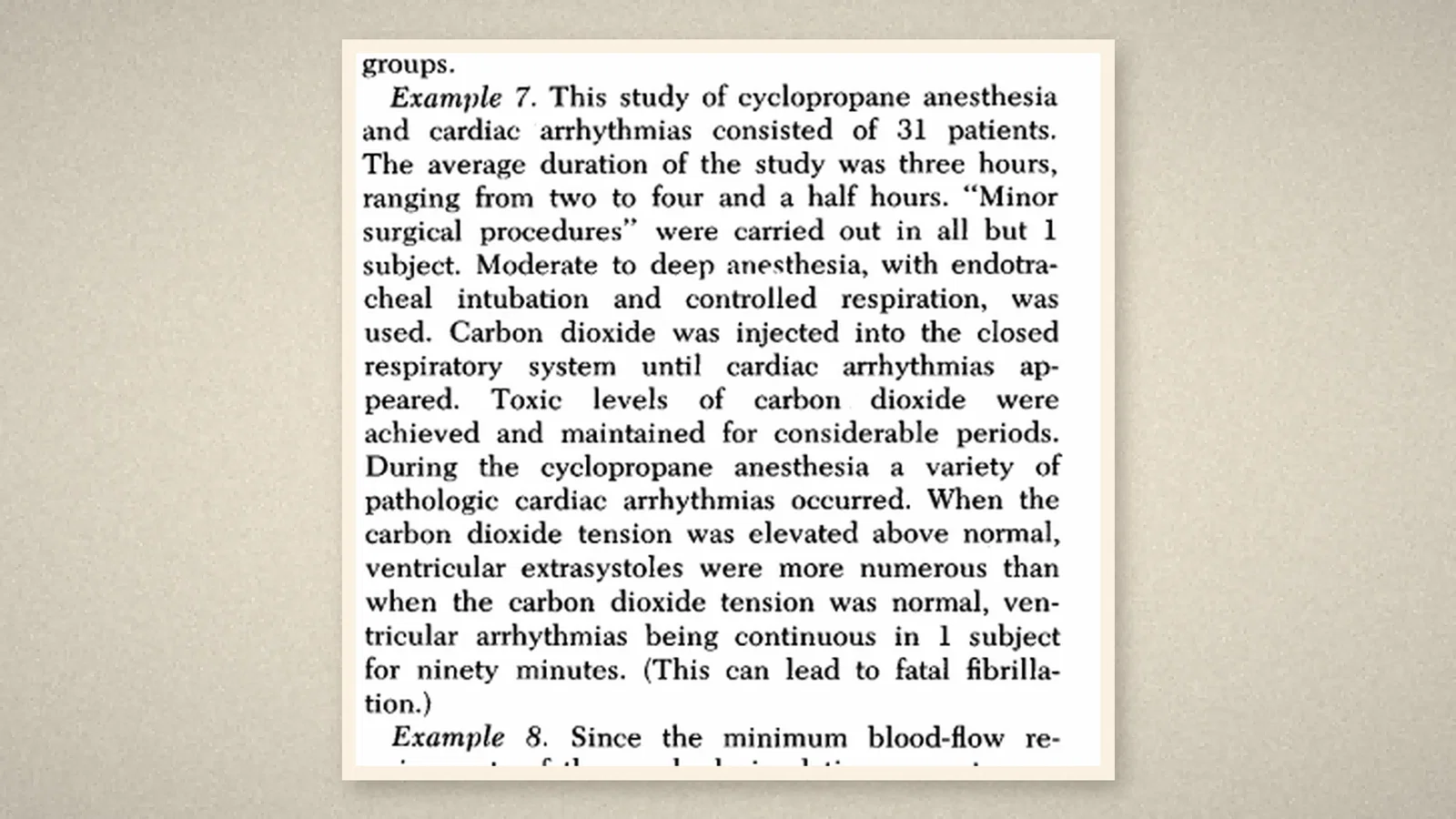
Some of the 22 examples withheld known effective treatment; others tried new techniques in people who could not benefit. Example 7 belonged to anaesthesia. In a study of cyclopropane anaesthesia and cardiac arrhythmias in 31 patients, lasting three hours on average, with "minor surgical procedures" in all but one, the subjects were intubated and ventilated, and carbon dioxide was injected into the closed respiratory system until arrhythmias appeared; toxic levels were maintained for considerable periods, and in one subject ventricular arrhythmias were continuous for ninety minutes. In parentheses Beecher added that this can lead to fatal fibrillation. [1, p. 1357]
In a section on death rates, drawing on three investigators, Beecher put the anaesthesia death rate in general at about 1 death per 2000 cases, and noted that the hazard was doubtless higher when practices such as deliberately provoking ventricular extrasystoles under cyclopropane were involved. [1, p. 1359]
Publication and conclusions
The article ended with publication. In the view of the British Medical Research Council it was not enough for research to be ethical; publications had to make that unmistakably clear. Beecher's own view was that improperly obtained data should not be published: how many would carry out such experiments if they knew the results would never appear? The conclusions state that an experiment is ethical or not at its inception and does not become ethical post hoc; ends do not justify means. [1, pp. 1359-60]
1968: irreversible coma
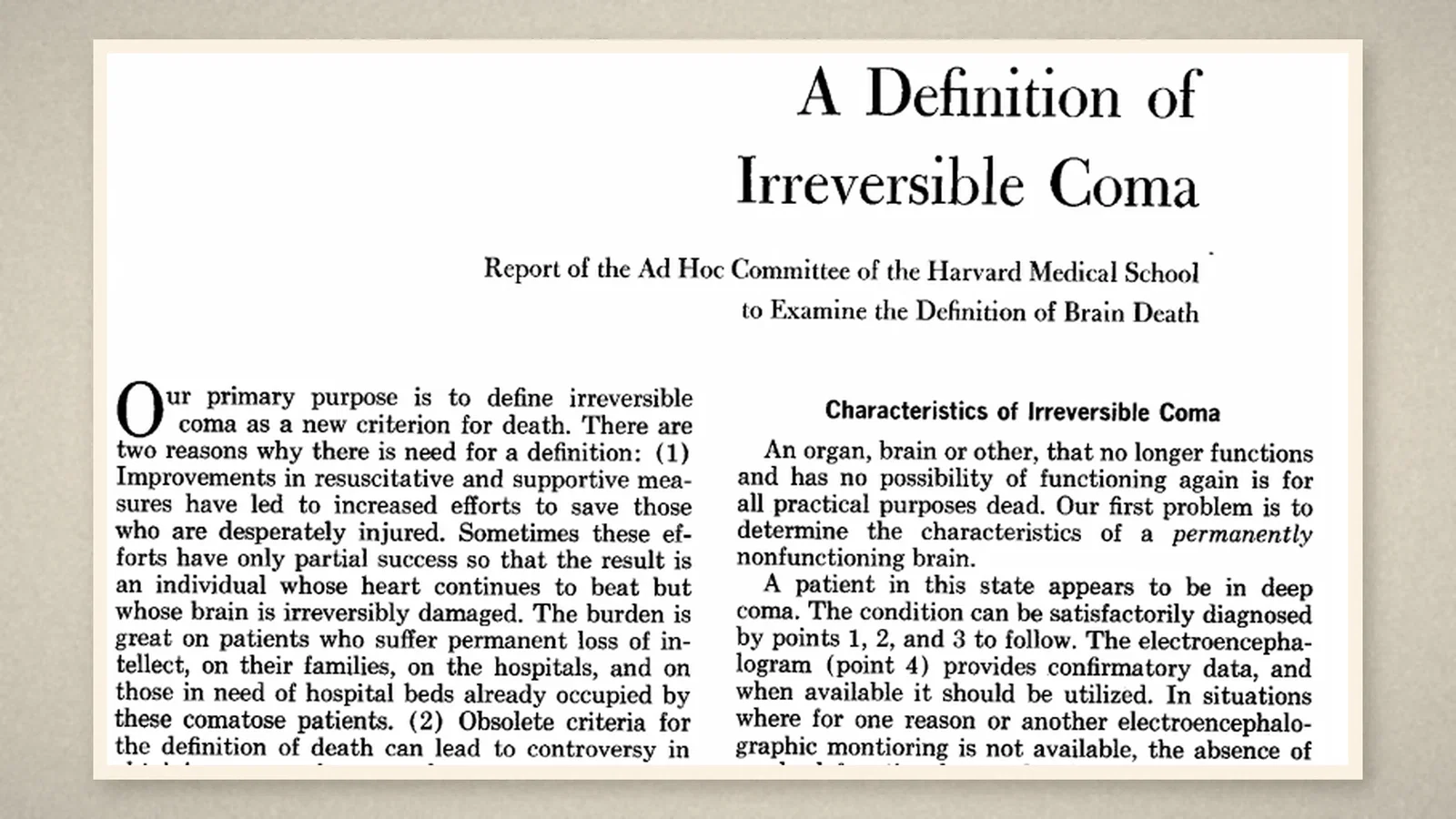
The committee's report opens with its purpose: to define irreversible coma as a new criterion for death. It gives two reasons. Improved resuscitation and support had produced patients whose hearts kept beating while their brains were irreversibly damaged, a burden on the patients, the families, the hospitals and those waiting for beds; and obsolete criteria for death could lead to controversy in obtaining organs for transplantation. Beecher chaired a committee whose members, by their listed degrees, included several MDs, one LLM, one PhD and one ThD. [2, p. 337]
The report lists four characteristics: unreceptivity and unresponsiveness; no movements or breathing, where a patient on a respirator may be disconnected for three minutes to see whether there is any effort to breathe, provided the carbon dioxide tension is normal at the start and the patient has breathed room air for at least 10 minutes; no reflexes; and a flat electroencephalogram, of great confirmatory value. All the tests are to be repeated at least 24 hours later with no change, and hypothermia below 32.2 C and central nervous system depressants such as barbiturates must be excluded. [2, pp. 337-8]
On procedure, death is to be declared and then the respirator turned off. The decision rests with the physician in charge in consultation with physicians directly involved in the case; "it is unsound and undesirable to force the family to make the decision". The committee advised that the physicians who declare death should not be involved in any later effort to transplant organs or tissue, to avoid any appearance of self-interest. A legal commentary argued that if the medical community adopted the new criteria, the legal concept of death could change without statute. [2, pp. 338-9]
What the record shows
Both texts come from the same anaesthetist. One deals with the consent of subjects and the responsibility of investigators; the other with how to determine death when respirators and resuscitation can sustain the heart. Each places problems that anaesthetists met every day, from risky physiological experiments to respirators and comatose patients, inside an ethical and institutional frame.
Sources and reading limits
Read: Beecher HK, "Ethics and Clinical Research", N Engl J Med, 16 June 1966, vol. 274, no. 24, pp. 1354-60, in full, with the page images of pp. 1354 and 1357 checked; and the Harvard Medical School ad hoc committee, "A Definition of Irreversible Coma", JAMA, 5 August 1968, vol. 205, no. 6, pp. 337-40, in full, with the page images of pp. 337 and 338 checked.
Not covered: a primary document for Beecher's appointment to the Dorr chair, which some timelines use to date this topic (the article mentions the chair only as the 1966 byline gives it); Beecher's companion article "Consent in clinical experimentation: myth and reality" (JAMA 1966), cited in the NEJM article; Beecher's placebo work.
Limits: the 1966 article names no investigators and gives no references for its examples, and this article does not try to identify them. Drug doses in the examples are not repeated. The committee members are described only by their listed degrees.
Three illustrations are taken from the two articles (1966, pp. 1354 and 1357; 1968, p. 337). One is a diagram drawn from the texts, with no people drawn.
- Beecher HK. Ethics and clinical research. N Engl J Med. 1966;274(24):1354-60. doi:10.1056/NEJM196606162742405
- A definition of irreversible coma. Report of the Ad Hoc Committee of the Harvard Medical School to Examine the Definition of Brain Death. JAMA. 1968;205(6):337-40. doi:10.1001/jama.1968.03140320031009
Continue exploring
Related reading connects shared questions and contexts; it does not by itself establish historical influence.
Anesthesia Epochs · The Source Room · About & Editorial Method
Published November 4, 2026. Sources and reading limits are stated above. Illustrations are labelled as original source images or AI-made. Historical accounts are educational; they are not current treatment instructions.