Chapter III, 'Anesthesia for Men Wounded in Battle', by Henry K. Beecher in the US Army Medical Department's official history Surgery in World War II, vol. II, General Surgery (1955), explains that anaesthesia and shock are closely linked in the wounded; that Pentothal, supplied in North Africa from November 1942, was popular because even inexperienced doctors could induce smoothly; that the theatre's first survey in September 1943 found 6 deaths attributable only to anaesthesia in 2,672 Pentothal operations (1:450), matching reports from Pearl Harbor, so that abandoning it was proposed; that analysis showed two correctable errors, use by inexperienced officers and use where contraindicated; and that a second survey in September 1944 found 2 such deaths in 11,136 operations (1:5,550), with 12 anaesthetic deaths in 27,564 anaesthetics across both surveys.
Reading Library · Anesthesia Epochs · 中文版
Watch the education video (for clinicians)
1943–1944: Beecher's War Surveys — Where the Danger Actually Was · Anesthesia Epochs Education Series
The intravenous agent Pentothal Sodium (thiopental) was widely used for war surgery in the Second World War: compact to carry and smooth in induction. It also brought a run of unexpected deaths. After the war the US Army Medical Department compiled a multivolume official history, Surgery in World War II, and in volume II, General Surgery, published in 1955, the chapter on anaesthesia was written by Henry K. Beecher. It records two surveys in the Mediterranean Theater that show, in numbers, how a drug went from near abandonment to acceptable use. This article reads that chapter. [1, p. 53][2, p. 62]
Anaesthesia and shock
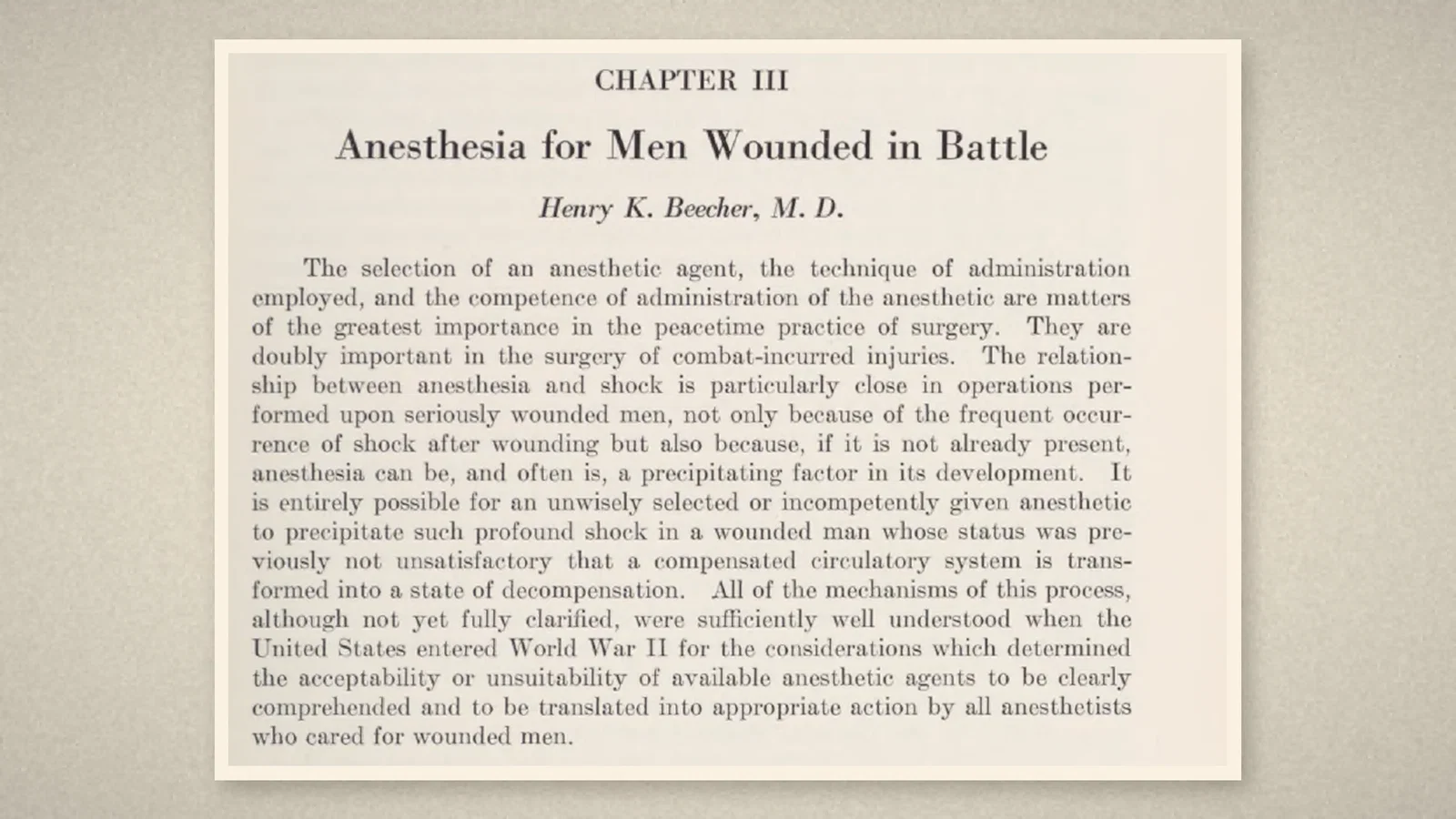
Chapter III is titled "Anesthesia for Men Wounded in Battle". Beecher opened by saying that the choice of agent, the technique and the competence of the anaesthetist, already of the greatest importance in peacetime surgery, are doubly important in the surgery of combat injuries; anaesthesia and shock are particularly closely related in seriously wounded men, not only because shock often follows wounding but because anaesthesia can, and often does, precipitate it, so that an unwisely chosen or incompetently given anaesthetic may turn a compensated circulation into decompensation. [1, p. 53]
The "Historical Note" observed that the anaesthesia section of the First World War's official history had been written by a surgeon, George Crile; the specialty was not represented in the Surgeon General's Office, and no consultants in anaesthesia were appointed at home or overseas. Beecher took this as a sign of how little emphasis anaesthesia had received in that war. [1, p. 53]
The theatre's first Pentothal survey
Pentothal Sodium, Beecher wrote, was supplied in the North African Theater from the first landings in November 1942; its ready availability, simple and compact equipment, smooth induction "even by inexperienced physicians" and apparently infrequent after-effects made it popular under combat conditions. Those advantages tended to outweigh more important considerations: it is a powerful tool, overdose is not easily overcome, the lethal amount varies widely from patient to patient, and it is definitely contraindicated in certain injuries. [1, p. 71]
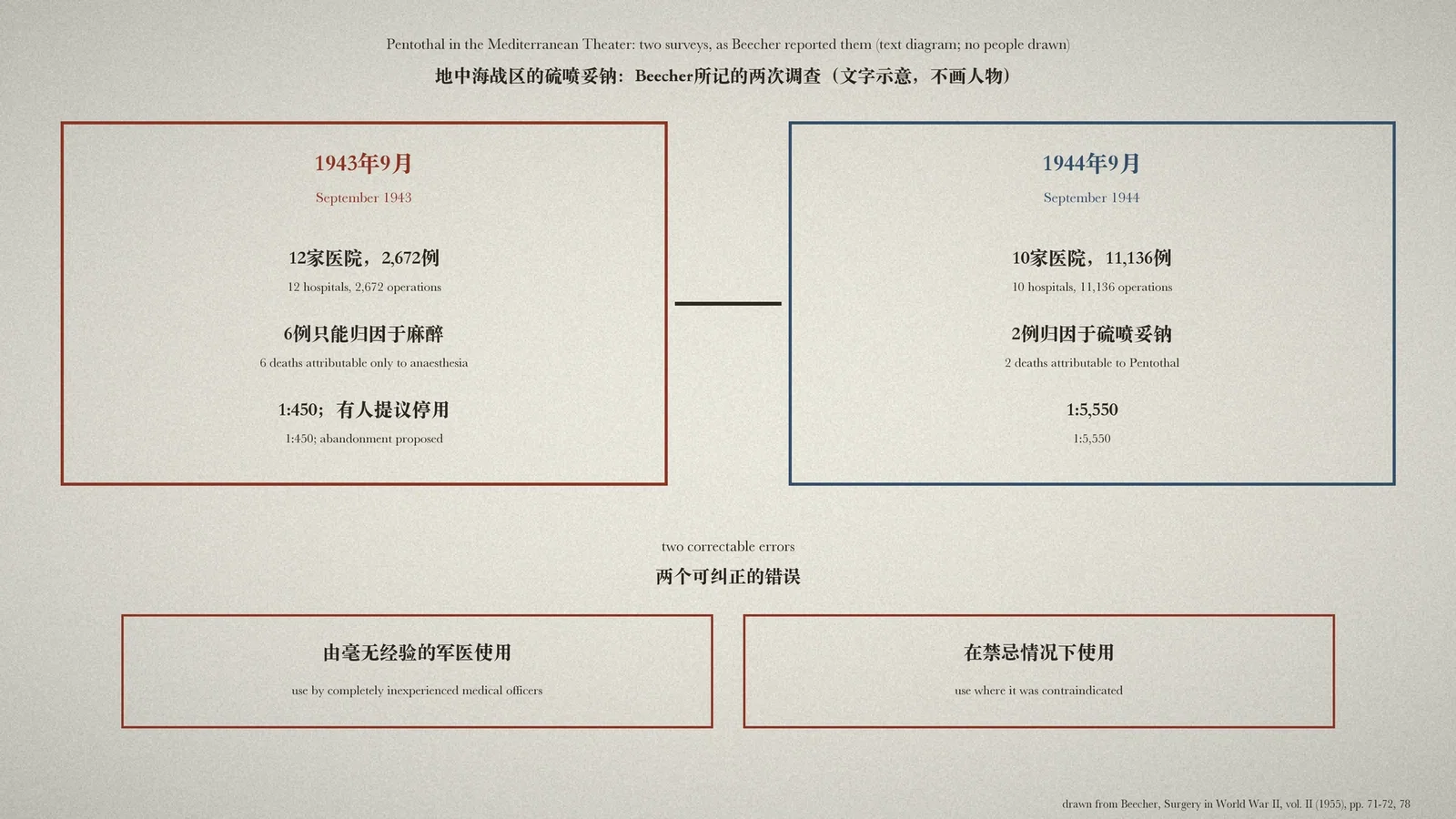
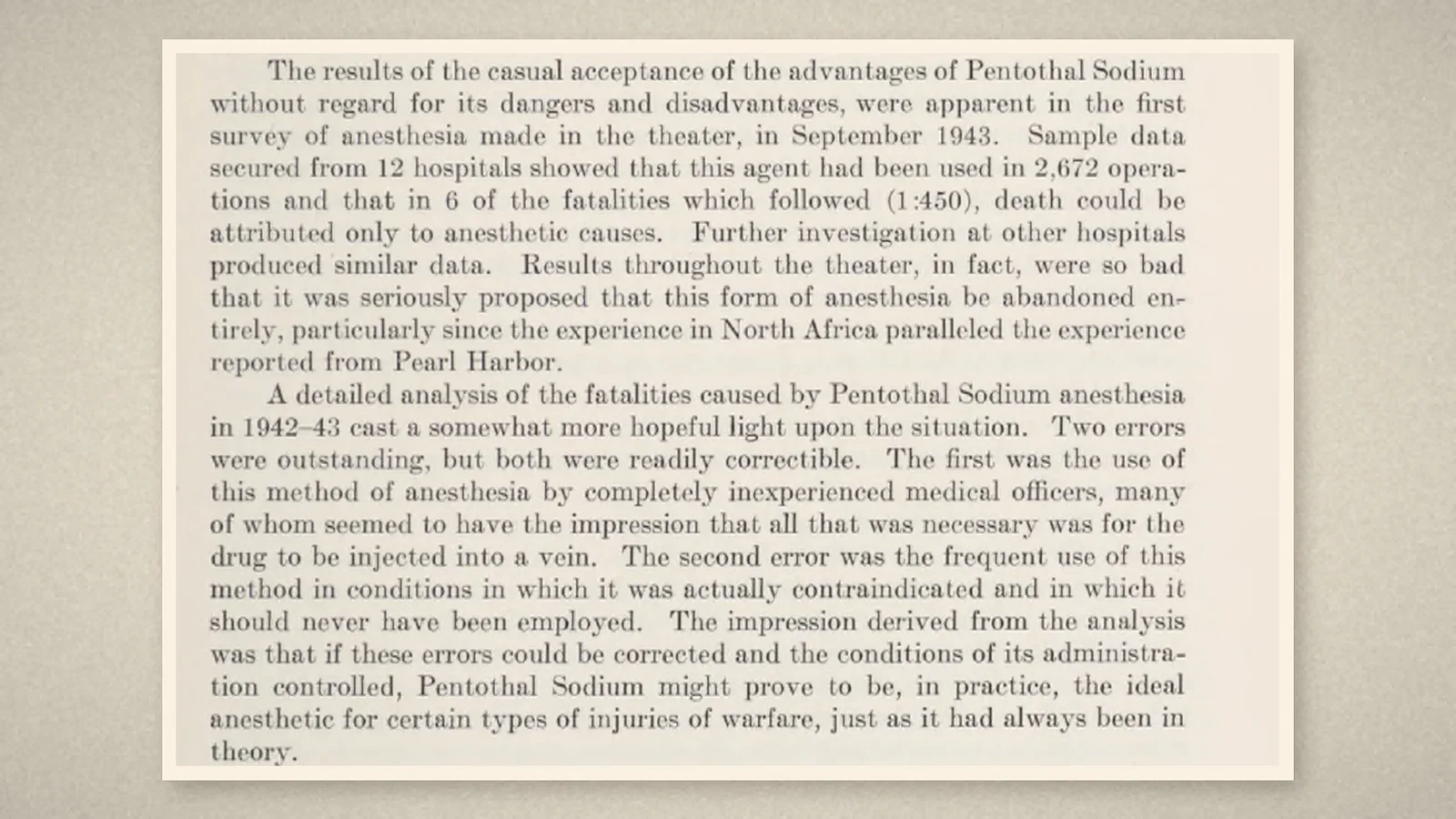
The consequences of accepting its advantages without regard for its dangers appeared in the theatre's first survey of anaesthesia, in September 1943: samples from 12 hospitals showed Pentothal used in 2,672 operations, with 6 deaths that could be attributed only to anaesthesia, about 1:450, and other hospitals produced similar data. Results throughout the theatre were so bad that it was seriously proposed to abandon this form of anaesthesia altogether, the more so since experience in North Africa paralleled that reported from Pearl Harbor. [1, p. 71]
A detailed analysis of the deaths gave more hope: two outstanding errors, both readily correctable. The first was use by completely inexperienced medical officers, many of whom seemed to think it enough to inject the drug into a vein; the second was frequent use in conditions where it was contraindicated. If these errors were corrected and administration controlled, the analysis suggested, Pentothal might prove in practice the ideal anaesthetic for certain war injuries, as it had always been in theory. [1, p. 71]
A year later
The decision to continue using Pentothal in the Mediterranean Theater proved sound, Beecher wrote: a survey of 10 hospitals in September 1944, a year after the first, showed only 2 deaths attributable to its effects in 11,136 operations, about 1:5,550. With about four times as many cases, it caused only a third as many deaths. [1, pp. 71-72]
What counted as an anaesthetic death
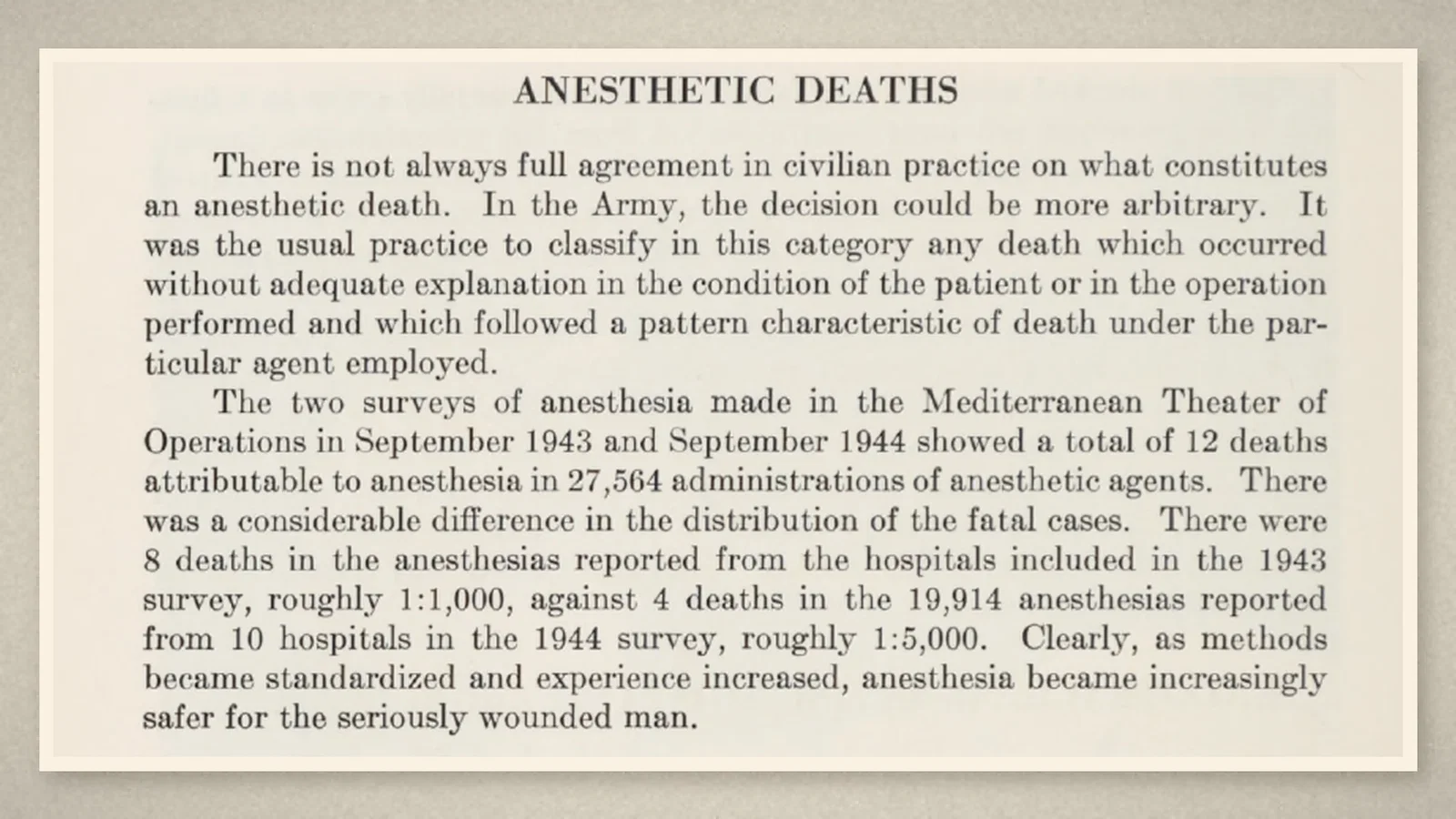
Under "Anesthetic Deaths" Beecher acknowledged that civilian practice did not fully agree on what constitutes an anaesthetic death, and that the Army's decision could be more arbitrary: any death without adequate explanation in the patient's condition or the operation, following the pattern characteristic of death under the agent used, was usually so classed. The two surveys found 12 such deaths in 27,564 anaesthetics: 8 in the 1943 hospitals, roughly 1:1,000, against 4 in 19,914 anaesthetics in the 10 hospitals of 1944, roughly 1:5,000. "Clearly, as methods became standardized and experience increased, anesthesia became increasingly safer for the seriously wounded man." [1, p. 78]
What the record shows
The chapter uses two surveys to show that whether a drug is dangerous depends greatly on who uses it and when. It also shows how deaths counted under a common definition can be used to change practice.
Sources and reading limits
Read: Surgery in World War II, vol. II, General Surgery (Office of the Surgeon General, Department of the Army, 1955; PDF from the National Library of Medicine Digital Collections, a US government publication): the title pages and list of contributors; chapter III, Henry K. Beecher, "Anesthesia for Men Wounded in Battle", its opening and historical note (pp. 53-56), the section on intravenous barbiturates and Pentothal Sodium (pp. 71-72) and the section on anaesthetic deaths (p. 78). The ASA 2024 timeline entry for 1955 (p. 62) used as the lead.
Not covered: the original 1943 and 1944 survey reports; the Pearl Harbor reports referred to; Beecher's 1945 Annals of Surgery article of the same title.
Limits: the timeline gives 1 in 450 "in the hands of inexperienced anaesthetists"; in the chapter that is the ratio of the first survey. Doses and dilutions are omitted. The editors, Coates (editor in chief) and DeBakey (editor for general surgery), are taken from the title pages.
Three illustrations are taken from the 1955 volume (pp. 53, 71 and 78). One is a comparison diagram drawn from the chapter, with no people drawn.
- Beecher HK. Anesthesia for men wounded in battle. In: Coates JB Jr, DeBakey ME, editors. Surgery in World War II. Vol. II, General Surgery. Washington, DC: Office of the Surgeon General, Department of the Army; 1955. p. 53-78. NLM Digital Collections
- Australian Society of Anaesthetists. Anaesthesia History Timeline. 2024. PDF
Continue exploring
Related reading connects shared questions and contexts; it does not by itself establish historical influence.
- 1914: Goodman Levy Blames Ventricular Fibrillation for Light Chloroform Deaths
- 1985: Harvard's Monitoring Standards Make Continuous Observation a Shared Requirement
- 1986: The ASA Adopts Monitoring Standards with Four Areas of Assessment
Anesthesia Epochs · The Source Room · About & Editorial Method
Published November 4, 2026. Sources and reading limits are stated above. Illustrations are labelled as original source images or AI-made. Historical accounts are educational; they are not current treatment instructions.