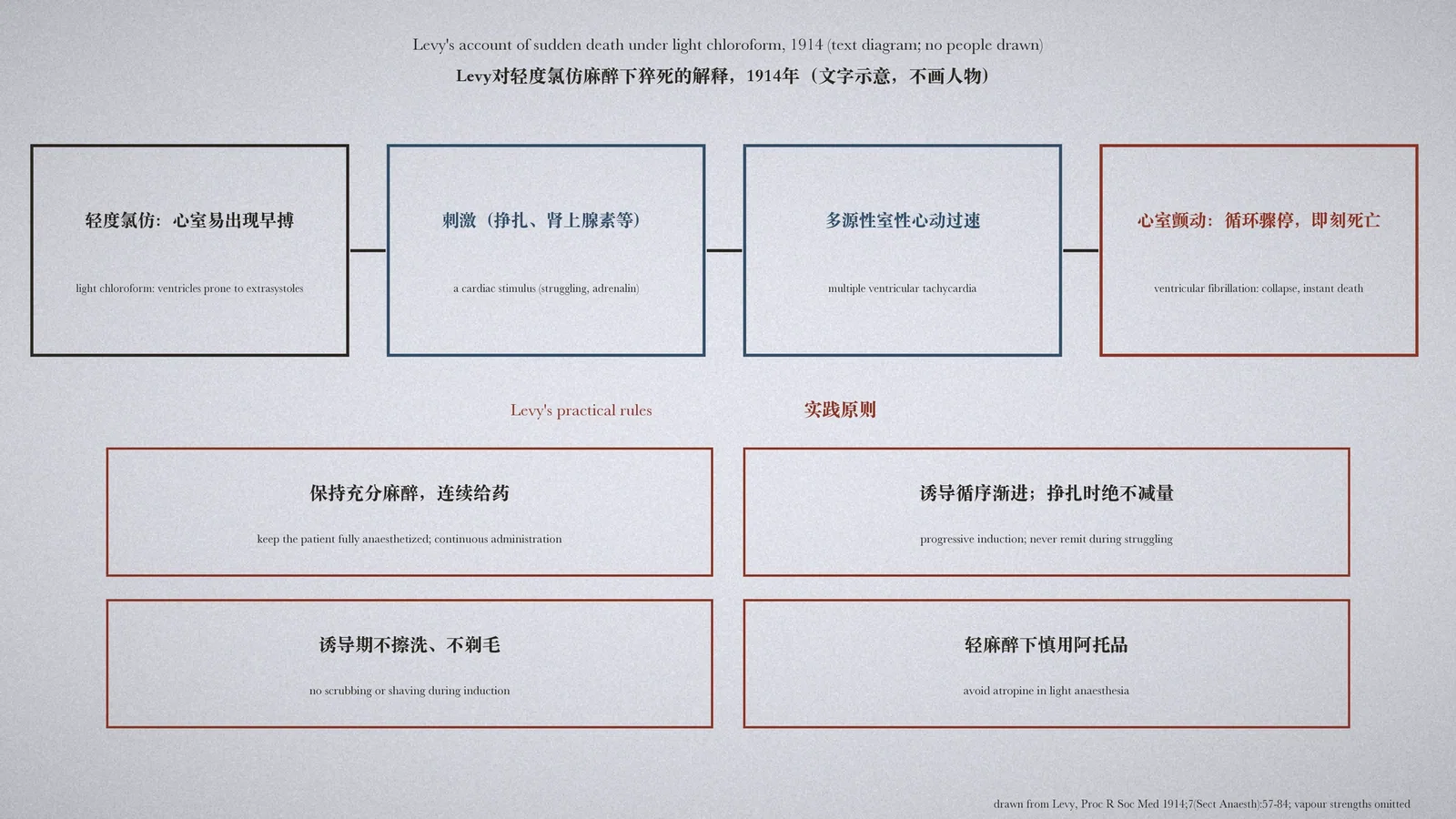
On 1 May 1914 A. Goodman Levy read 'Sudden death under light chloroform anaesthesia' to the Section of Anaesthetics of the Royal Society of Medicine (Proceedings vol. 7): adrenalin throws a heart lightly affected by chloroform into ventricular fibrillation, sudden circulatory collapse and instantaneous death, always preceded under chloroform by a multiple ventricular tachycardia and excited by some cardiac stimulation; Levy reanalysed the 109 deaths collected by the 1864 chloroform committee; urged that patients be kept fully anaesthetized with continuous, progressive induction, never easing off during struggling, undisturbed until unconscious and deeply enough anaesthetized at incision; warned against atropine in light anaesthesia; and blamed recent teaching of extreme dilution for rising deaths in the Registrar-General's figures.
Reading Library · Anesthesia Epochs · 中文版
Watch the education video (for clinicians)
1914: Chloroform and Fibrillation — Mechanism Is Not Incidence · Anesthesia Epochs Education Series
Ever since the girl at Winlaton in 1848, sudden death under chloroform had troubled anaesthetists: why did some patients die while anaesthesia was still light, or just after the chloroform had been taken away? The committee of 1864 said strong vapour stops the heart; the Hyderabad commission said chloroform never suddenly stops it. On 1 May 1914 A. Goodman Levy, formerly of Guy's Hospital, read a long paper to the Section of Anaesthetics of the Royal Society of Medicine offering another answer: ventricular fibrillation. This article reads that paper. [1, p. 57][2, p. 36]
A meeting and a long paper
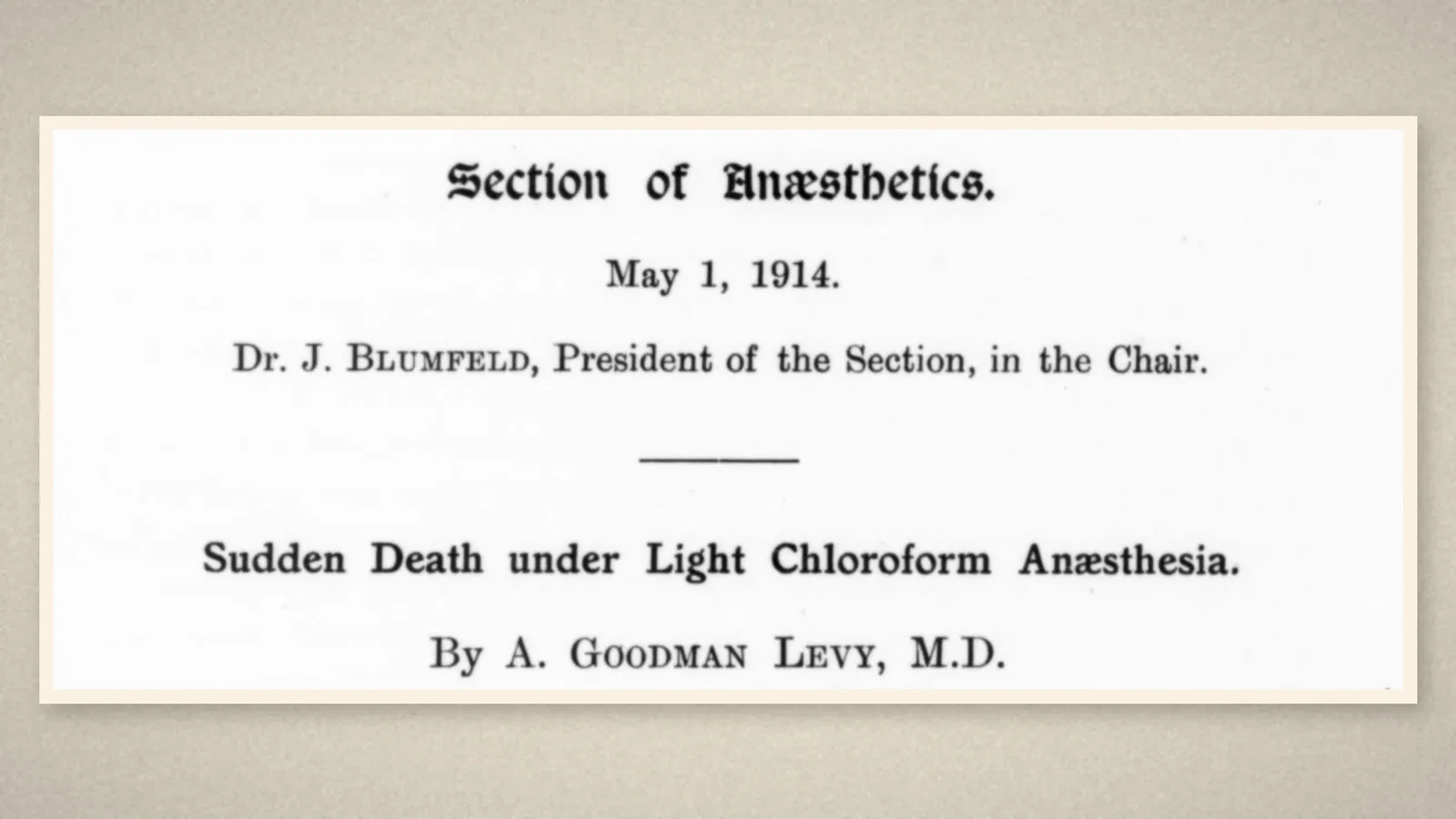
Dr J. Blumfeld, president of the section, was in the chair. Levy's paper, "Sudden death under light chloroform anaesthesia", was printed in the Proceedings of the Royal Society of Medicine vol. 7 (1913-14), Section of Anaesthetics, pp. 57-84. Levy began by recalling earlier reports on small doses of adrenalin acting on the mammalian heart under chloroform: when the heart is affected by low concentrations of chloroform, adrenalin throws it into ventricular fibrillation, but not when it is affected by full concentrations; the paper was "but the logical sequence of this principle". [1, p. 57]
What ventricular fibrillation is
Levy admitted that there was as yet no distinct conception of the intimate nature of ventricular fibrillation, but ineffectual ventricular contractions were known to follow one another very rapidly, abolishing the function of the ventricles, so that its clinical manifestation was sudden vascular collapse and "consequent instantaneous death"; in lower mammals it was generally permanent. Professor McWilliam had suggested years earlier that it might explain some sudden deaths, but it had been treated as a physiological curiosity; the suggestion linking it to Levy's own anomalous blood-pressure curves came from Professor Cushny. [1, pp. 57-58]
Under chloroform, fibrillation never arose from a normal rhythm. It was always preceded by a highly irregular ventricular action, with impulses from many abnormal foci rather than the normal conducting path, a condition called multiple ventricular tachycardia; it was very common under low percentages of chloroform, might persist and revert to a regular rhythm, or might occasionally end in fibrillation. To the finger the pulse would feel weak, irregular, "fluttering". Chloroform renders the ventricles liable to extrasystoles but does not excite them directly; the exciting cause is some form of cardiac stimulation, and with proper care a cat could be kept under chloroform without a single extrasystole. [1, pp. 58-59]
Levy also reanalysed the 109 deaths under chloroform collected by the Royal Medical and Chirurgical Society's committee and published in 1864, grouping those the committee had called not fully anaesthetized and those with definite evidence of light anaesthesia, and listing many deaths in light anaesthesia or soon after the chloroform had been removed. [1, pp. 75-78]
Practical rules
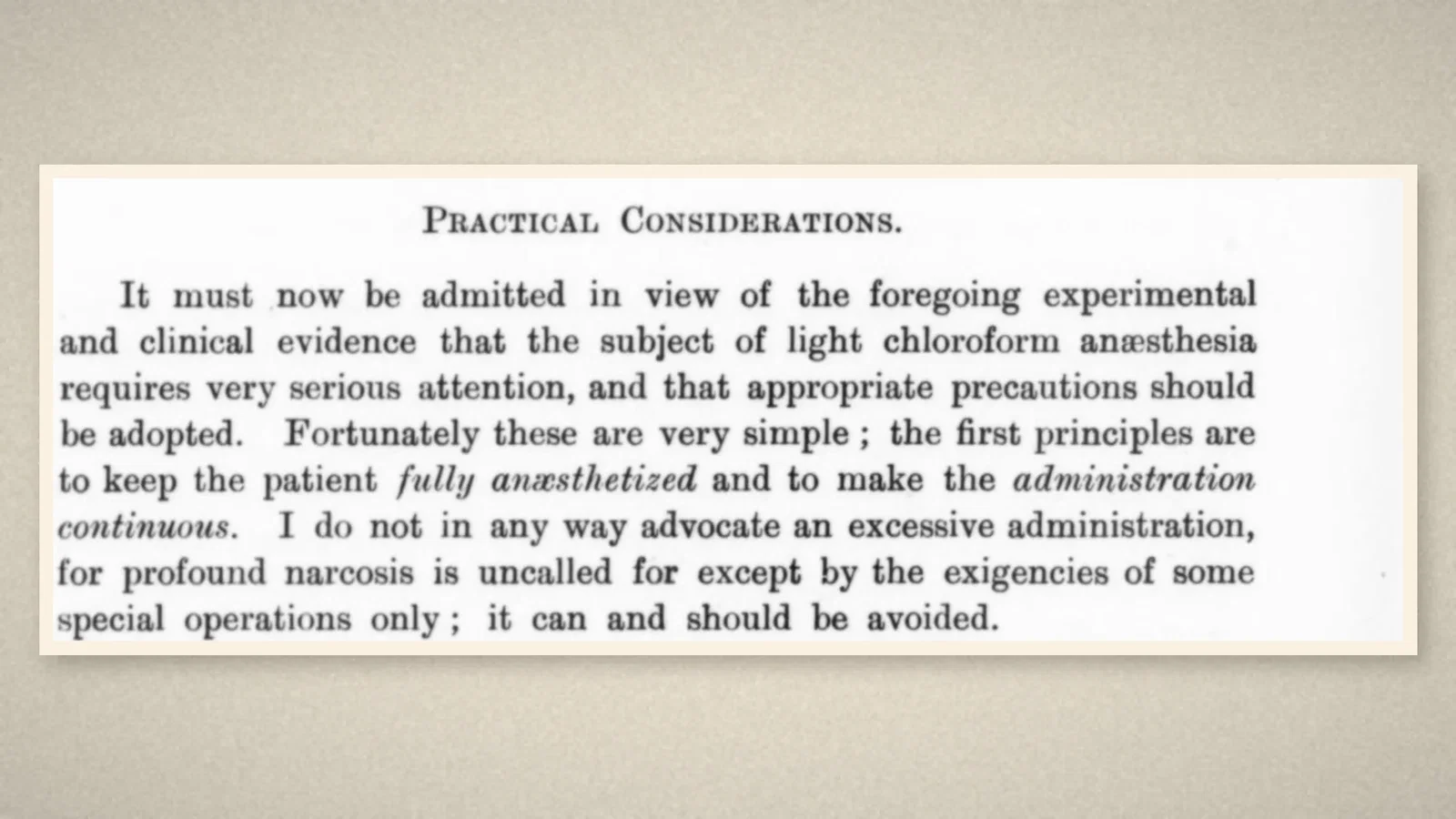
Under "Practical Considerations" Levy wrote that, in view of the experimental and clinical evidence, light chloroform anaesthesia required very serious attention; fortunately the precautions were simple: "the first principles are to keep the patient fully anaesthetized and to make the administration continuous". Levy did not advocate excess, since profound narcosis was needed only for a few special operations and should otherwise be avoided. [1, p. 70]
During induction the administration should be continuous and progressive, the vapour strengthened as quickly as possible without distressing the patient, to bring the patient fully under the influence of chloroform as soon as practicable. If the patient became excited or struggled, the administration "should never, on any account, be remitted", as was then the practice and teaching. Levy thought one detail important: the patient should be left entirely undisturbed until fully anaesthetized, without scrubbing or shaving the skin during induction to save time, and even the bandages left alone until consciousness was abolished; the incision and earliest stages of operation should be done under full anaesthesia, and the vapour reduced later but increased again before severe stimuli. These new facts, Levy said, almost reopened the old question whether to watch the pulse or the respiration. [1, pp. 70-71]
Atropine and the death statistics
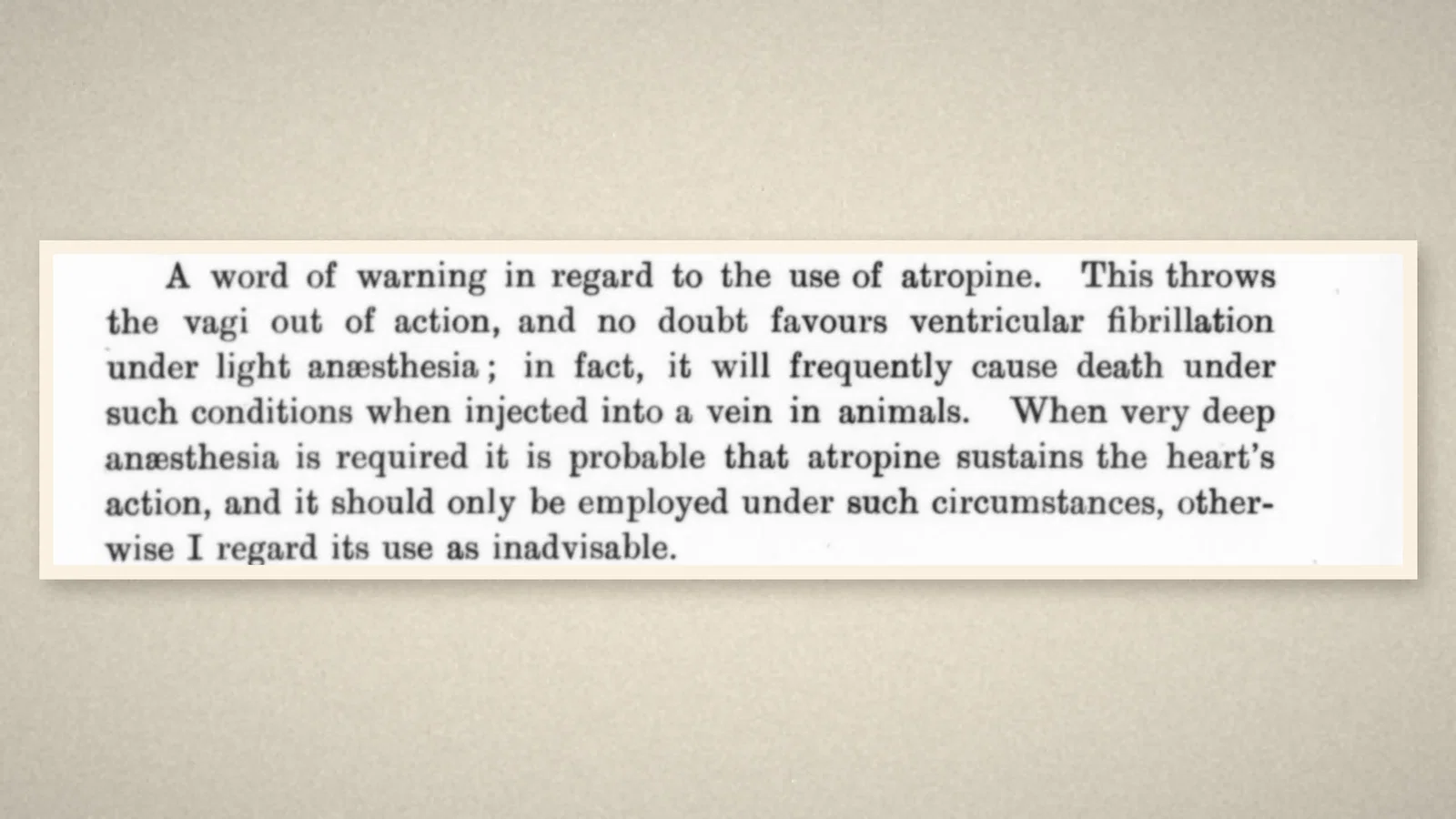
Levy added "a word of warning in regard to the use of atropine": by putting the vagi out of action it no doubt favours ventricular fibrillation under light anaesthesia, and injected into a vein it frequently kills animals in that state. When very deep anaesthesia is needed atropine probably sustains the heart, and it should be used only then; otherwise Levy regarded it as inadvisable. [1, p. 74]
Finally Levy cited the Registrar-General's reports: recorded deaths under chloroform were 116 in 1900 and had risen every year, doubling to 234 by 1910; with more accurate registration in 1911 the total was 276. Some of the rise reflected more operations, Levy granted, but chloroform was also being displaced by other anaesthetics, and the insistent teaching of extreme attenuation of chloroform vapour had "done nothing to reduce the number of fatalities"; in Levy's opinion it had been largely responsible for their continuation and increase. Levy expressed full confidence in these views while accepting that clinical observation might modify them, and asked that every administrator who saw a death under chloroform put the fullest possible report on record. [1, pp. 74-75]
What the record shows
Levy reduced the apparent paradox of why light anaesthesia was dangerous to an arrhythmia that could be reproduced in experiment, and drew from it practical rules that ran against the teaching of the day. The closing request that every death be fully recorded points toward the later inquiries into anaesthetic deaths.
Sources and reading limits
Read: Levy, "Sudden death under light chloroform anaesthesia", Proceedings of the Royal Society of Medicine vol. 7 (1913-14), Section of Anaesthetics, pp. 57-84: the meeting heading of 1 May 1914, the experimental observations on fibrillation and extrasystoles (pp. 57-59), the practical considerations (pp. 70-71), the atropine warning, Registrar-General figures and conclusion (pp. 74-75), and the analysis of the 1864 committee's 109 cases (pp. 75-78, skimmed). The ASA 2024 timeline entry for 1911 (p. 36) was also consulted.
Not covered: the PMC PDF (PMC2002826), which could not be accessed; Levy's 1911 Physiological Society communication and the 1913 and 1914 papers in Heart; the discussion after the paper (glanced at only).
Limits: this is Levy's own argument; "shown", in the timeline's wording, is the timeline's claim. The vapour strengths recommended in the paper are omitted, and the illustrations stop before those passages. The Guy's Hospital background comes from the timeline.
Three illustrations are crops of the Proceedings of 1914 (pp. 57, 70 and 74). One is a text diagram drawn from the paper, with no people drawn.
- Levy AG. Sudden death under light chloroform anaesthesia. Proceedings of the Royal Society of Medicine. 1914;7(Sect Anaesth):57-84. DOI
- Australian Society of Anaesthetists. Anaesthesia History Timeline. 2024. PDF
Continue exploring
Related reading connects shared questions and contexts; it does not by itself establish historical influence.
- 1864: The Royal Medical and Chirurgical Society Sets Chloroform Safety Rules
- 1889: The Second Hyderabad Commission Says Chloroform Stops Breathing Before the Heart
Anesthesia Epochs · The Source Room · About & Editorial Method
Published November 4, 2026. Sources and reading limits are stated above. Illustrations are labelled as original source images or AI-made. Historical accounts are educational; they are not current treatment instructions.