
In 1889 a second chloroform commission in Hyderabad, with Lauder Brunton representing The Lancet, concluded from animal experiments that chloroform freely diluted with air stops the breathing before the heart and never causes sudden death by stopping the heart; The Lancet called these conclusions sweeping.
Reading Library · Anesthesia Epochs · 中文版
Watch the education video (for clinicians)
1889: The Hyderabad Chloroform Commissions — Which Stops First? · Anesthesia Epochs Education Series
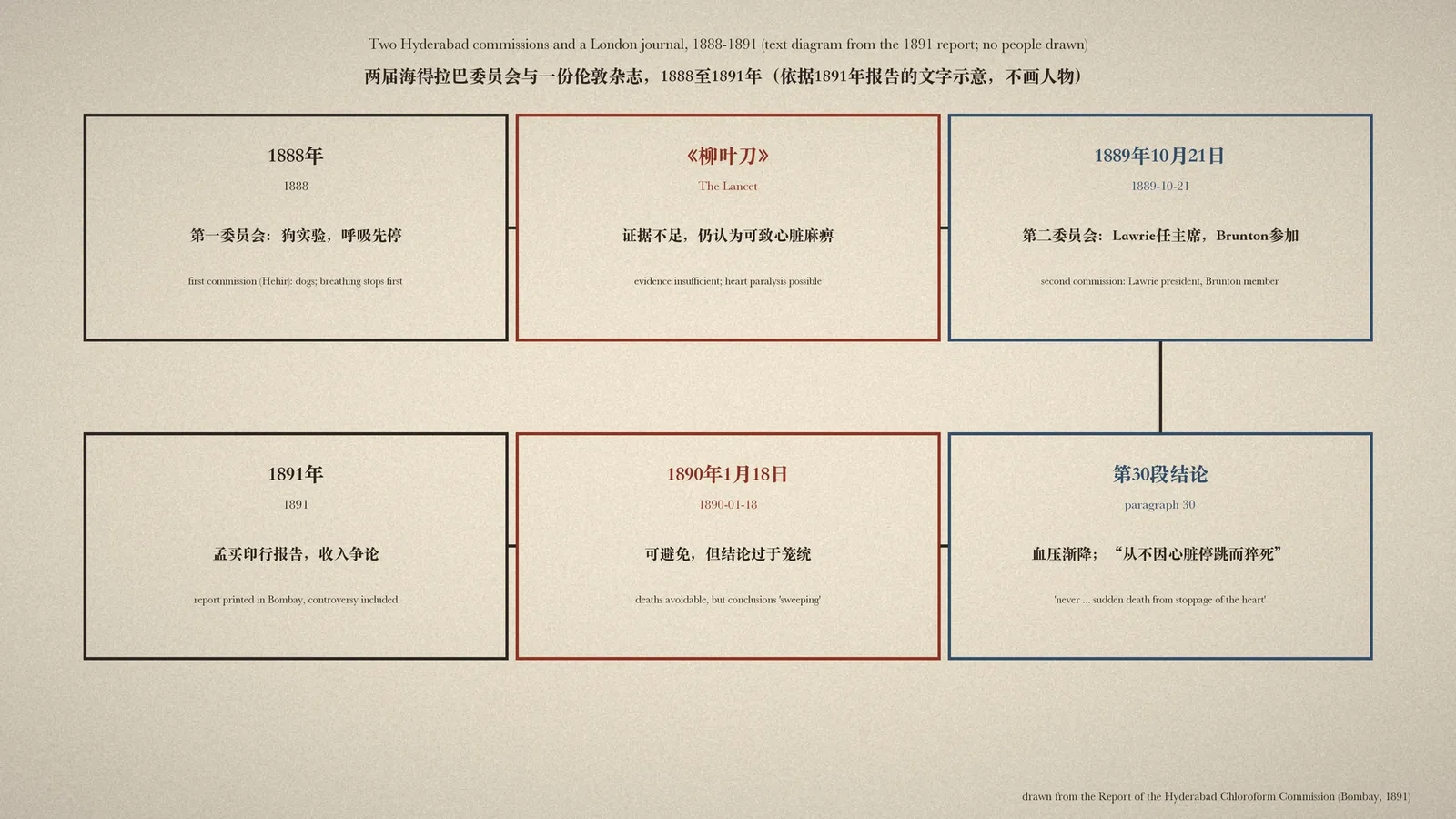
In the later nineteenth century there were two schools on how chloroform kills. One held that it can paralyse the heart directly, so the pulse must be watched; the other, following Syme of Edinburgh, held that chloroform is safe so long as the breathing is watched. Edward Lawrie, Residency Surgeon at Hyderabad in India, belonged to the second school and persuaded the Nizam's Government to pay for two commissions to prove it. The full report was printed in Bombay in 1891. This article reads that report and the Lancet leader it reprints. [1, title page][1, pp. 1-2]
The first commission
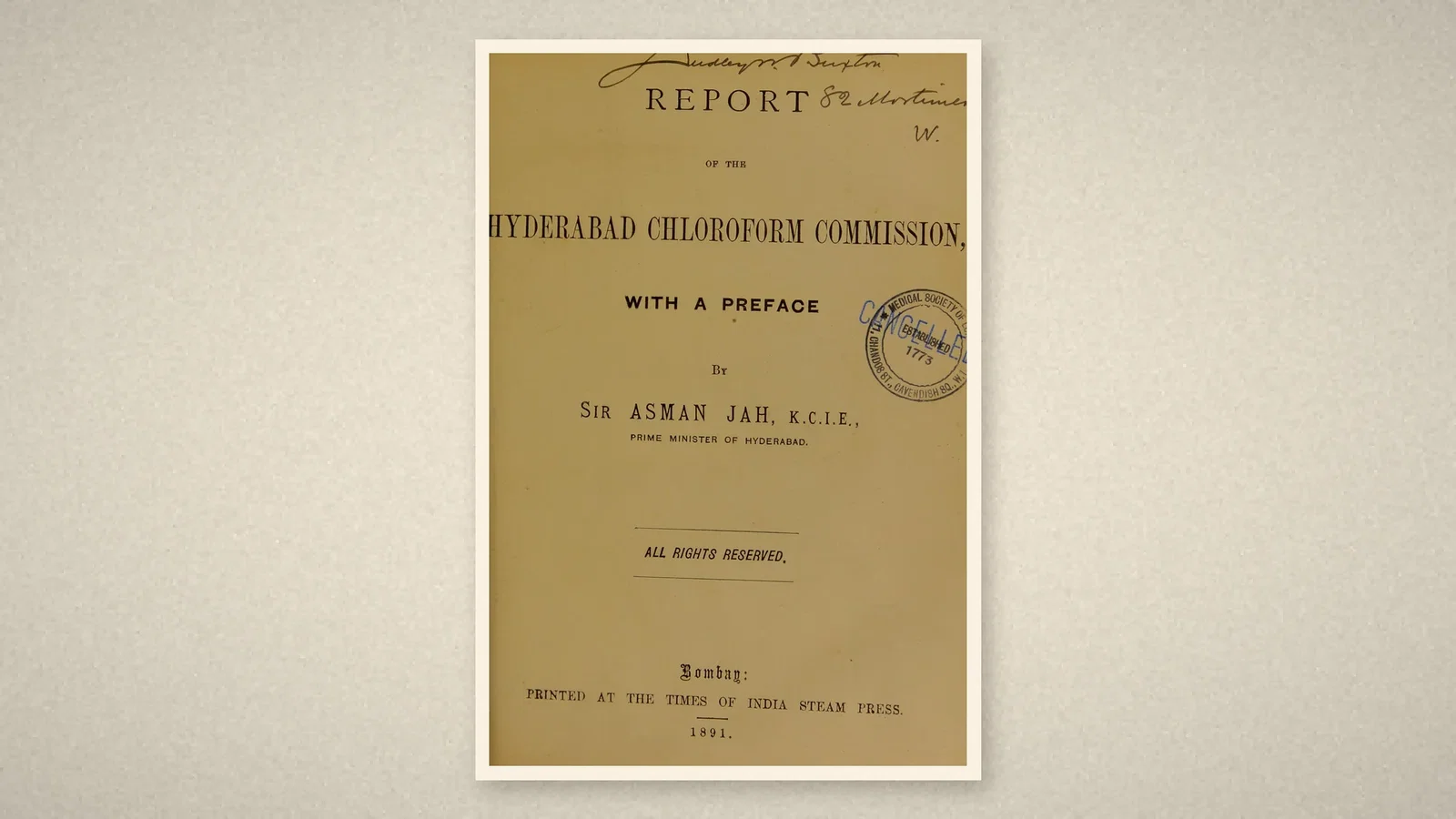
The report carries a preface by Sir Asman Jah, prime minister of Hyderabad, and was printed at the Times of India Steam Press, Bombay, in 1891. The preface apologises for the delay, due partly to the dispersal of the members and partly to the unexpected controversy over the commission's results; Lawrie had also wanted the experimental data tested by long clinical experience; and everything of importance raised in the controversy had been included. The credit for originating the commissions, the preface says, belonged to Lawrie. [1, preface]
The report explains that the Nizam's Government appointed two commissions on the alleged dangers of chloroform. The first, in 1888, had Surgeon Hehir as president with Kelly and Chamarette, and was set up at Lawrie's request: Lawrie had always believed Syme's teaching that chloroform used judiciously does good without risk, and wished to show by experiments on dogs that "in death from chloroform the respiration always stops before the heart". Lawrie's letter to Hehir of 18 January 1888 asked the committee to study the effects on circulation and respiration, to give chloroform as in the hospitals, and to vary the dose, speed and admixture of air. With that point "proved", the report says, a second commission was sought, because Syme's principles must rest on a firm physiological basis. [1, pp. 1-2]
The Lancet's doubt and the second commission
The Lancet's leader reprinted in the report tells what followed. When the first commission's report and Lawrie's comments reached London, the journal found the facts insufficient to overturn the conclusions of many observers at home and abroad that one danger of chloroform was paralysis of the heart. Lawrie then proposed a second commission with a Lancet representative, the Nizam's Government generously paying, and The Lancet chose Lauder Brunton. [1, appendix]
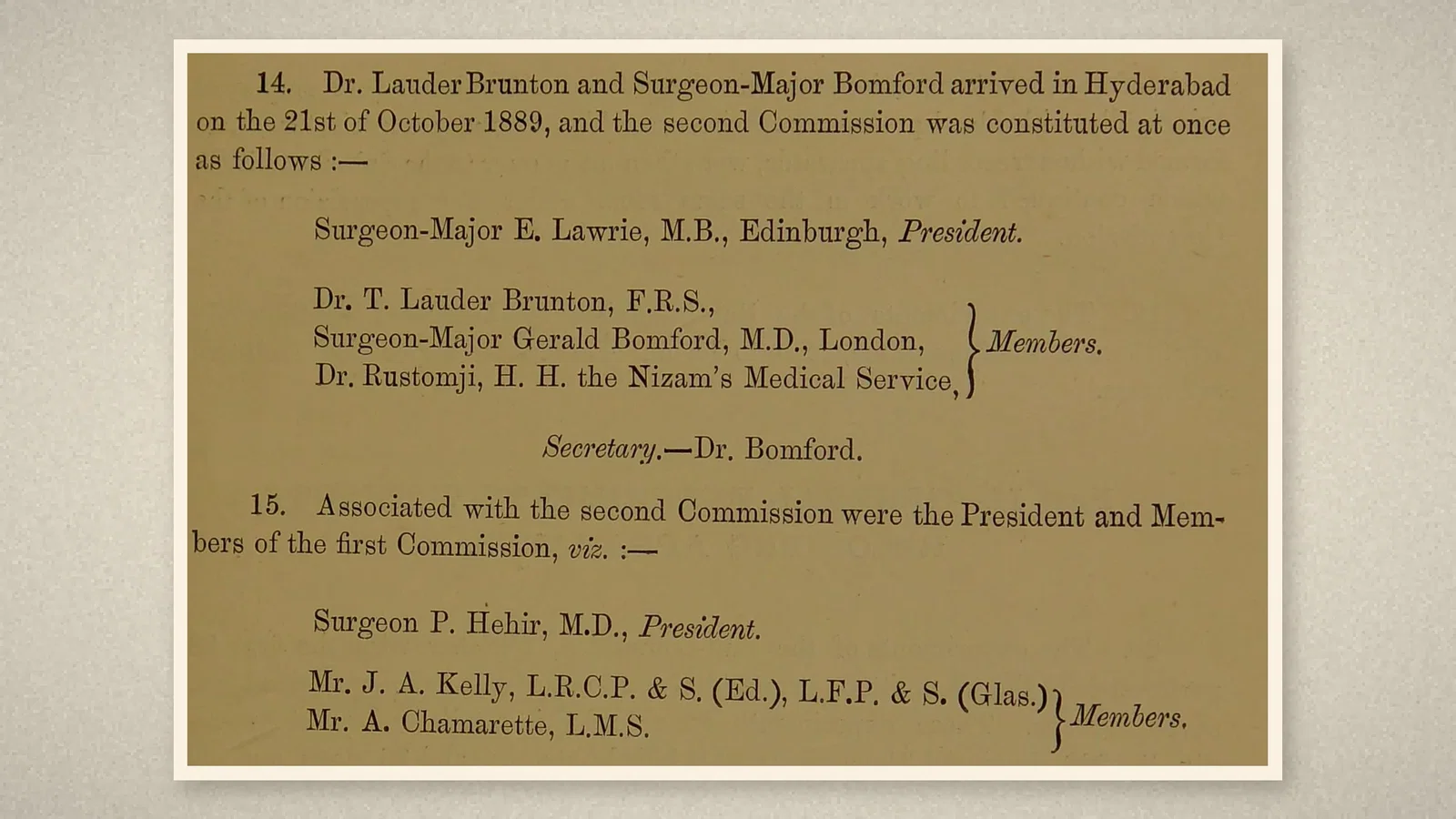
Paragraph 14 of the report records that Lauder Brunton and Surgeon-Major Gerald Bomford of the Indian Medical Service arrived in Hyderabad on 21 October 1889 and the second commission was constituted at once: Lawrie as president, with Brunton, Bomford and Rustomji of the Nizam's Medical Service as members and Bomford as secretary; Hehir, Kelly and Chamarette of the first commission were associated with it. [1, p. 11]
The conclusions of paragraph 30
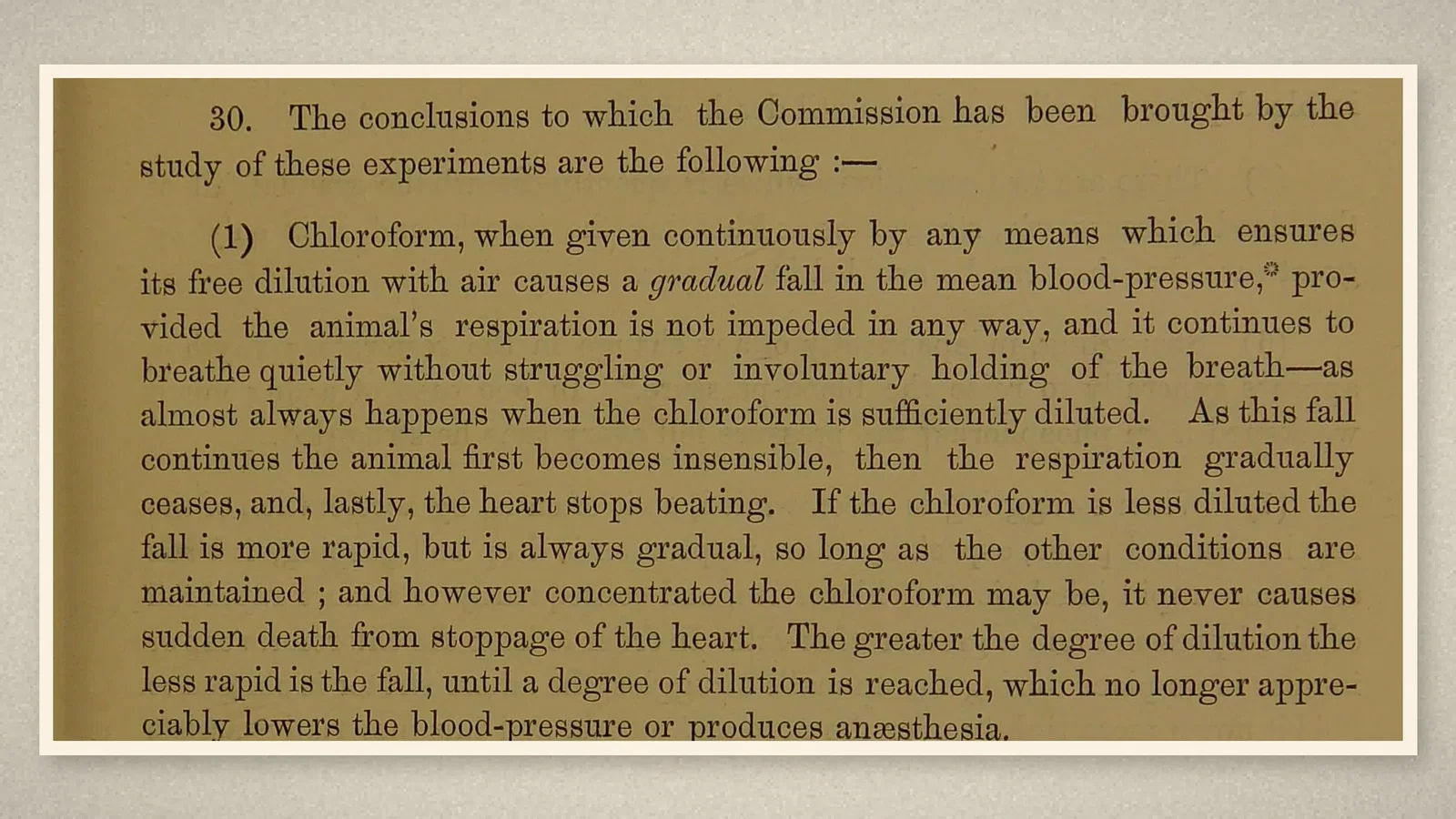
The commission experimented on dogs, monkeys and other animals and recorded blood-pressure tracings. Paragraph 30 sets out its conclusions. The first: chloroform given continuously with free dilution in air, while the animal breathes quietly without struggling or involuntary breath-holding, causes a gradual fall in mean blood pressure; as it continues, the animal first becomes insensible, then breathing gradually ceases, and lastly the heart stops; stronger vapour makes the fall more rapid, but always gradual while the conditions hold, and "however concentrated the chloroform may be, it never causes sudden death from stoppage of the heart". [1, p. 17]
The following points add that if inhalation is interrupted the pressure goes on falling for a time, probably from chloroform left in the air passages, so breathing present when chloroform is stopped may cease afterwards; that if it is stopped early the pressure recovers; and that struggling and involuntary breath-holding are the two conditions that disturb the gradual fall, the gasping after breath-holding drawing chloroform in rapidly and quickly producing a dangerous fall. [1, pp. 17-18]
The response in London
The Lancet published the report on 18 January 1890. Its leader said the practical outcome seemed to be that deaths from chloroform were not inevitable, were therefore preventable, and could with due care be avoided with certainty; yet it called the commission's conclusions "sweeping" and not to be accepted "without abundant evidence", and promised to publish the most important of some six hundred tracings. [1, appendix]
What the record shows
The Hyderabad commissions moved a dispute between clinical schools into the laboratory and used blood-pressure tracings to ask whether breathing or the heart stops first. Their conclusions were later much disputed, but they represent a method: answering a question of anaesthetic safety with recorded experiments that others could examine, and printing the controversy in the report itself.
Sources and reading limits
Read: Report of the Hyderabad Chloroform Commission, with a preface by Sir Asman Jah (Bombay: Times of India Steam Press, 1891; Internet Archive b28093173, Wellcome Collection copy, public domain mark): the title page and preface; the introduction on the two commissions and Lawrie’s letter of 18 January 1888 (pp. 1-2); the constitution of the second commission (p. 11); the conclusions of paragraph 30 (pp. 17-19); and The Lancet’s leader of January 1890 as reprinted in the appendices. The WFSA Update in Anaesthesia review of anaesthesia in India was read for background only; its statement that Lawrie led the first study differs from the report, which names Hehir as president.
Not covered: the hundreds of experiment records and tracings; Part IX on clinical experience; The Lancet of 18 January 1890 itself (quoted here from the reprint in the report); the first commission’s separate report; later critiques such as Gaskell and Shore.
Limits: the report is the record of the commission and of Lawrie's side; "proved" is the report's word. The reprinted Lancet leader gives Brunton’s arrival as 22 October; this article follows the report’s 21 October. Concentrations and doses are omitted.
Three illustrations are taken from the 1891 report (title page, p. 11, p. 17). One is a flow diagram drawn from the text, with no people drawn.
- Report of the Hyderabad Chloroform Commission, with a preface by Sir Asman Jah. Bombay: Times of India Steam Press; 1891. Internet Archive
- Kamabathula S, Muppana BV, Bala Bhaskar S. The journey of anaesthesia in India. Update in Anaesthesia. 2025;40. PDF
Continue exploring
Related reading connects shared questions and contexts; it does not by itself establish historical influence.
- 1864: The Royal Medical and Chirurgical Society Sets Chloroform Safety Rules
- 1891: Rupa Bai in the Record of Chloroform Anesthesia
Anesthesia Epochs · The Source Room · About & Editorial Method
Published November 4, 2026. Sources and reading limits are stated above. Illustrations are labelled as original source images or AI-made. Historical accounts are educational; they are not current treatment instructions.