
In a clinical lecture printed in the 1891 report of the Hyderabad Chloroform Commission, Surgeon-Major Edward Lawrie recorded that Miss R. Furdonji, a fifth-year Parsi woman student later identified as Rupa Bai, kept a patient anesthetized with chloroform for an hour and a half.
Reading Library · Anesthesia Epochs · 中文版
Watch the companion film
1891: Rupa Bai in the Chloroform Record · Watch on YouTube
The document is a letter of introduction, not a diploma. Dated April 27, 1909 and signed Annie Besant, its reproduced pages introduce a Parsi woman doctor traveling to Edinburgh to develop medical abilities further. The writer asks for introductions that might make the visitor feel less alone in an unfamiliar place.[2,Fig.2;3,p.2]
That distinction matters in the history of Rupa Bai Furdoonji. Training, clinical work, professional recognition and specialist certification are not interchangeable. Rupa Bai’s contribution becomes clearer when we ask what each surviving document actually records.
Before the letter, a name in a lecture
The 1891 Report of the Hyderabad Chloroform Commission contains a clinical lecture by Surgeon-Major E. Lawrie. Its opening recalls an operation witnessed by the audience the previous day: removal of the uterus and its appendages for sarcoma. Lawrie names the person who maintained the anesthesia.[1,p.274]
Miss R. Furdonji, Lawrie writes, was a fifth-year Parsi woman student. Later historical accounts identify this student as Rupa Bai. The student kept the patient fully anesthetized for one and a half hours, reportedly without assistance or interference.[1–3]
The next sentence deserves to remain beside that account. Lawrie claimed entire responsibility for the safety of the patients. Lawrie’s description of the student managing the anesthetic does not mean that Rupa Bai performed the operation alone, or that nobody else retained responsibility.[1,p.274]
Nor does the duration establish a standard length of chloroform action. It belongs to one reported administration. The lecture does not provide a complete perioperative follow-up for that patient, and it cannot establish Rupa Bai's lifetime complication rate.[1,pp.274–279]
What it does preserve is a specific division of work. The surgical operation had its operator; the anesthetic had a named practitioner. A woman student appears as someone doing the work, not merely standing in the background.
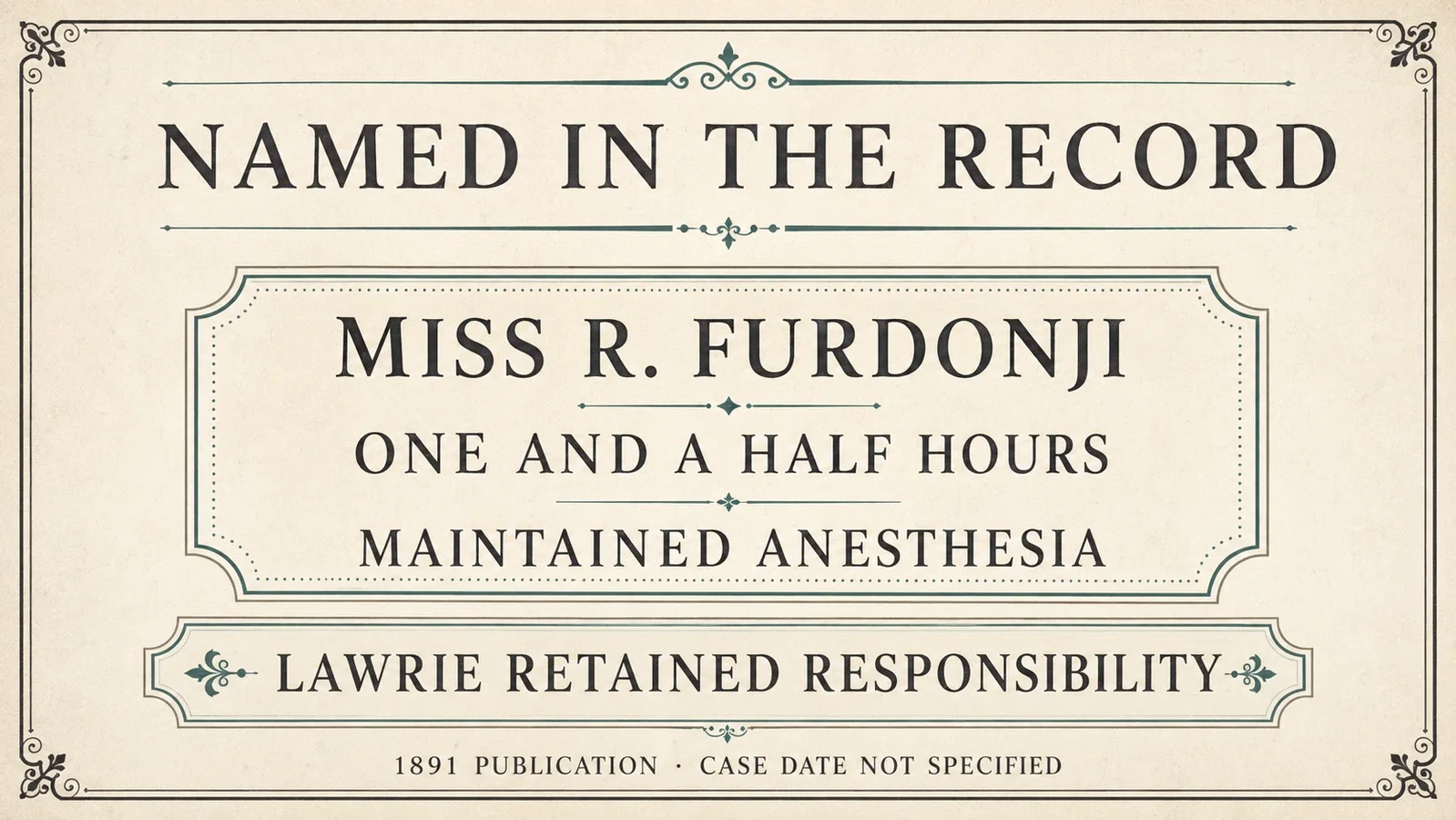
A modern reading guide, not a clinical chart. One and a half hours is the reported anesthetic duration in this account, not a drug guarantee. Responsibility for patient safety remained with Lawrie.[1,p.274]
The date on the book is not the date of the operation
The volume was printed in Bombay in 1891. Asman Jah's preface is dated September 11 of that year. Neither fact supplies the exact day of Rupa Bai's case.[1,title/preface]
The book also distinguishes two commissions. The first was appointed in 1888. The second was constituted after Brunton and Bomford arrived on October 21, 1889, and began work on October 23. Those events are not an 1891 commission merely because the collected report appeared in that year.[1,pp.1,11]
Lawrie's lecture cites material from September 1890. Its reference to an operation “yesterday” therefore cannot simply be assigned to 1889 from a later biographical timeline. This article uses 1891 as a documentary publication anchor and leaves the exact lecture and case dates unresolved.[1,pp.275,277–279]
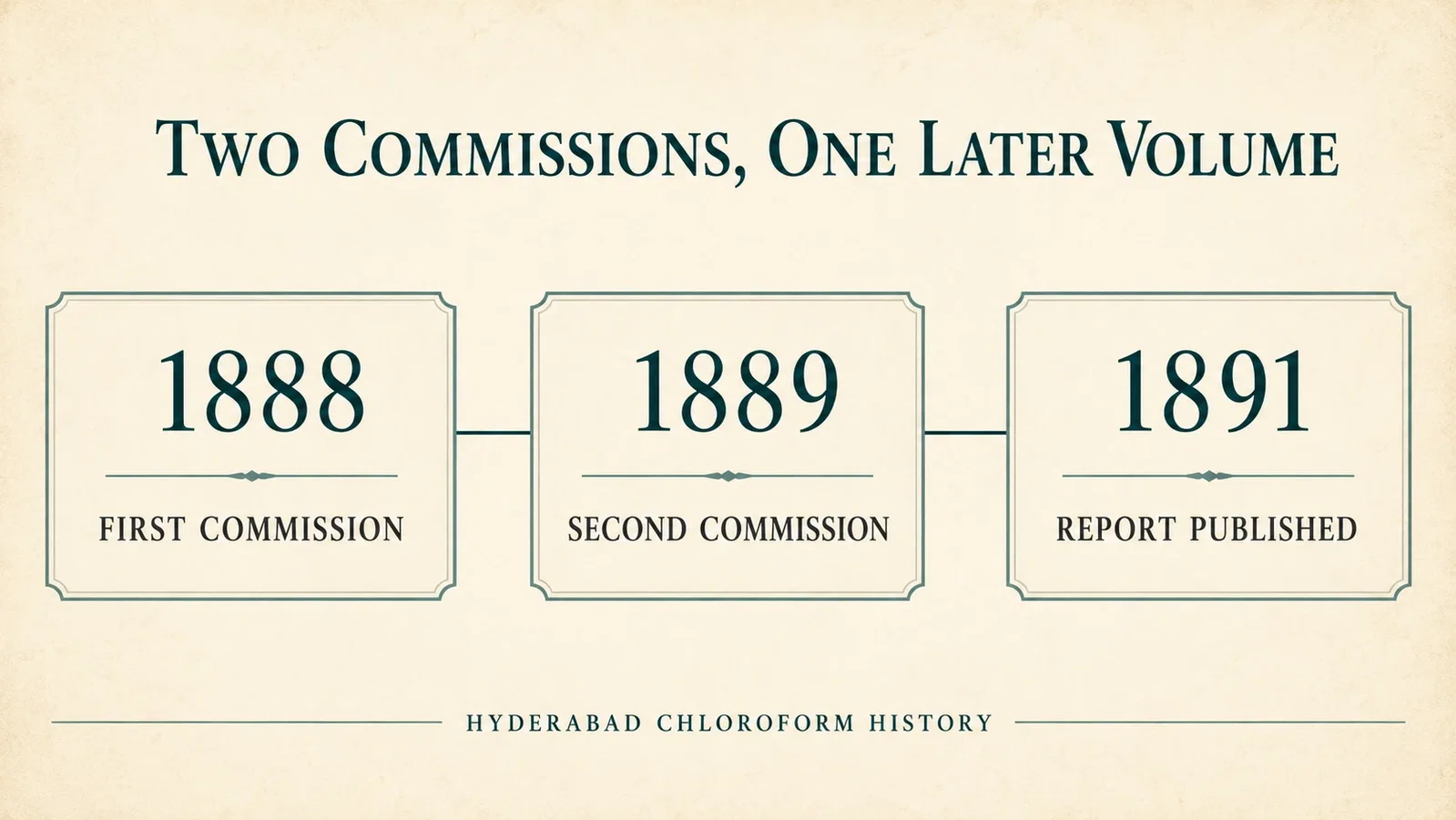
Three different events: 1888 first commission, 1889 second commission, 1891 report publication. This is not a qualification timeline or an exact date for the named anesthetic.[1,title/pp.1,11]
A valuable witness was also an advocate
Lawrie did not offer the anecdote as a neutral biographical entry. It opened a forceful defense of Lawrie’s approach to chloroform, challenging other physicians’ interpretation of deaths and arguing for the Hyderabad school’s account of respiratory and cardiac danger.[1,pp.274–279]
The volume preserves disagreement. A reprinted 1889 Lancet criticism warned against neglecting the heart as a factor in chloroform danger; Lawrie disputed that position. Lawrie’s confidence in students’ work was part of this larger controversy.[1,p.4]
The account can serve as evidence that Lawrie named a woman student performing anesthesia without accepting every physiological or safety assertion that followed. A documented contribution and a correct general theory are different historical questions.
Medical education was not a modern specialty certificate
The 2010 historical article by Ala and colleagues describes Rupa Bai's medical education in Hyderabad during 1885–1889. It explains the qualification called Hakeem as western medical training in this particular setting. It also describes Rupa Bai’s anesthesia work in Hyderabad hospitals during 1889–1917.[2,pp.259–260]
These are retrospective biographical statements. They do not fully explain the original lecture's fifth-year-student description. The discrepancy is left as it stands. Neither formulation establishes a modern anesthesia specialty credential.[1–2]
The same 2010 article reports a 1909 Edinburgh visit and a diploma in physics and chemistry. None of these sources reproduces a diploma. Besant's reproduced letter supports the further-study journey and the request for introductions; it does not certify admission, completion or the award of a particular qualification.[2–3]

Blank paper is an illustrative prop, not a facsimile of Besant's handwriting or an invented certificate. A letter of introduction and a specialist qualification are different kinds of evidence.[2,Fig.2;3,p.2]
Recognition without an unsupported ranking
WFSA's 2023 page celebrating women in anesthesia calls Rupa Bai the world's first female anaesthetist. That is an attributable professional recognition.[4]
A university-hosted UncoverED essay takes a more cautious view of the evidence for global priority. Its author emphasizes gaps in the surviving biography. This is a historiographical assessment, not an official university adjudication; the essay also contains chronological errors.[3]
The point is not to replace one certain ranking with another. It is to distinguish recognition from a comparison that has been comprehensively established across countries and historical definitions of professional training.
Rupa Bai's contribution need not disappear when that ranking remains unresolved. On page 274, a named Parsi woman student maintained anesthesia during an operation. The account is incomplete and its author's medical arguments require scrutiny. Yet the work and the person performing it are both visible. That is enough to deserve a place in the history.[1]
A teaching tradition within the same volume
The volume also looks back to Simpson’s 1847 report on chloroform. A separate passage on page 239 traces the principles attributed to Syme back to Simpson, situating the writer's own teaching tradition.[1,p.239] This is the volume's account of its intellectual ancestry. It does not establish that Rupa Bai studied with Simpson, nor justify the passage's claim of absolute safety.
Sources and reading limits
Read: from the 1891 Report of the Hyderabad Chloroform Commission, the title page and preface, selected pages on the history of the commissions, page 239 and Lawrie’s complete clinical lecture (pp. 274–279); the 2010 article by Ala and colleagues with its figures; Yechareddy’s UncoverED essay; and the 2023 WFSA entry. [1–4]
Not covered: the rest of the 1891 volume; any original diploma or enrollment record, so the Johns Hopkins attendance mentioned by Ala and colleagues is not adopted; and the exact dates of the lecture and the case. The photograph and letter in the UncoverED essay come from the same source as those in Ala and colleagues and are not independent corroboration.
- Report of the Hyderabad Chloroform Commission, with a preface by Sir Asman Jah. Bombay: Times of India Steam Press; 1891. Yale/Internet Archive scan.
- Ala N, Bharathi K, Subhaktha PKJP, Gundeti M, Ramachari A. Dr. (Miss) Rupa Bai Furdoonji: World's first qualified lady anaesthetist. Indian J Anaesth. 2010;54:259–261. DOI: 10.4103/0019-5049.65371; PMCID: PMC2933491. Complete article.
- Yechareddy S. Reckoning with Remembrance: The life of Rupa Bai Furloonji. DDI/UncoverED-hosted PDF. Undated; not peer reviewed.
- WFSA. Who are anaesthesia's female innovators, pioneers and leaders?, 2023.
Continue exploring
Related reading connects shared questions and contexts; it does not by itself establish historical influence.
Anesthesia Epochs · The Source Room · About & Editorial Method
Sources and reading limits are stated above. Illustrations are labelled as original source images or AI-made. Historical accounts are educational; they are not current treatment instructions.