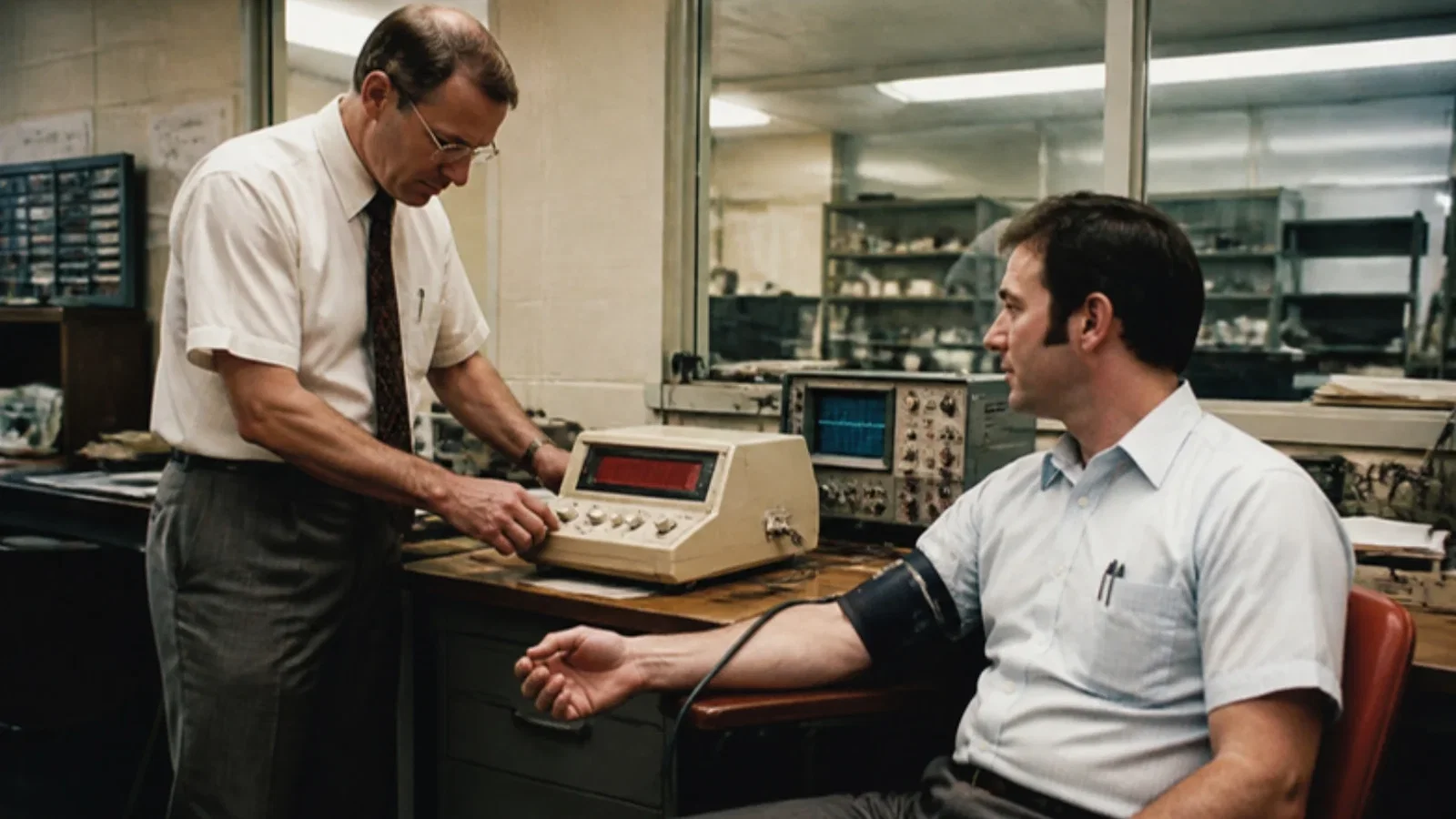
Two US patents granted in 1982 to Maynard Ramsey III and assigned to Johnson & Johnson, 'Automatic mean blood pressure reading device' (4,349,034 and 4,360,029), trace their origin to a continuation-in-part application filed on 26 March 1976. Apart from direct intra-arterial measurement, the patents say, there was no automatic indirect way to obtain mean blood pressure; the device inflated a cuff automatically, deflated it in pressure steps, tested successive pulsations at each step for artefact, and displayed the lowest cuff pressure with maximum oscillation as mean arterial pressure, before deflating, waiting and repeating. The ASA timeline dates the first automated oscillometric mean arterial pressure machine, DINAMAP 825, to 1976 and credits Ramsey.
Reading Library · Anesthesia Epochs · 中文版
Watch the education video (for clinicians)
1976: The Dinamap — The Cuff That Reads Itself · Anesthesia Epochs Education Series
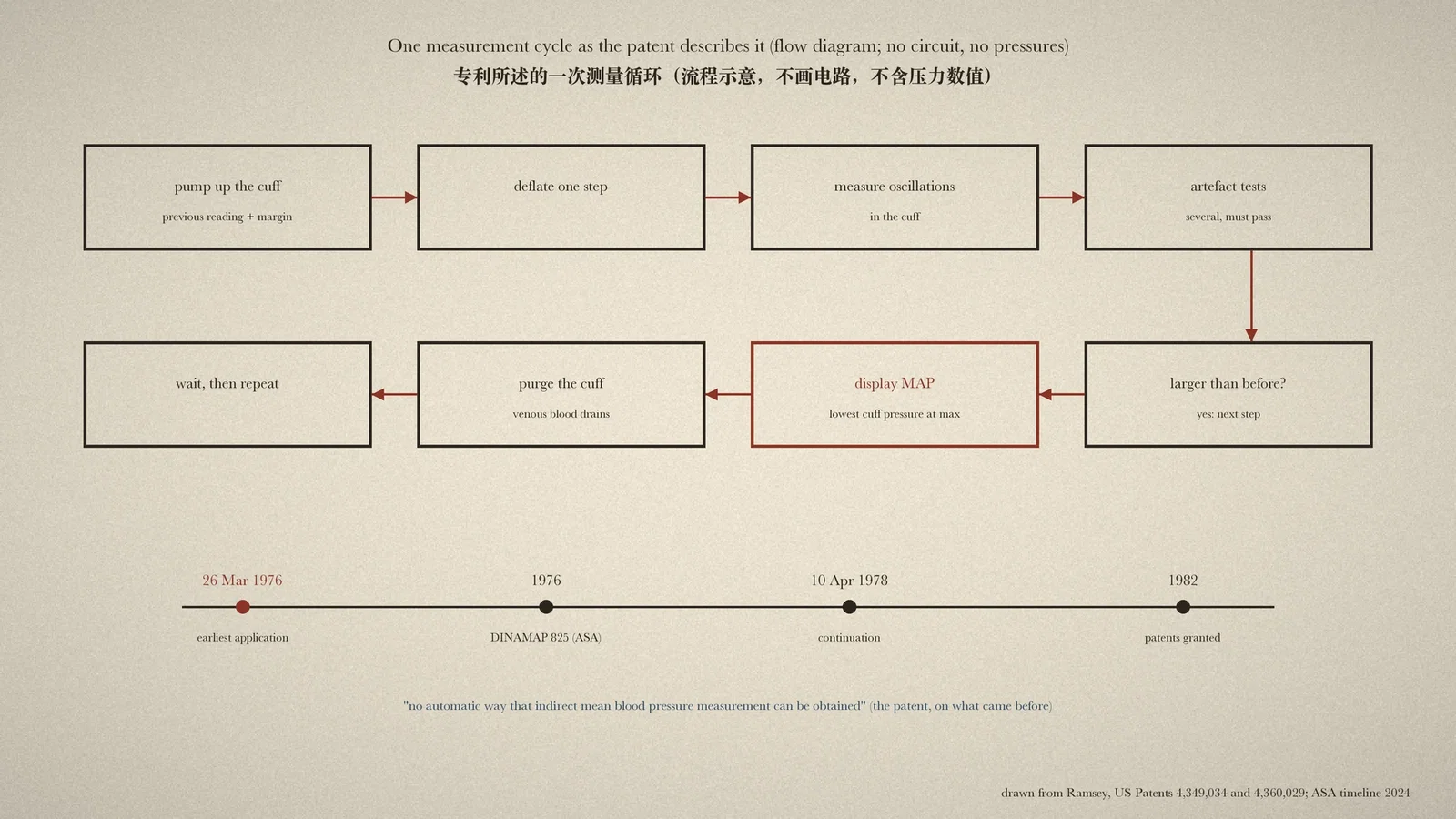
The cuff that inflates by itself every few minutes on an anaesthetised patient's arm is so ordinary now that it is hard to picture an operating theatre without it. The idea behind it is old; making it work without a person listening was not. Its paper trail begins with a patent application filed in March 1976 by an inventor in Tampa, Florida. [1]
What was missing
US Patent 4,360,029, "Automatic mean blood pressure reading device", was granted to Maynard Ramsey III of Tampa on 23 November 1982 and assigned to Johnson & Johnson. It was a continuation of an application filed on 10 April 1978, "which in turn is a continuation-in-part of U.S. application Ser. No. 670,902, filed Mar. 26, 1976". A companion patent, 4,349,034, with the same title, had been granted in September 1982. [1][2]
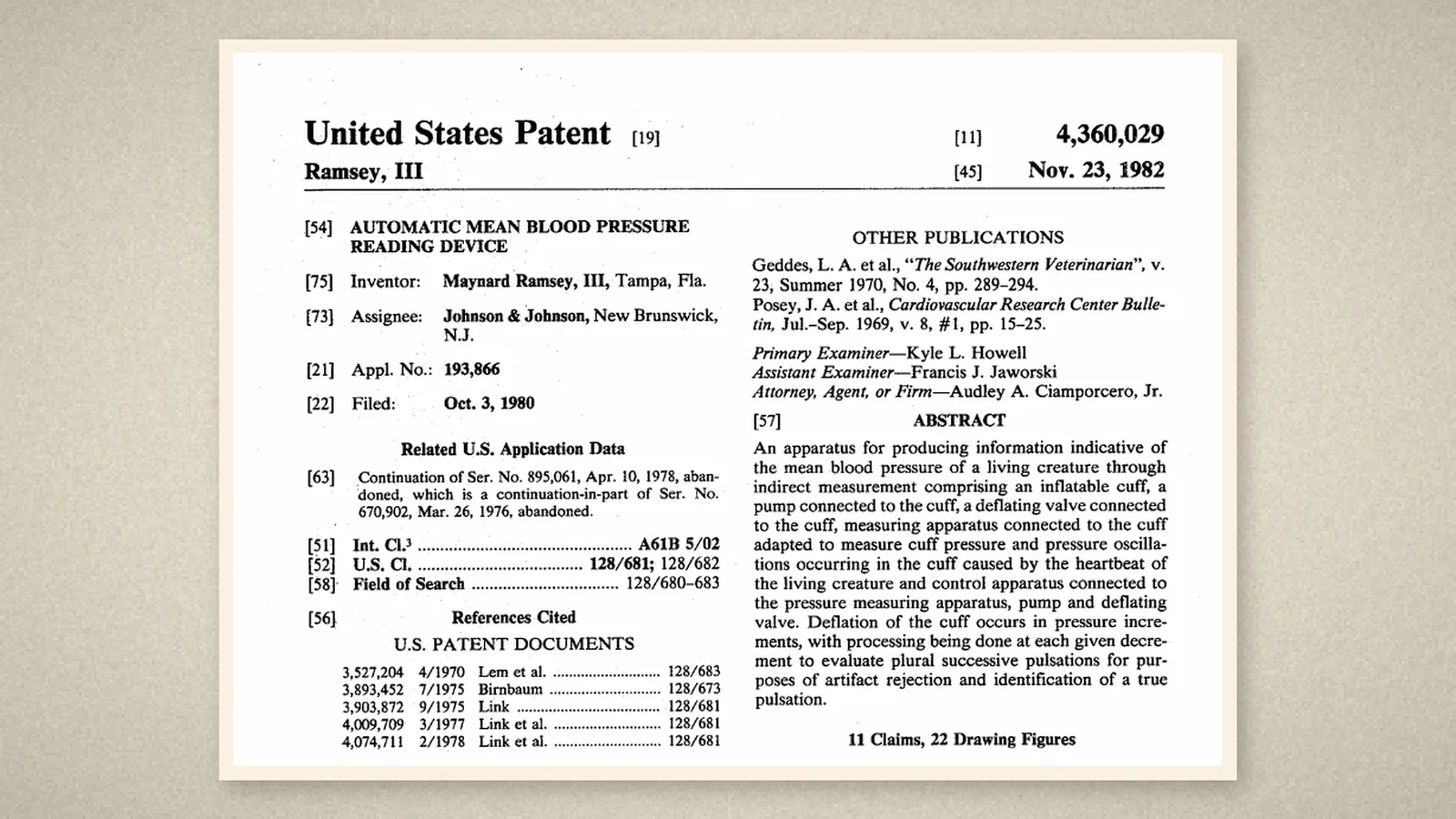
The patent opens with the gap. Doctors took indirect systolic and diastolic readings, but "there is currently no automatic way that indirect mean blood pressure measurement can be obtained". "True mean arterial pressure is not the arithmetic average of the systolic and diastolic pressure"; it depends on the shape of the pressure wave. "Presently the only means of measuring mean arterial pressure is to monitor it with direct intra-arterial means." Listening for Korotkoff sounds failed in shock, when there was not enough flow to make them; ultrasound probes needed jelly and careful placement and could shift during a long operation. Measuring oscillations in the cuff itself was an old method that "dates from the turn of the century but has not been widely utilized"; the closest earlier work, a measurement of mean pressure in a horse described in 1970, "requires operator judgment" to tell when the oscillations were largest. [1, cols. 1-3]
How the machine decides
The summary describes a cycle that needs no one to watch it. The device pumps up the arm cuff, using the previous reading to avoid more pressure than necessary, then lets the cuff down in steps. At each step it measures the oscillations in the cuff, and "it is required that the pressure oscillations satisfy a plurality of artifact detecting tests" before a value is accepted. When the oscillations have reached their largest at the lowest cuff pressure and further steps produce nothing larger, that cuff pressure is displayed as mean arterial pressure; the cuff is emptied so that venous blood can drain, and after a programmed wait the cycle starts again. A three-digit display showed the result, alarms compared it with limits, and a printer could keep a record. [1, cols. 3-6]
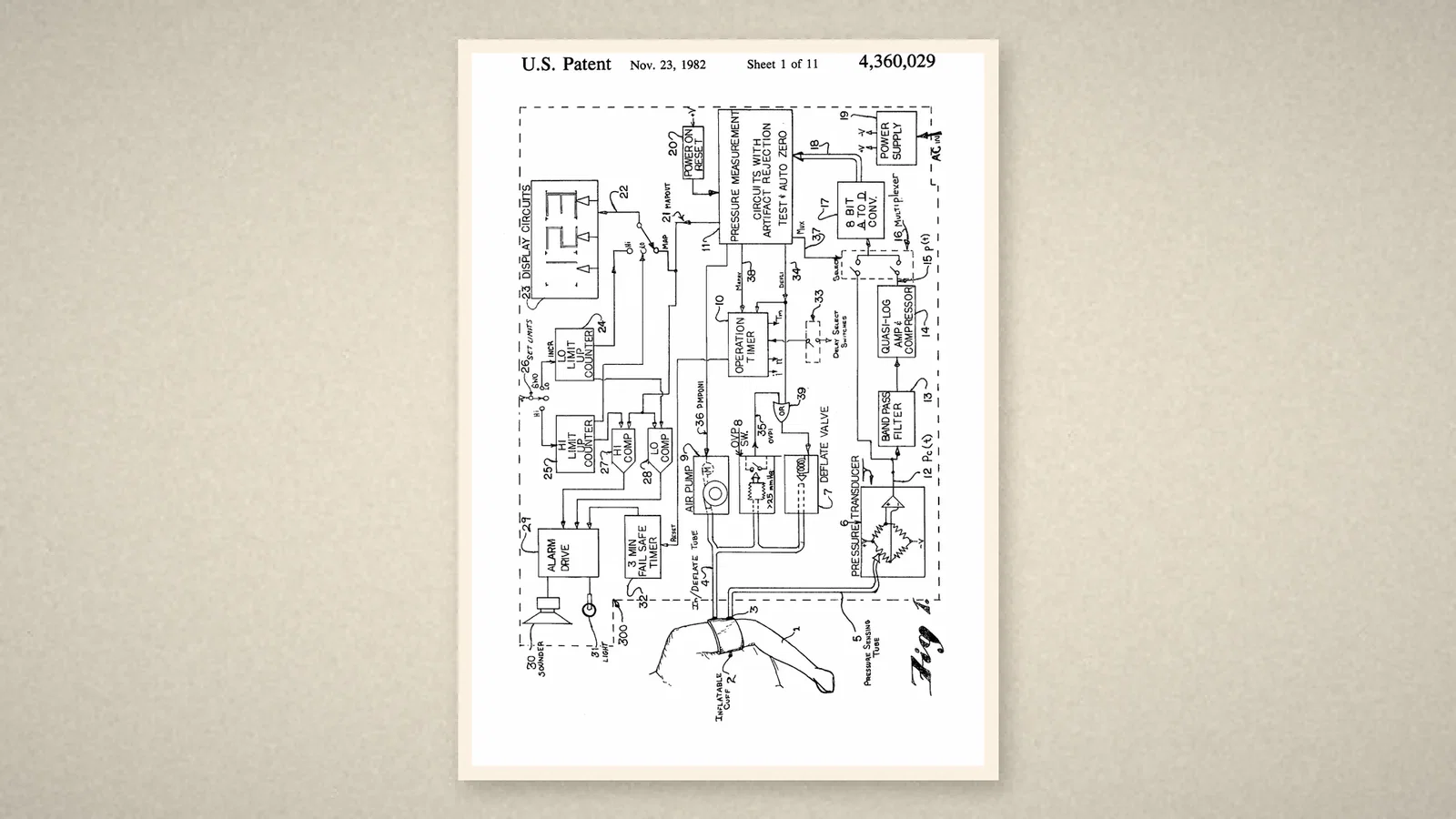
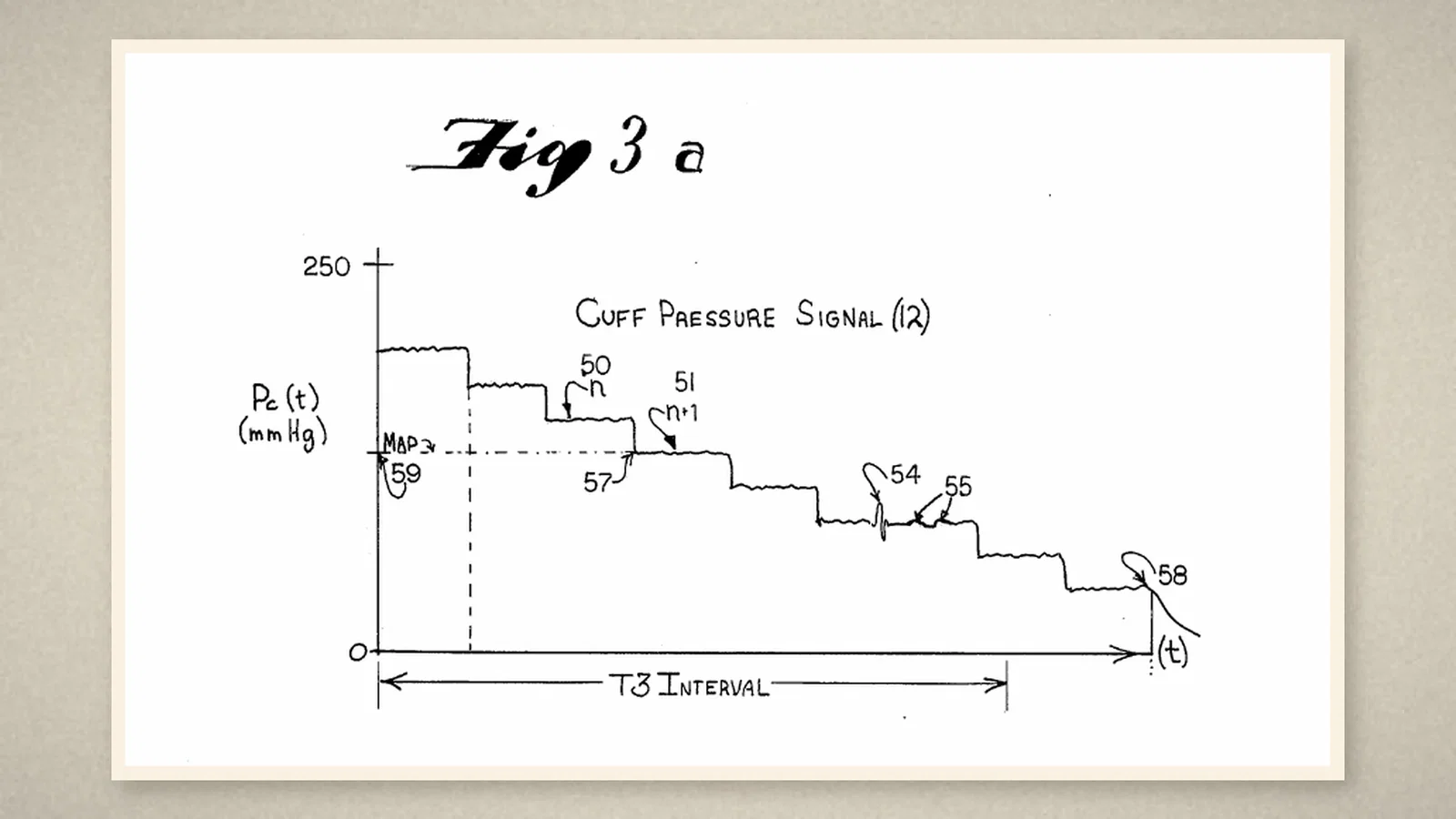
The patent's drawings show the cuff on an arm connected by one tube to a pump, a deflating valve and a pressure transducer, with circuits "with artifact rejection" and a display; its third sheet shows the cuff pressure falling in a staircase, with the mean arterial pressure marked at the step where the pulsations peak, and the arterial pulsations themselves. [1, Figs. 1, 3a-3b]
The timeline's account
The Australian Society of Anaesthetists (ASA) timeline lists under 1976 the "First automated oscillometric Device for Indirect Non-invasive Assessment of Mean Arterial blood Pressure machine - DINAMAP 825", "developed by Dr Maynard Ramsey III", and adds that much oscillometric research "by many other investigators preceded this particular development". [3, p. 75]
What the record shows
The moment blood pressure stopped needing an ear. The oscillometric principle was decades old; what the patent claimed was the logic that let a machine apply it reliably on its own: step down, test every pulse for artefact, take the largest, repeat. That logic is why an anaesthetist can now attend to the patient while the cuff takes care of itself.
Sources and reading limits
Read: US Patent 4,360,029, the front page, related-application data, background, summary, list of drawings and parts of the detailed description (patent PDF with text layer, page images of the front page and sheets 1-3); US Patent 4,349,034, front page; the ASA timeline 2024, p. 75.
Not covered: the abandoned applications of 1976 and 1978 themselves; Ramsey's own published description of the device; the maker's literature on DINAMAP 825; the 1969 bulletin and the 1970 veterinary paper cited by the patent.
Limits: the 1976 date is the filing date of the earliest application named in the patent, not a date of first clinical use. The ASA says the machine was produced by GE Medical Systems; the patents were assigned to Johnson & Johnson, and the change of ownership is not documented in what was read. Pressure increments, timings and circuit values are not repeated. Quotations are from the English original.
Three illustrations are crops of US Patent 4,360,029; one is drawn from it.
- Ramsey M III. Automatic mean blood pressure reading device. US Patent 4,360,029. 23 Nov 1982 (filed 3 Oct 1980). Google Patents
- Ramsey M III. Automatic mean blood pressure reading device. US Patent 4,349,034. 14 Sep 1982. Google Patents
- Australian Society of Anaesthetists. Anaesthesia history timeline. 2024:75. ASA
Continue exploring
Related reading connects shared questions and contexts; it does not by itself establish historical influence.
Anesthesia Epochs · The Source Room · About & Editorial Method
Published November 3, 2026. Sources and reading limits are stated above. Illustrations are labelled as original source images or AI-made. Historical accounts are educational; they are not current treatment instructions.