
The New England Journal of Medicine for 20 October 1977 (vol. 297, no. 16) carried 'Multifactorial index of cardiac risk in noncardiac surgical procedures' by Lee Goldman and colleagues of the departments of Medicine and Anesthesiology at the Massachusetts General Hospital. The most widely used preoperative assessment of surgical risk, the Dripps-American Surgical Association classification, was an excellent predictor of perioperative noncardiac complications but not necessarily of cardiac ones, and earlier reports on heart disease and surgical risk had been limited to univariate analysis. The study followed 1001 patients over 40 prospectively through major noncardiac operations and used multivariate discriminant analysis to identify nine preoperative factors independently correlated with life-threatening and fatal cardiac complications: a third heart sound or jugular venous distention; myocardial infarction in the preceding six months; frequent premature ventricular contractions documented at any time before operation; a rhythm other than sinus or premature atrial contractions on the preoperative electrocardiogram; age over seventy; intraperitoneal, intrathoracic or aortic operation; emergency operation; important valvular aortic stenosis; and poor general medical condition. Each factor was weighted from its discriminant coefficient and the totals divided patients into four classes of significantly different risk. The authors recommended that only truly life-saving procedures be undertaken in the highest class, that the next class warrant routine preoperative cardiac consultation, and they noted that a substantial share of the points are potentially controllable before operation.
Reading Library · Anesthesia Epochs · 中文版
Watch the education video (for clinicians)
1977: The Goldman Cardiac Risk Index — Nine Findings, Four Classes · Anesthesia Epochs Education Series

The commonest question in a preoperative conversation is whether the heart will stand the operation. On 20 October 1977 the New England Journal of Medicine, vol. 297, no. 16, published "Multifactorial index of cardiac risk in noncardiac surgical procedures" by Lee Goldman and a dozen colleagues from the departments of Medicine and Anesthesiology at the Massachusetts General Hospital. This article reads that paper. [1, p. 845]
The existing classification was not enough
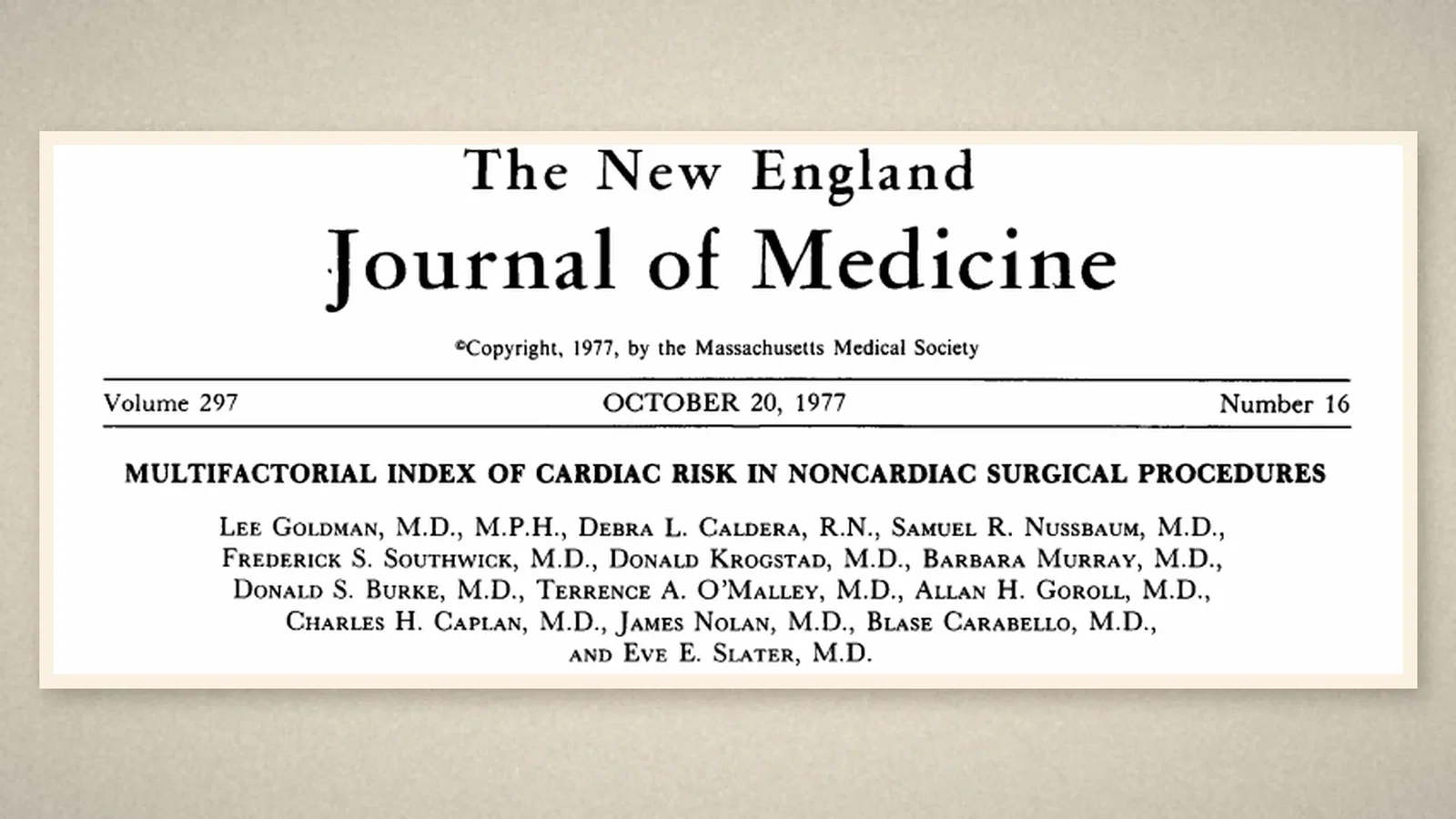
The article opens by observing that the most widely used technique for preoperative assessment of surgical risk, the Dripps-American Surgical Association classification, is an excellent predictor of perioperative noncardiac complications but not necessarily of perioperative cardiac problems. Existing data showed that a recent preoperative myocardial infarction, and most other signs and symptoms of cardiac disease, correlate with overall surgical and usually with specific cardiac risk; but those reports were limited to univariate analysis and came from before the era of widespread cardiac surgery. The present study therefore attempts a multifactorial approach to estimating cardiac risk in noncardiac procedures. [1, p. 845]
How it was done
The study enrolled 1001 patients over forty years of age prospectively as they came to major operations on the general surgical, orthopaedic and urological services of the Massachusetts General Hospital between October 1975 and April 1976, together with the patients of eleven co-operating private surgeons. Minor operations under local anaesthesia, uncomplicated endoscopies and transurethral resections of the prostate were excluded. [1, p. 845]
The analysis was by multivariate discriminant analysis; in the discussion the authors cite the view that this linear discriminant technique is the statistical method that best simulates the formation of clinical judgments. [1, p. 848]
The nine factors
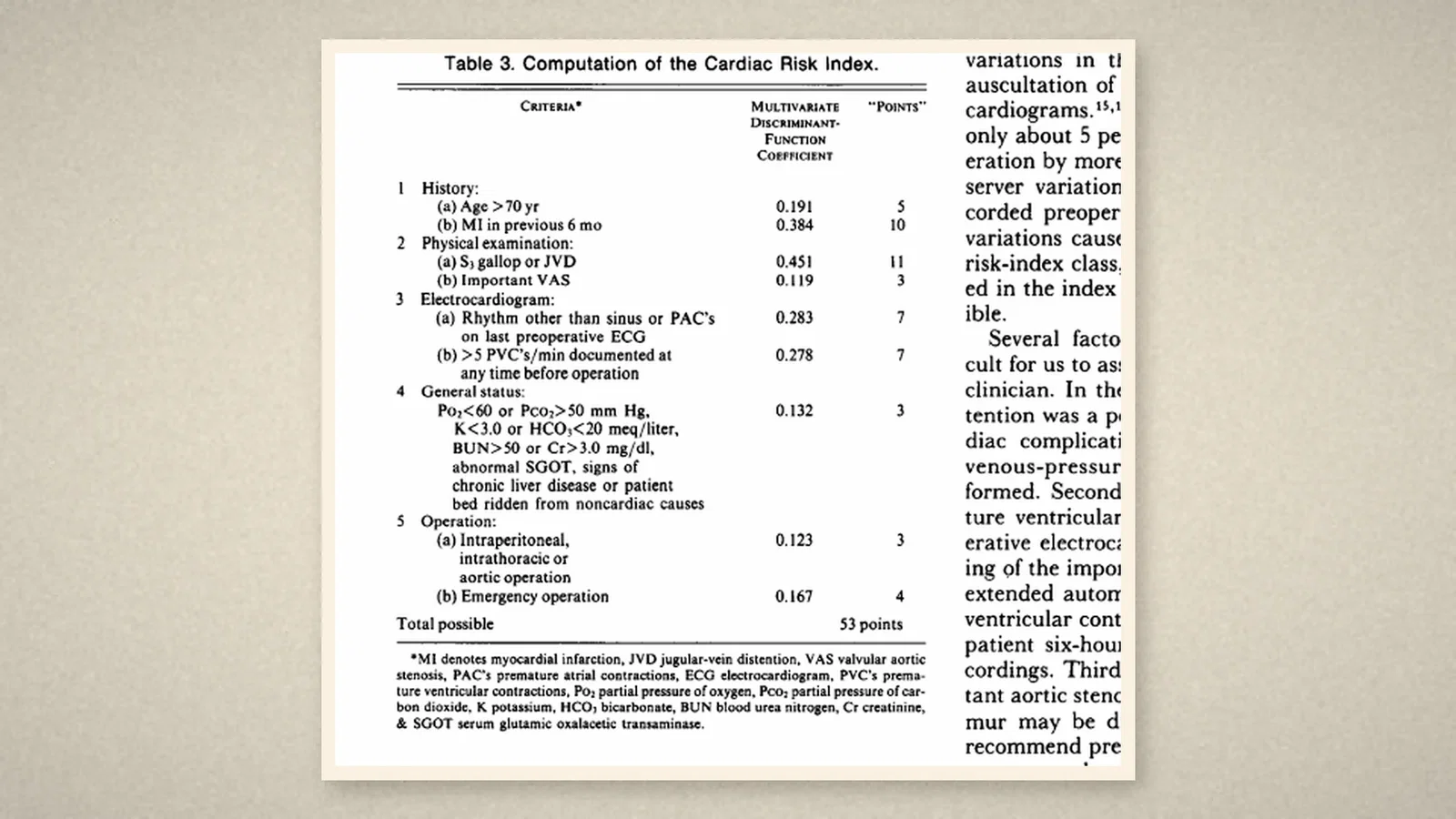
Nine preoperative factors emerged as independent significant correlates of life-threatening and fatal cardiac complications. [1, p. 845][1, p. 848]
- History: age over seventy; myocardial infarction in the previous six months.
- Physical examination: a third heart sound or jugular venous distention; important valvular aortic stenosis.
- Electrocardiogram: a rhythm other than sinus, or premature atrial contractions, on the last preoperative tracing; more than five premature ventricular contractions a minute documented at any time before operation.
- General status: a composite of blood gas, electrolyte, renal and liver findings, or being bedridden from noncardiac causes.
- The operation itself: an intraperitoneal, intrathoracic or aortic procedure; an emergency operation.
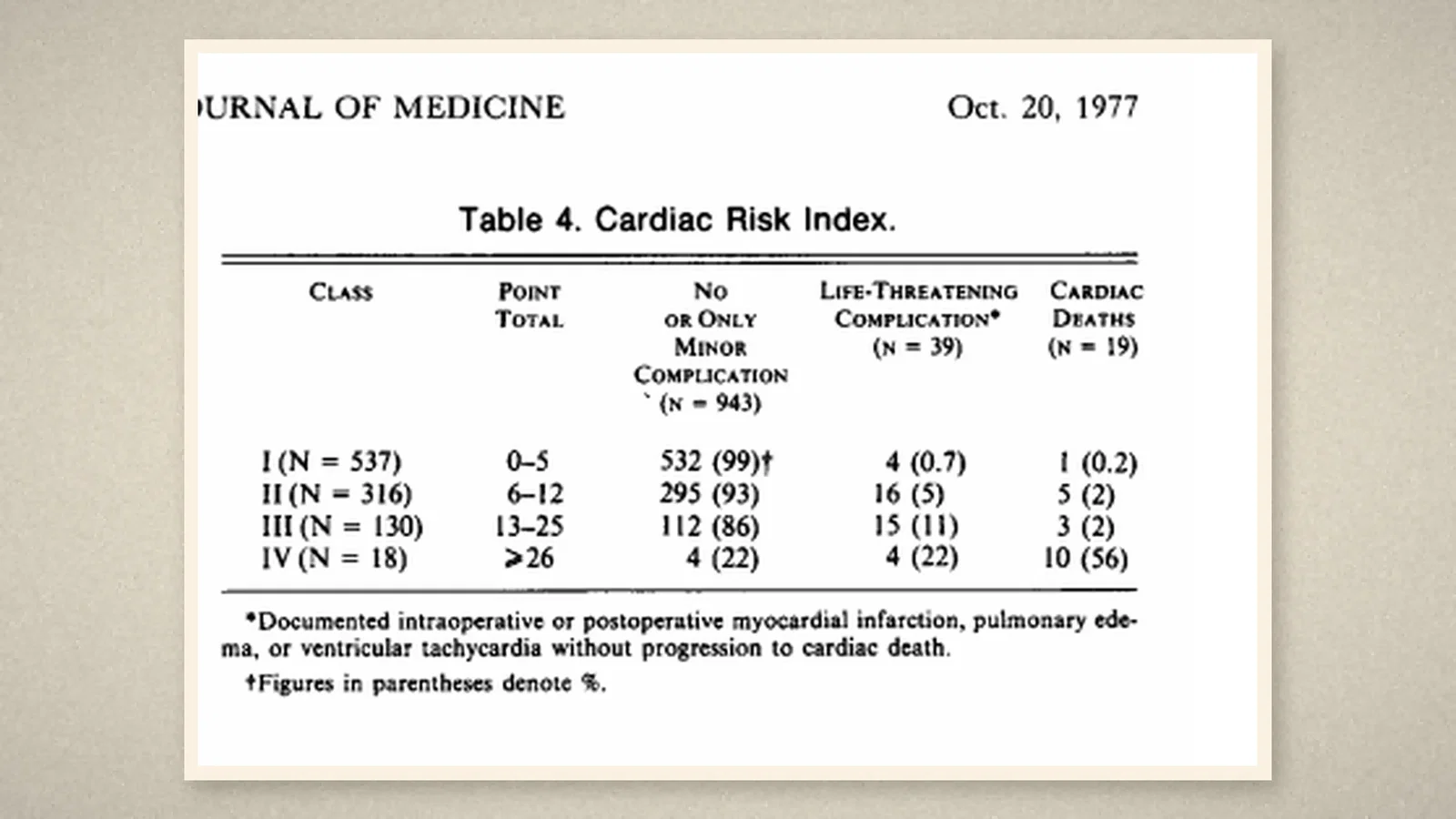
Each factor was given a point value derived from its discriminant function coefficient. The two heaviest were a third heart sound or jugular venous distention and a myocardial infarction in the preceding six months; the total possible was fifty-three points. Adding each patient's points placed that patient in one of four classes of significantly different risk, set out in the paper's Table 4. [1, p. 848]
How the authors proposed to use it
The section on potential uses is carefully qualified. Whether or not to operate is a multifactorial decision that must weigh operative against nonoperative risk and include the patient's own wishes; the standard risks of most procedures are roughly known and can be modified by the existing classification, by the surgeon's experience and by the facilities of the hospital. The index, the authors stress, estimates the additional cardiac risk in patients over forty, at one university hospital where cardiac operations are common and central-pressure monitoring is frequently used; only if prospective studies showed it applicable elsewhere could a patient's index score be added to surgical risk in estimating overall morbidity and mortality. [1, p. 850]
Within those limits they make two recommendations: that only truly life-saving procedures be performed on patients in the highest class, and that patients in the next class probably have enough cardiac risk to warrant routine preoperative medical consultation from a cardiac standpoint. They also point out that a substantial share of the points are potentially controllable, a third heart sound or jugular venous distention, a myocardial infarction in the preceding six months, an emergency operation and poor general medical condition together accounting for more than half the total, so that the possibility of lower overall risk after delay, with the patient medically more stable, should always be considered. If a patient has unstable angina or electrocardiographic changes suggesting acute infarction, nonemergency operations should be delayed until the cardiac condition is stabilised. [1, p. 850]
The weaknesses the authors state
The paper does not dodge its problems. Because daily electrocardiograms and cardiac enzymes were not done, and patients were not routinely monitored electrocardiographically after the recovery-room period, the recorded incidence of documented infarction and of ventricular tachycardia may understate the true complication rate; and because patients with complicated courses were followed more closely, the proportion of complications in that group may be overstated. Several factors, moreover, were hard for the authors to assess and might equally trouble a clinician: jugular venous distention, though a powerful correlate, is in question where central venous pressure has been measured; premature ventricular contractions can be missed without longer recordings; and distinguishing important aortic stenosis from a benign murmur may be difficult on physical examination. [1, p. 848]
What the record shows
The paper turns "will the heart stand it?" from an impression into a short list of signs, electrocardiographic findings and features of the operation that can be checked one by one before the day, and it separates the risk of the procedure from the additional risk the patient's heart brings. As notable as the index is the instruction for its use: which points can be worked on, and on what condition the index may be carried to another hospital at all.
Sources and reading limits
Read: Goldman L, Caldera DL, Nussbaum SR and colleagues, "Multifactorial index of cardiac risk in noncardiac surgical procedures", New England Journal of Medicine, 20 October 1977, vol. 297, no. 16, pp. 845-50 (scanned PDF obtained through institutional access), in full; page images of p. 845 (title and abstract) and p. 848 (Tables 3 and 4) checked.
Not covered: the Dripps-American Surgical Association papers and the earlier univariate studies cited here; later validations and revisions of the index.
Limits: no drug doses are reproduced here; the index's own point values and classes are the subject of this article and are given as the paper states them, while the laboratory thresholds inside the general-status criterion are summarised rather than listed. The per-class counts of complications and deaths are in the paper's Table 4 and are not repeated item by item.
Three illustrations are taken from the 1977 paper (p. 845; Tables 3 and 4 on p. 848). One is a diagram drawn from the text, with no people drawn.
- Goldman L, Caldera DL, Nussbaum SR, Southwick FS, Krogstad D, Murray B, et al. Multifactorial index of cardiac risk in noncardiac surgical procedures. N Engl J Med. 1977;297(16):845-50. doi:10.1056/NEJM197710202971601
Continue exploring
Related reading connects shared questions and contexts; it does not by itself establish historical influence.
Anesthesia Epochs · The Source Room · About & Editorial Method
Published November 5, 2026. Sources and reading limits are stated above. Illustrations are labelled as original source images or AI-made. Historical accounts are educational; they are not current treatment instructions.