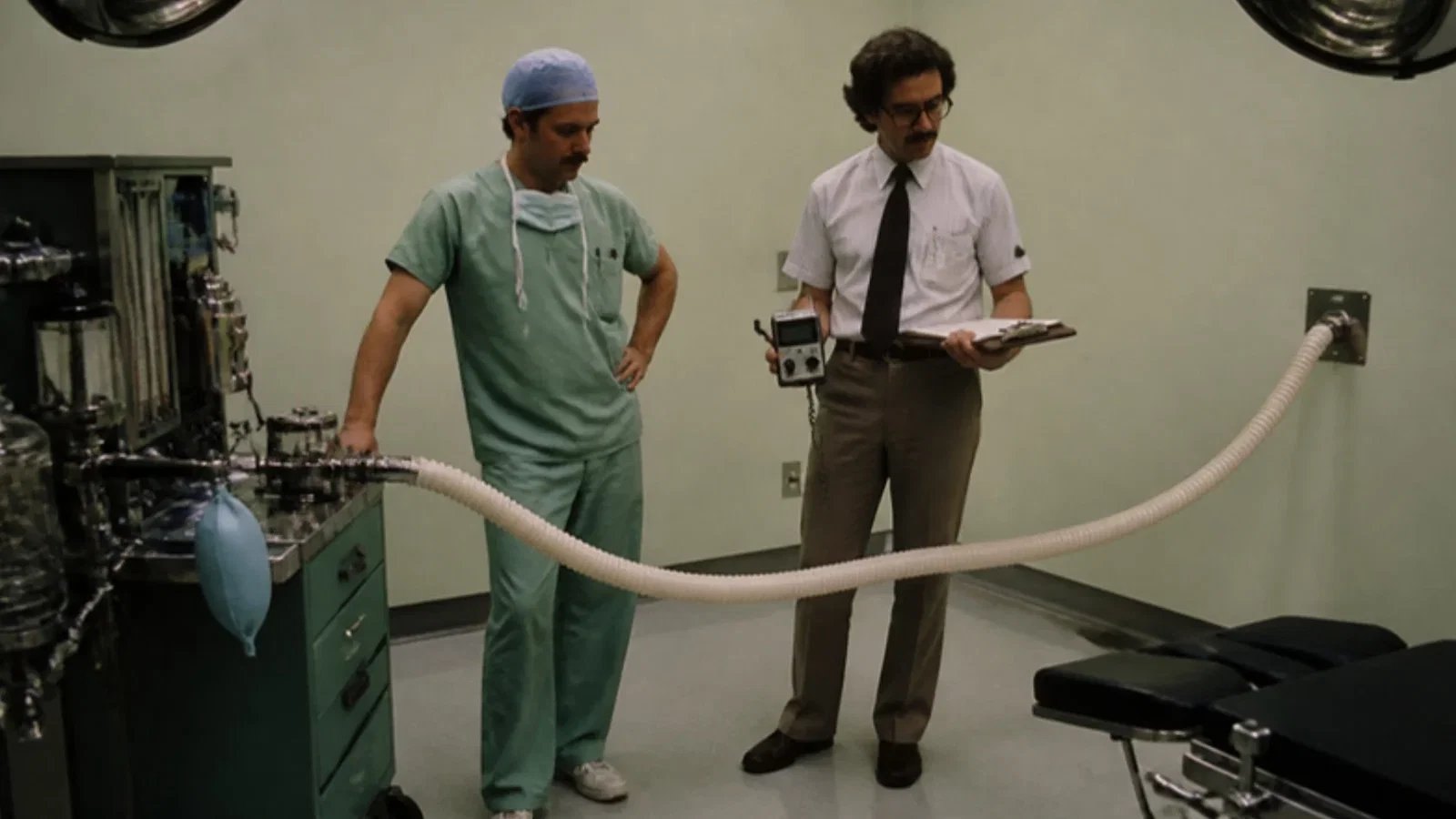
A US Air Force technical report turns a Stanford anaesthetist's experience into operating-room rules: collect, dispose, maintain and monitor.
Reading Library · Anesthesia Epochs · 中文版
Watch the education video (for clinicians)
1978: Whitcher on Waste Anaesthetic Gases — No Single Control Suffices · Anesthesia Epochs Education Series
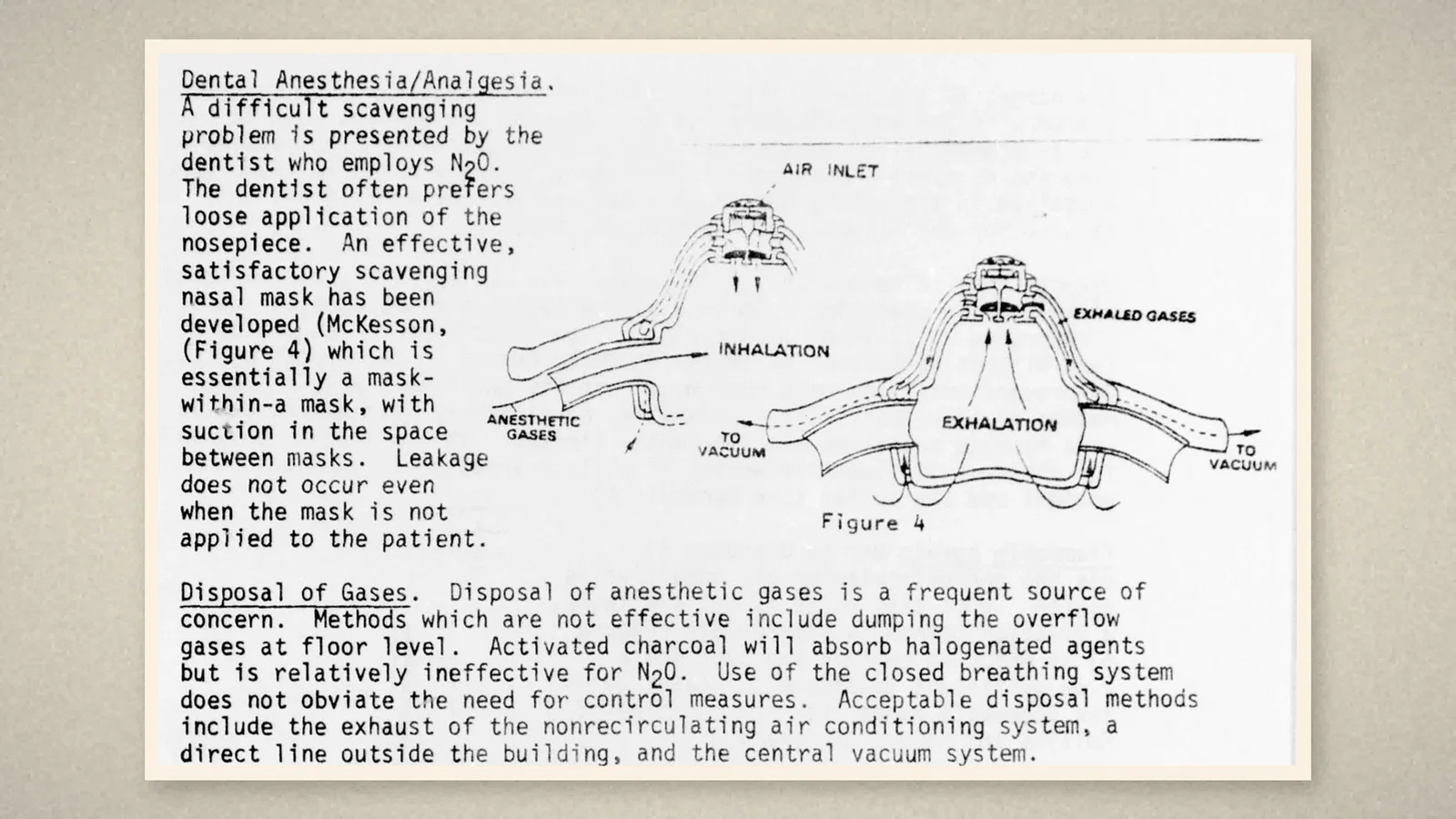
Every modern anaesthesia machine has a scavenging port, and operating rooms monitor trace gases. In 1978 these were new obligations. In January 1978 the US Air Force Occupational and Environmental Health Laboratory at Brooks Air Force Base reprinted a short course by Charles E. Whitcher of Stanford University Medical Center as a technical report: "Control of Occupational Exposure to Inhalational Anesthetics – Current Status". [1, cover] The Air Force explained why: many bases were "facing the problem of establishing some sort of waste anesthetic scavenging system", standards were in draft, and "there is much confusion". It judged Whitcher's text "the best advice currently available on this subject". [1, preface]
The case for control
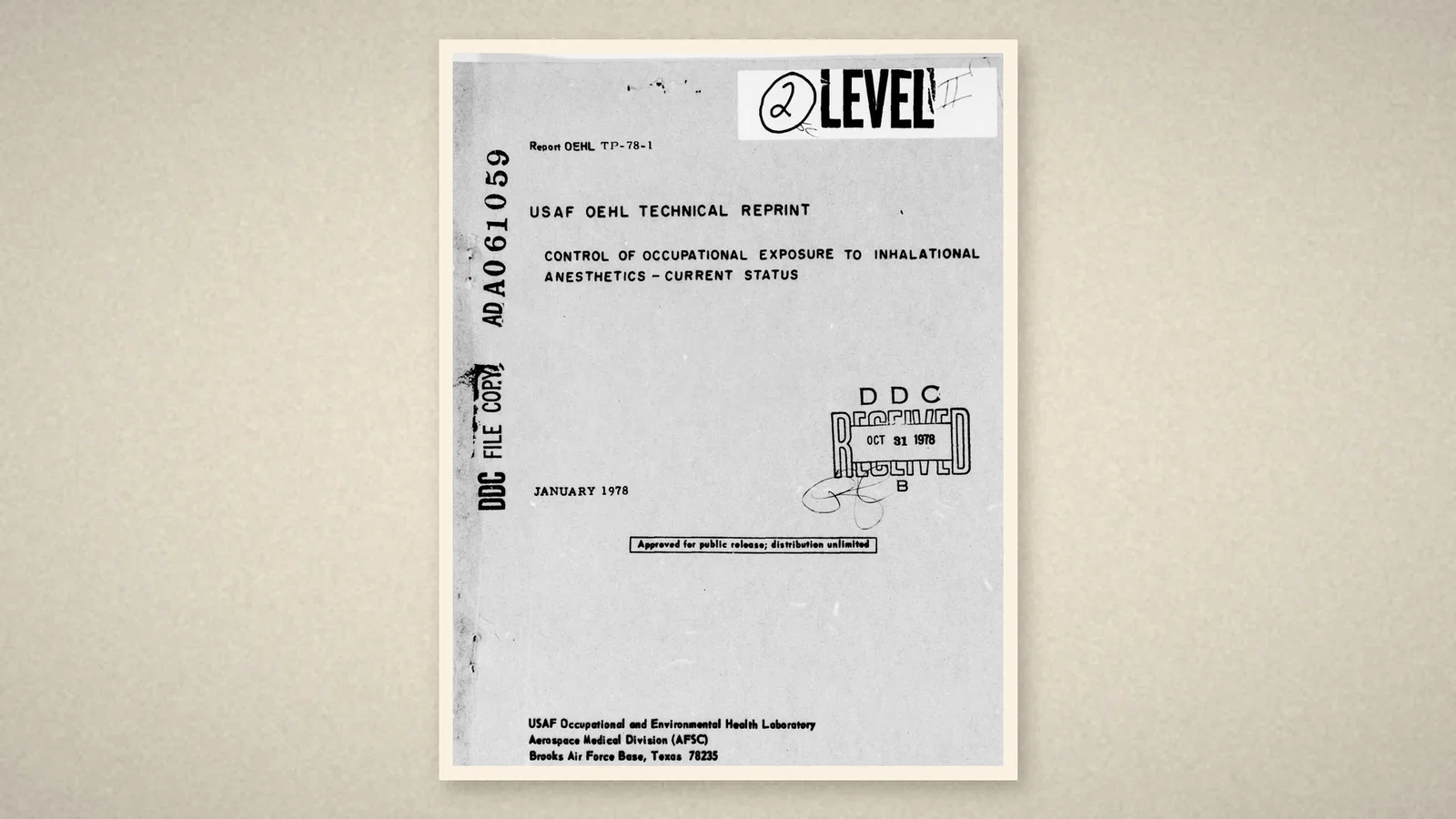
Whitcher began with numbers. "Without control measures N2O may be present in the operating room air in concentrations of 100–1000 ppm." The methods Whitcher described had reduced it to about 10 ppm, and halothane and enflurane to small fractions of the nitrous oxide level. [1, p. 1] The evidence of harm came from surveys and experiments. Three large retrospective surveys in the United States and the United Kingdom, combined, showed "a significant increase in spontaneous abortion among female physicians who work in the operating room", more birth defects in the children of women physicians exposed to it, and more liver disease in male anaesthetists. Animal studies were supportive. [1, p. 1] Whitcher did not overstate it: "Not all investigators are convinced", and stress had been cited as an alternative cause. Still, "the evidence of toxicity has proved sufficient to recommend the use of control measures", as committees of the American Society of Anesthesiologists and the American Dental Association had done; a NIOSH criteria document was under review by OSHA, and "if approved, control measures will be required by law". [1, p. 1–2]
Where the gas comes from
Without controls, "the most important leak sources are the relief valve of the absorber and the ventilator". Once those were scavenged, other leaks showed: the high-pressure nitrous oxide connections, flowmeters, absorber and tubing, and careless habits such as "turning the gases on, then engaging in unnecessary conversation with the patient prior to application of the facemask". [1, p. 2] Whitcher worked the physics: a leak of 100 cc a minute into a 20 × 20 × 10-foot room with ten air changes an hour gives 5.3 ppm at equilibrium. With a good programme nitrous oxide could be held "below 5–10 ppm" and halothane below 0.1–0.2 ppm; the OSHA limits then proposed were 25 ppm of nitrous oxide in the operating room, 50 in the dental office, and 1 ppm for potent agents. [1, p. 2]
Scavenging, and everything else
"To reduce concentrations of inhalational anesthetics in the operating room to a minimum, no single control measure by itself is sufficient." Scavenging was "one of the essential measures", defined as "the collection of waste anesthetic gases at the various breathing systems and their disposal outside the building". It had to be joined by careful handling, higher maintenance standards with frequent leak tests, and an air-monitoring programme that actually measured the gases. [1, p. 2] The report's foreword, quoting the NIOSH document, put the share of waste gas from anaesthetists' work practices in a well-scavenged room at 94 to 99 per cent: poorly chosen face masks, under-inflated endotracheal cuffs, spillage when filling vaporizers. [1, foreword]
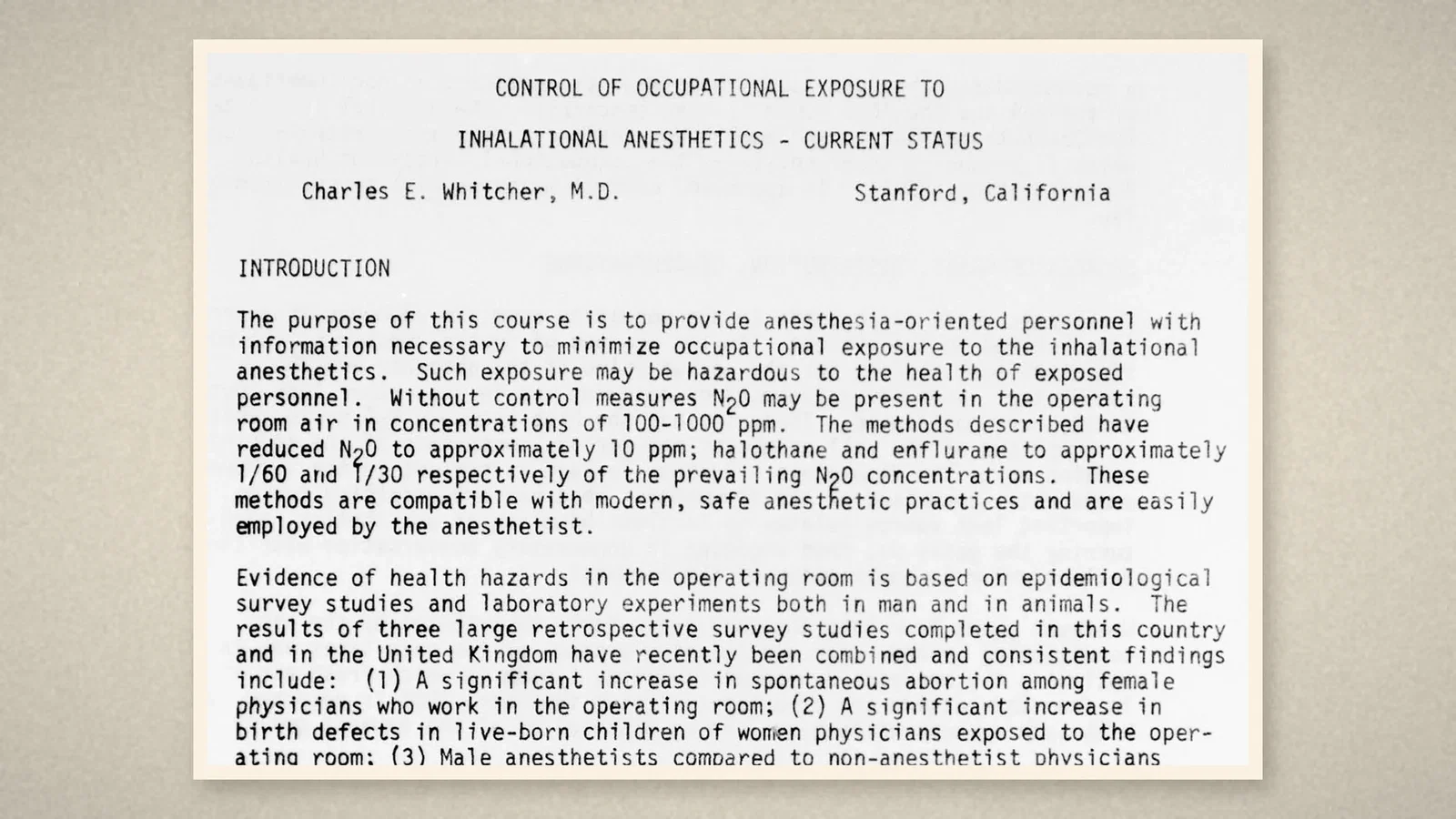
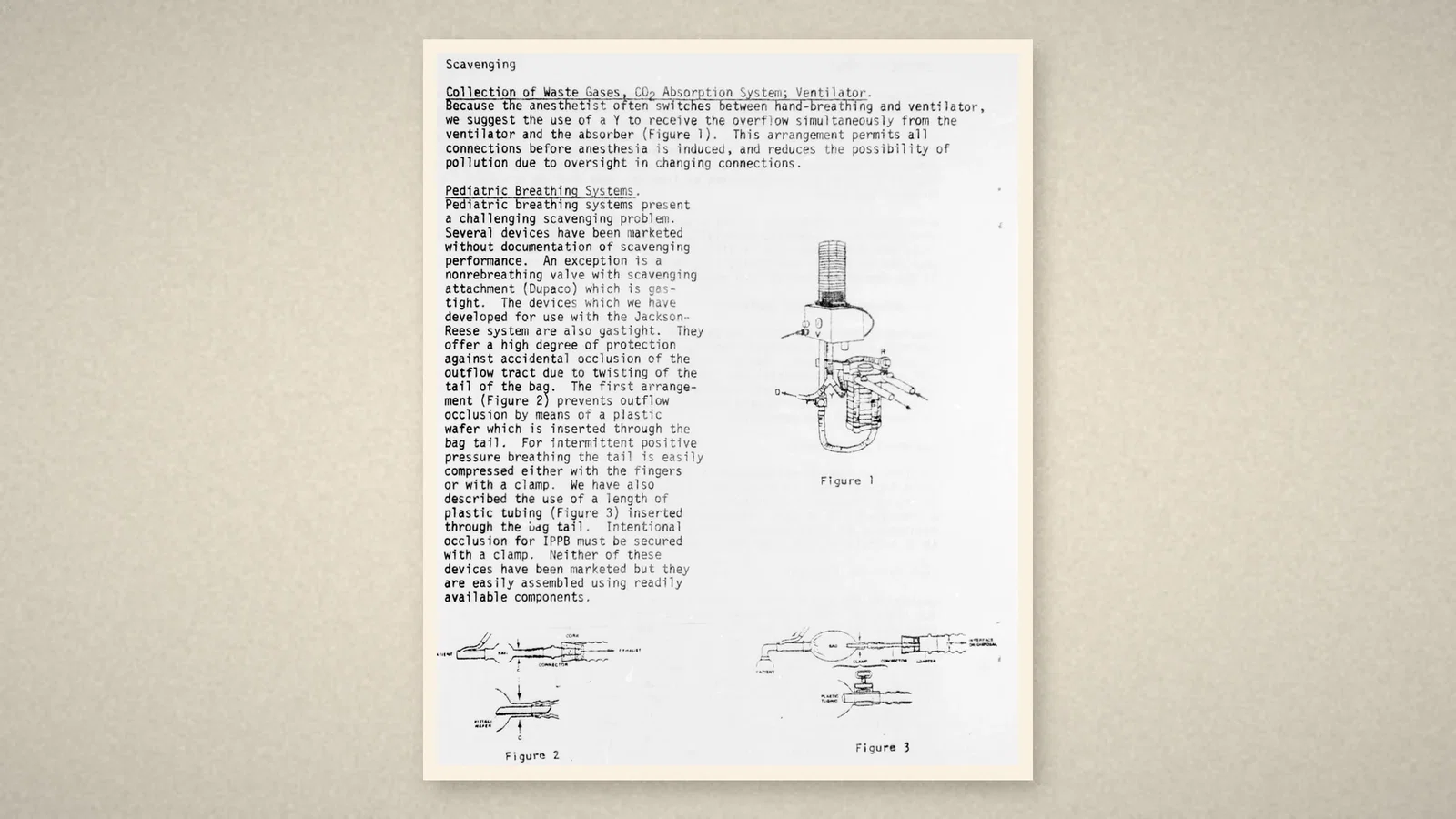
The practical pages were concrete. A Y-piece should take the overflow from both ventilator and absorber, so that switching between hand and machine ventilation left nothing unconnected. Paediatric systems needed gastight devices on the Jackson-Rees bag tail. [1, p. 4] For dental nitrous oxide a scavenging nasal mask, "essentially a mask-within-a-mask, with suction in the space between masks", stopped leakage even when lifted from the face. For disposal, dumping gas at floor level was ineffective; "activated charcoal will absorb halogenated agents but is relatively ineffective for N2O"; a closed breathing system did not remove the need for control. Acceptable routes were a non-recirculating air-conditioning exhaust, a direct line outside the building, or the central vacuum. [1, p. 5]
What the record shows
By 1978 the protection of operating-room staff from their own gases had become a matter of engineering and habit: pipes to carry gas outside, maintenance to stop leaks, monitors to prove it, and an anaesthetist who did not open the flowmeters before the mask was on. The report set the hazard out with caution about its certainty, and set the remedy out precisely.
Sources and reading limits
Read: USAF OEHL Technical Reprint TP-78-1, January 1978, by Charles E. Whitcher, with the Air Force preface and foreword.
Not covered: the sources on Tiegel's activated-charcoal filter of 1934 and Vaisman's Soviet survey of 1967 are not covered (Vaisman's 1967 paper is listed in PubMed but its text was not available), so neither is described here. The ASA committee report of 1974 and the NIOSH criteria document of 1977 are referred to only as the 1978 report cites them; the NIOSH document itself returned an access error. The article is dated January 1978.
All four illustrations are crops of the 1978 report.
- Whitcher CE. Control of occupational exposure to inhalational anesthetics – current status. USAF OEHL Technical Reprint, Report OEHL TP-78-1. Brooks Air Force Base (TX): USAF Occupational and Environmental Health Laboratory; January 1978. DTIC AD-A061059. Internet Archive
Continue exploring
Related reading connects shared questions and contexts; it does not by itself establish historical influence.
Anesthesia Epochs · The Source Room · About & Editorial Method
Published November 2, 2026. Sources and reading limits are stated above. Illustrations are labelled as original source images or AI-made. Historical accounts are educational; they are not current treatment instructions.