Separating an animal experiment, crisis-treatment approval and a later preventive indication.
Reading Library · Anesthesia Epochs · 中文版
Watch the companion film
1979: Intravenous Dantrolene — A Drug for the Crisis · Watch on YouTube
Historical anchor: 1979. Date details and source qualifications are explained below.

Five animals and eight treatment experiments are not interchangeable counts. In his 1975 paper, Gaisford G. Harrison reported repeated experiments in susceptible pigs to investigate whether dantrolene could interrupt halothane-induced malignant hyperpyrexia. Muscle rigidity, deep-muscle temperature and acid–base changes were among the observations.[3, pp.62–64]

One pig underwent three treatment experiments, another two, and the remaining three one each. The first animal initially improved but relapsed and died; the subsequent seven experiments had survival outcomes.[3, p.63 and Table I] Repeated observations in surviving animals must not become eight independent animals, eight patients, or an unqualified claim of complete success.
Harrison also described the difficulty of applying uniform criteria for when to begin treatment. Experimental conditions, doses and ancillary measures require attention in interpreting the report.[3, p.63] The paper supports an observed response in this animal model. It does not by itself reconstruct the later FDA review or quantify a benefit in human patients.
The regulatory event came on September 19, 1979. FDA’s official history records approval of Dantrium injection under NDA 018264 as a new dosage form. A later FDA review associates that approval with management of the skeletal-muscle hypermetabolism characteristic of malignant hyperthermia crisis, alongside supportive measures.[1–2]
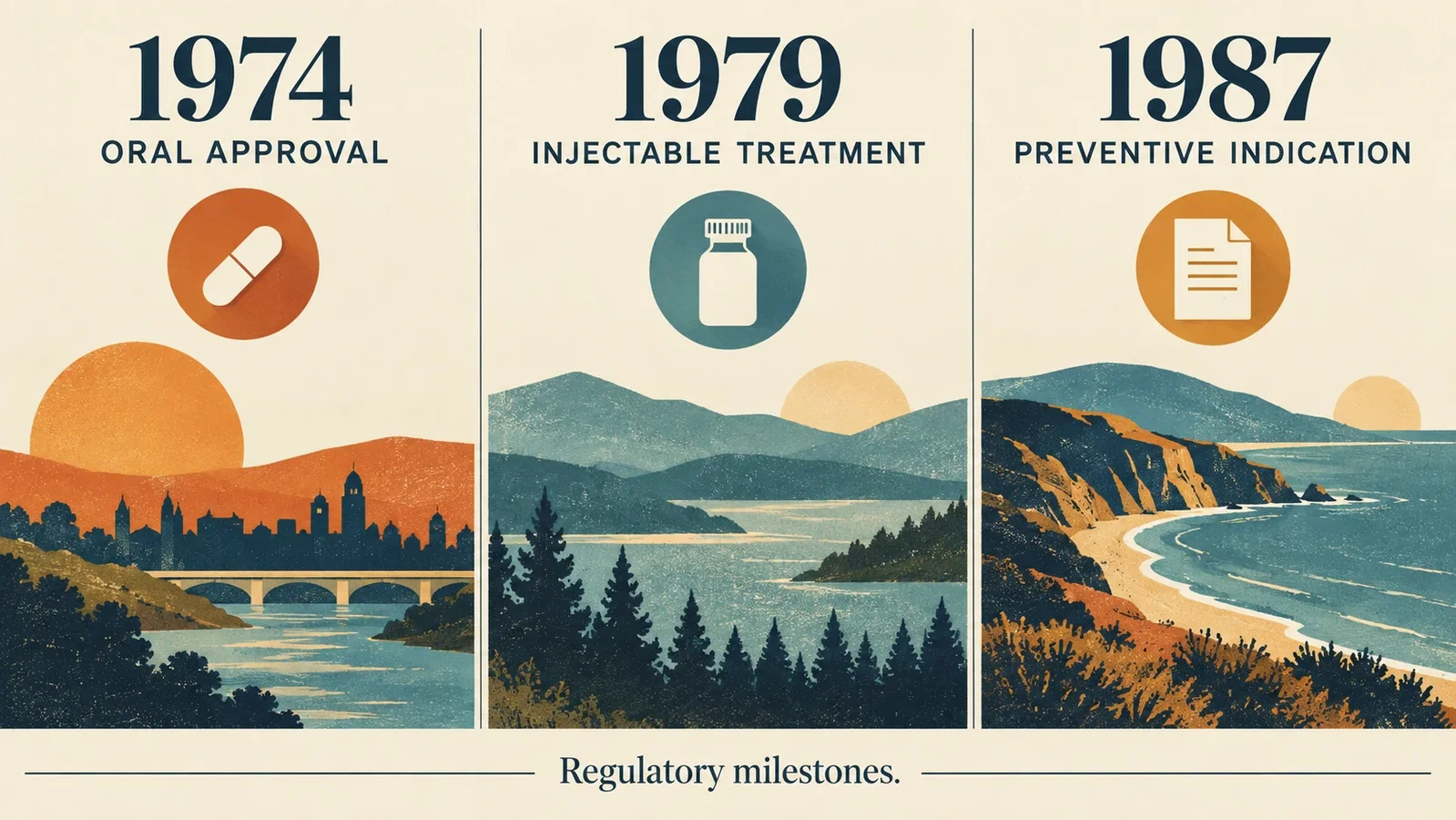
The agency’s regulatory history places oral capsule approval in 1974 and the injectable product’s preoperative and postoperative preventive indication in May 1987.[2, Regulatory History] Those dates distinguish the 1979 crisis-treatment milestone from both the earlier oral product and a later expansion of use.
There is also a useful connection to the recognition of malignant hyperthermia. In his 1986 retrospective, Michael Denborough recalled the 1960 patient reaction and family history of anesthetic deaths that led him to consider an inherited abnormality.[4] Recognition of risk and investigation of a treatment address different problems within the same syndrome. This editorial connection does not establish a direct causal line from one investigator to the later regulatory decision.
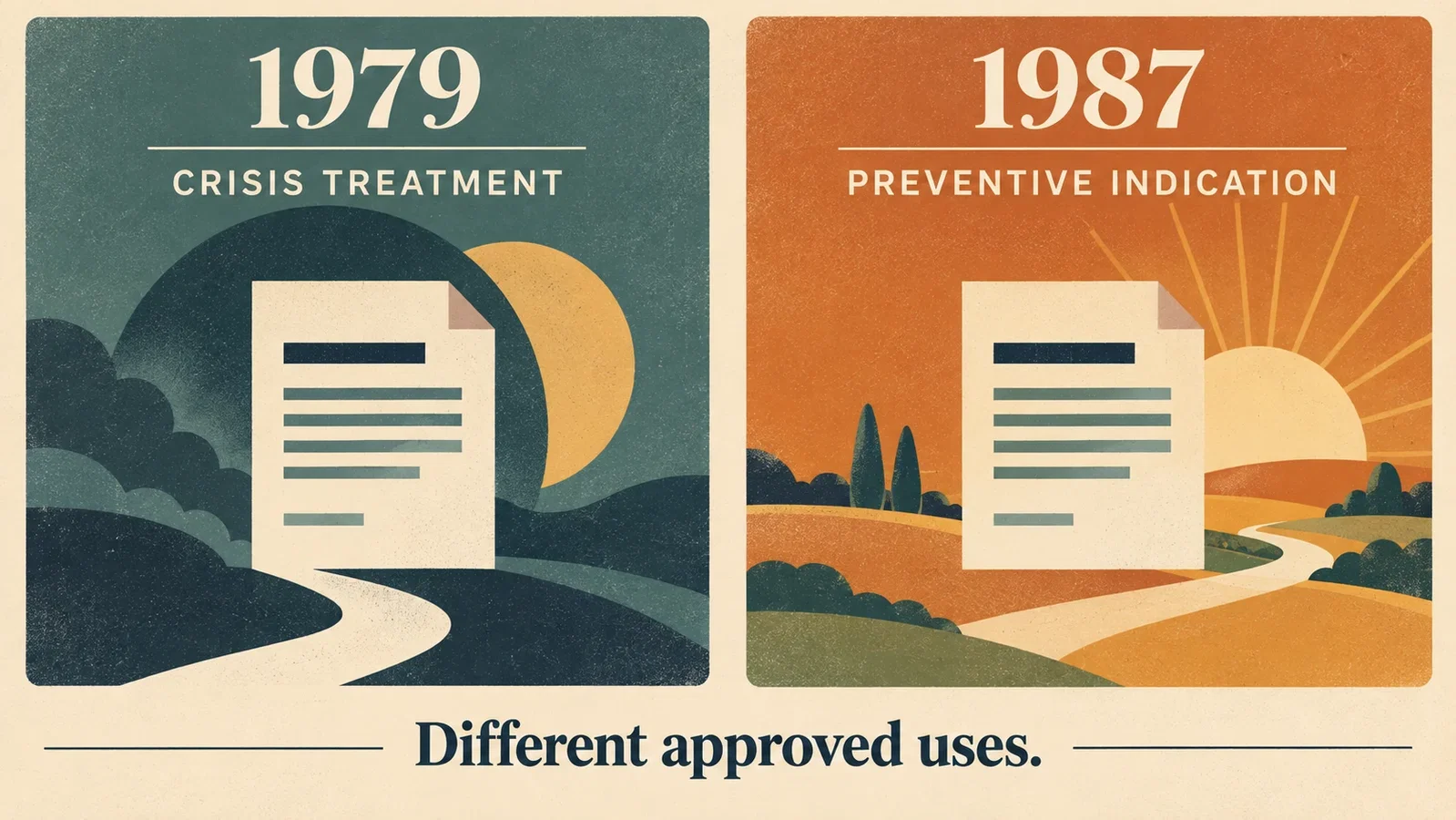
A notice entitled “Dantrolene sodium approved for malignant hyperthermia” appeared in the November 1979 FDA Drug Bulletin, volume 9, issue 5, page 27.[5] The notice’s publication date is separate from the September approval action. Keeping the formulation, indication and date together makes the historical claim precise without turning an animal experiment into a clinical trial or a later label into the original one.
Image note: all four images are modern editorial illustrations. Documents, vials, people and geometric icons are conceptual, without reproducing an original approval letter, package, historical person or animal experiment. The count diagram distinguishes animals from experiments and does not depict human efficacy. No dose or rescue protocol is shown.
Sources and reading limits
- U.S. Food and Drug Administration. Drugs@FDA: NDA 018264, Dantrium. Original approval action dated September 19, 1979; Type 3, new dosage form. Official history and openFDA record read; the original 1979 letter and label are not covered.
- FDA. NDA 205579, Ryanodex: Other Reviews, 2014. Selected PDF pp.11, 14 and 62 of 88 read. Regulatory history: Pharmacovigilance Review, July 17, 2014, printed p.2, reference ID 3594709. This later agency review is not a facsimile of the 1979 label.
- Harrison GG. Control of the malignant hyperpyrexic syndrome in MHS swine by dantrolene sodium. Br J Anaesth. 1975;47(1):62–65. DOI. All four original pages read, including methods and Table I.
- Denborough M. This Week’s Citation Classic: Anaesthetic deaths in a family. Current Contents. 1986;(45):18, November 10. Complete one-page participant retrospective read; commentary dated August 22, 1986. The 1960 and 1962 original reports are not covered.
- Dantrolene sodium approved for malignant hyperthermia. FDA Drug Bull. 1979 Nov;9(5):27. PubMed. Metadata only; bulletin full text not covered.
The official FDA decision record, three selected pages of the 2014 review package, all four pages of Harrison’s original article and Denborough’s one-page retrospective were read. The 1979 bulletin full text and original label are not covered. The agency’s decision record establishes the approval date, but no verbatim reconstruction of the 1979 label is claimed. This is a historical account, not current treatment guidance.
Continue exploring
Related reading connects shared questions and contexts; it does not by itself establish historical influence.
The Source Room · About & Editorial Method
Sources and reading limits are stated above. Illustrations are labelled as original source images or AI-made. Historical accounts are educational; they are not current treatment instructions.