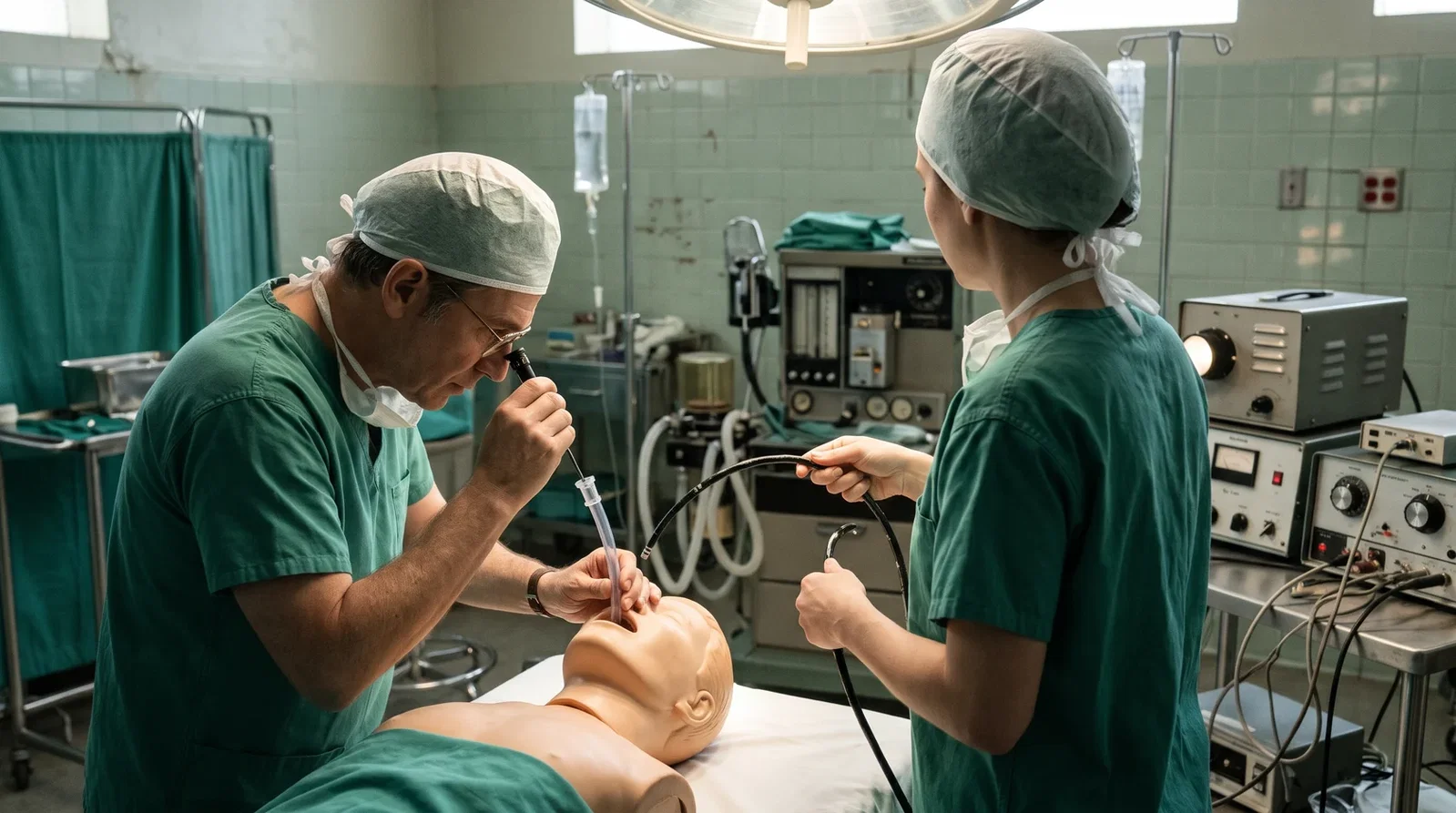
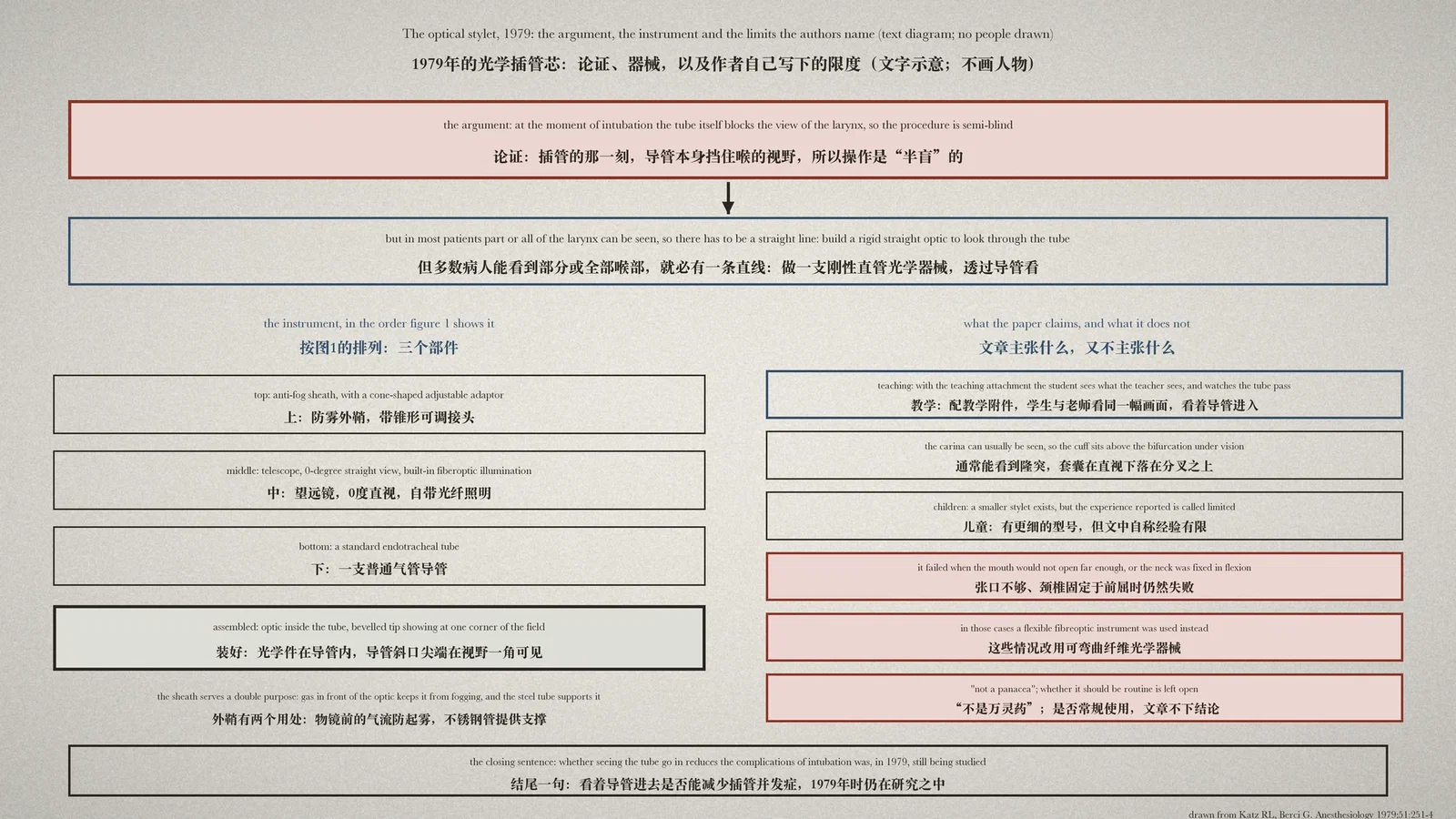
In September 1979 Anesthesiology, vol. 51, no. 3, pp. 251-254, carried a four-page Clinical Report by Ronald L. Katz and George Berci, 'The optical stylet - a new intubation technique for adults and children with specific reference to teaching'. The paper says where the idea came from: talking about difficult intubations, an endoscopist and an anaesthesiologist noticed that even in good conditions the tracheal tube itself blocks the view of the larynx at the moment of intubation, so the procedure is performed semi-blindly. Since in most patients some or all of the larynx can be seen, they reasoned, there must be a straight line; so they built a rigid straight optical instrument that lets the operator see through the tube. It is a telescope with built-in illumination inside an anti-fog sheath that serves a double purpose: gas blown between sheath and telescope keeps positive pressure in front of the optic so it does not mist, and the steel tube supports the optic against breakage; an adjustable adaptor joins it to the tracheal tube. Assembled, the bevelled tip of the tube shows at one corner of the field and can lift the epiglottis. The authors report a series of patients, and say that because the carina can usually be seen the tube can be placed between the cords and the bifurcation under vision, so that the risk of intubation of one main bronchus is virtually eliminated. With a teaching attachment a student sees what the teacher sees, and watches the tube pass; the paper's own claim is that the instrument's greatest value may be in teaching. It also records where it failed - a mouth that would not open far enough, a cervical spine fixed in flexion - cases in which a flexible fibreoptic bronchoscope was used instead; the authors write that the optical stylet is not a panacea, decline to say whether it should be routine or reserved, and close by noting that whether it reduces complications was still being studied.
Reading Library · Anesthesia Epochs · 中文版
Watch the education video (for clinicians)
1979: The Optical Stylet — Katz and Berci · Anesthesia Epochs Education Series
Most descriptions of a new instrument begin with the instrument. This one begins with a complaint about the old way of doing things, and the complaint is the interesting part. In September 1979 Anesthesiology printed, in its Clinical Reports section, four pages by Ronald L. Katz of UCLA and George Berci of Cedars-Sinai. Their claim was not that intubation was difficult. It was that intubation, as everyone then performed it, was partly done without looking. [1, p. 251]
The sentence the rest of the paper hangs on
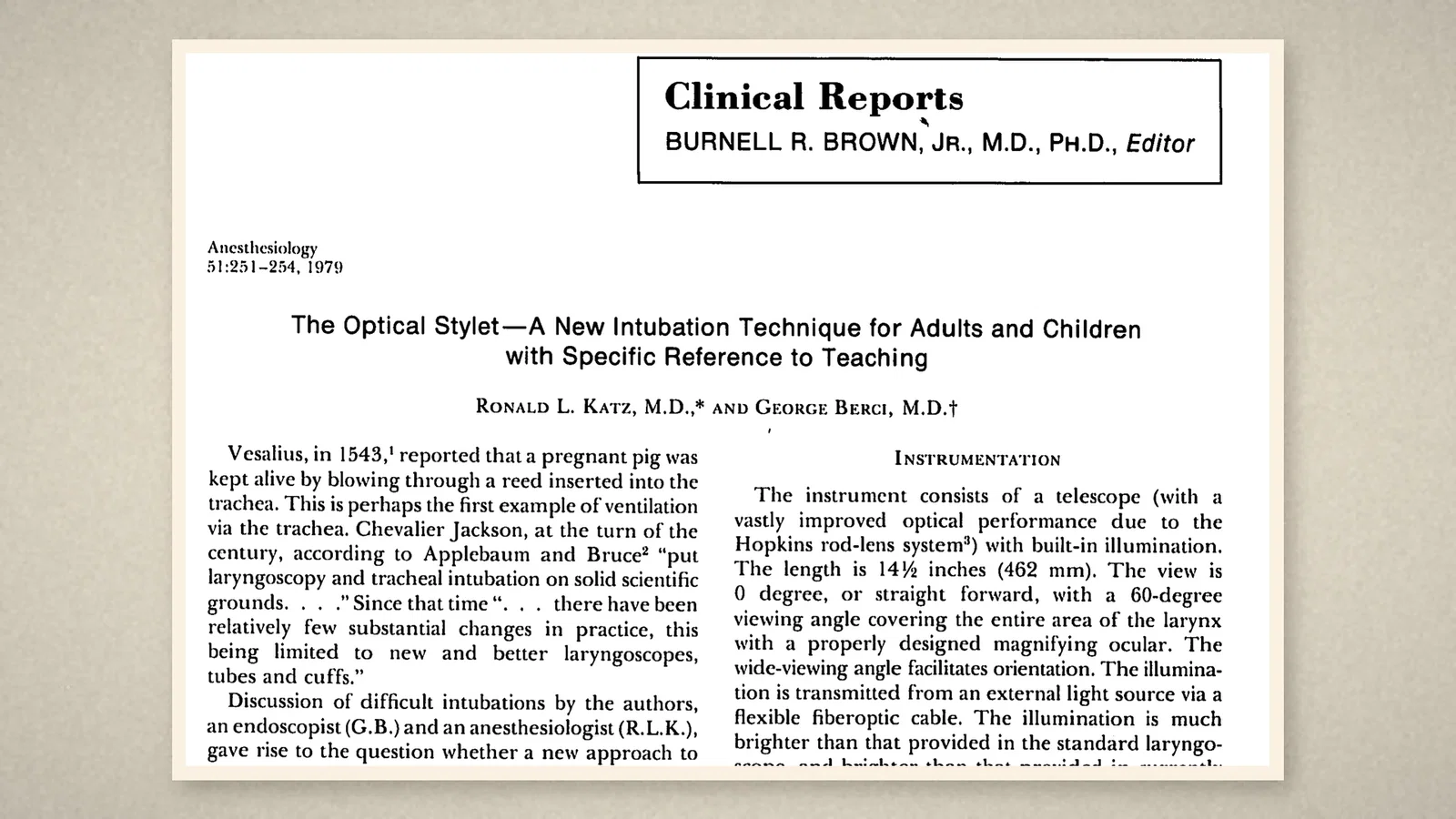
The paper opens at a distance, with Vesalius in 1543 keeping a pig alive through a reed in the trachea, and with Chevalier Jackson putting laryngoscopy and tracheal intubation, as the authors quote a textbook saying, on solid scientific grounds. Then it arrives at the point. Discussion of difficult intubations between "an endoscopist (G.B.) and an anesthesiologist (R.L.K.)" raised the question of whether a new approach might be worth trying, and the reason given is precise: even in excellent conditions, at the moment of intubation, "the endotracheal tube blocks the view of the larynx" and so "the procedure is performed semi-blindly". [1, p. 251]
From there the design follows almost as a deduction. If in most patients some or all of the larynx can be seen, then a straight line to it must exist — many anaesthetists, after all, use a straight blade. So build a rigid, straight optical instrument and look through the tube rather than around it. "We refer to this instrument as the" optical stylet. [1, p. 251]
What it was
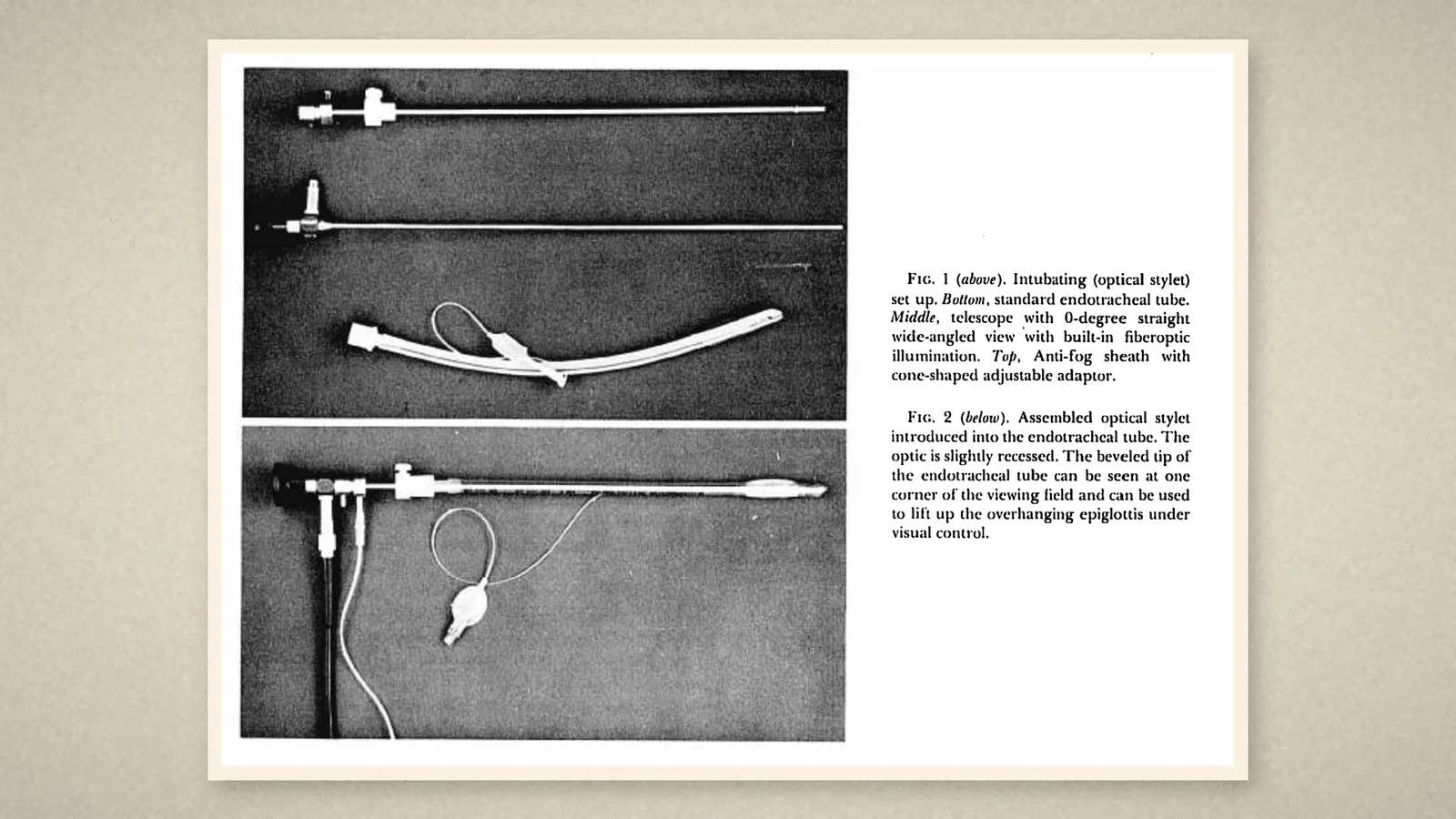
Figure 1 photographs the parts in order: at the bottom a standard tracheal tube, in the middle the telescope with its straight-forward view and "with built-in illumination", at the top an anti-fog sheath with a cone-shaped adjustable adaptor. Figure 2 shows them assembled. [1, p. 252]
"The instrument consists of a telescope" with the Hopkins rod-lens system and its own light, fed from an external source through a fibreoptic cable. [1, p. 251] The sheath into which it slides is given a stated double role — "serving a double purpose": gas can be run between sheath and telescope and directed at the front of the optic, "creating positive pressure to avoid fogging"; and the steel tube supports the optic and keeps it from breaking in use. [1, p. 251] Locked inside a tracheal tube, the assembly leaves the bevelled tip of the tube visible at one corner of the field, where it can be used as a lever to lift an overhanging epiglottis. [1, p. 252]
What they claimed
Three claims, each kept modest in the paper's own wording.
For practice: the carina can usually be seen, so the tube can be set between the cords and the bifurcation under vision, and "the risk of intubation of one main bronchus is virtually eliminated". [1, p. 252]
For children: a smaller version exists, but the authors write that "Our experience thus far is limited to" a small number of patients, and offer only an impression about it. [1, p. 252]
For teaching — and this is the claim the title announces: "A teaching attachment" can be coupled to the stylet so that students see the pharynx, larynx and trachea along with the teacher, and it "allows the students to observe the passage of the" tube. The authors say the greatest value of the instrument may lie "in teaching the anatomy of the larynx, trachea and pharynx". [1, pp. 252-253] It is worth noticing what is being proposed. Until then a student learning intubation watched a pair of hands and was told afterwards what had been seen. An attachment that splits the image makes the teacher's view into a shared object.
What they refused to claim
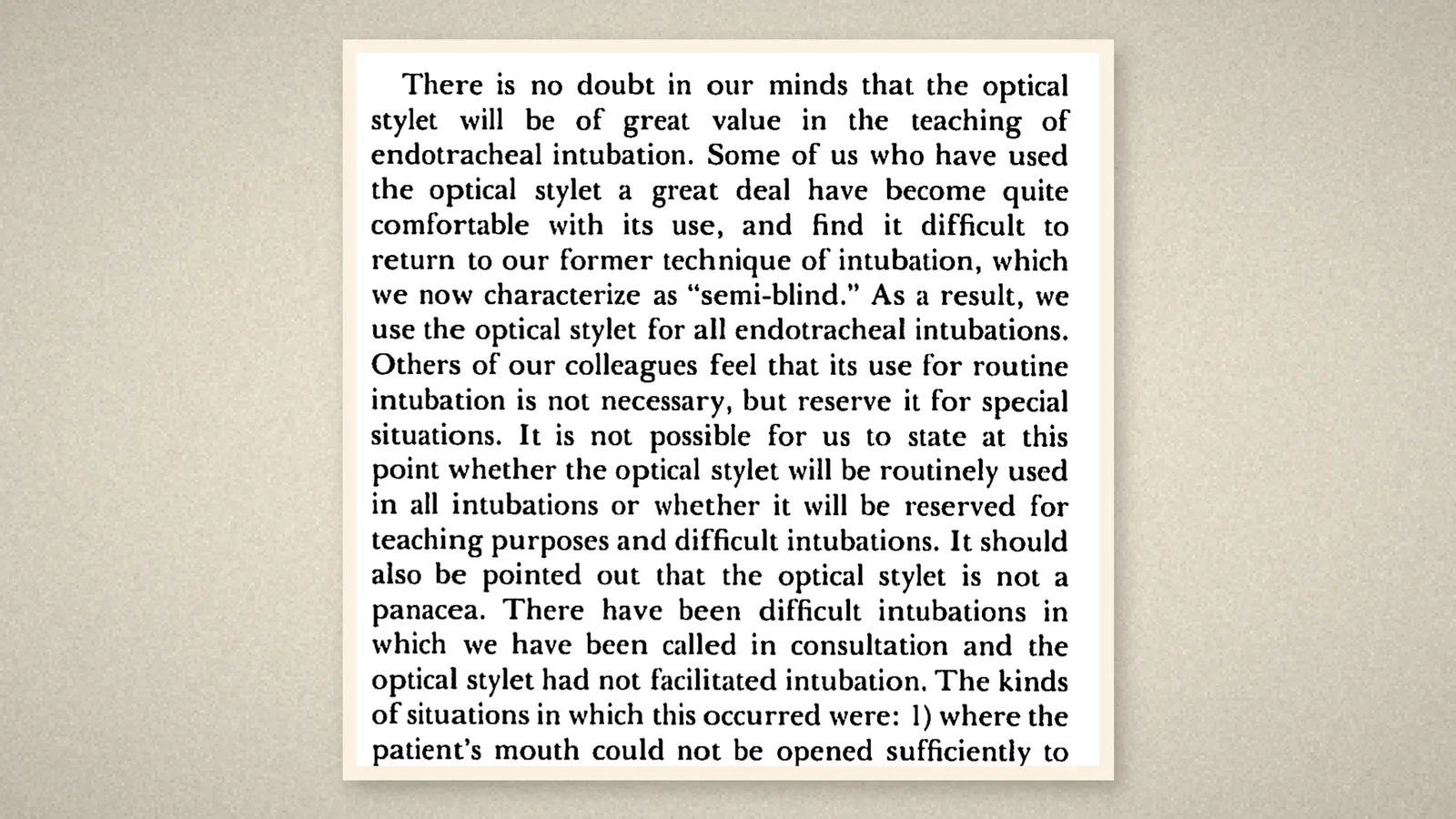
The discussion is unusually candid for a paper introducing a device its authors helped design. Some of them had used it so much that they found it hard to go back to a technique "which we now characterize as "semi-blind."" Others of their colleagues thought it unnecessary for routine work. The authors then decline to settle it: "It is not possible for us to state at this point" whether the stylet would be used in all intubations or reserved for teaching and for difficult cases. [1, p. 253]
Then the sentence that does the paper most credit: "the optical stylet is not a panacea". They list the cases where it failed them — where "the patient's mouth could not be opened sufficiently" to admit tube and stylet together, and where "the cervical spine was fixed in a flexed anterior position" so that the cords could not be brought into the straight line the instrument requires. In those patients "a flexible fiberoptic bronchoscope was" used instead. [1, pp. 253-254]
And the closing line is a question, not an answer. Whether placing the tube under direct vision would reduce the complications known to follow intubation was not asserted: "A study is currently under way to determine whether" it does. [1, p. 254]
What the record shows
An instrument paper is usually a small thing. What makes this one worth an article is the premise, stated in 1979 in a journal's own pages: that the normal, competent, everyday performance of a core procedure was partly blind, and that this was a problem to be engineered away rather than a fact of life to be managed by skill. The particular instrument described here is rigid, has a straight-only view, and fails exactly where a straight line cannot be had. Its premise outlived it.
Sources and reading limits
Read: Katz RL, Berci G, "The optical stylet — a new intubation technique for adults and children with specific reference to teaching", Anesthesiology, September 1979, vol. 51, no. 3, pp. 251-254, in full.
A note on the source. The article's registered DOI, 10.1097/00000542-197909000-00014, resolves on the publisher's site to a different article in the same volume (pp. 263-264), and the September 1979 contents list there omits this article altogether. The copy used here is a scan of the printed pages; its pagination, running heads and footline confirm it is the right article.
Not covered: the optics paper and the teaching-attachment chapter the article cites for its own technology; the manufacturer's literature; and the result of the follow-up study the paper says was under way, so nothing here should be read as evidence about complications.
Limits: the number of patients, the paediatric experience and the claim about endobronchial intubation are reported as the paper states them, in a single series by the instrument's own designers, with no control and no independent comparison. Figure 3 (endoscopic views of a patient's larynx) and Figure 4 (a photograph of an operator, a student and a patient on the table) are not reproduced here, because this site does not use patient images or photographs of identifiable people; Figures 1 and 2 show the instrument alone and are used.
Three illustrations are crops of the original page images (pp. 251, 252 and 253). One is a diagram drawn from the text, with no people drawn.
- Katz RL, Berci G. The optical stylet — a new intubation technique for adults and children with specific reference to teaching. Anesthesiology. 1979;51(3):251-4. PMID 475027
Continue exploring
Related reading connects shared questions and contexts; it does not by itself establish historical influence.
Anesthesia Epochs · The Source Room · About & Editorial Method
Published November 5, 2026. Sources and reading limits are stated above. Illustrations are labelled as original source images or AI-made. Historical accounts are educational; they are not current treatment instructions.