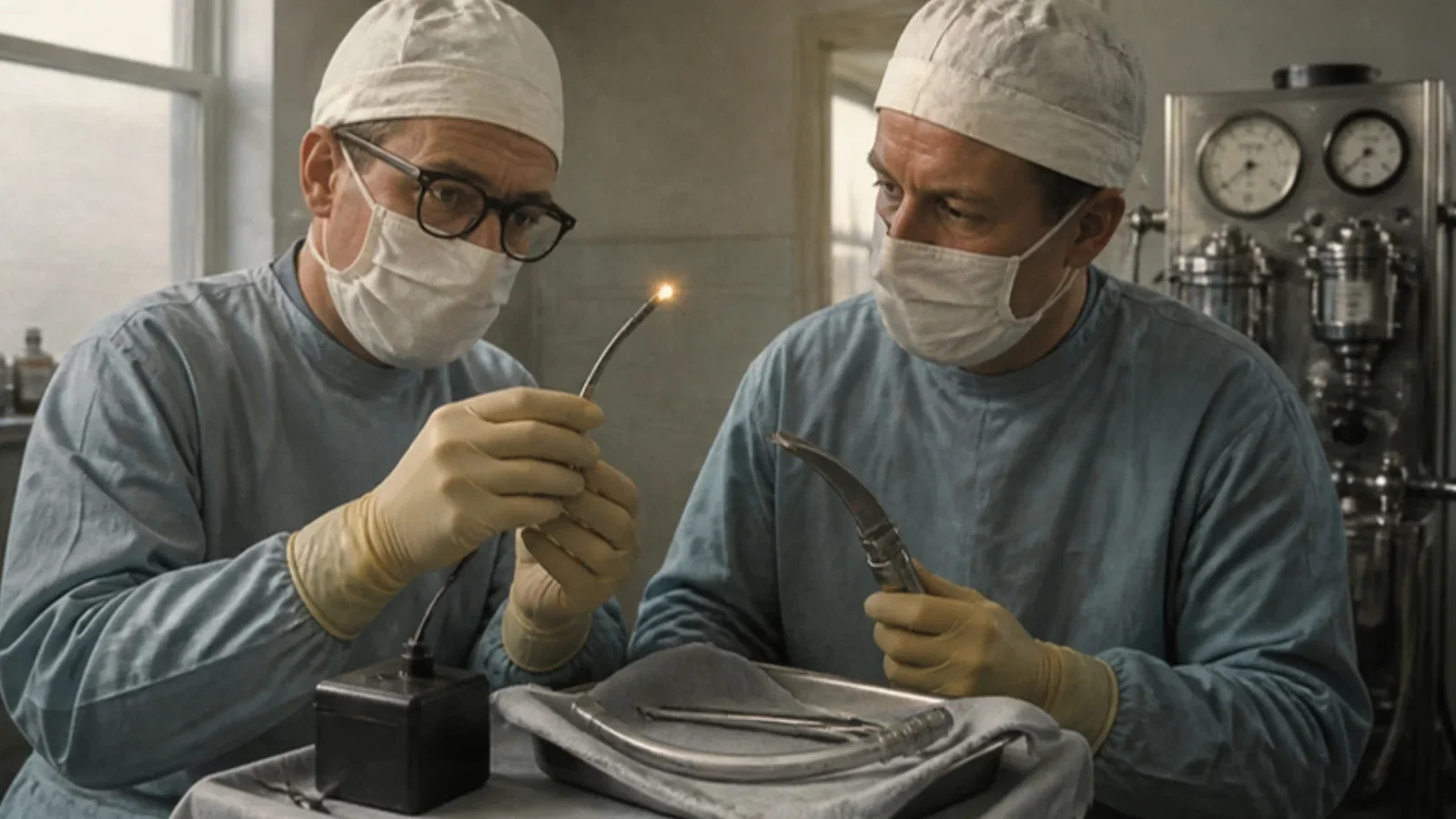
In April 1957 Robert Macintosh and Harry Richards described an introducer for tracheal tubes that combined a bendable guide with a lamp at its tip, so that the cords could be lit and the tube passed under direct vision even with the laryngoscope bulb disconnected.
Reading Library · Anesthesia Epochs · 中文版
Watch the education video (for clinicians)
1957: The Illuminated Introducer — Transillumination · Anesthesia Epochs Education Series
In a difficult intubation an anaesthetist often lacks two things: a guide that can bend round into the glottis, and a light that reaches the target. In April 1957 a three-page item in the New Inventions section of Anaesthesia built both into one device. [1, p. 223][1, p. 224]
Two antecedents
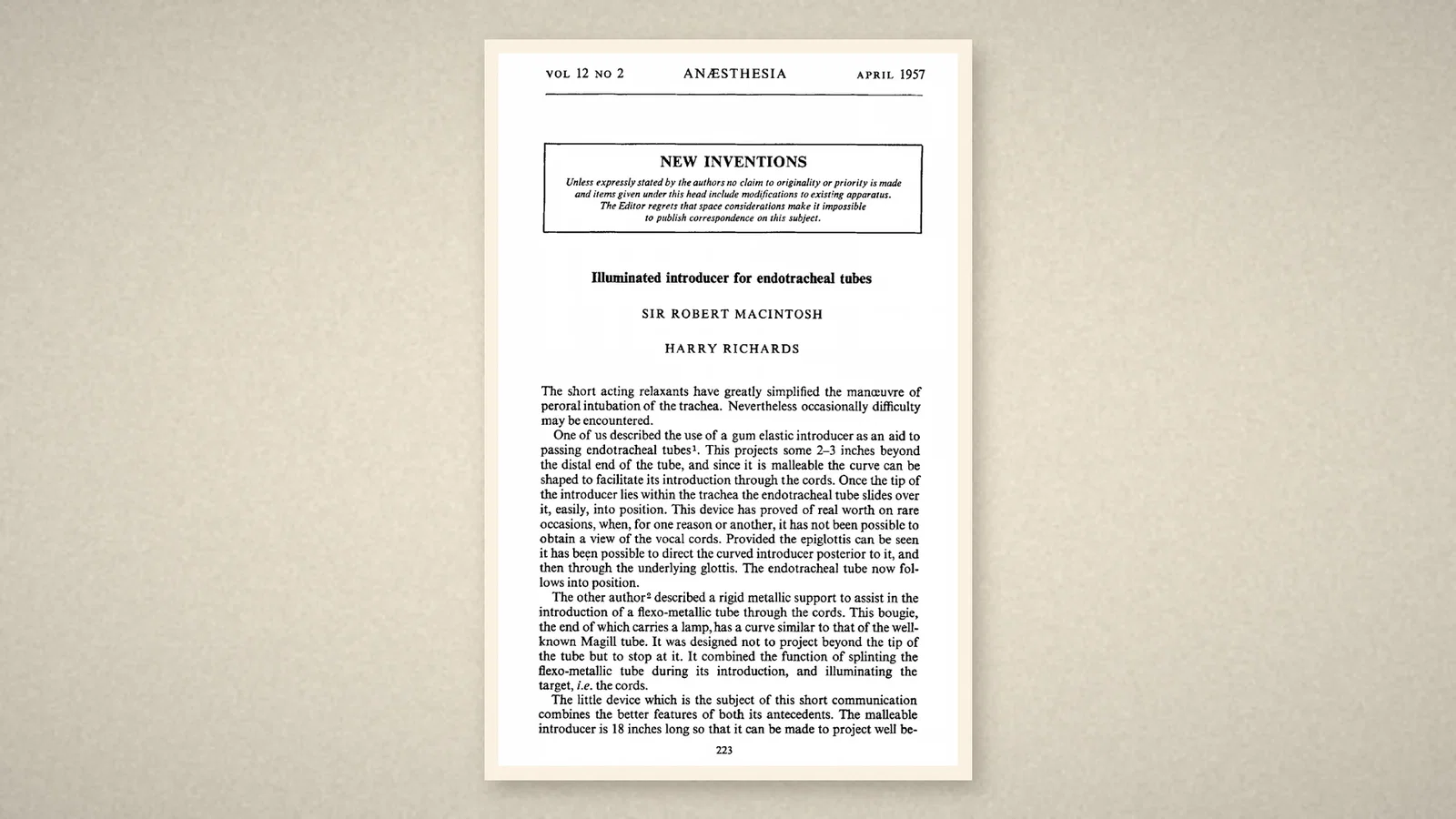
The authors were Sir Robert Macintosh and Harry Richards. The section opens with a note: unless the authors say so, no claim to originality or priority is made, and the items include modifications of existing apparatus. [1, p. 223]
The item begins by observing that the short-acting relaxants had greatly simplified oral intubation, but that difficulty was still met now and then. Each author had an antecedent. One had described the gum elastic introducer. It projected two or three inches beyond the tube and could be shaped, and it "has proved of real worth on rare occasions" when the cords could not be seen: provided the epiglottis was visible, its curved end could be directed behind it and through the glottis, and the tube then slid over it. The reference for it is the British Medical Journal of 1949. The other author had described, in Anaesthesia earlier the same year, a rigid metal support carrying a lamp, curved like a Magill tube and stopping at the tube's tip. It both splinted a flexo-metallic tube and illuminated "the target, i.e. the cords". [1, p. 223][1, p. 225]
Two in one
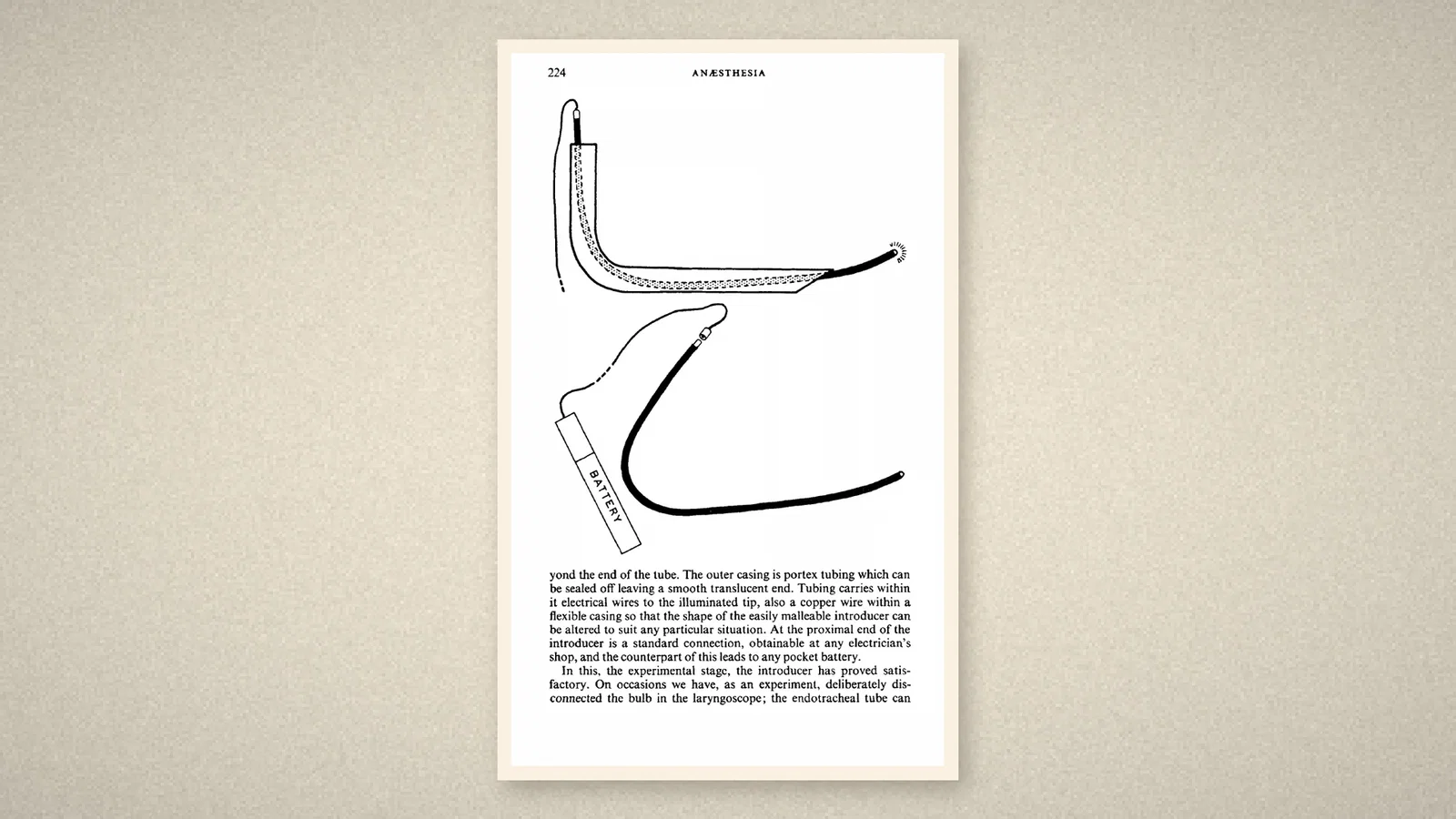
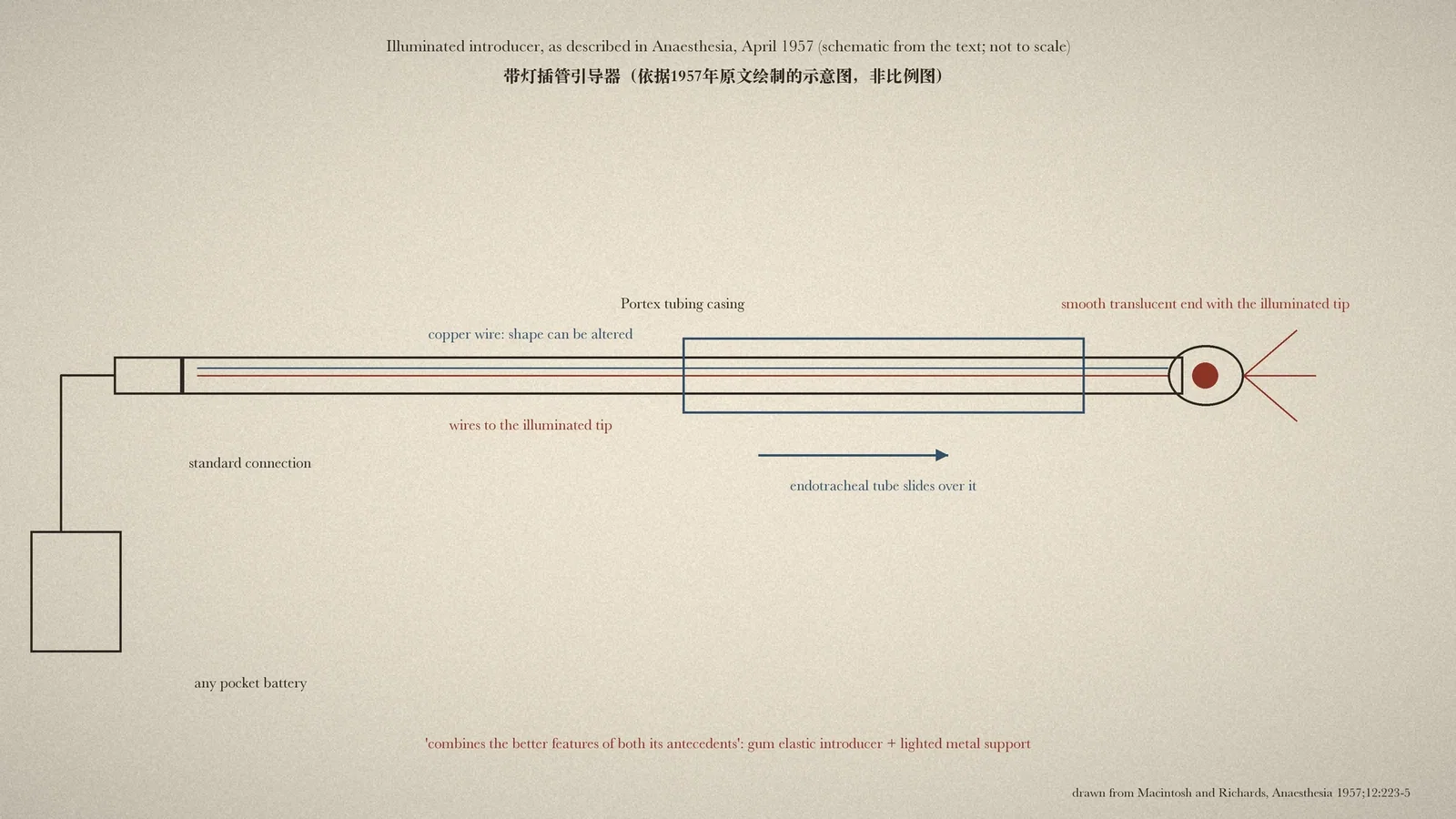
The new device, the authors wrote, "combines the better features of both its antecedents". The introducer was malleable and much longer than the tube, so it could project well beyond it. Its outer casing was Portex tubing sealed off to a smooth, translucent end. Inside ran electrical wires to the illuminated tip and a copper wire in a flexible casing, so that its shape could be altered for any situation. At the proximal end was a standard connection, available at any electrician's shop, whose counterpart led to any pocket battery. The paper's own drawing shows it two ways: threaded through a tube bent at a right angle, with the lit tip projecting, and on its own, curved and wired to a cell marked "battery". [1, p. 224]
The experimental stage
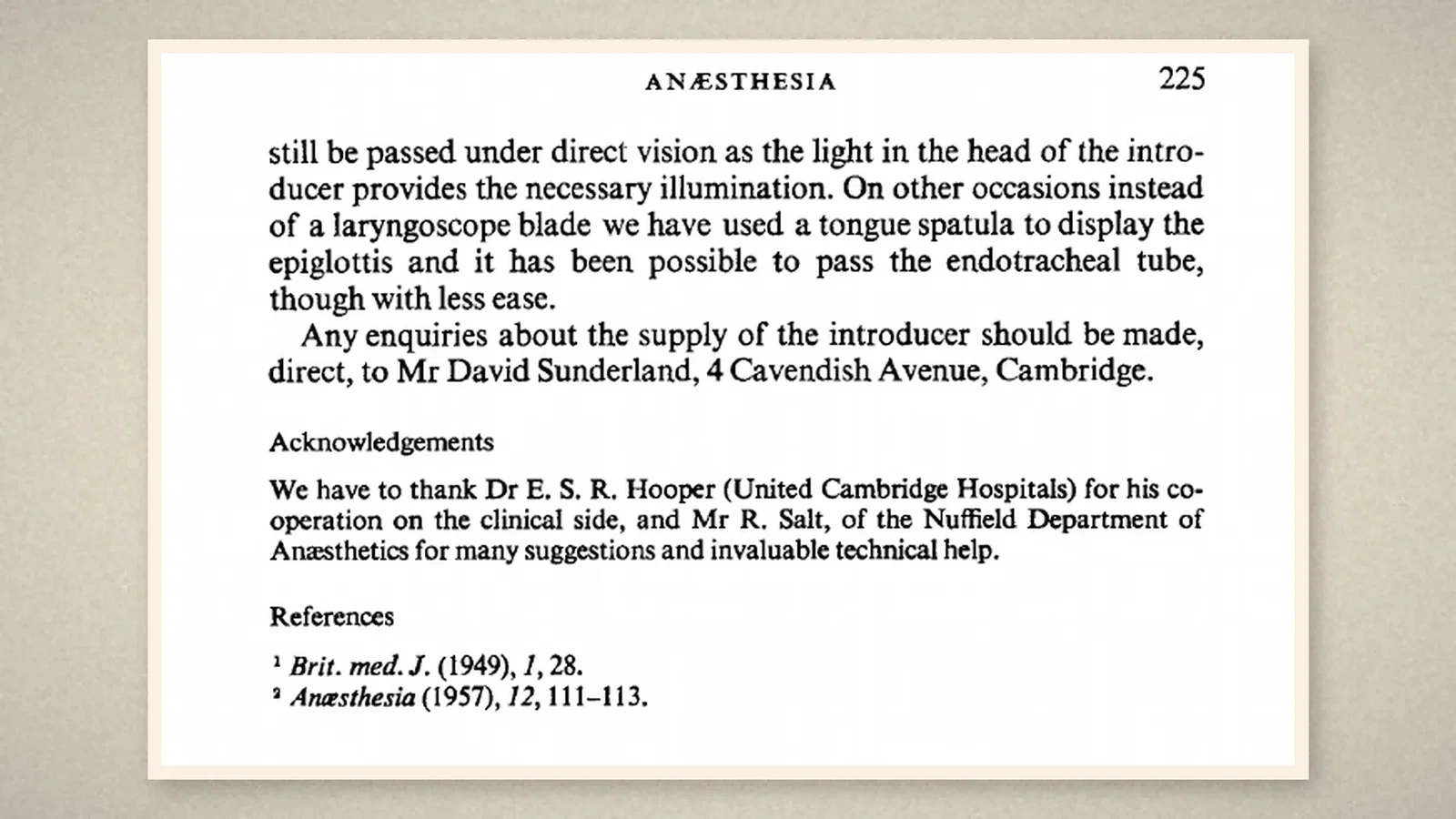
In this experimental stage, the authors wrote, the introducer had proved satisfactory. On some occasions they deliberately disconnected the bulb in the laryngoscope. The tube could still be passed under direct vision, because the light in the head of the introducer provided the illumination. On others they used a tongue spatula instead of a laryngoscope blade to display the epiglottis, and the tube could be passed, though with less ease. [1, p. 224][1, p. 225]
The item ends by directing enquiries about supply to Mr David Sunderland of Cambridge. It thanks Dr E. S. R. Hooper of the United Cambridge Hospitals for cooperation on the clinical side, and Mr R. Salt of the Nuffield Department of Anaesthetics for many suggestions and technical help. [1, p. 225]
What the record shows
This introducer shone its light from inside onto the cords, so that the target could be seen even with the laryngoscope dark or with only a spatula. It did not transilluminate the neck and gave no case numbers, but it put guiding and lighting into one bendable tube. Some timelines date this topic to a 1959 device for transilluminated blind intubation, and that report could not be read.
Sources and reading limits
Read: Macintosh and Richards, "Illuminated introducer for endotracheal tubes", Anaesthesia 1957;12:223-5 (the whole item, with page images of all three pages checked); and the PDF supplied under the DOI of Yamamura and colleagues' "Device for blind nasal intubation" (Anesthesiology 1959;20:221), which on opening contained only the preceding Current Comment pages 219-220 (a pulse-monitor note with Severinghaus's comment, conductive heels and a recovery-room record). Both were obtained through institutional access.
Not covered: Yamamura and colleagues' device report itself (p. 221), the 1959 date some timelines give; Richards's earlier lighted metal support (Anaesthesia 1957;12:111-3); later lightwands. Macintosh's 1949 gum elastic introducer is told in an earlier article. The ASA timeline entry was not used as evidence.
Limits: some timelines anchor transillumination and lightwand intubation on Yamamura in 1959; since that report could not be read, this article describes the 1957 illuminated introducer instead. Macintosh and Richards's device lights the cords from the tip of an introducer for direct vision; the paper does not describe transilluminating the neck, and this article does not say that it does. Items in New Inventions claim no originality or priority unless the authors state it, and this one does not. The item gives no case numbers or dates.
Three illustrations are pages 223, 224 and 225 of Anaesthesia 1957 (p. 224 carries the paper's own figure). One is a schematic drawn from the text, not to scale, with no hands or patient drawn.
- Macintosh R, Richards H. Illuminated introducer for endotracheal tubes. Anaesthesia. 1957;12:223-5. DOI
- PDF supplied under this DOI (in fact Anesthesiology 1959;20:219-20, Current Comment): Yamamura H, et al. Device for blind nasal intubation. Anesthesiology. 1959;20:221. DOI
Continue exploring
Related reading connects shared questions and contexts; it does not by itself establish historical influence.
Anesthesia Epochs · The Source Room · About & Editorial Method
Published November 3, 2026. Sources and reading limits are stated above. Illustrations are labelled as original source images or AI-made. Historical accounts are educational; they are not current treatment instructions.