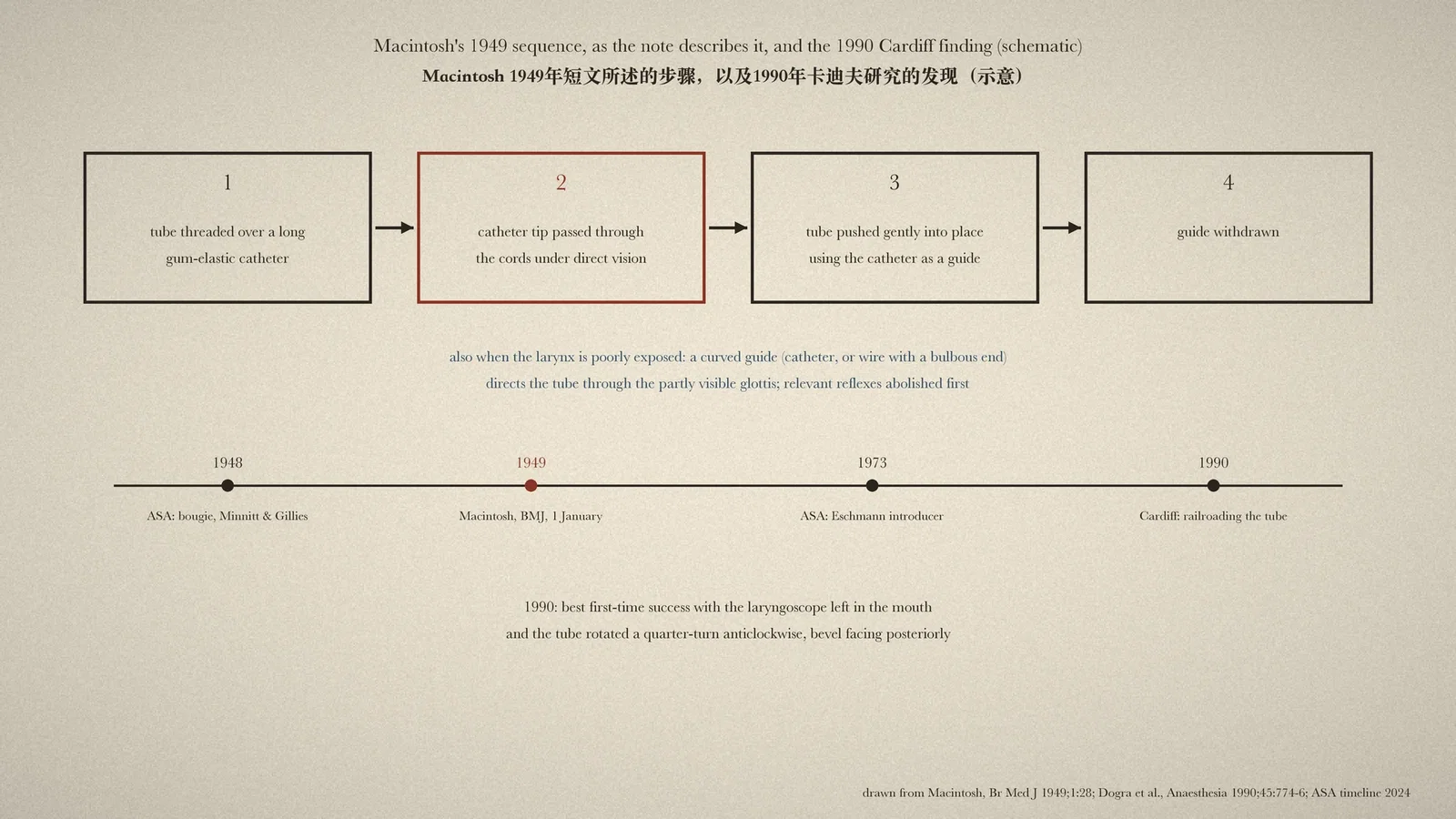
On 1 January 1949 the British Medical Journal printed, under 'Preparations and Appliances', a short note by R. R. Macintosh, Nuffield Professor of Anaesthetics at Oxford, 'An aid to oral intubation': because a large-bore oral tube hid the view of the cords, Macintosh threaded it over a long gum-elastic catheter, passed the catheter tip through the cords under direct vision, and used it as a guide to push the tube into place; when the larynx was poorly exposed, a curved guide could be directed through the partly visible glottis. Forty-one years later a randomised study from Cardiff still credited the method to Macintosh while working out how best to railroad a tube over a gum-elastic bougie.
Reading Library · Anesthesia Epochs · 中文版
Watch the education video (for clinicians)
1949: Macintosh's Gum-Elastic Guide — Difficult Intubation · Anesthesia Epochs Education Series
Every difficult-airway trolley carries a long, slightly curved stick over which a tracheal tube can be slid once the stick is in the trachea. Anaesthetists call it a bougie. Its origin in print is a note of fewer than two hundred words in the British Medical Journal of New Year's Day 1949, in the section reserved for "Preparations and Appliances". [1]
The note
"Dr. R. R. Macintosh, Nuffield Professor of Anaesthetics, Oxford, writes: During the past two years I have been experimenting with large-bore oral endotracheal tubes of different shapes." The difficulty was simple: beyond a certain size, "the body of the tube obscures the view of the cords through which the tip must be directed". [1]
The solution took one sentence. "In order to overcome this I thread the tube over a long gum-elastic catheter, the tip of which is then passed through the cords under direct vision (Figs. 1 and 2). Using the catheter as a guide the tube is gently pushed down into position (Fig. 3) and the guide is then withdrawn." [1]
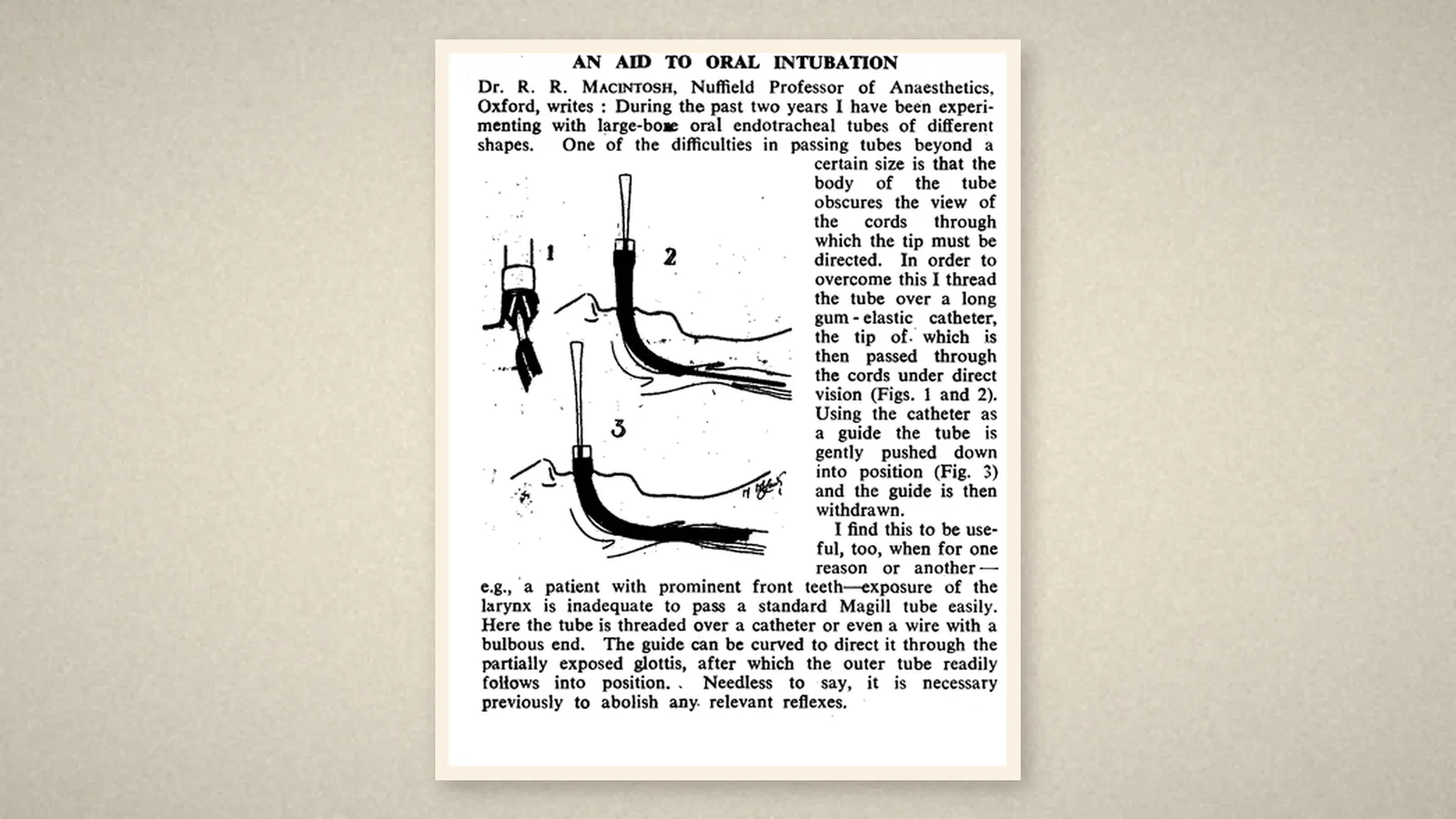
Macintosh then described the use that would outlive the large-bore tubes. The method was useful "when for one reason or another, e.g., a patient with prominent front teeth, exposure of the larynx is inadequate to pass a standard Magill tube easily. Here the tube is threaded over a catheter or even a wire with a bulbous end. The guide can be curved to direct it through the partially exposed glottis, after which the outer tube readily follows into position." The note ends with a caution: "Needless to say, it is necessary previously to abolish any relevant reflexes." [1]
The three small drawings show the tube sitting on the catheter, the catheter's tip entering the larynx, and the tube following it down. The note gives no length, gauge or maker for the catheter. [1]
The timeline's version
The Australian Society of Anaesthetists (ASA) timeline tells the story slightly differently. It lists "Gum-elastic bougie introduced" under 1948 and credits it to Robert James Minnitt and John Gillies of Liverpool; it then says that in 1949 Macintosh reported extensive experience with the device, describing it as 60 cm long, 15 French gauge, with a 40-degree J tip, "specifically called an Eschmann Tracheal Tube Introducer", and calls this "the first report of intubation assisted by an introducer". Under 1973 it records the reusable Eschmann introducer, later renamed the Portex Venn introducer. [3, pp. 55, 73]
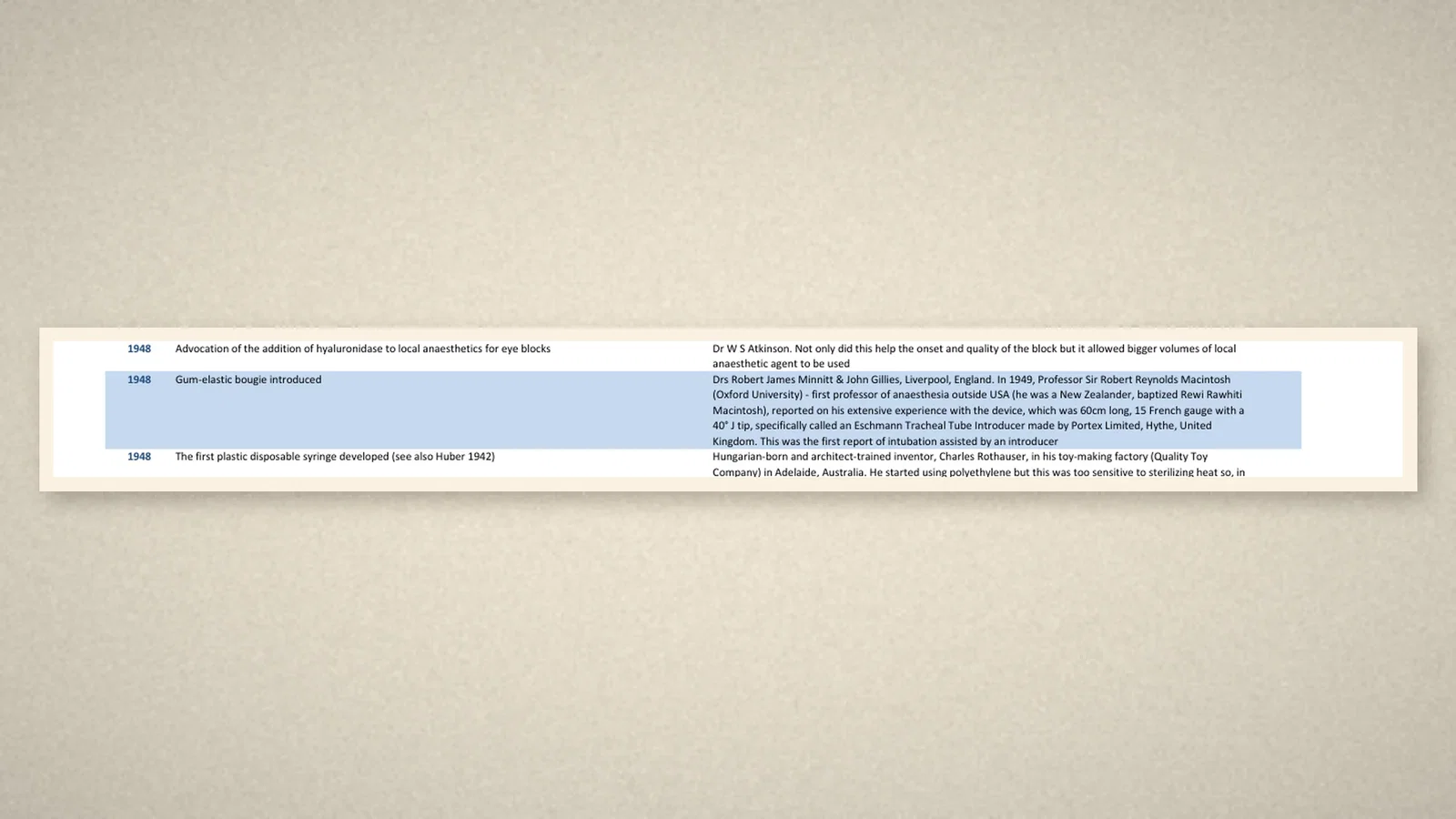
Set beside the 1949 note, the timeline's description looks like that of the later commercial introducer: Macintosh's note speaks only of "a long gum-elastic catheter", and of a wire as an alternative. This article found no 1948 publication by Minnitt and Gillies.
Forty-one years later
By 1990 the bougie was a routine tool for difficult intubation, and the question had become how best to get the tube to follow it. At the University Hospital of Wales in Cardiff, S. Dogra, R. Falconer and I. P. Latto described the manoeuvre as two phases: passing the bougie through the larynx, and then passing the tube over it, which "may frequently be followed by difficulty". In 100 patients with a grade 3 view simulated by the laryngoscope, they used a 15 FG Eschmann gum-elastic bougie and compared the tube's orientation and whether the laryngoscope stayed in the mouth. [2, p. 774]
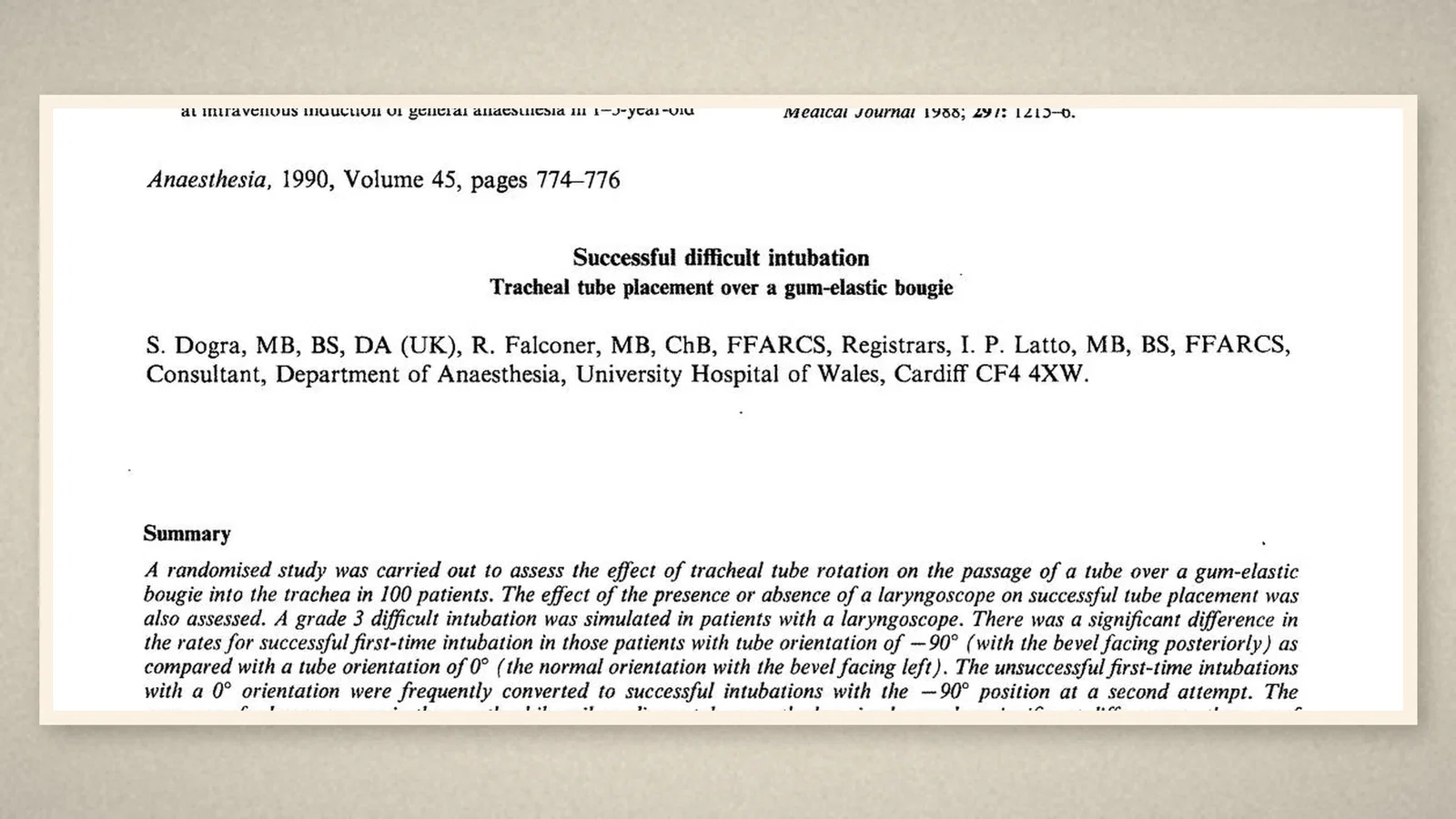
First-attempt success ranged from 8 per cent with the laryngoscope removed and the tube in its usual position to the best result with the laryngoscope left in and the tube turned a quarter-turn anticlockwise, bevel facing backwards. The authors explained why: in the usual position the tube's tip tended to catch behind the larynx, while rotated "the bevel of the tube rides up the slope of the soft tissue behind the larynx and enters the trachea without hold-up". And they named the origin: the use of the gum-elastic bougie where the view of the cords was obscured by the tube "was pioneered in 1949 by Macintosh". [2, pp. 774-6]
What the record shows
A device that began as a workaround for a tube too large to see past, written up in a paragraph, and kept because it also solved a harder problem: the larynx that cannot be seen at all. The 1949 note already holds both uses; the later literature refined how the tube follows the guide.
Sources and reading limits
Read: Macintosh's note in the British Medical Journal of 1 January 1949, p. 28, in full; Dogra, Falconer and Latto, Anaesthesia 1990;45:774-6, in full; the ASA timeline entries for 1948 and 1973.
Not covered: any 1948 publication by Minnitt and Gillies; Venn's account of the Eschmann introducer; the manufacturer's records; the 1988 Cardiff study and Cossham's letter cited in the 1990 paper.
Limits: the 1948 date and the attribution to Minnitt and Gillies are the ASA's; the dimensions the ASA gives are not in Macintosh's note and may belong to the later Eschmann introducer. "First report" is the ASA's phrase and "pioneered" the 1990 authors'. The 1990 study simulated difficulty in patients with normal airways; its drug doses are not repeated. Quotations are from the English originals.
Three illustrations are crops of the 1949 BMJ page, the 1990 Anaesthesia page and the ASA timeline; one is drawn from the sources.
- Macintosh RR. An aid to oral intubation. Br Med J. 1949;1(4591):28. PMC
- Dogra S, Falconer R, Latto IP. Successful difficult intubation: tracheal tube placement over a gum-elastic bougie. Anaesthesia. 1990;45:774-6. Internet Archive
- Australian Society of Anaesthetists. Anaesthesia history timeline. 2024. ASA
Continue exploring
Related reading connects shared questions and contexts; it does not by itself establish historical influence.
- 1937: Leech's Pharyngeal Bulb Gasway for Closed-Circuit Cyclopropane
- 1962: Robertshaw's Low-Resistance Double-Lumen Endobronchial Tubes
Anesthesia Epochs · The Source Room · About & Editorial Method
Published November 3, 2026. Sources and reading limits are stated above. Illustrations are labelled as original source images or AI-made. Historical accounts are educational; they are not current treatment instructions.