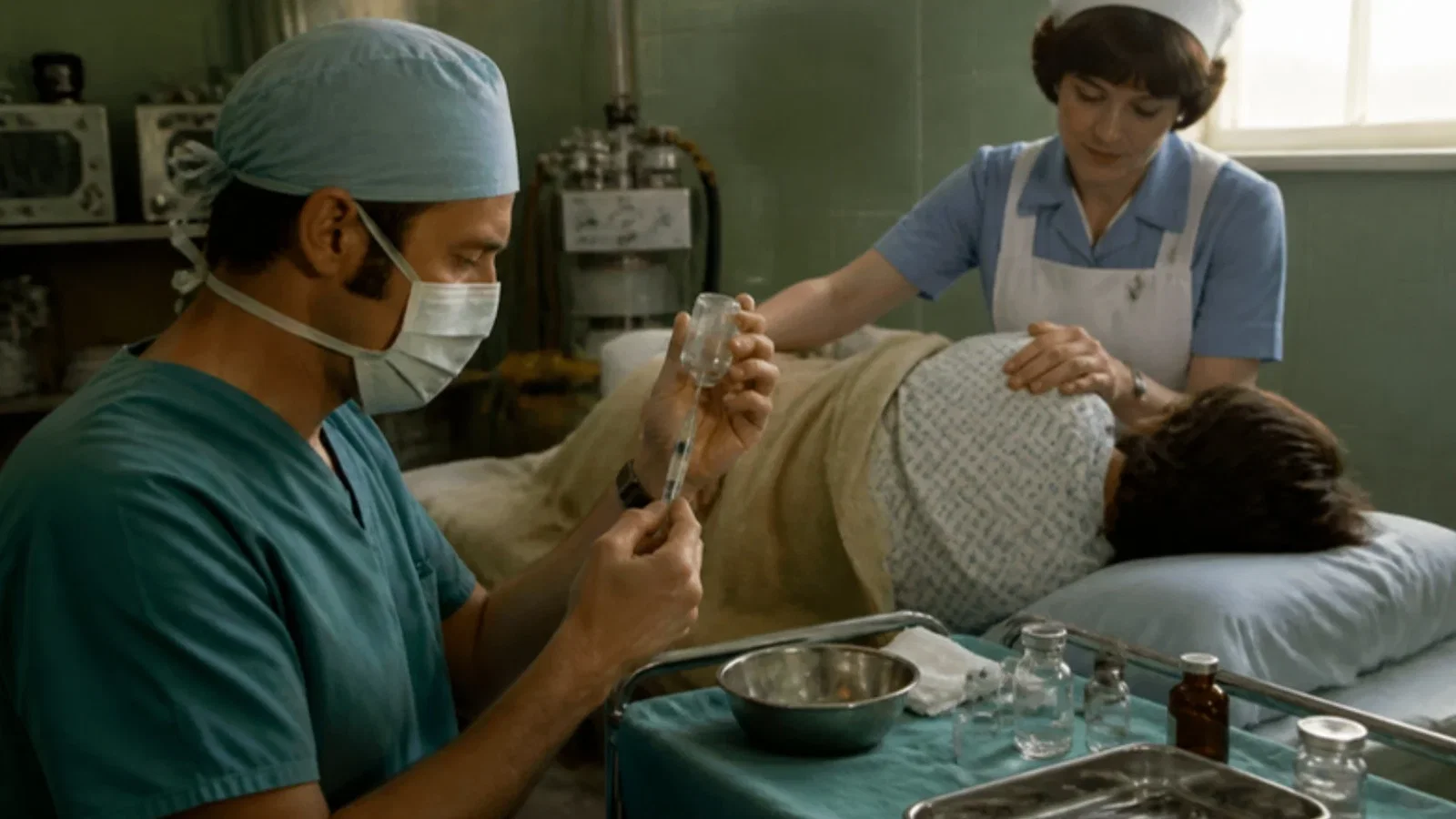
Three years after rats showed that narcotics act directly on the spinal cord, two clinical groups published within a month: Wang and colleagues with intrathecal morphine for cancer pain, Behar and colleagues with epidural morphine.
Reading Library · Anesthesia Epochs · 中文版
Watch the education video (for clinicians)
1979: Spinal Morphine — Intrathecal and Epidural, a Month Apart · Anesthesia Epochs Education Series
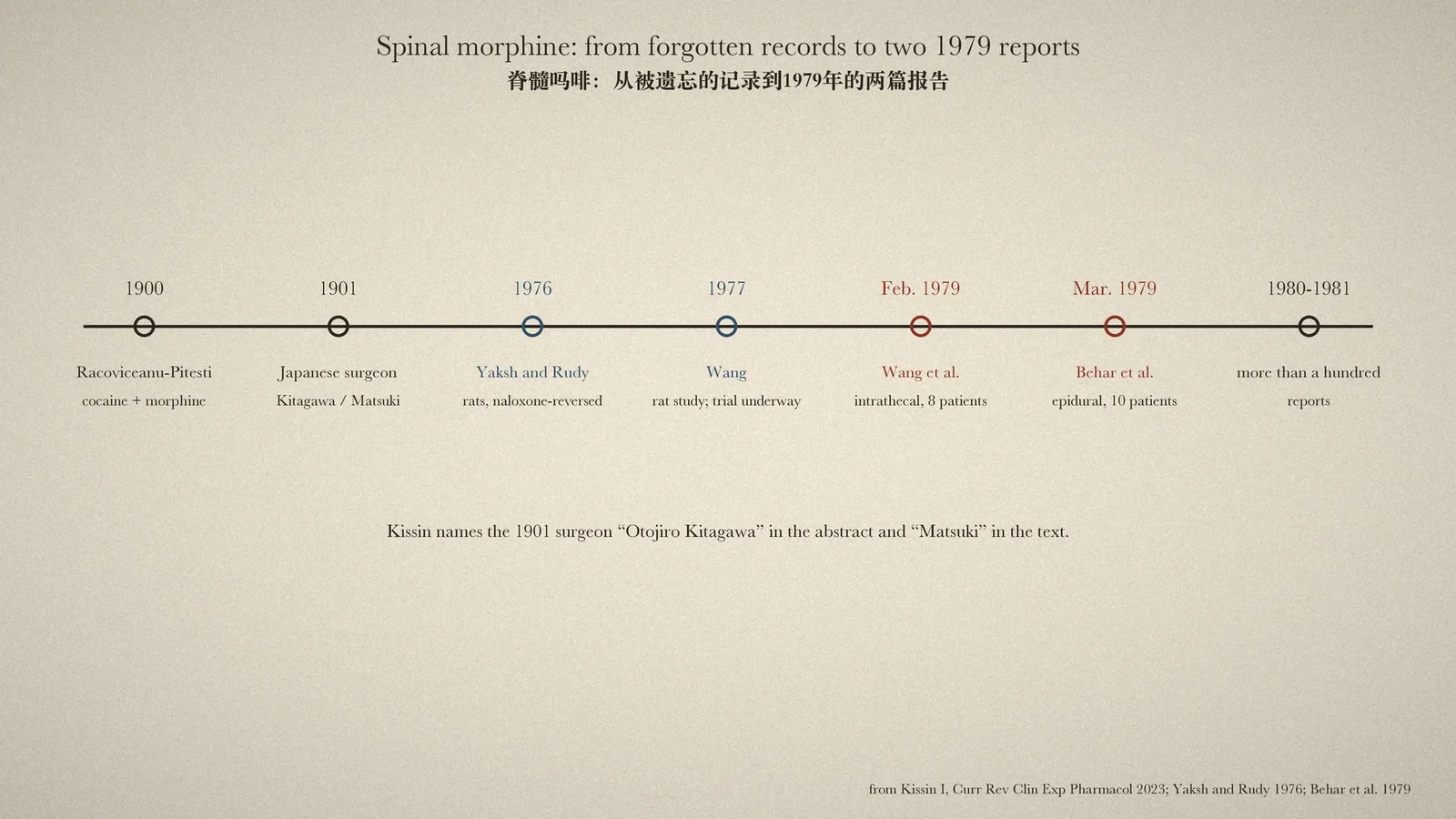
Spinal anaesthesia with cocaine was already in surgical use around 1900; spinal opioids, which now give hours of pain relief after a caesarean section or a major operation from a fraction of a milligram, arrived almost eighty years later. This article follows how that happened, through two clinical reports published a month apart in 1979, the animal work behind them, and the earlier attempts that nobody followed up. [1] [2] [3] [4]
The laboratory step
In 1976 T. L. Yaksh and T. A. Rudy reported in Science that narcotic analgesics "administered directly into the spinal subarachnoid space of the rat via a chronically inserted catheter produce a potent analgesia that can be antagonized by naloxone". Acting only at the spinal level, the drugs blocked not only spinal reflexes but also the animals' learned response to painful stimuli. [3] According to I. Kissin's 2023 review of the period, J. K. Wang published a rat study of intrathecal morphine in 1977 whose discussion already mentioned a clinical trial in patients with intractable cancer pain, with very encouraging preliminary results. [4]
Two reports, two routes
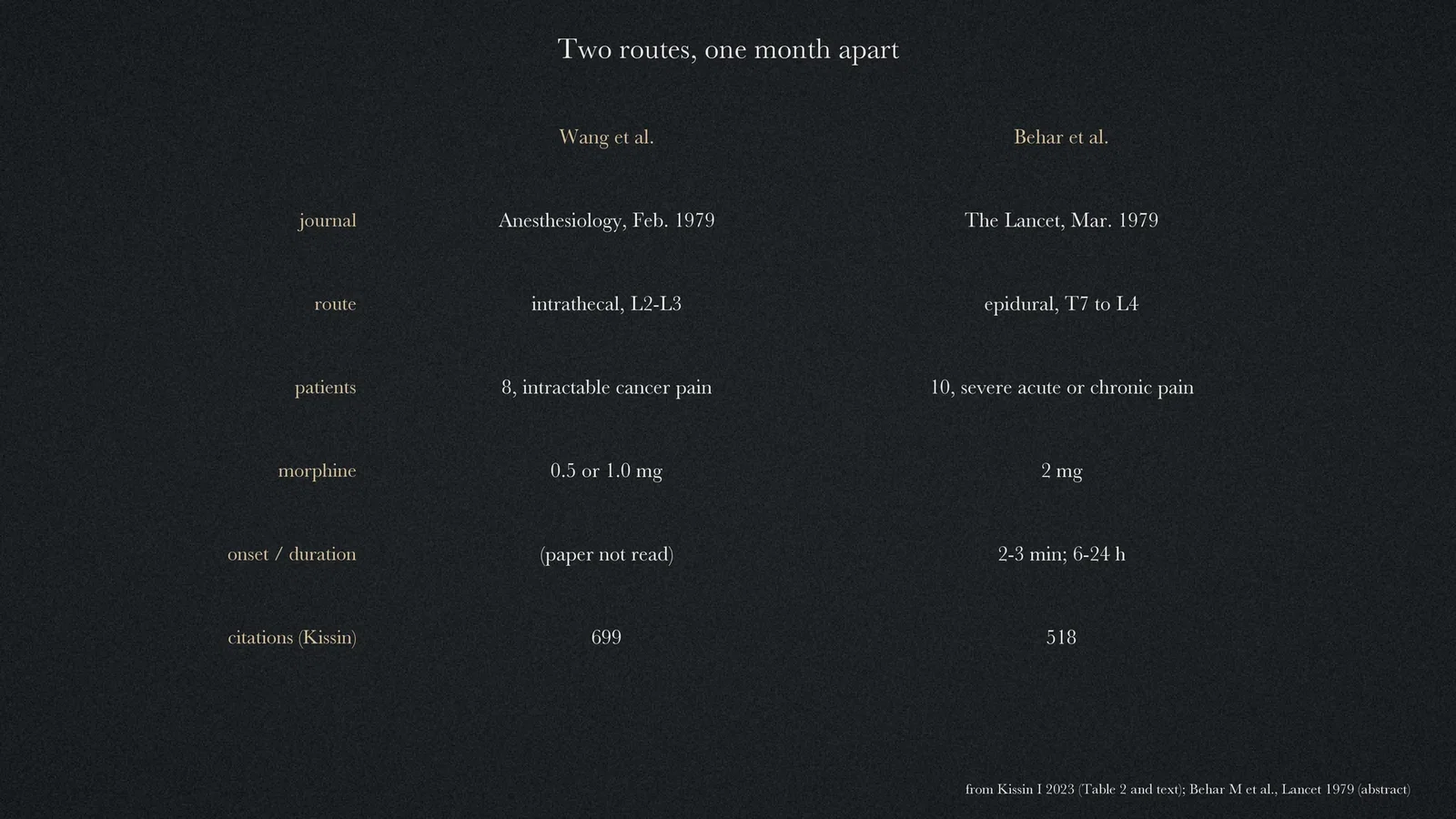
In February 1979 Anesthesiology printed "Pain relief by intrathecally applied morphine in man" by J. K. Wang, L. A. Nauss and J. E. Thomas. [1] The paper itself could not be read for this article; Kissin describes it as reporting intrathecal morphine, 0.5 or 1.0 mg, injected at the L2-L3 interspace in eight patients with intractable cancer pain, and notes that it had been accepted for publication on 9 May 1978. [4]
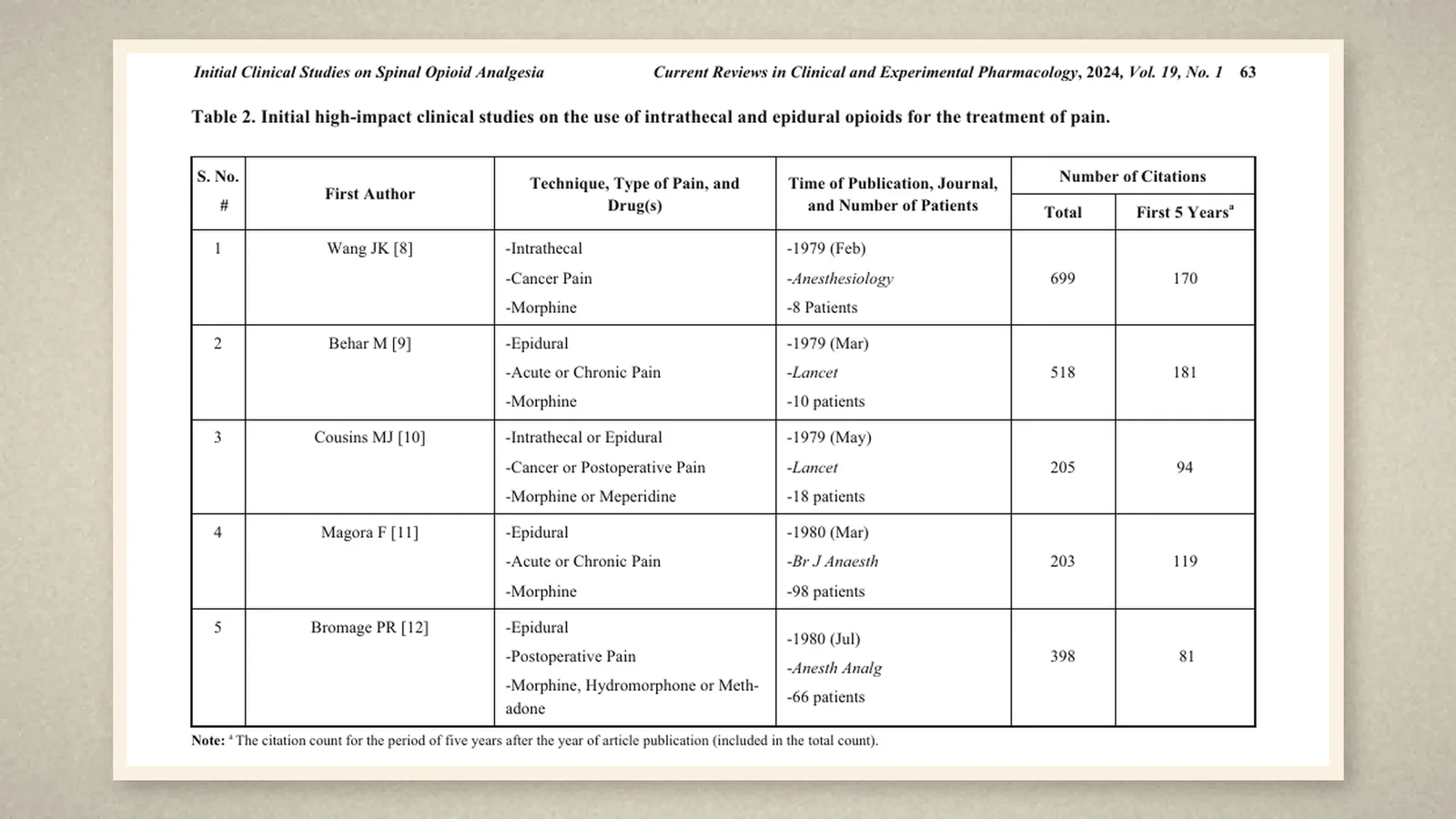
On 10 March 1979 The Lancet published "Epidural morphine in treatment of pain" by M. Behar, F. Magora, D. Olshwang and J. T. Davidson. Their abstract is short and specific: "Epidural injections of a 2 mg morphine were given to 10 patients with severe acute or chronic pain. All cases had considerable amelioration of pain, which commenced within 2-3 min, reached a peak in 10-15 min, and was effective for 6-24 h." The authors suggested that the morphine reached the subarachnoid space and acted "on the specific opiate receptors in the substantia gelatinosa of the posterior-horn cells of the spinal cord". [2] Kissin notes that Behar's group cited Snyder's work on opiate receptors and Yaksh's animal studies, and chose the epidural route for its clinical advantages. [4]
The response
Kissin counts close to a dozen reports on the subject in 1979 and more than a hundred in 1980-1981. Six letters answered Behar's paper in The Lancet that year alone, and among the responses were the first reports of respiratory depression after spinal opioids. [4] By Kissin's count the two 1979 papers were cited 699 and 518 times. Kissin weighs priority carefully: Wang's paper appeared a month earlier and was preceded by preliminary reports in 1977 and 1978, which Behar's group cited, and Magora, one of Behar's co-authors, acknowledged in 2004 that their report came after Wang's. [4]
The forgotten precursors
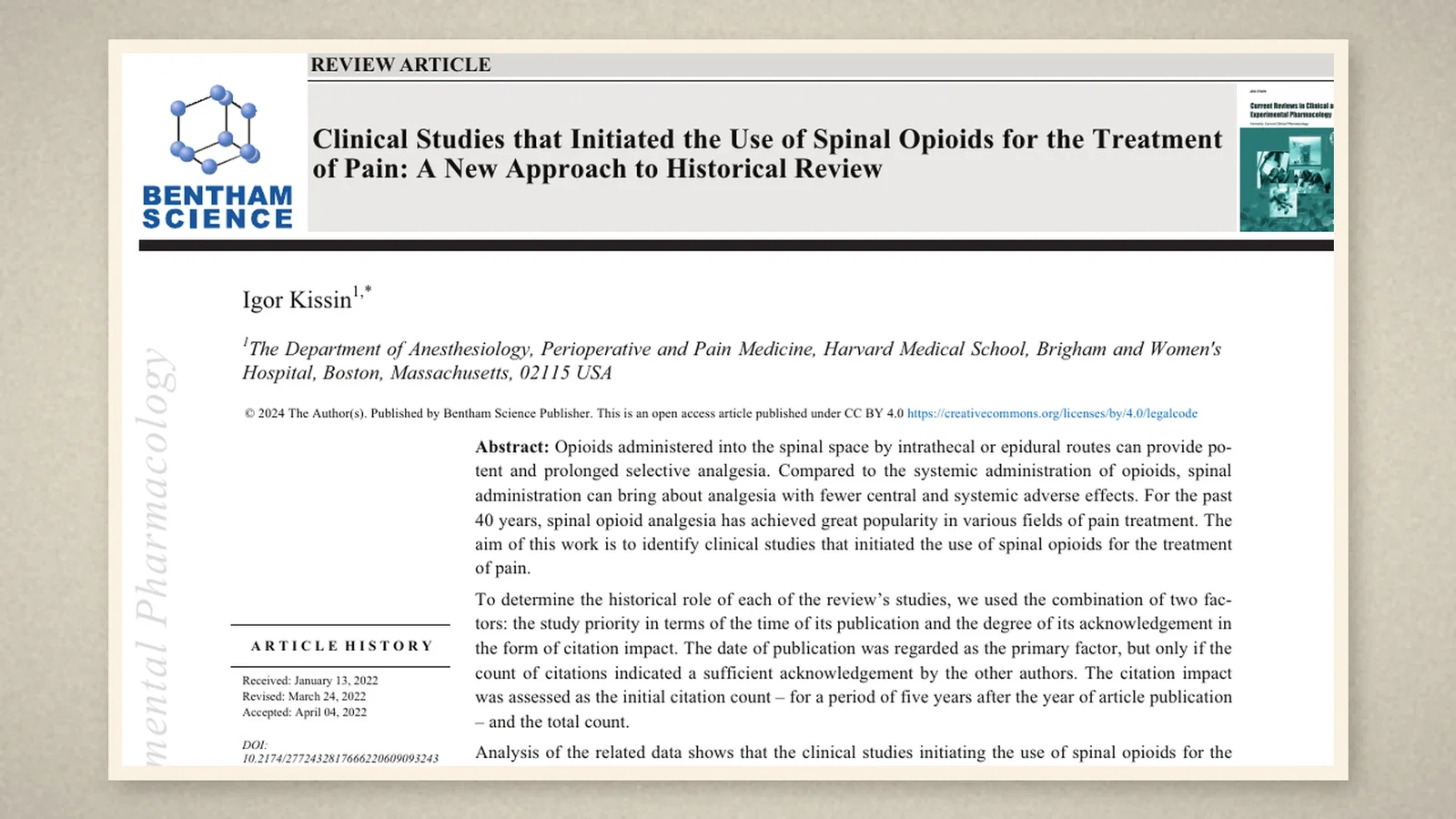
Spinal morphine itself was not new. Kissin records that in 1900 the Romanian surgeon Racoviceanu-Pitesti injected a combination of cocaine and morphine intrathecally, and that in 1901 a Japanese surgeon described two patients with severe back pain who had intrathecal morphine with a local anaesthetic and pain relief lasting several days. These records, Kissin writes, found no following in medical literature for more than three quarters of a century. [4] The review is not consistent about the Japanese surgeon's name: the abstract gives "Otojiro Kitagawa", the text "Matsuki". [4]
What the record shows
The 1979 reports turned an old observation into a method because they arrived with a mechanism: receptors in the spinal cord and animal experiments showing analgesia from the spinal level alone. The same rapid uptake also brought the first warnings about delayed breathing problems within months. Wang's own paper remains unread here; the details of it come from a careful but secondary review.
Sources and reading limits
Read: the PubMed abstracts of Behar et al. 1979 and Yaksh and Rudy 1976; the PubMed record of Wang et al. 1979 (title and citation only); the full text of Kissin's review.
Not covered: the full text of Wang et al., which could not be accessed; the full text of Behar et al.; Wang's 1977 and 1978 preliminary reports; the 1900 and 1901 records, known only through Kissin; the respiratory-depression letters. The review's printed page header gives 2024, while PubMed gives 2023; the PubMed year is used. Doses are as printed.
Two illustrations are page crops from Kissin's review; two are drawn from the sources.
- Wang JK, Nauss LA, Thomas JE. Pain relief by intrathecally applied morphine in man. Anesthesiology. 1979;50(2):149-51. PubMed
- Behar M, Magora F, Olshwang D, Davidson JT. Epidural morphine in treatment of pain. Lancet. 1979;1(8115):527-9. PubMed
- Yaksh TL, Rudy TA. Analgesia mediated by a direct spinal action of narcotics. Science. 1976;192(4246):1357-8. PubMed
- Kissin I. Clinical studies that initiated the use of spinal opioids for the treatment of pain: a new approach to historical review. Curr Rev Clin Exp Pharmacol. 2023;19(1):61-7. DOI
Continue exploring
Related reading connects shared questions and contexts; it does not by itself establish historical influence.
- 1899: Tuffier Brings Spinal Cocaine to the Société de Chirurgie
- 1858: Charles Hunter Injects Morphine Away from the Pain
Anesthesia Epochs · The Source Room · About & Editorial Method
Published November 2, 2026. Sources and reading limits are stated above. Illustrations are labelled as original source images or AI-made. Historical accounts are educational; they are not current treatment instructions.