
Abscesses forced Hunter to stop injecting at the painful spot; injections into the arm relieved neuralgia as well, and the 'hypodermic method' was argued into being.
Reading Library · Anesthesia Epochs · 中文版
Watch the education video (for clinicians)
1858: Charles Hunter's Hypodermic Morphine — Away from the Pain · Anesthesia Epochs Education Series
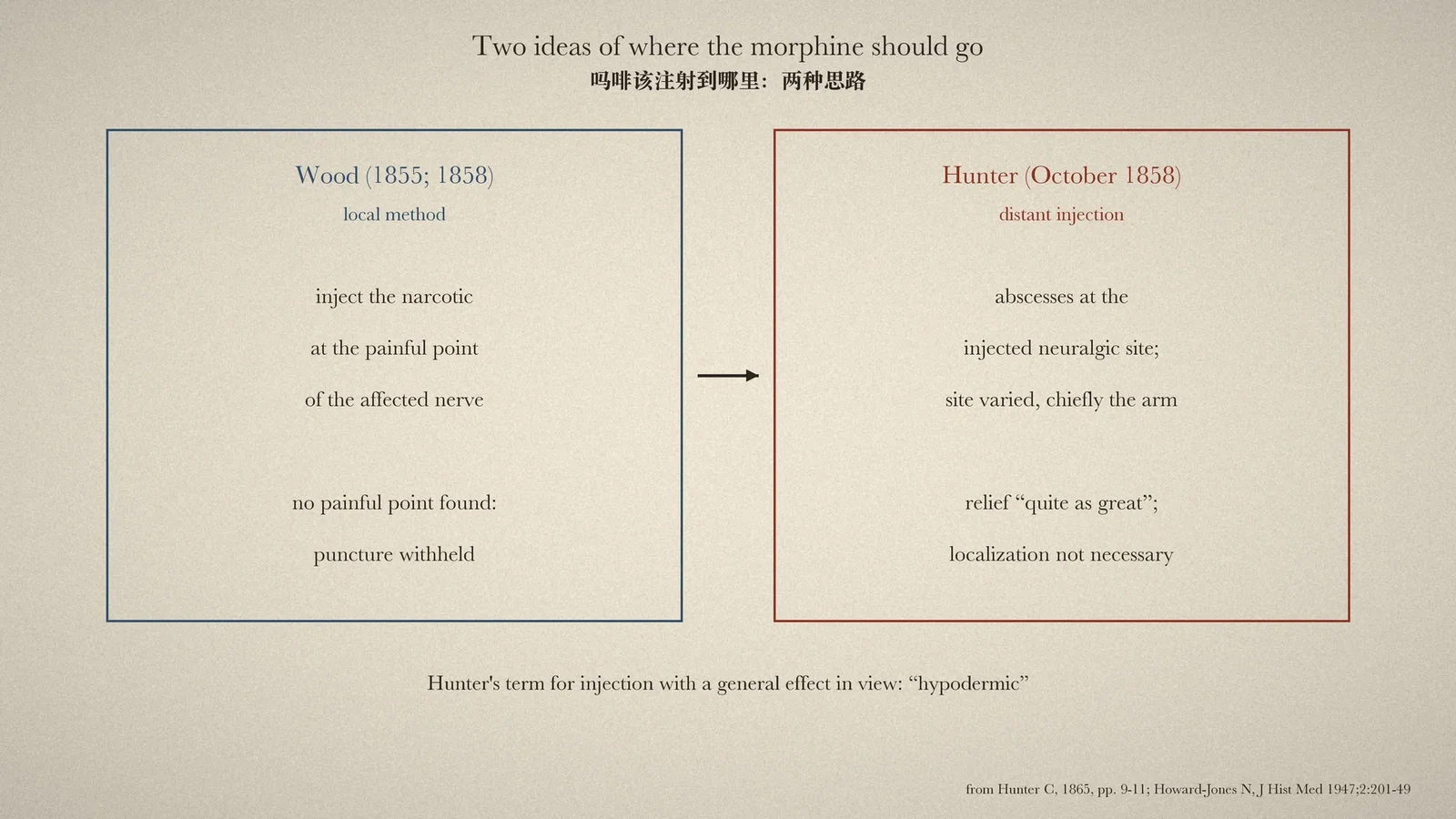
When morphine was first injected under the skin, the point was to put it in the right place. Two patients, two abscesses and a young London house surgeon changed that. In the autumn of 1858 Charles Hunter found that morphine injected into a healthy arm relieved neuralgia as well as morphine injected at the painful spot, and drew a general conclusion from it. The idea that an injected drug acts on the whole body is now routine in anaesthesia and pain medicine. Its arrival was untidy, and the two sources read for this article, Hunter's own 1865 pamphlet and a 1947 history by Norman Howard-Jones, show how. [1] [2]
The local method
Howard-Jones traces a line of attempts to put opiates under the skin. G. V. Lafargue in 1836 pushed morphine paste under the epidermis; Rynd in 1845 described a treatment of neuralgia "intended as a direct application of morphine solution to the affected nerve"; and in 1855 "Dr. Alexander Wood of Edinburgh" published the method of subcutaneous injection. [2] Wood's aim was in the title: a new method of treating neuralgia "by the direct application of opiates to the painful points". The first trial produced "profound somnolence", and Wood discussed absorption at length, but Howard-Jones argues that in practice Wood held to the local idea, even withholding injection from a patient in whom no painful point could be found. [2]
Two patients at St George's
According to Howard-Jones, the subcutaneous method was widely used in Edinburgh after 1855 but "little, if at all known or used" in London. [2] In 1858 Hunter, a house surgeon at St George's Hospital, tried Wood's plan, and a letter in the Medical Times and Gazette of 16 October described two cases. [2] Hunter's own later account names them only by initials: a man, T. G., "who had suffered frightfully from neuralgia for four years", and a young woman, E. P., about eighteen, with severe one-sided head pain and a disorganised eye. [1] Both improved, "neither were speedily cured; both had abscess in the neuralgic site, from the continuance of the localization". [1] When injections stopped in the first case, morphine was given by mouth, "with no relief". [2]
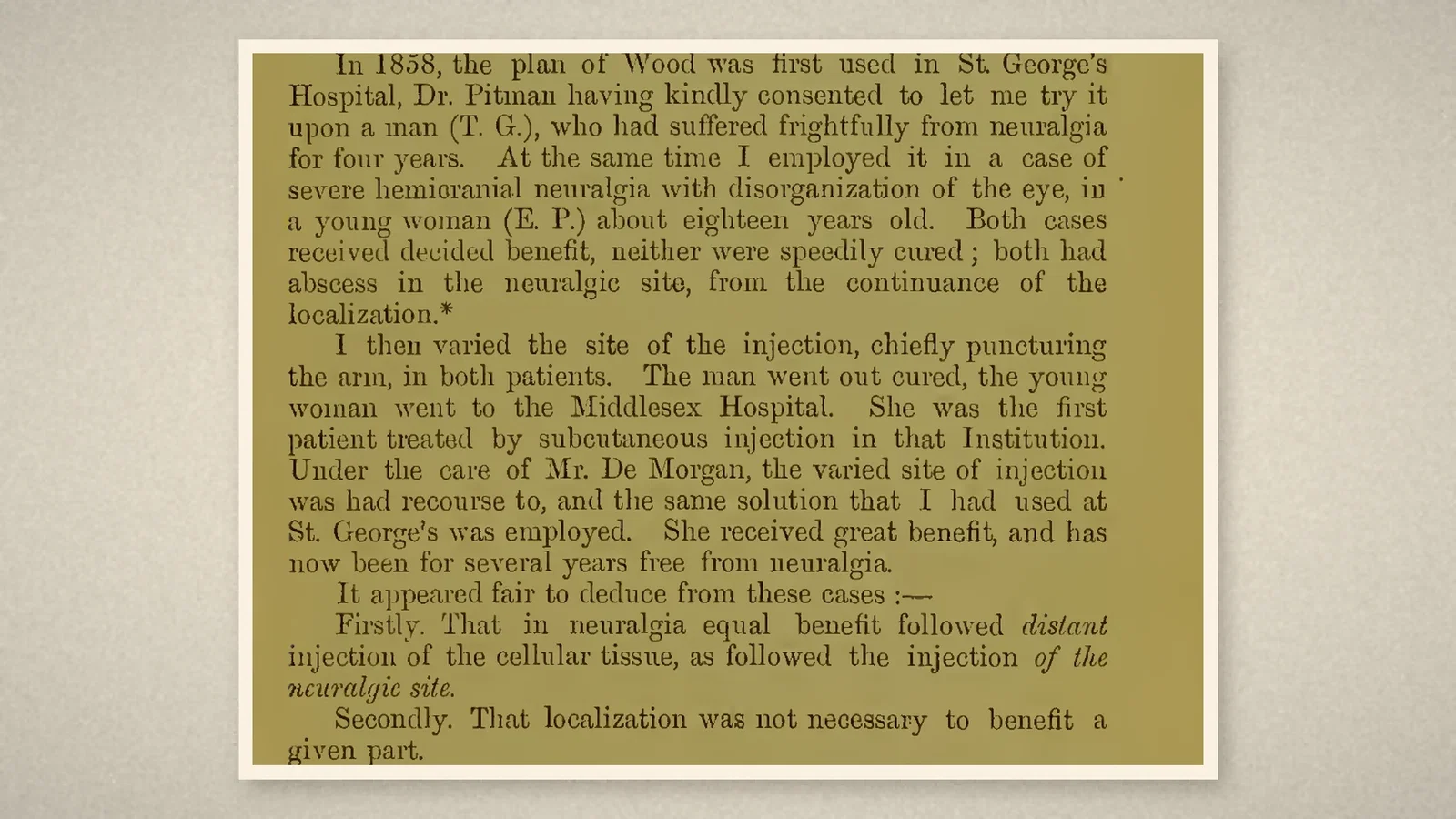
Two weeks later a second letter reported the change. As Howard-Jones quotes it: "I have given up the localization of the remedy as proposed by Dr. Wood ... and have adopted the employment of narcotic injections into the cellular tissue of various parts of the body." The injections went into "healthy parts, such as the neck, arm, etc.", never twice in the same spot, and both patients benefited again. [2] Hunter's conclusion was explicit: injected at a distance from the neuralgia, "the relief that follows appears quite as great" as when injected into the painful part, so "the idea that the relief results from the localization of the remedy in the painful part is erroneous". [2] In the 1865 account the man "went out cured", and the young woman, treated afterwards at the Middlesex Hospital with the same solution at varied sites, had been free of neuralgia for several years. [1]
A name and a quarrel
Hunter went further. In April 1859 Hunter read a paper on experiments, chiefly in animals with morphia, strychnia and antimony, comparing injection with doses by mouth, and concluded that injected drugs "acted by absorption", acted faster and more fully, and that a small injected dose matched a much larger one swallowed. [1] Hunter also coined a word. "Hypodermic", from the Greek for beneath the skin, was "the name I gave this plan of introducing medicines in 1859", meant to distinguish injection with a general effect in view from Wood's local practice. [1]
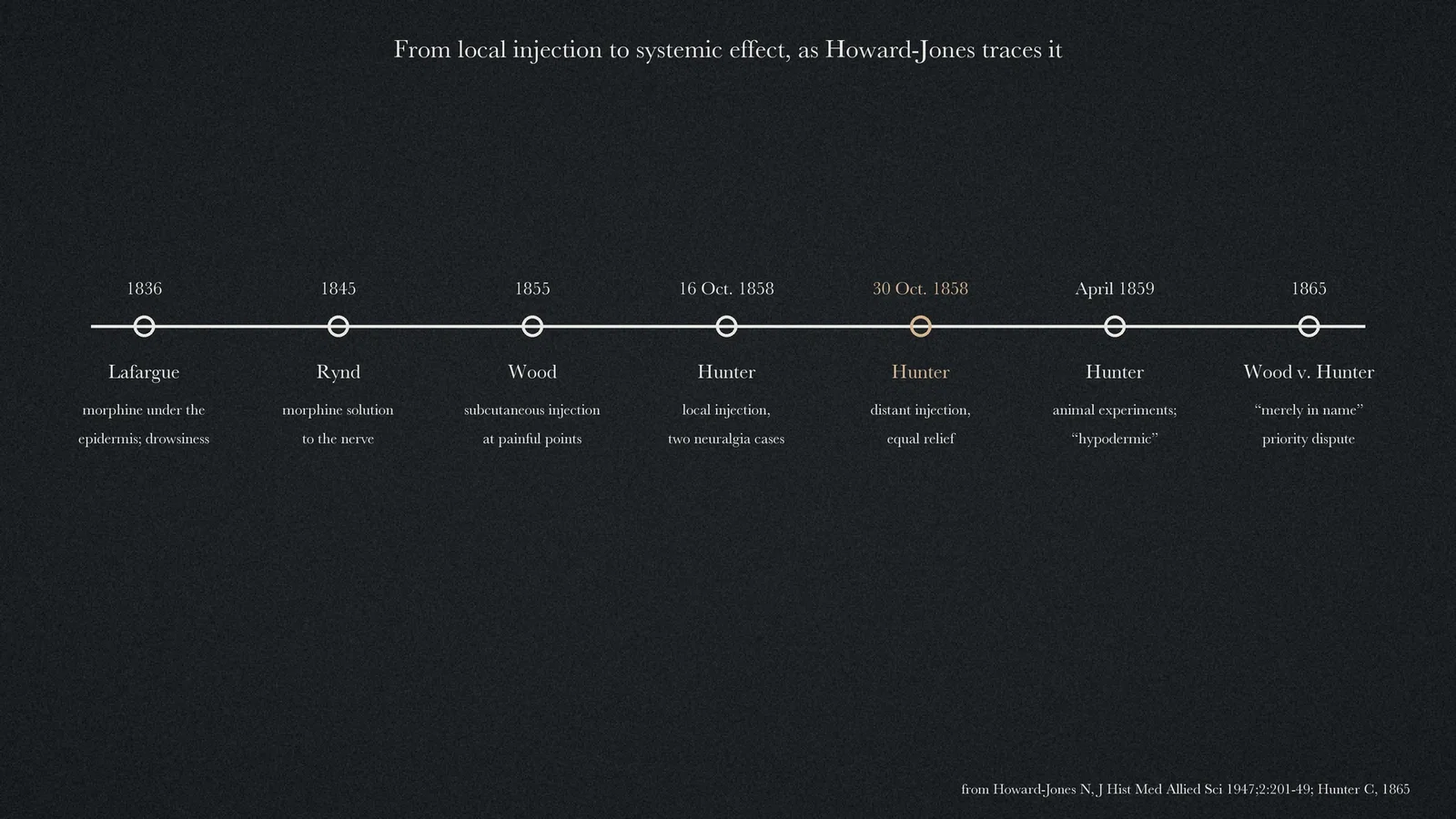
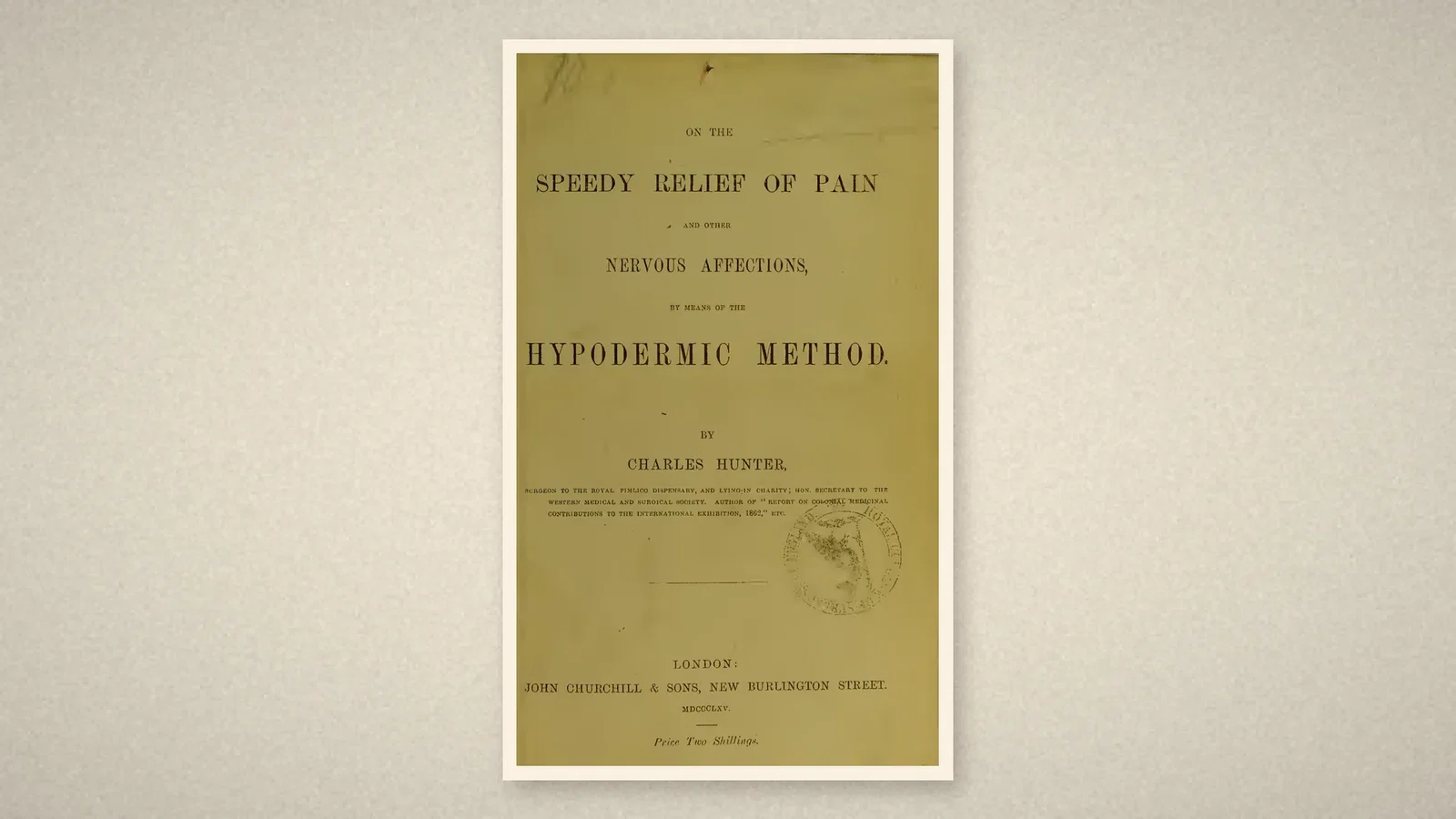
In 1865 Hunter published On the Speedy Relief of Pain and Other Nervous Affections, by Means of the Hypodermic Method, which states that Hunter's "experiments in 1858 were the first to upset" the theory that an injection must be made into the affected place. [1] Wood, silent for seven years, replied that the hypodermic method differed from Wood's own "merely in name": Wood had called it subcutaneous, from the Latin, and Hunter had renamed it from the Greek. [2] Howard-Jones's verdict is mixed: Lafargue and Wood had both seen systemic effects without grasping their significance; Hunter, having "accidentally made an important discovery", saw it, but then built a therapeutic system on it and overstated the originality. [2]
What the record shows
The shift recorded here is conceptual rather than technical. The syringe and the drug were Wood's; what changed in 1858 was the understanding of where the drug works. Two patients and an abscess problem led to a test that separated local from general action, and from it the modern idea of giving an analgesic under the skin for its effect on the whole body. The record also shows how that idea arrived wrapped in a priority dispute, and how thin, two patients, the original evidence was.
Sources and reading limits
Read: Hunter's 1865 pamphlet (front matter, preface and Chapter I); sections 5 and 6 of Howard-Jones's 1947 history, which quote Hunter's 1858 letters, Wood's papers and the 1865 exchange.
Not covered: Hunter's 1858 letters and 1859 paper in the original journal; Wood's papers in the original; the 1863 report of morphine after an amputation and other later items grouped in this topic. The patients are named only by Hunter's initials. Hunter's claim of priority is reported as Hunter's own.
Two illustrations are page images from Hunter's pamphlet; two are drawn from the sources.
- Hunter C. On the speedy relief of pain and other nervous affections, by means of the hypodermic method. London: John Churchill; 1865. Internet Archive
- Howard-Jones N. A critical study of the origins and early development of hypodermic medication. J Hist Med Allied Sci. 1947;2(2):201-49. PubMed
Continue exploring
Related reading connects shared questions and contexts; it does not by itself establish historical influence.
- 1836: Lafargue's Morphine Inoculation and Martin-Solon's Caution
- 1853: Wood and Pravaz, Similar Instruments for Different Questions
Anesthesia Epochs · The Source Room · About & Editorial Method
Published November 2, 2026. Sources and reading limits are stated above. Illustrations are labelled as original source images or AI-made. Historical accounts are educational; they are not current treatment instructions.