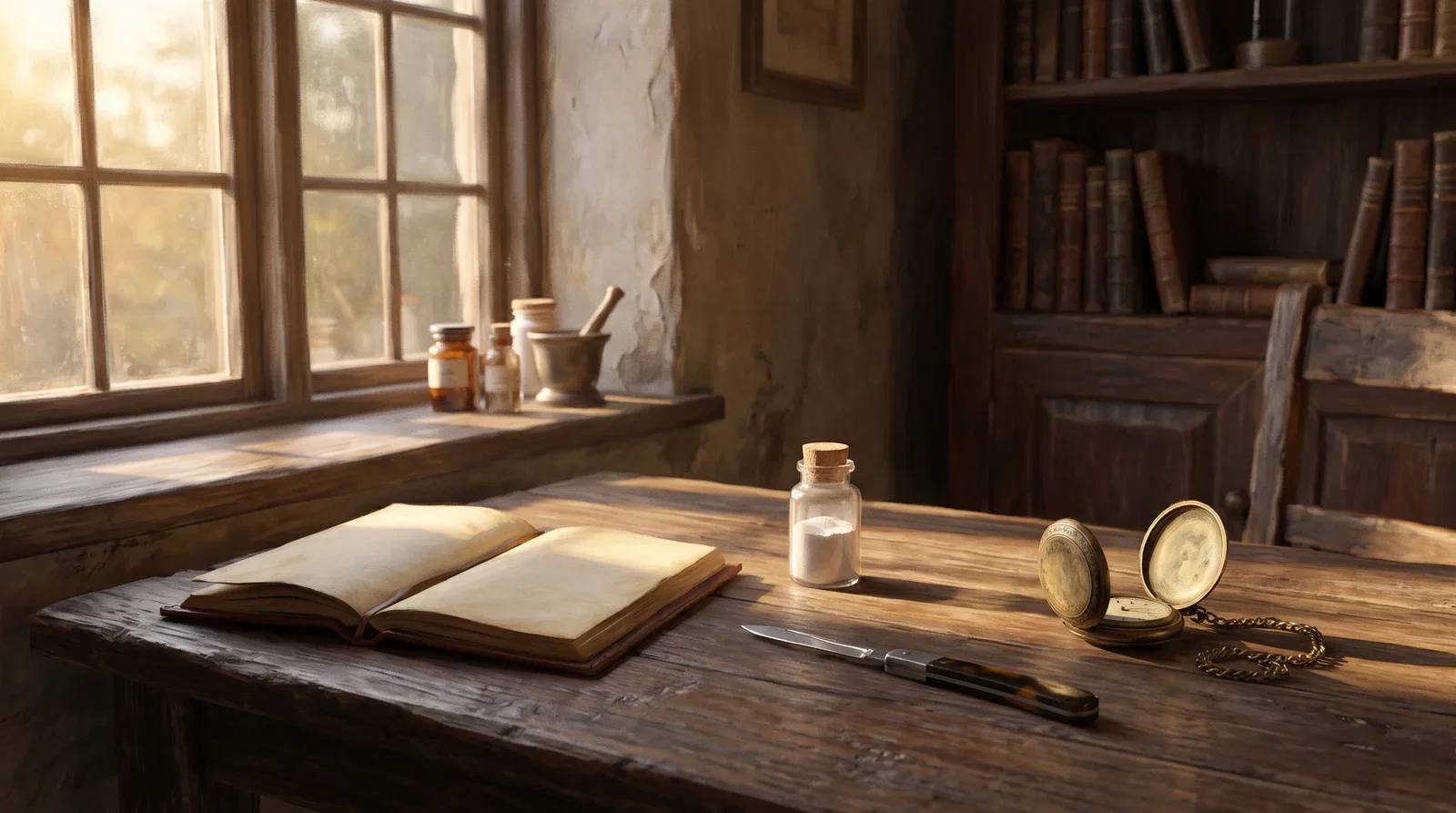
A country doctor slipped morphine under the epidermis with a vaccination lancet to treat neuralgia; the Academy's reporter repeated the tests and warned against half-proofs.
Reading Library · Anesthesia Epochs · 中文版
Watch the education video (for clinicians)
1836: Lafargue's Morphine Inoculation — Martin-Solon's Caution · Anesthesia Epochs Education Series
Before the hypodermic syringe, doctors who wanted morphine to act in one place had few choices: rub it on the skin, or raise a blister and dress the raw surface with it. In 1836 a country physician proposed a third way, and the Paris Academy of Medicine asked one of its members to check it. The two documents, the proposal and the check, were printed in the first volume of the Academy's Bulletin, and together they make a small case study in how a new route for pain relief was tested. [1] [2]
The letters from Saint-Émilion
According to Norman Howard-Jones's 1947 history of hypodermic medication, Dr G. V. Lafargue of Saint-Émilion sent two short letters to the Académie des Sciences, read on 26 September and 3 October 1836, and a fuller communication read to the Académie de Médecine on 4 October, followed by a second one a week later. [3] The Bulletin prints the medical letters word for word. [1]
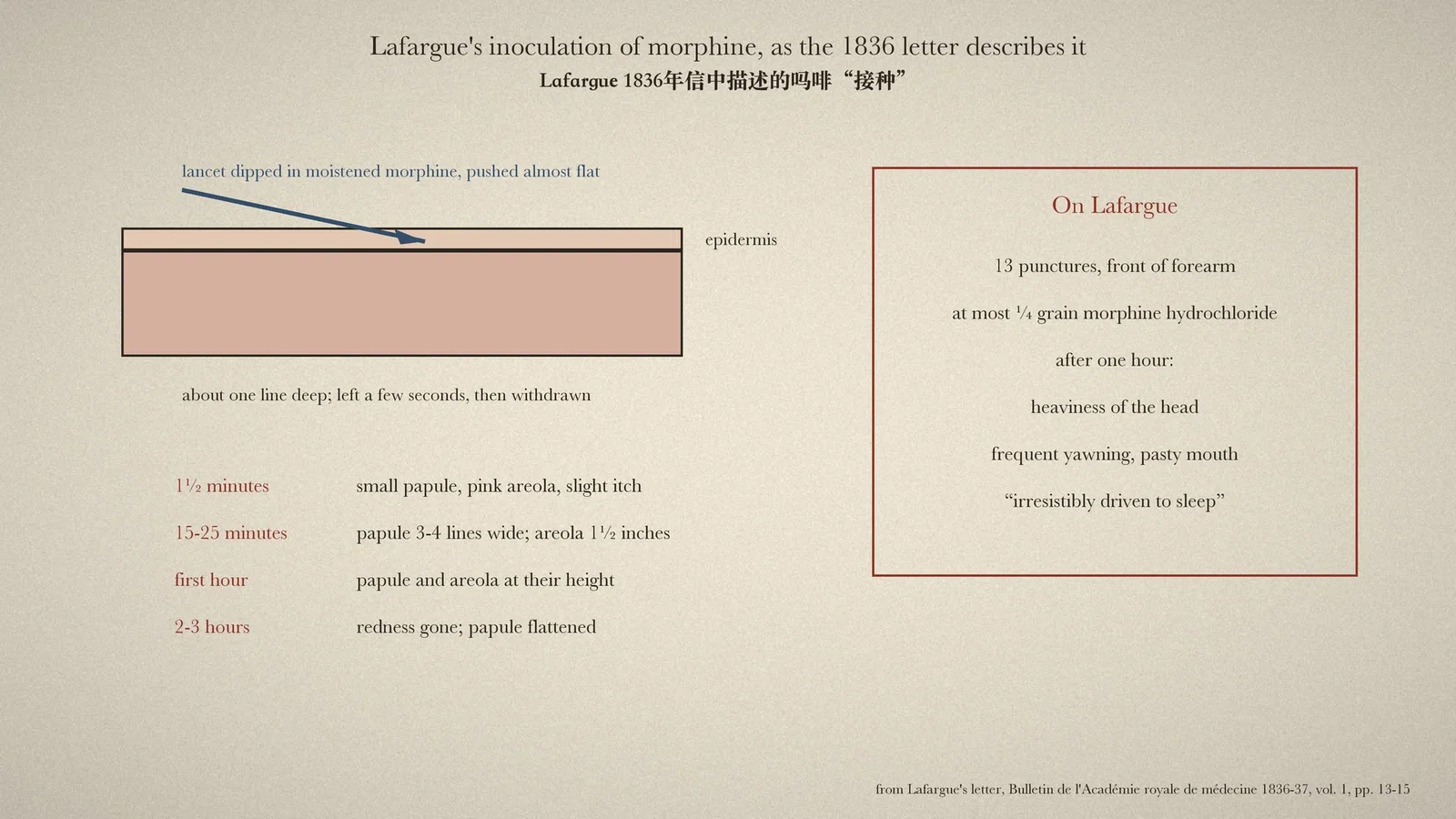
Lafargue had been studying what happens when drugs are applied to skin with or without its epidermis, and wondered what would follow "the introduction under the epidermis, with a lancet", of morphine and its salts. [1] The method was simple. Dip the tip of a lancet in morphine moistened with a little water, push it almost horizontally under the epidermis to a depth of about one line, leave it a few seconds and withdraw it. A minute and a half later a small papule and a pink areola appear, with slight itching; within fifteen to twenty-five minutes the papule is three or four lines wide and the areola an inch and a half across; both are at their height during the first hour and fade over the next few. Several punctures together look, Lafargue wrote, like a mild smallpox. [1]
A self-experiment
Was the effect only local? Lafargue answered "by a fact". After making thirteen punctures on the front of the forearm, using "at most a quarter grain" of morphine hydrochloride, Lafargue felt within an hour a marked heaviness of the head and frequent yawning, the mouth became pasty, and Lafargue was "irresistibly driven to sleep". [1] What, the letter asks, would have happened with double or four times the dose? [1]
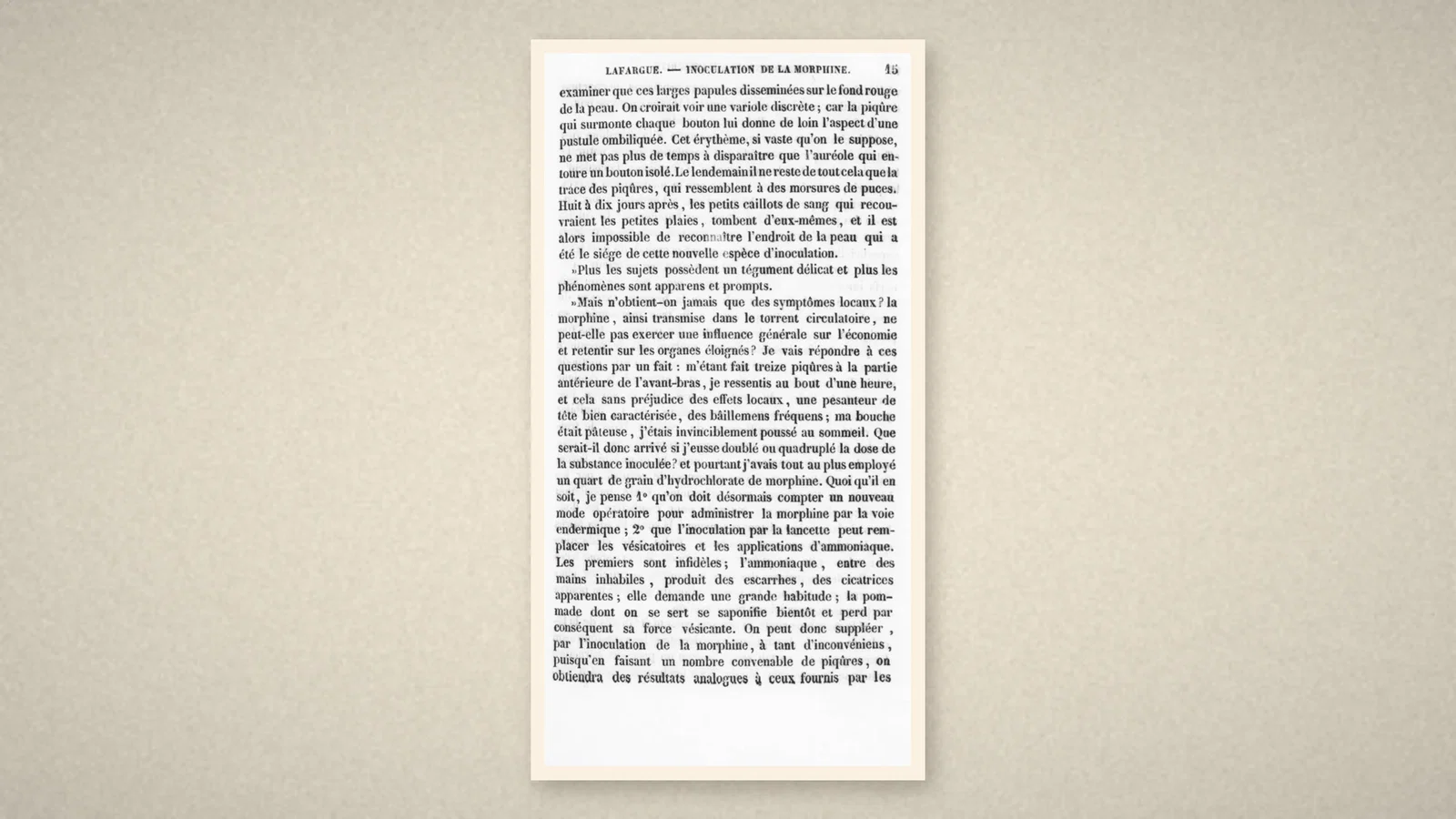
Lafargue drew two conclusions: that there was now "a new operative mode" for giving morphine by the endermic route, and that lancet inoculation could replace blisters and ammonia, which were unreliable or left scars. [1] But the main hope was local. The method, Lafargue wrote, would be valuable in superficial neuralgias of the occipital, frontal, infra-orbital, inferior dental, intercostal and ulnar nerves, and Lafargue reported having been cured of a neuralgia of the branch of the dental nerve that leaves the chin, by ten punctures three times a day, relieved from the first session. [1] Howard-Jones notes that Lafargue does not seem to have been impressed by the systemic possibilities. [3]
A second letter turned to forensic medicine. A drop of Sydenham's laudanum diluted in 25, 50 or even 100 parts of water still produced the papule, and Lafargue proposed the reaction as a test for opium in the stomach contents of suspected poisonings. [1]
The reporter's tests
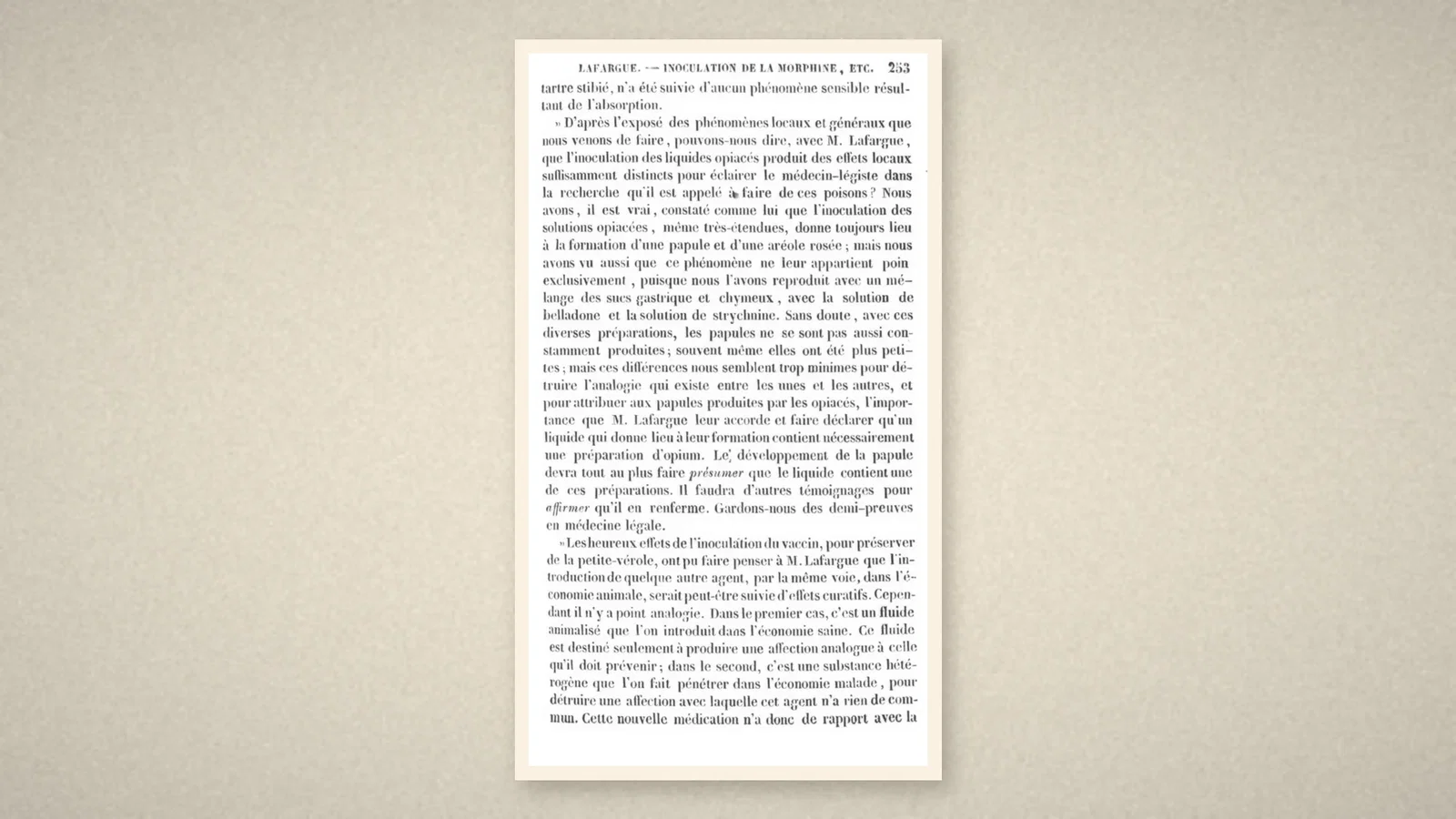
On 27 December 1836 Martin-Solon, a physician of the Hôpital Beaujon, reported to the Academy. [3] Helped by an intern, M. Florimont, Martin-Solon had repeated Lafargue's experiments "from the double point of view of forensic medicine and therapeutics". [1] The lancet alone or with water raised no papule. Opiates, even well diluted, always did. But so, often enough, did belladonna, stramonium, strychnine and even the gastric juice of a cadaver. The papule could at most make one suspect opium: "Let us beware of half-proofs in forensic medicine." [1]
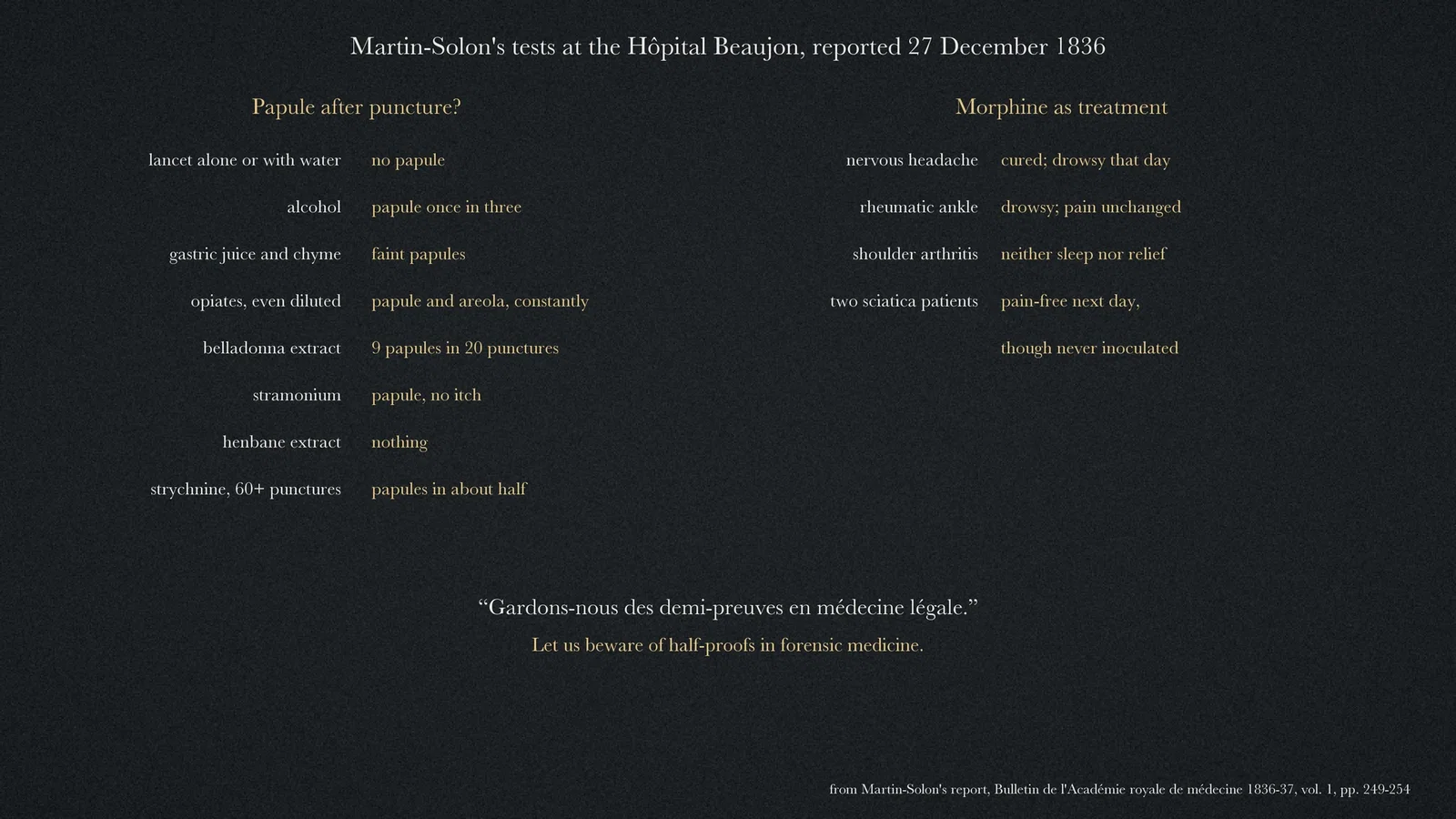
The therapeutic results were no better. A woman with nervous headaches, given eight punctures at the temples with a quarter grain of morphine salt, was promptly cured and drowsy that day; a young woman with rheumatic pain of the ankle became drowsy but kept the pain; a young woman with shoulder arthritis had papules but neither sleep nor relief. [1] Then came the observation that makes the report memorable. Two patients with rheumatic pain along the sciatic nerve were prescribed morphine inoculation; the next day neither complained, "and yet the punctures had not been made". Had they been done, Martin-Solon wrote, "we would have counted these facts among the successes obtained. This is how therapeutic marvels are too often given credit." [1] The report rejected Lafargue's analogy with vaccination, allowed that the method might help in some local complaints, and ended politely that the work "is not without interest". [1]
What came after
Howard-Jones, writing in 1947, praised Martin-Solon's discrimination as a contrast to the uncritical enthusiasm of later advocates of hypodermic techniques. [3] Lafargue kept working: in 1847 Lafargue described a long grooved needle that combined acupuncture with inoculation, having noticed relief of pain too quick to be due to the morphine. [3] Howard-Jones goes on to Rynd's retractable trocar in Dublin in 1845 and the hypodermic syringe that followed. [3]
What the record shows
Lafargue's letter records a recognisable step towards giving an opioid through the skin rather than by mouth, with a dose, a timeline and a self-experiment. Martin-Solon's report records the other half of good practice: a control with plain water, a search for false positives, a count of failures, and two patients who improved without treatment. Both belong in the history of pain medicine.
Sources and reading limits
Read: Lafargue's two letters and Martin-Solon's report in the Bulletin de l'Académie royale de médecine, vol. 1; section 2 of Howard-Jones's 1947 article.
Not covered: Lafargue's letters in the Comptes rendus of the Académie des Sciences; Lafargue's 1847 paper and later writings; Rynd's paper. The reading dates come from Howard-Jones. Howard-Jones gives 30 seconds for the papule to appear; the letter says a minute and a half, which is followed here. The neuralgia cure is Lafargue's own report. Quotations from the French are translated for this article.
Two illustrations are page images from the Bulletin; two are drawn from it.
- Lafargue. Lettres sur l'inoculation de la morphine. Bulletin de l'Académie royale de médecine. 1836-37;1:13-16, 40-42. Internet Archive
- Martin-Solon. Rapport sur les lettres de M. Lafargue. Bulletin de l'Académie royale de médecine. 1836-37;1:249-54. Internet Archive
- Howard-Jones N. A critical study of the origins and early development of hypodermic medication. J Hist Med Allied Sci. 1947;2(2):201-49. PubMed
Continue exploring
Related reading connects shared questions and contexts; it does not by itself establish historical influence.
- 1784: James Moore Compresses Nerves to Spare Amputation Pain
- c. 450 BCE: The Poppy in the Hippocratic Corpus
- 1844: Rynd's Cases, After the Pain Eased
- 1853: Wood and Pravaz, Similar Instruments for Different Questions
Anesthesia Epochs · The Source Room · About & Editorial Method
Published November 2, 2026. Sources and reading limits are stated above. Illustrations are labelled as original source images or AI-made. Historical accounts are educational; they are not current treatment instructions.