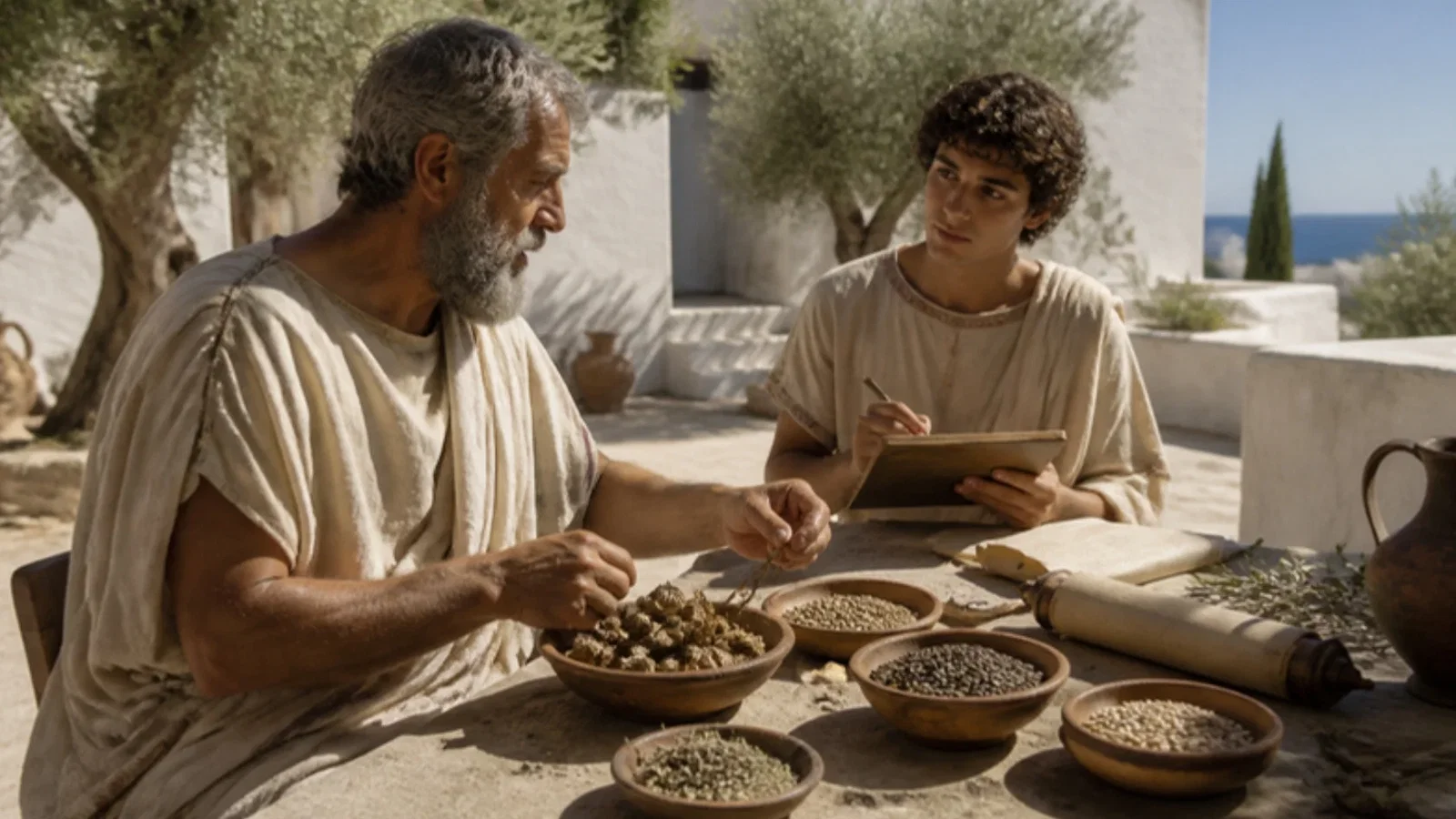
In Regimen II the poppy is a binding, nourishing seed; later historians read hypnotic and narcotic uses elsewhere in the Corpus, and a 1998 statistical study concluded that its power against pain was not yet recognised.
Reading Library · Anesthesia Epochs · 中文版
Watch the education video (for clinicians)
5th Century BCE: The Hippocratic Poppy — Food, Medicine, Pain · Anesthesia Epochs Education Series
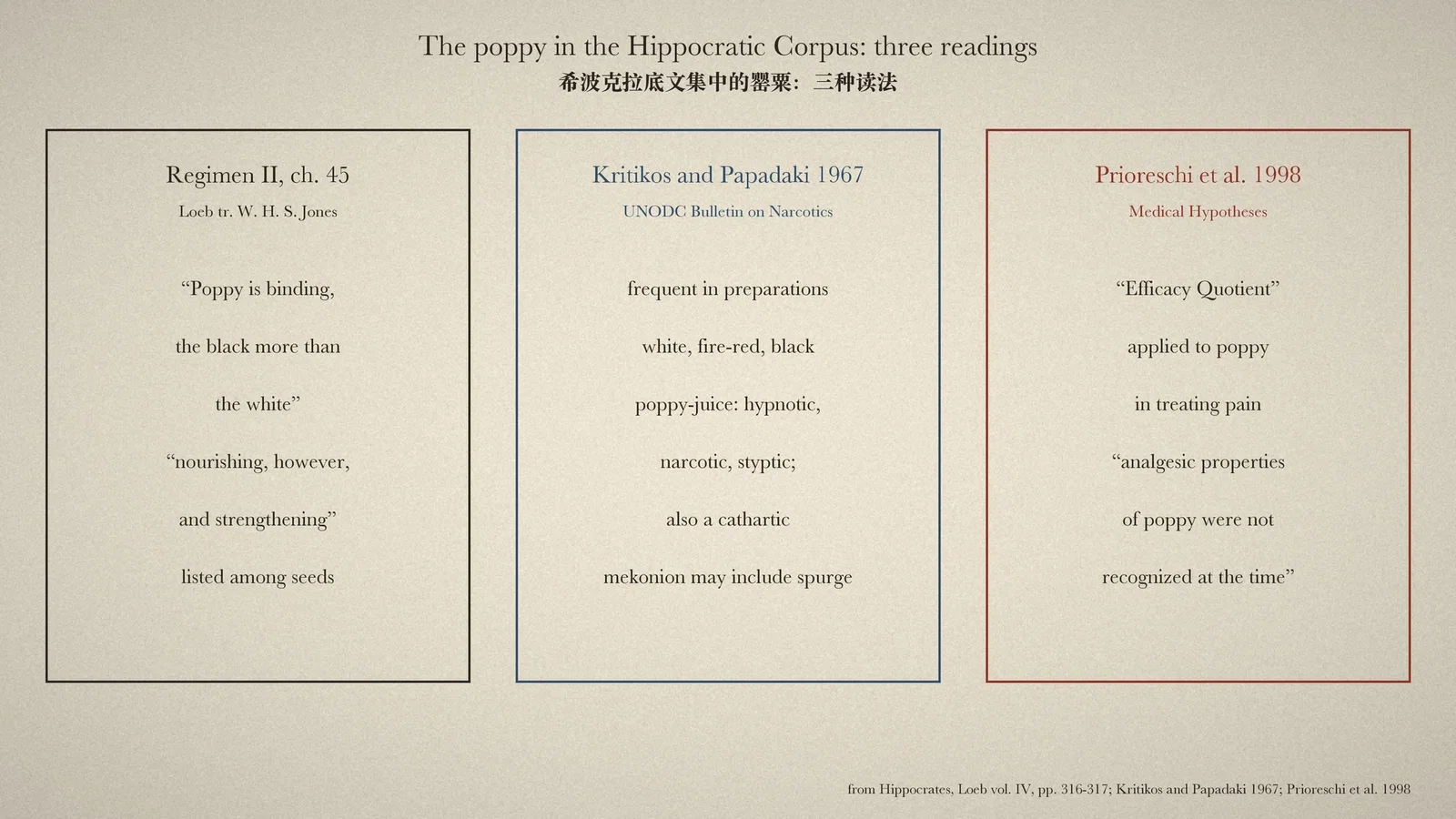
Opium sits so near the centre of the history of pain relief that it is natural to assume the Hippocratic physicians used it against pain. This article reads one Hippocratic passage closely and sets beside it two later attempts to sum up the whole Corpus. They do not say the same thing.
A seed among seeds
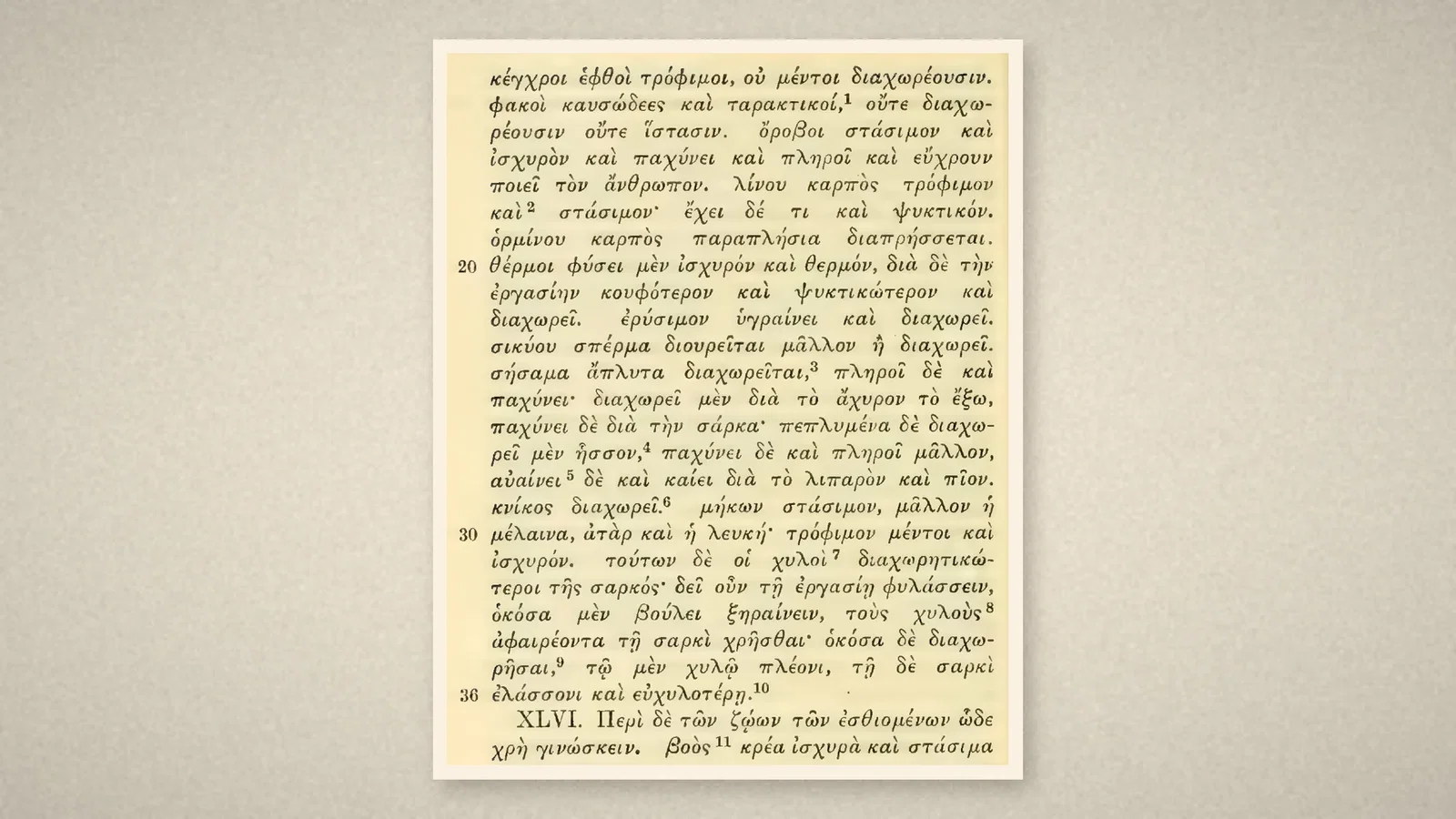
The second book of the treatise Regimen surveys foods and their effects on the body. Chapter 45 deals with seeds and pulses: lentils, vetches, linseed, lupins, cucumber seed, sesame, wild saffron. The poppy comes in this list. In W. H. S. Jones's Loeb translation, first printed in 1931: "Poppy is binding, the black more than the white, but the white also. It is nourishing, however, and strengthening." [1] The Greek on the facing page reads mēkōn stasimon, the same adjective the chapter uses for other foods that check the bowels. [1] The chapter then explains how to use the juices of these seeds to loosen the bowels or their substance to dry them. [1]
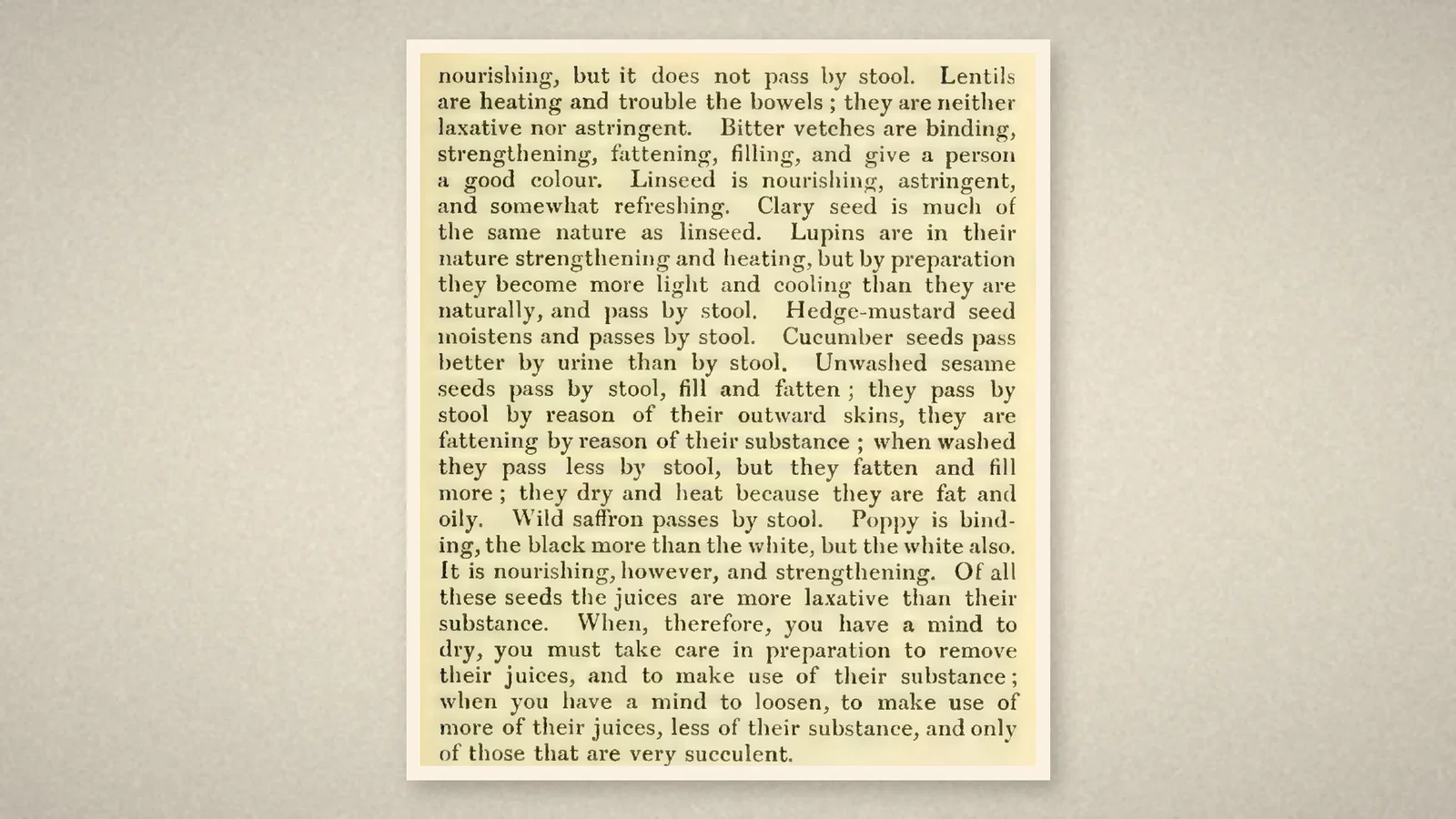
In this passage the poppy is food. It binds, nourishes and strengthens. It is not said to bring sleep, to dull sensation, or to ease pain. That is a single chapter, and the Corpus contains many treatises, but it is the passage most readily checked in a standard translation.
A wider reading in 1967
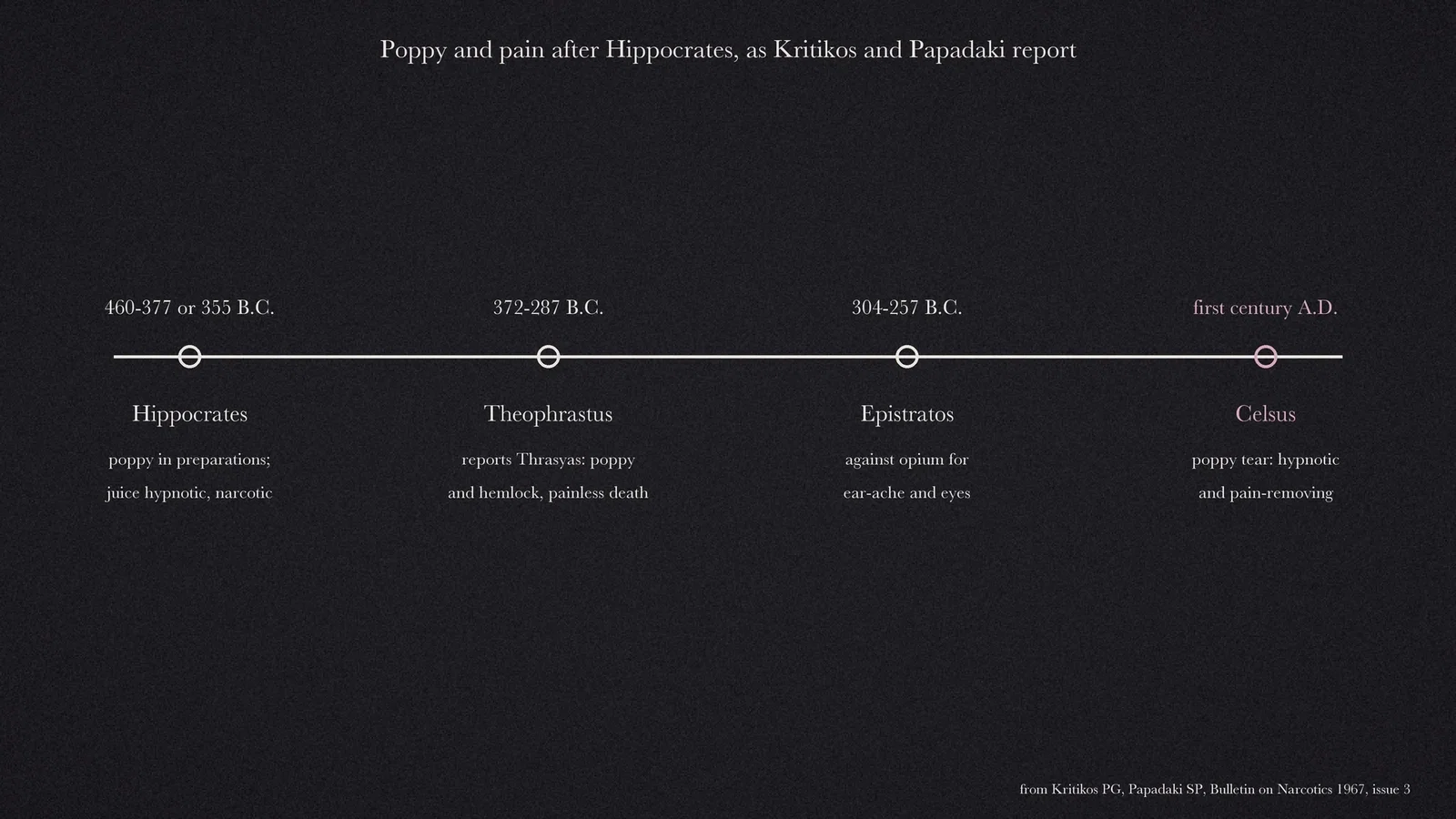
In 1967 P. G. Kritikos and S. P. Papadaki published a long history of the poppy and opium in antiquity in the United Nations Bulletin on Narcotics. Their section on the Greeks dates Hippocrates to "460-377 or 355 B.C." and says the Hippocratic writings make "frequent mention of the poppy as being used in medicinal preparations", distinguishing white, fire-red and black kinds, and using unripe, ripe and baked poppy. [2] Citing Littré's French edition, the two authors write that poppy-juice appears "as a hypnotic, narcotic, and styptic drug; also as a cathartic", and that the Corpus mentions the hypnotic poppy and the nutritive value of its seeds. [2] They add a caution that matters for anyone counting: the contradiction between styptic and cathartic may arise because the ancients used the word mekonion for the juice of spurge as well as of poppy. [2]
Kritikos and Papadaki then follow the poppy forward. Theophrastus reports that the Mantineian root-doctor Thrasyas made "an easy and painless death" from the juices of poppy and hemlock; according to Diagoras, a commentator on Hippocrates, a founder of the Alexandrian school whom they call Epistratos (probably Erasistratus) objected to opium for ear-ache and eye complaints because it "dulled the sight and is a narcotic"; and Celsus, in the first century AD, refers to the poppy's tear as "an hypnotic and pain-removing drug". [2]
A count in 1998
Sleep and narcosis are not the same as pain relief. In 1998 P. Prioreschi, R. P. Heaney and E. Brehm asked the narrower question directly. Their aim was a method for judging whether ancient physicians chose a drug for its efficacy or for other reasons, such as tradition or chance. They devised a statistical test, an "Efficacy Quotient", and applied it to Hippocratic uses of poppy in the treatment of pain, comparing them with uses of plants that have no analgesic action. The abstract states the result plainly: "The authors conclude that the analgesic properties of poppy were not recognized at the time." [3] Only the abstract was available for this article, so the counts behind the conclusion could not be checked.
What the record shows
The three readings fit together better than they first appear. The Regimen passage shows the poppy as a binding, nourishing food. Kritikos and Papadaki show it used in many preparations and associated with sleep and narcosis, with the warning that the ancient word was not always about the poppy. Prioreschi and colleagues find no sign that Hippocratic physicians singled it out for pain. On the evidence read here, the step from a sleep-bringing poppy to a pain-removing one is recorded later, in the authors Kritikos and Papadaki cite after Hippocrates. That is a modest conclusion, but it keeps a familiar claim, that the Hippocratic physicians gave opium for pain, in its proper place: as something still to be shown, not assumed.
Sources and reading limits
Read: chapters 45-46 of Regimen II in Jones's Loeb volume; the web text of Kritikos and Papadaki's 1967 article, section II, with its footnotes; the PubMed abstract of Prioreschi, Heaney and Brehm 1998.
Not covered: the full text of Prioreschi et al., including their list of passages and their counts; the other Hippocratic passages cited by Kritikos and Papadaki from Littré's edition, so their description of poppy-juice is reported as theirs; Theophrastus, Celsus and the other later authors, known here only through Kritikos and Papadaki. The dates of Hippocrates are as Kritikos and Papadaki give them; the treatises of the Corpus are not dated here, and the century label is a browsing anchor. "Epistratos" is spelled as Kritikos and Papadaki print it; the name probably refers to Erasistratus, whom Pliny names with Diagoras as condemning opium outright (Natural History 20.200, Latin text checked).
Two illustrations are crops of the Loeb volume; two are drawn from the sources.
- Hippocrates. Regimen II, chapters 45-46. In: Jones WHS, translator. Hippocrates, vol. IV. Loeb Classical Library. First printed 1931:316-17. Internet Archive
- Kritikos PG, Papadaki SP. The history of the poppy and of opium and their expansion in antiquity in the eastern Mediterranean area. Bulletin on Narcotics. 1967;(3):17-38. UNODC
- Prioreschi P, Heaney RP, Brehm E. A quantitative assessment of ancient therapeutics: poppy and pain in the Hippocratic Corpus. Med Hypotheses. 1998;51(4):325-31. PubMed
Continue exploring
Related reading connects shared questions and contexts; it does not by itself establish historical influence.
- c. 50: Celsus Places Limits on Sleep and Pain Relief
- c. 50: Mandragora Before Cutting or Cautery in Dioscorides
- c. 1550: Paracelsus' Laudanum, One Name for Several Remedies
Anesthesia Epochs · The Source Room · About & Editorial Method
Published November 2, 2026. Sources and reading limits are stated above. Illustrations are labelled as original source images or AI-made. Historical accounts are educational; they are not current treatment instructions.