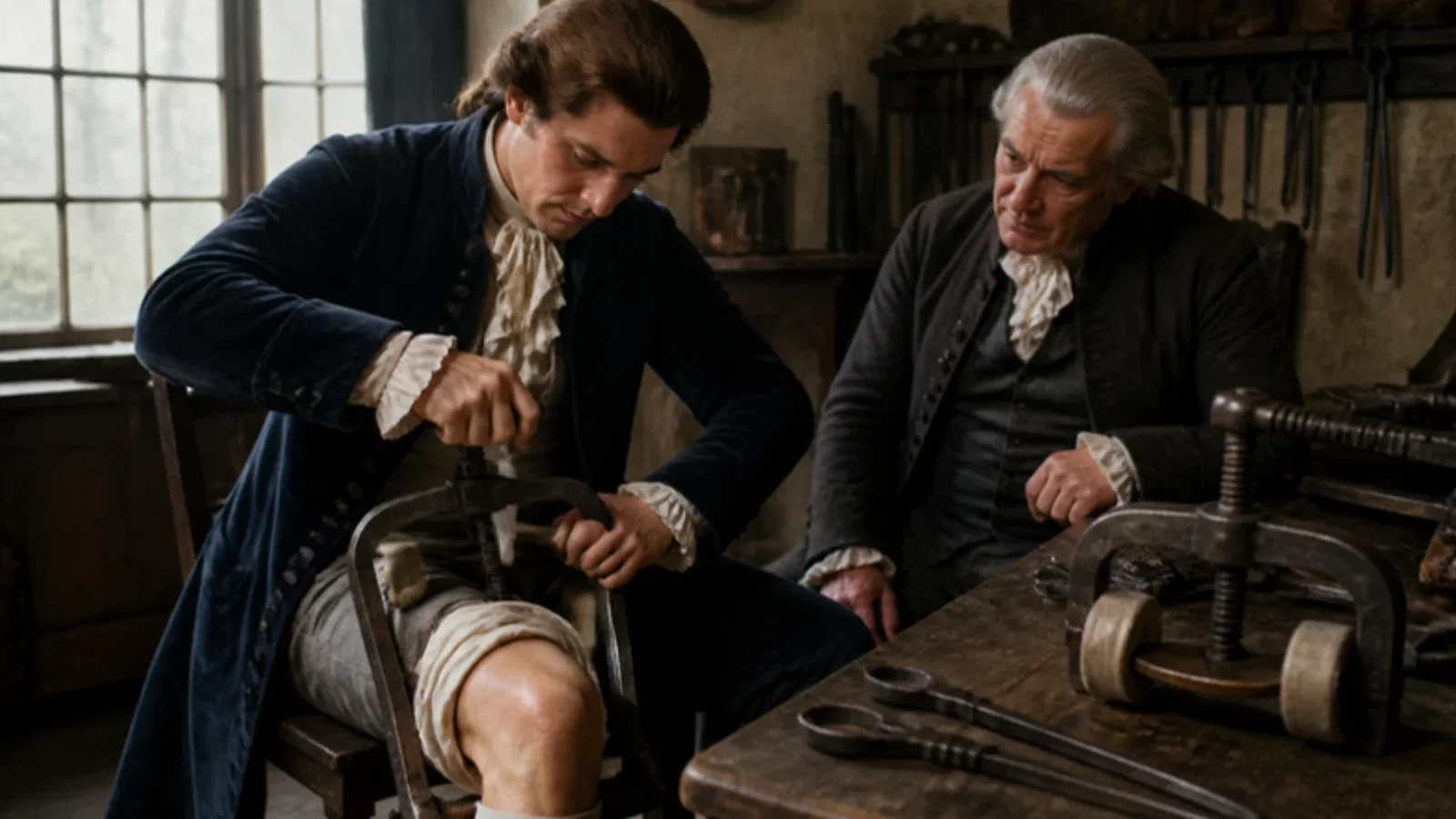
Moore numbed a limb by pressing on its nerves, tested the method on his own thigh, and watched John Hunter amputate a leg while the patient barely cried out.
Reading Library · Anesthesia Epochs · 中文版
Watch the education video (for clinicians)
1784: James Moore's Nerve Compression — Sparing Amputation Pain · Anesthesia Epochs Education Series
In November 1784 a young London surgeon published a pamphlet of about fifty pages, priced at two shillings, with a title that stated its whole ambition: A Method of Preventing or Diminishing Pain in Several Operations of Surgery. The author was James Moore, "Member of the Surgeons Company of London". The dedication, signed in Clifford Street on 20 November 1784, is addressed to John Gunning, John Hunter, Charles Hawkins and William Walker, the surgeons of St George's Hospital, where Moore had been a pupil and house surgeon. [1] Long before ether, the pamphlet tried to take the pain out of an amputation by pressing on nerves.
Why opium was not enough
Moore begins with the surgeon's dilemma. The profession whose object is to relieve suffering must inflict the worst of it, and every improvement in instruments had been made for speed or safety, not for the patient's feelings. [1] Anodynes had long been tried. Opium, Moore wrote, "is the most powerful of this class of drugs", and a moderate dose was "highly expedient to abate the smarting of the wound after an operation is over, and to induce sleep; but the strongest dose we dare venture to give, has little or no effect in mitigating the sufferings of the patient during the operation". [1]
The experiment on his own thigh
Cutting the nerves of a limb before amputating it would be pointless, Moore reasoned, since cutting them hurts too. But everyone knows the feeling of a leg "sleeping" after sitting on it, and Moore attributed it to pressure on the sciatic nerve. [1] So Moore decided to "try the experiment on myself": a compress over the sciatic nerve where it crosses the edge of the ischium, a bandage across the pelvis, and a tourniquet tightened as far as could be borne. Nothing happened. A thicker compress and harder pressure did no better. [1] Puzzling over the failure, Moore remembered that a leg only goes to sleep after one has sat for some time, and resolved to keep the pressure on longer. After about fourteen minutes the toes tingled; then they grew numb, the numbness spread up the leg, and within half an hour the foot, leg and outside of the thigh were "perfectly insensible; so that when I pricked or scratched them with pins, I felt nothing". [1] The inside of the thigh kept some feeling, which Moore put down to the crural and obturator nerves, still uncompressed. [1]
A second trial, with compresses on all three nerves, made the whole limb insensible in about half an hour. Moore then sent for his father, the physician Dr. John Moore, and told him of the experiments for the first time. His father pricked the leg with a pin without causing the least uneasiness, but, seeing it red and swollen and fearing that a vessel might burst, loosened the tourniquet. [1]
An instrument instead of a tourniquet
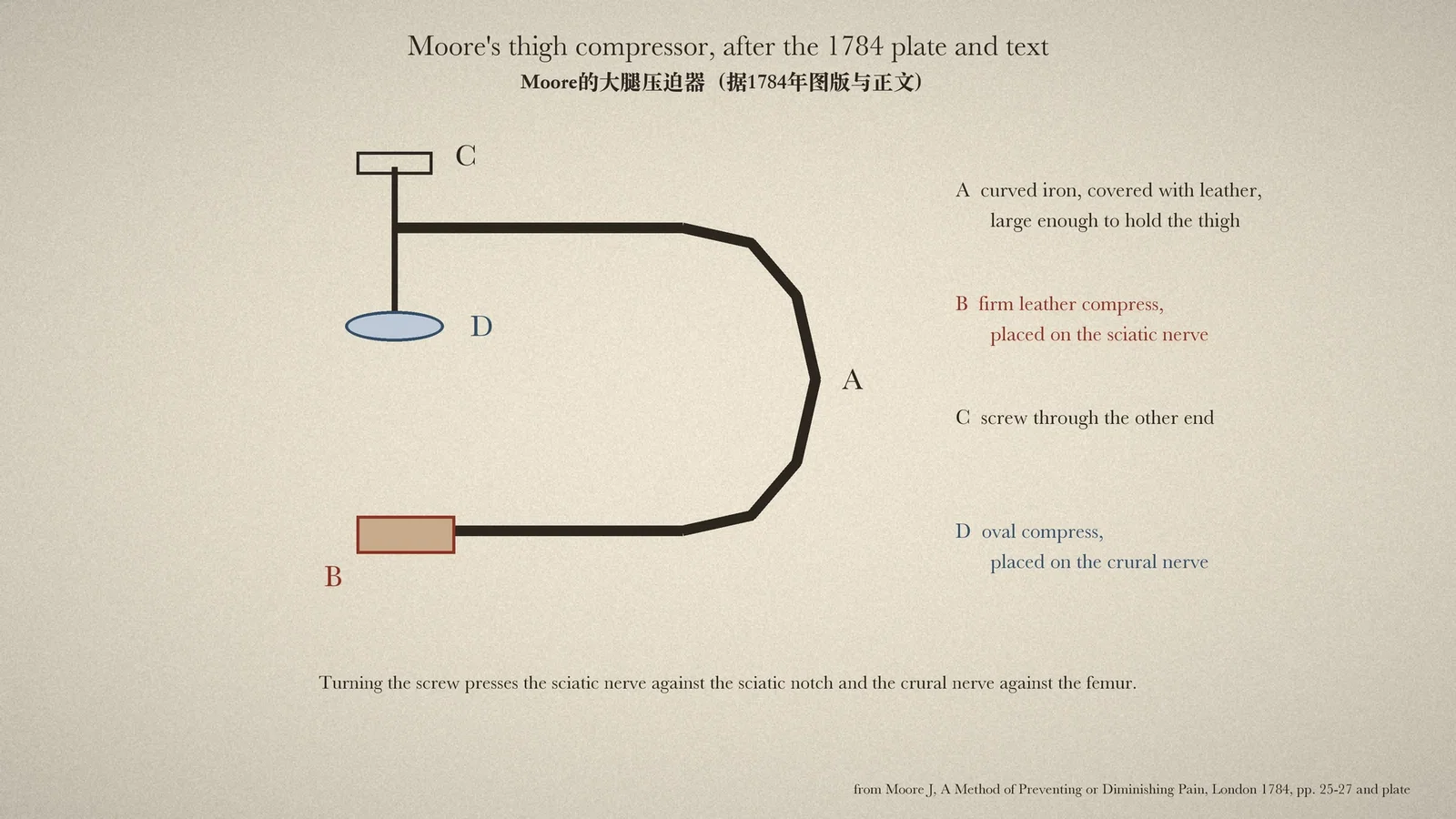
Squeezing the whole thigh stopped the circulation. Moore therefore designed a compressor that pressed on two points only, and had it made by Mr. Savigny in Pall Mall. The folding plate shows it: a curved piece of iron covered with leather (A), wide enough to hold the thigh; a firm leather compress at one end (B) for the sciatic nerve; and a screw (C) at the other end ending in an oval compress (D) for the crural nerve, found by the pulse of the crural artery beside it. Turning the screw pressed the sciatic nerve against the edge of the sciatic notch and the crural nerve against the femur. [1] A smaller version was meant for the arm, where all the nerves "form a plexus in the axilla" and the instrument "will compress the whole plexus at once". [1]
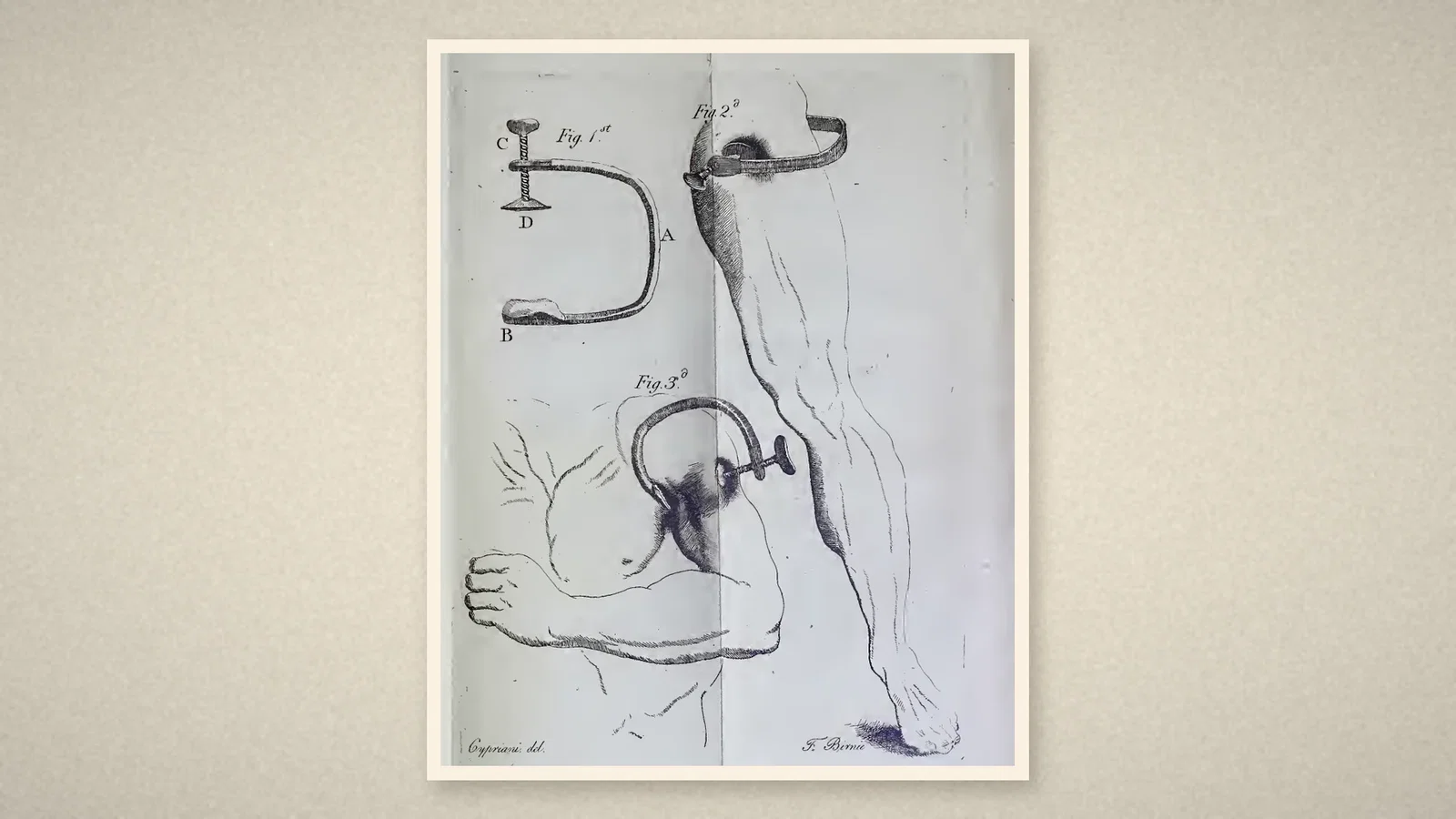
Tried on his own thigh, the new compressor left everything below the knee without feeling after half an hour, but the thigh itself kept considerable sensation from branches the instrument did not reach. Moore concluded frankly that it would not relieve the pain of amputations above the knee as well as below. [1]
The amputation at St George's
Moore wanted a trial in a real operation before publishing. Mr. Hunter, told of the experiments, offered a man at St George's Hospital whose leg was to be taken off below the knee within a few days. The patient had lost all the toes and had a large, inflamed ulcer on the foot that hurt at the gentlest dressing. On the day before the operation Moore applied the compressor for half an hour, after which rubbing the ulcer briskly gave no pain. [1]
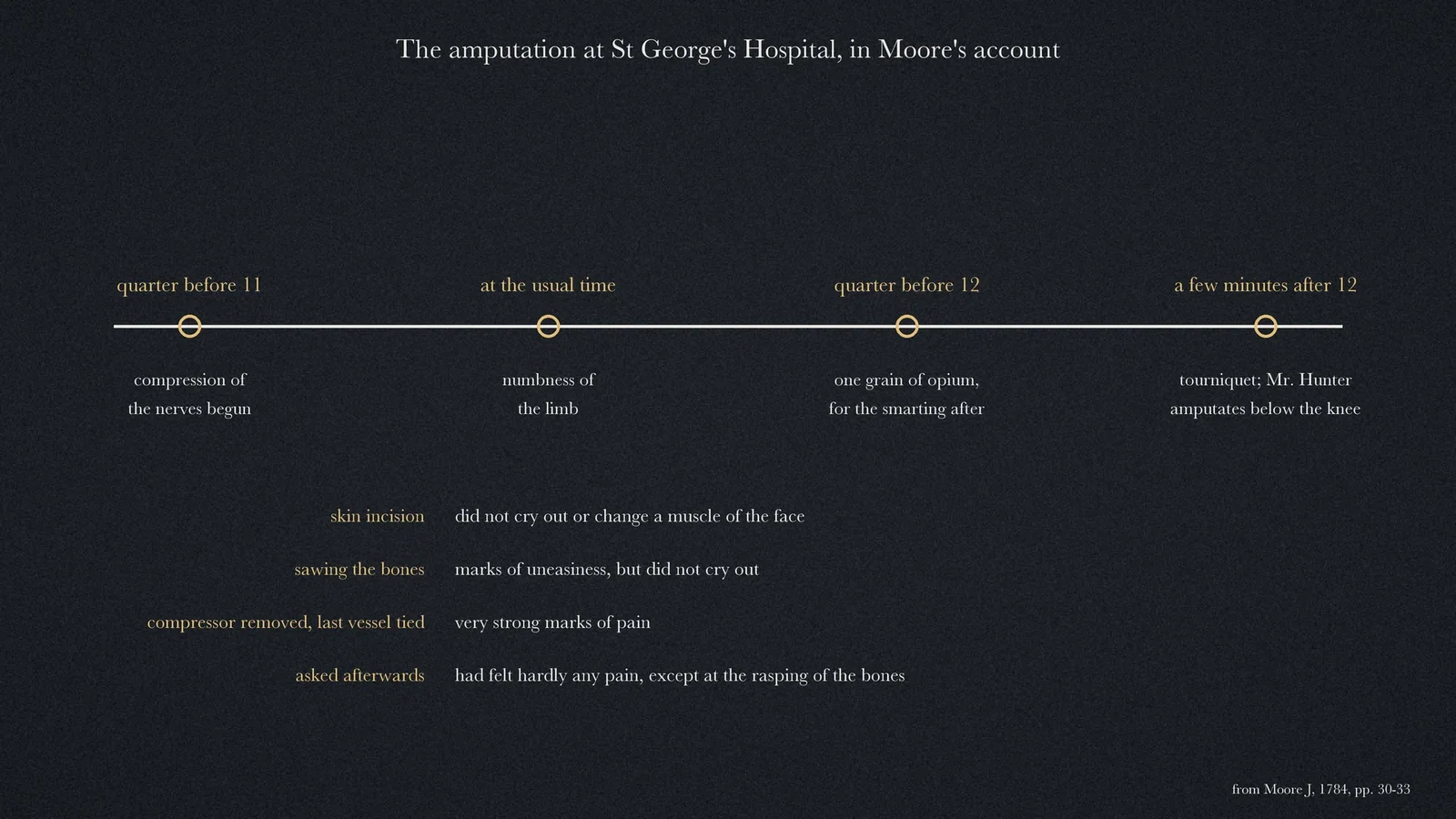
Next morning Moore began the compression at a quarter before eleven, and the numbness followed at the usual time. At a quarter before twelve Moore gave opium, explicitly for the smarting of the wound after the compressor came off. A few minutes after twelve the tourniquet was applied and Hunter amputated at the usual place below the knee. At the circular incision through the skin, the patient "did not cry out", changed no muscle of the face and showed no sign of pain; during the sawing of the bones there were marks of uneasiness, but no cry. [1] Five arteries had to be tied, the patient grew faint and asked for water, and when a small vessel bled after the compressor had been removed, tying it brought "very strong marks of pain". Asked afterwards, the patient said there had been hardly any pain except at the rasping of the bones. [1]
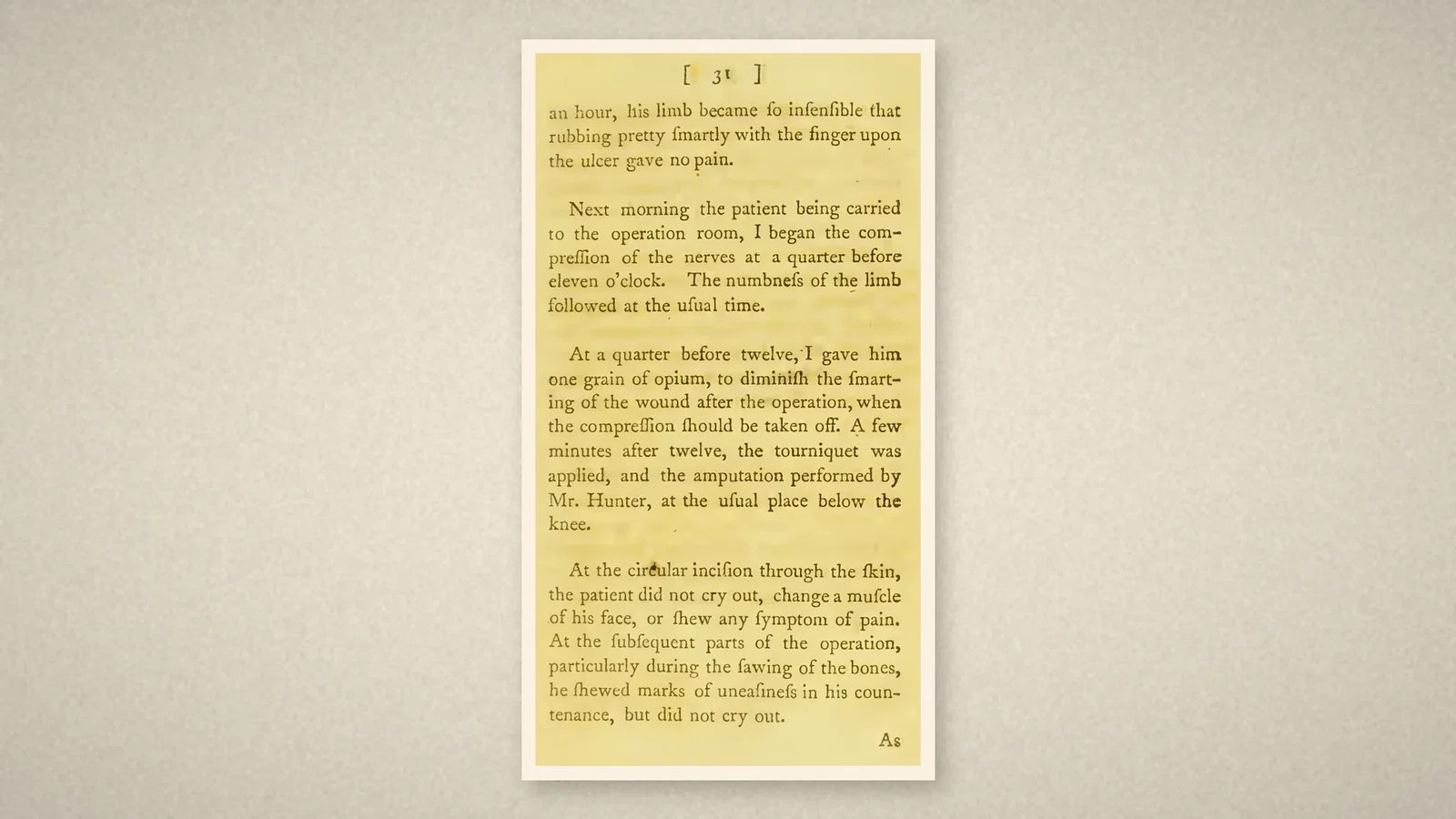
Moore judged the trial to have had all the success expected, with the most remarkable relief during the first incisions through skin and muscle, "generally by far the most severe parts of the operation", and recommended applying the compressor at least an hour and a half beforehand. [1]
What happened next
A 2024 review by J. T. Wildsmith calls the trial "apparently" successful and notes that, although Moore's humane approach was noticed, "the method does not seem to have found wider favour". [2] A 2026 paper by J. D. Parker and P. M. Reid describes the pamphlet as "a quiet beginning in 1784" for modern regional anaesthesia, calls it the first English book devoted solely to anaesthesia, credits Moore with the first brachial plexus anaesthesia, and reports that the authors have rediscovered one of Moore's compressors in Scotland. [3] In the pamphlet itself, the arm compressor is tried only on Moore's own arm. [1]
What the record shows
Moore's essay belongs in the history of regional anaesthesia not because the compressor caught on, but because of the reasoning it records: a clear statement that opium could not abolish operative pain, a hypothesis drawn from a common sensation, a failure honestly reported, a corrected experiment on the author's own body, an instrument built to reduce harm, and a single clinical trial described with its limits, including the pain that returned when the compressor was released.
Sources and reading limits
Read: Moore's 1784 pamphlet in the University of Bristol copy digitised by the Internet Archive, from the dedication to the end of the essay; the PubMed abstracts of Wildsmith 2024 and Parker and Reid 2026.
Not covered: the full texts of the two modern papers; any hospital record of the operation or note by Hunter; the 1958 article on Hunter and this amputation in Medical History; later responses to the compressor. The account of the operation is Moore's own, and the patient's words reach us only through Moore. The patient was also given opium shortly before the operation. The two modern abstracts give different birth years for Moore, 1763 and 1762, and agree on 1860 for the death; this article does not decide between them. Quotations modernise the long s only.
Two illustrations are crops of the 1784 pamphlet; two are drawn from it.
- Moore J. A method of preventing or diminishing pain in several operations of surgery. London: T. Cadell; 1784. Internet Archive
- Wildsmith JT. James (Carrick) Moore (1763-1860): another (Scottish) local anaesthetic hero. J R Coll Physicians Edinb. 2024;54(4):335-9. DOI
- Parker JD, Reid PM. James Moore and a quiet beginning of modern regional anaesthesia. Anaesth Intensive Care. 2026;54(3 Suppl):36-43. DOI
Continue exploring
Related reading connects shared questions and contexts; it does not by itself establish historical influence.
- c. 450 BCE: The Poppy in the Hippocratic Corpus
- 1829: Cloquet's Surgical Report, What Was Seen and What Followed
Anesthesia Epochs · The Source Room · About & Editorial Method
Published November 2, 2026. Sources and reading limits are stated above. Illustrations are labelled as original source images or AI-made. Historical accounts are educational; they are not current treatment instructions.