
In a 1984 Nature Letter, Franks and Lieb showed that general anaesthetics inhibit a pure, lipid-free firefly enzyme competitively and at potencies matching those in whole animals, pointing to proteins as possible targets.
Reading Library · Anesthesia Epochs · 中文版
Watch the education video (for clinicians)
1984: Franks and Lieb — From Lipid to Protein · Anesthesia Epochs Education Series

For most of a century the standard answer to "how does a general anaesthetic work?" pointed at fat. Agents as unlike each other as chloroform, ether and a simple alcohol had almost nothing in common chemically, but their potencies tracked how readily they dissolved in oil. The natural conclusion was that they act physically, by dissolving into the lipid of cell membranes. On 16 August 1984, Nature published three pages that proposed a different place to look. [1, p. 599]
A title that is a question
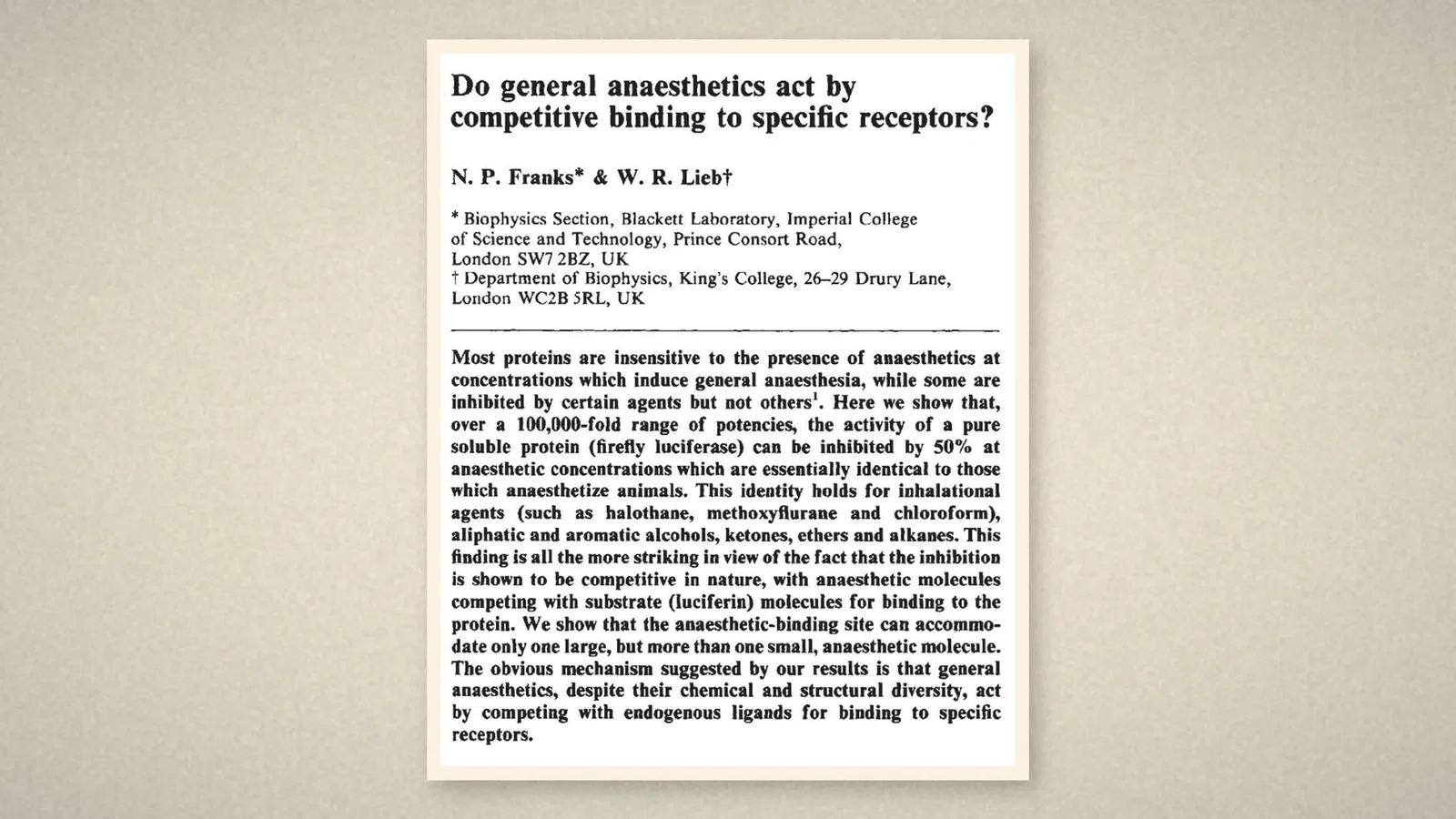
The Letter by N. P. Franks and W. R. Lieb, of Imperial College and King's College London, is headed "Do general anaesthetics act by" "competitive binding to specific receptors?" [1, p. 599] A question mark in a title is a choice. It tells you the authors think the possibility is live and know they have not closed it.
The abstract begins by conceding the strongest point against them: "Most proteins are insensitive to the presence of anaesthetics at" the concentrations that anaesthetize. [1, p. 599] That is the fact the lipid account had always leaned on. Proteins did not respond; membranes did.
Choosing what to look at
The authors' move was less a new experiment than a new choice of object, and they state the reasoning plainly. To test whether anaesthetics act directly on protein, "it is essential to study a pure protein," one "completely free of lipid, so that any effects observed can be" attributed to the drug and the protein and nothing else. [1, p. 599] The lipid hypothesis cannot be argued away; it has to be removed from the vessel.
Earlier work on whole cells and crude extracts had suggested that "the light-emitting luciferase proteins" were promising, and the enzyme they purified came "from the North American firefly". [1, p. 599] The choice is elegant for a reason that has nothing to do with anaesthesia: luciferase makes light. Inhibit it and the signal dims. The experiment reports itself.
Two findings
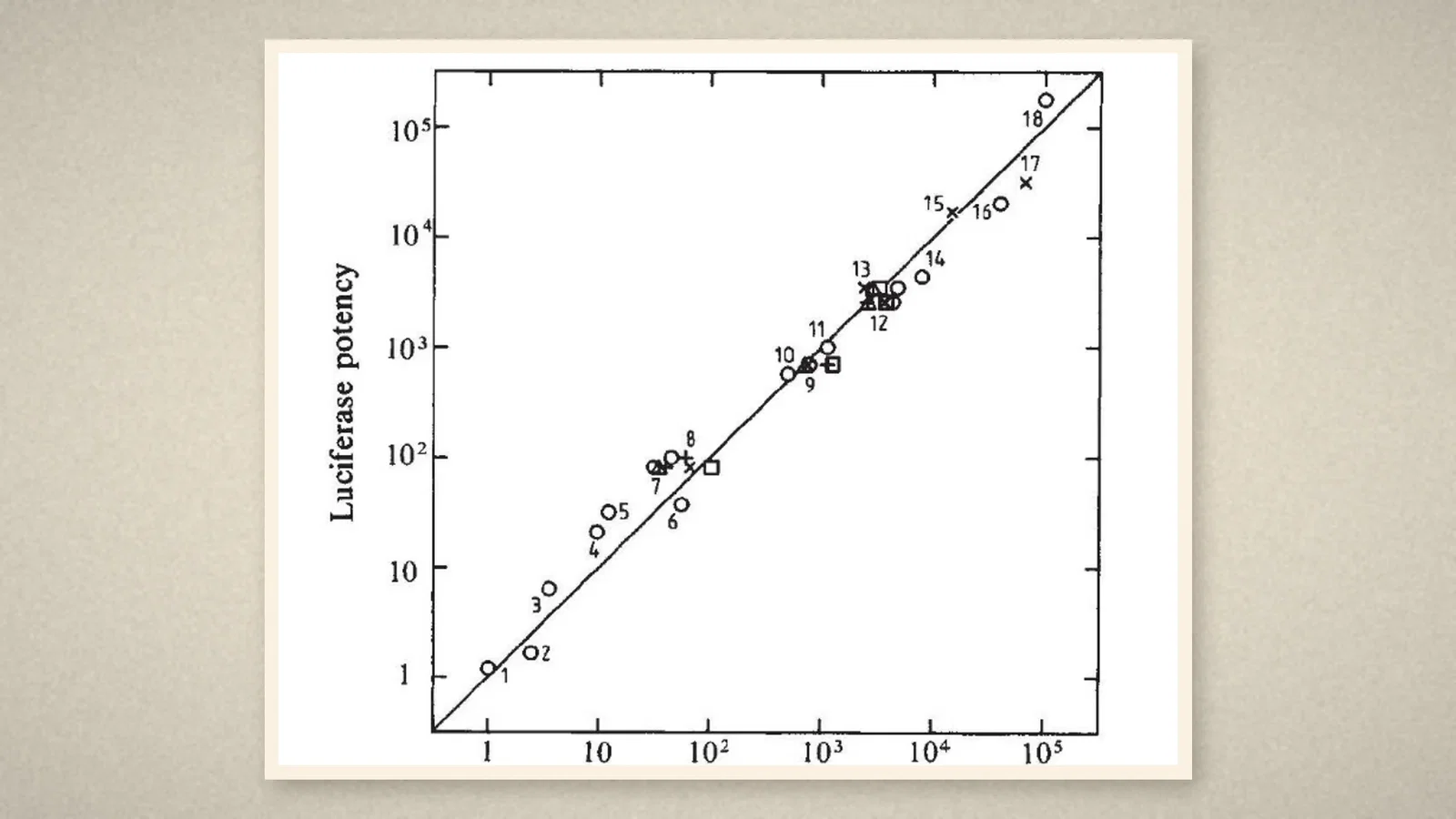
The first finding is a correspondence. "These data show a striking correlation between" the concentration of an agent that inhibits the enzyme and the concentration that anaesthetizes a whole animal, "with all points lying to within a factor of about 2 from the line" of identity. [1, p. 599] Figure 2 is the whole argument in one plot: a long diagonal, each point an agent, each symbol a species — man, mouse, newt, tadpole, goldfish.
What makes it worth attention is not the tightness of the line but its reach. The agreement holds across an unusually wide range of potencies, and it holds for things that have no chemical family resemblance at all: "This identity holds for inhalational" agents, and for "aliphatic and aromatic alcohols, ketones, ethers and alkanes". [1, p. 599] The authors say so themselves — what is remarkable is "the diversity of anaesthetics used". [1, p. 599]
The second finding is about the kind of inhibition, and it matters more than the first. The anaesthetic is not simply disabling the enzyme; it is "competing with substrate (luciferin) molecules for binding to the" protein. [1, p. 599] A competitive inhibitor occupies a particular place. It is not a general physical disturbance.
A site with a size
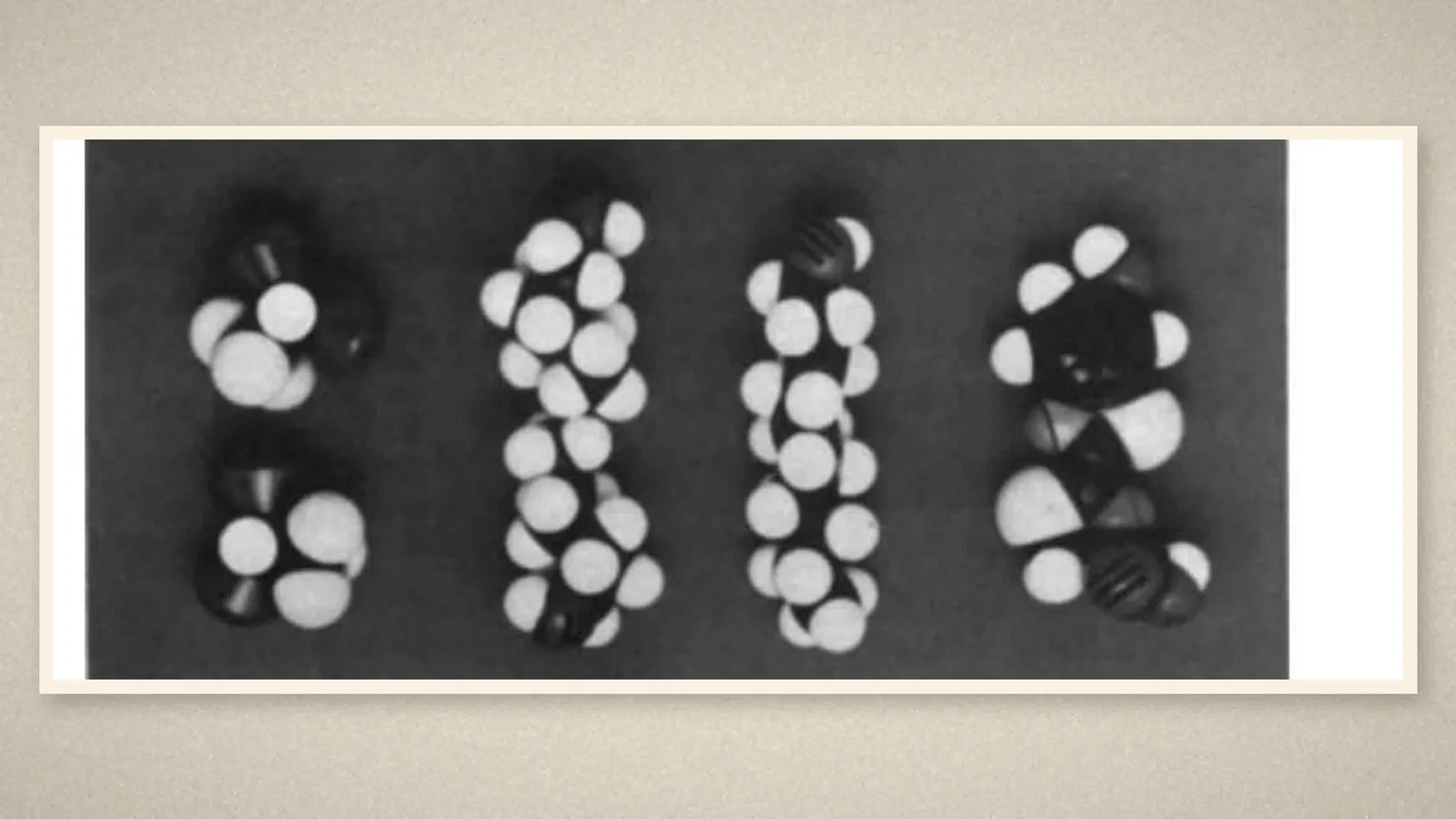
From there the authors do something neat. Molecules of different sizes do not inhibit in the same pattern: smaller ones behave as though more than one can bind, larger ones as though only one can. That asymmetry is a measuring instrument. "It thus appears that the anaesthetic molecules bind to the protein" "at a site of limited size". [1, p. 600] Figure 4d sets space-filling models side by side so the reader can see the comparison the argument rests on. Taken with the competitive inhibition, the conclusion is that the "anaesthetic molecules are binding within the luciferin site" — the enzyme's own working surface. [1, p. 600]
What the Letter refuses to say
The discussion raises the obvious objection before anyone else can. That molecules so unlike one another should all compete at specific sites "might, at first sight, seem very implausible". [1, p. 601] The authors do not pretend to dispose of it: "A detailed answer to this question must await future work". [1, p. 601]
What they claim instead is narrower than their own title. "our luciferase data nonetheless show clearly that such sites on" — "proteins do exist". [1, p. 601] They also allow that "The molecular mechanism of general anaesthesia may well" involve several different protein interactions. [1, p. 601] The Letter closes with a prospect rather than a result: if the endogenous ligands at such sites could be identified, it might become possible to design agents "more specific than those currently available". [1, p. 601]
What the record shows
It would be easy to describe this paper as the one that disproved the lipid theory. It does not say that, and it does not do that. A firefly enzyme is not a neuron, and an enzyme's substrate pocket is not a receptor in the brain.
What the Letter changes is what counts as a plausible kind of target. Before it, the chemical diversity of anaesthetics was the strongest argument for a non-specific, physical mechanism: no protein pocket could possibly accept all of them. After it, there was a pure protein, with no lipid anywhere near it, whose single binding site did accept all of them, in the right order, at the right concentrations. The question in the title stays open; the space of acceptable answers does not stay the same.
Sources and reading limits
Read: Franks NP, Lieb WR, "Do general anaesthetics act by competitive binding to specific receptors?", Nature, 16 August 1984, vol. 310, pp. 599-601, in full, including the four figures and their legends. The copy is the publisher's three-page scan; it was read both in the text layer and in page images rendered at 300 dpi. The upper part of page 599 belongs to the preceding Letter, on cochlear sensory hairs, and is no part of this article.
Not covered: the authors' own earlier papers that this Letter cites as its background, the later work in which the question was pursued, and any contemporary reply. This article therefore reports what one Letter argued in 1984 and makes no assessment of whether the argument held.
Limits: no concentrations, inhibition constants, enzyme constants or other laboratory values are reproduced in the text or in the drawn figure; the findings are given in direction and in kind. The two source plates of figures reproduce the printed pages as published, where the authors' own axes and numbering appear. Nothing here should be read as a statement about how anaesthetics act in people: the experiments are on a purified enzyme, and the comparison with whole animals is a correlation of potencies, which the paper presents as such.
Three illustrations are crops of the original page images (pp. 599, 600 and 601). One is a diagram drawn from the text, with no people drawn and no values shown.
- Franks NP, Lieb WR. Do general anaesthetics act by competitive binding to specific receptors? Nature. 1984;310(5978):599-601. doi:10.1038/310599a0
Continue exploring
Related reading connects shared questions and contexts; it does not by itself establish historical influence.
Anesthesia Epochs · The Source Room · About & Editorial Method
Published November 5, 2026. Sources and reading limits are stated above. Illustrations are labelled as original source images or AI-made. Historical accounts are educational; they are not current treatment instructions.