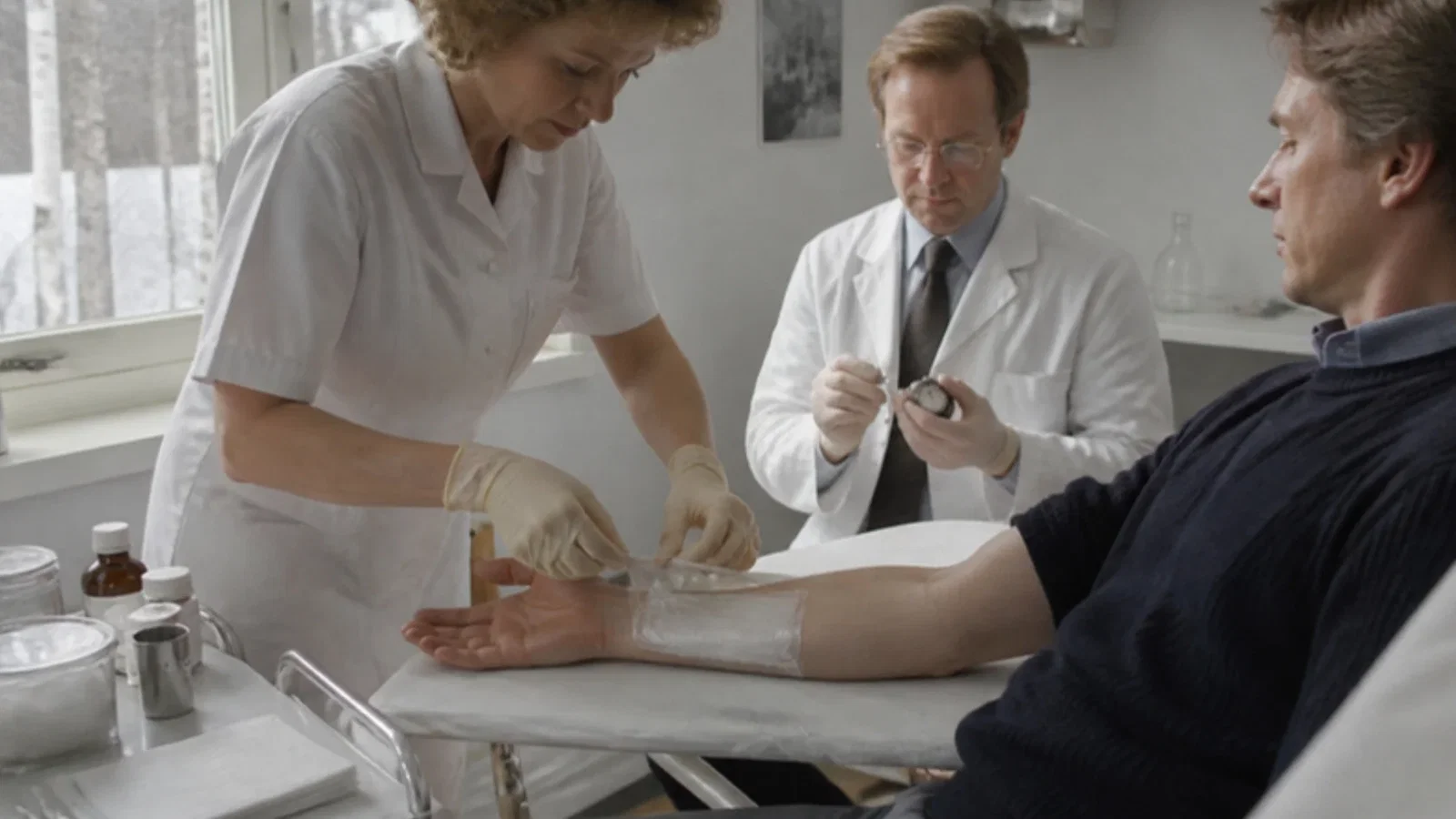
Swedish investigators explained how melting lignocaine and prilocaine bases together let a cream carry enough local anaesthetic through intact skin, and showed in volunteers that an hour under a dressing could block the pain of pin-prick and of an intravenous cannula.
Reading Library · Anesthesia Epochs · 中文版
Watch the education video (for clinicians)
1985: EMLA Cream — A Eutectic Mixture on Intact Skin · Anesthesia Epochs Education Series
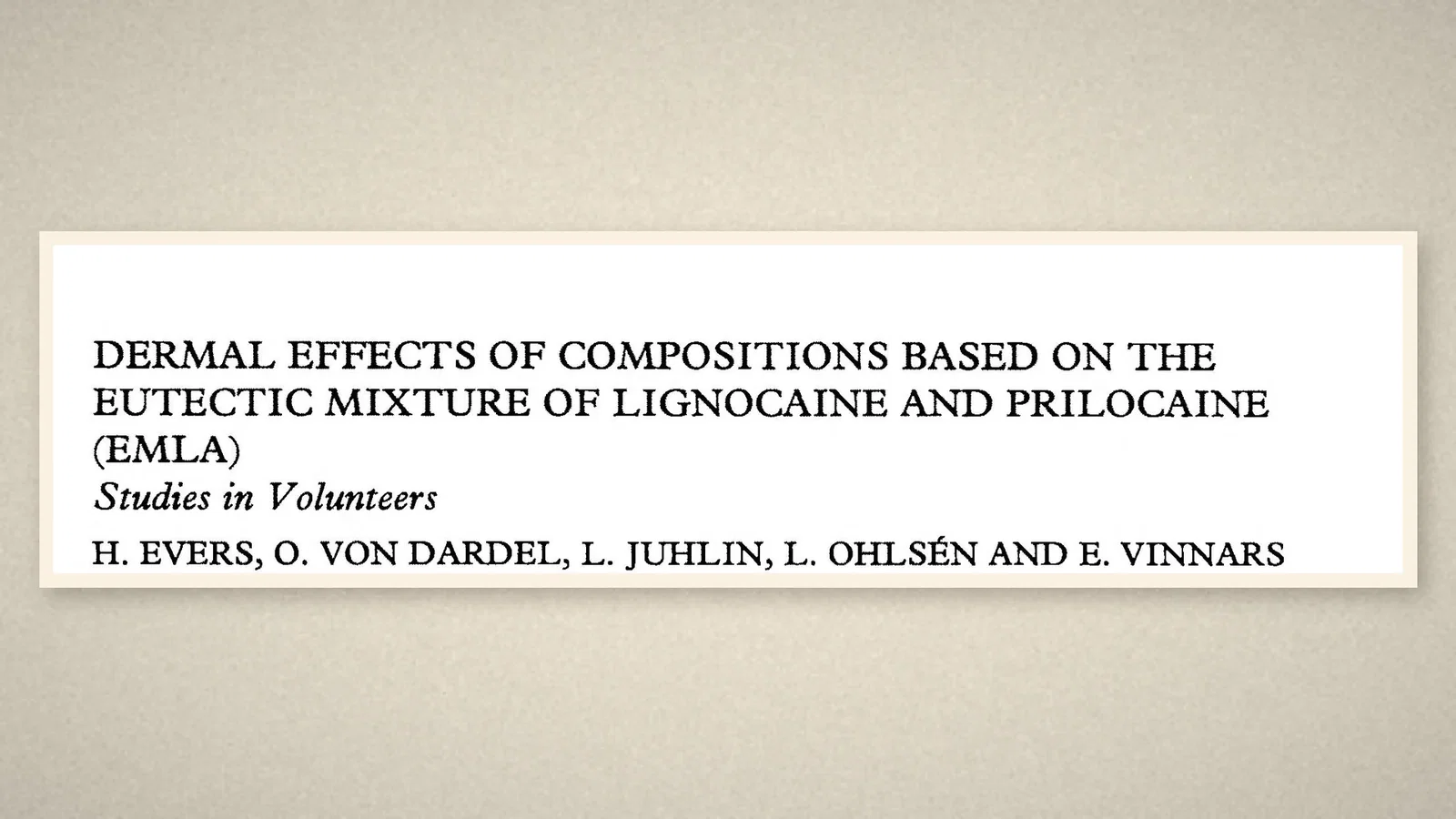
For an anaesthetist the needle is routine; for a frightened patient, and above all a child, it can be the worst moment of the day. Local anaesthetics had long been sprayed on mucous membranes, but intact skin resisted them. In 1985 a group from Astra and from hospitals in Stockholm and Uppsala explained, in the British Journal of Anaesthesia, how a cream could get through, and showed in volunteers that it could block the pain of an intravenous cannula. The cream was EMLA. The Australian Society of Anaesthetists' timeline dates its marketing to 1984. This article reads the 1985 paper in full. [1][2]
Why skin is hard to numb
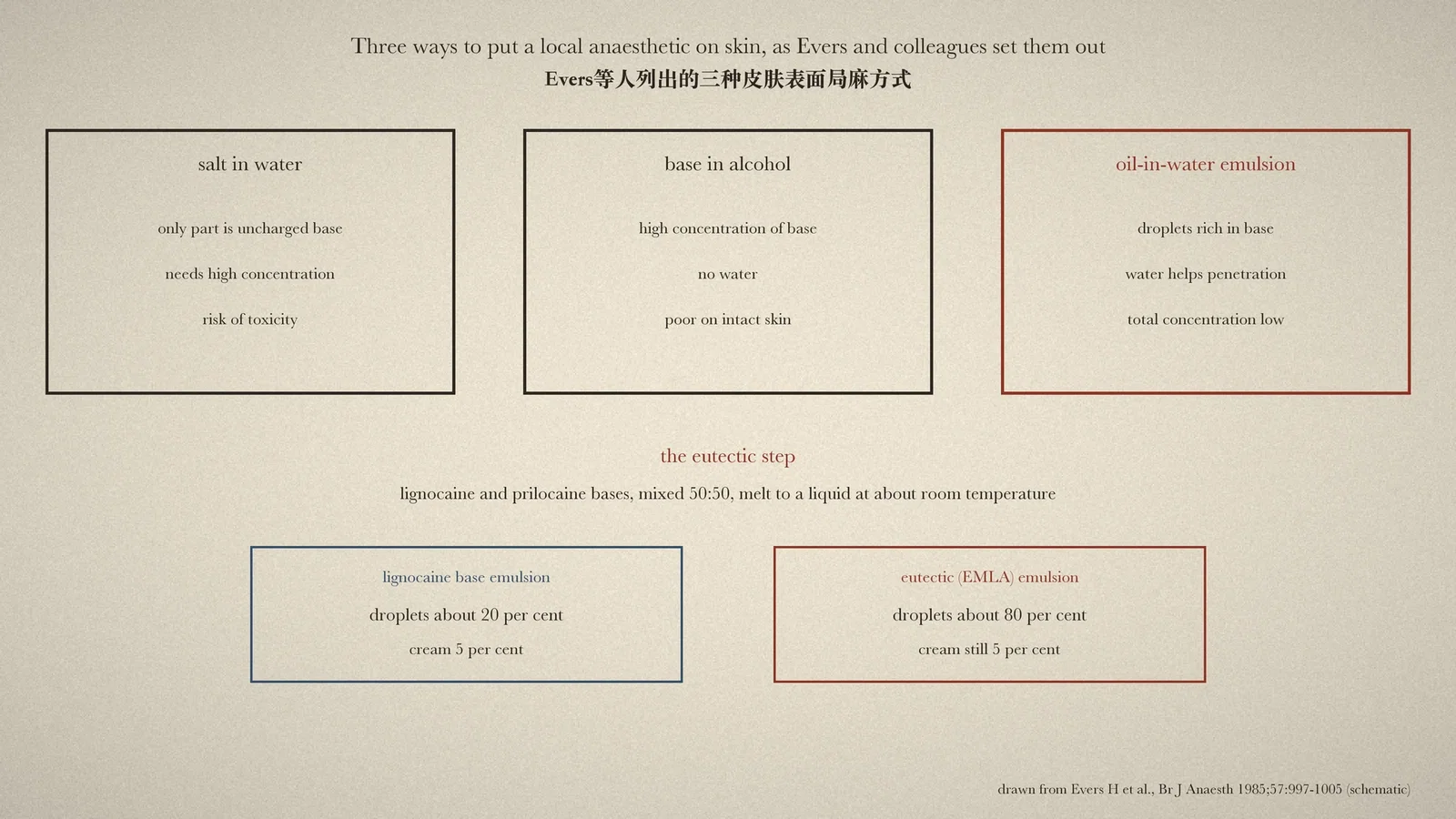
Hans Evers, Otto von Dardel, Lennart Juhlin, Lennart Ohlsén and Erik Vinnars began with chemistry. It is the charged form of a local anaesthetic that blocks the nerve, but "it is the uncharged (base) form which penetrates and diffuses into the tissues". A salt dissolved in water contains only part of the drug in that form, so for topical use "the local anaesthetic must be used in high concentration, with the attendant risk of toxic complications". A base dissolved in alcohol can be concentrated, but without water it has "poor penetrative properties if applied to the intact skin". An oil-in-water emulsion offered a way round: the droplets could hold base at high concentration, about 20 per cent lignocaine, while the emulsion as a whole held only 5 per cent. [1]
The eutectic step
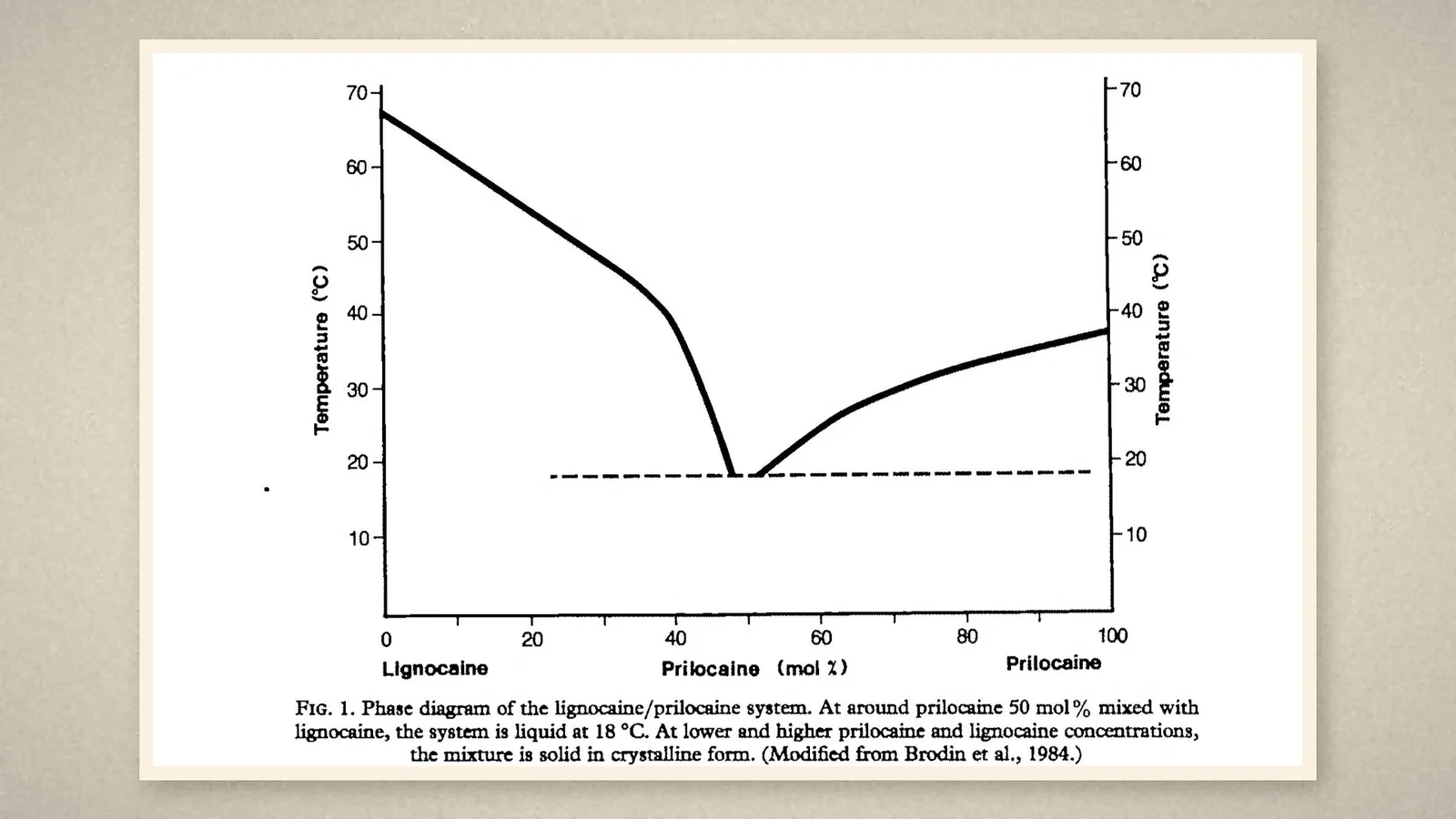
The next step came from physical chemistry. Brodin and colleagues had reported that a mixture of lignocaine and prilocaine bases melts at a much lower temperature than either alone, so that "two crystalline powders interact in such a way that, when mixed with each other, a liquid is formed at approximately room temperature". That removed the need for an oil solvent and raised the concentration of local anaesthetic in the droplets "from approximately 20% (lignocaine) to about 80% (lignocaine-prilocaine)", while the total concentration stayed at 5 per cent. The authors cite Broberg and Evers' earlier work of 1981 on such emulsions. EMLA was a 50:50 eutectic mixture of the two bases with an emulsifier, Arlatone, and water. [1]
In volunteers
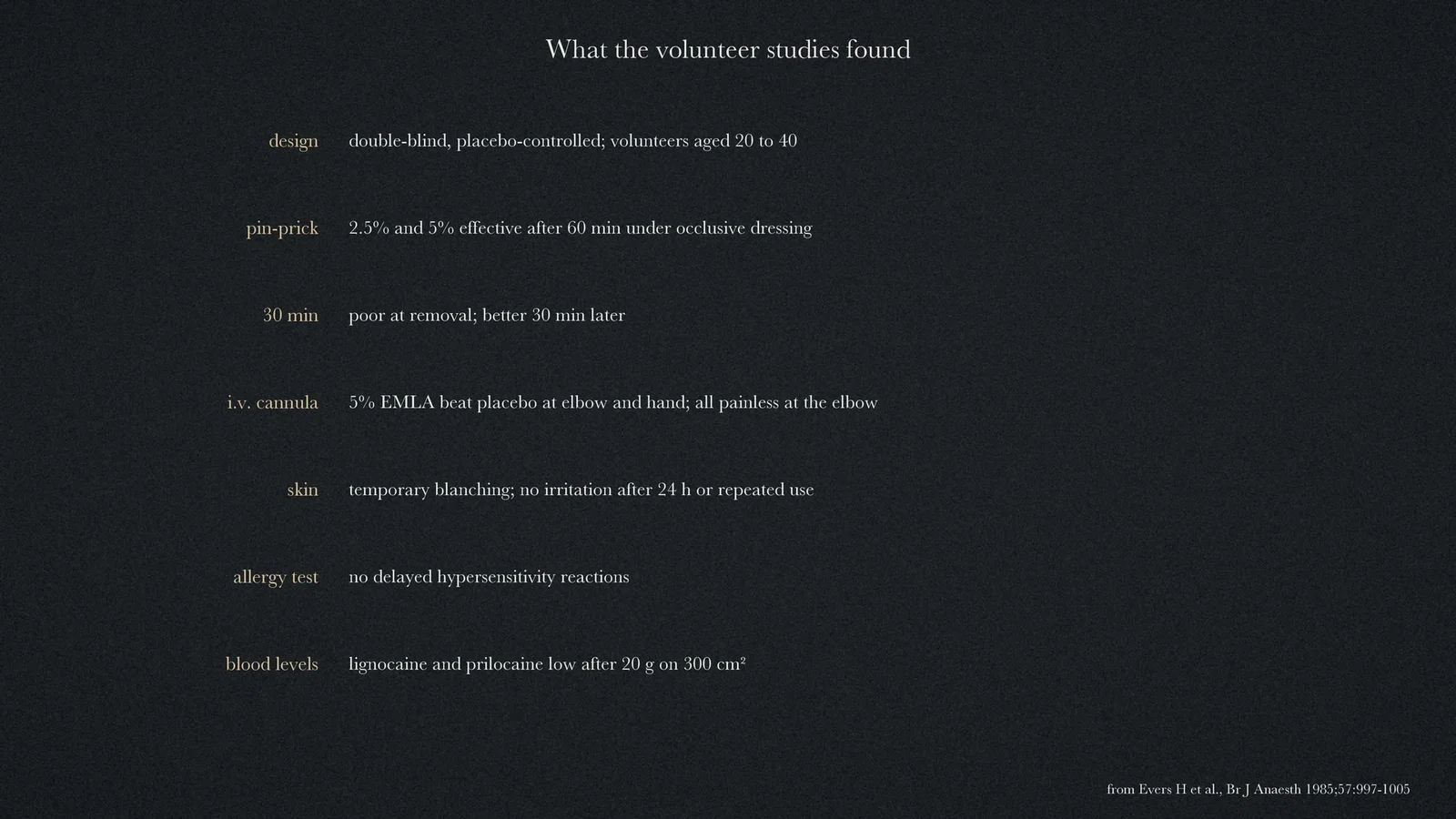
All the studies were double-blind and placebo-controlled, in volunteers aged 20 to 40. Under an occlusive dressing, 2.5 and 5 per cent EMLA produced analgesia to pin-prick, and worked best after 60 minutes' contact; after 30 minutes the effect was poor on removal but improved over the next half hour. To test the use that mattered most, the investigators inserted standard 17-gauge Venflon cannulae after 60 minutes under 5 per cent EMLA or placebo. EMLA blocked the pain of skin puncture and of intravascular placement significantly better than placebo at the elbow and on the back of the hand, though not on the forearm, and "if applied in the antecubital area, 5% EMLA cream was completely effective in blocking the pain of needle insertion in all volunteers". [1]
The skin often blanched for a while after the dressing came off, but 24-hour and repeated applications caused no irritation, and patch tests showed no delayed hypersensitivity. After 20 g of cream, containing 500 mg of each drug, on 300 cm² of thigh for an hour, plasma concentrations of lignocaine and prilocaine were low. [1]
What the record shows
EMLA turned a phase diagram into a practical tool: two local anaesthetic bases that melt together, carried into the skin by water, and given an hour to work. The 1985 paper established the method in adults. Its use for children's needle pain and the later EMLA patch belong to studies this article did not read.
Sources and reading limits
Read: Evers and colleagues' 1985 paper in full; the 2024 ASA timeline entry.
Not covered: Broberg and Evers' 1981 work and Brodin and colleagues' 1984 paper on the eutectic mixture; Juhlin's earlier dermatological paper; the first paediatric studies; the 1993 patch. The volunteers were adults. One author worked for Astra, the maker, and the results are the authors' own. Concentrations and doses are as printed.
Two illustrations are page crops from the 1985 paper; two are drawn from it.
- Evers H, von Dardel O, Juhlin L, Ohlsén L, Vinnars E. Dermal effects of compositions based on the eutectic mixture of lignocaine and prilocaine (EMLA). Studies in volunteers. Br J Anaesth. 1985;57:997-1005. Internet Archive
- Australian Society of Anaesthetists. Anaesthesia history timeline. 2024. ASA
Continue exploring
Related reading connects shared questions and contexts; it does not by itself establish historical influence.
Anesthesia Epochs · The Source Room · About & Editorial Method
Published November 2, 2026. Sources and reading limits are stated above. Illustrations are labelled as original source images or AI-made. Historical accounts are educational; they are not current treatment instructions.