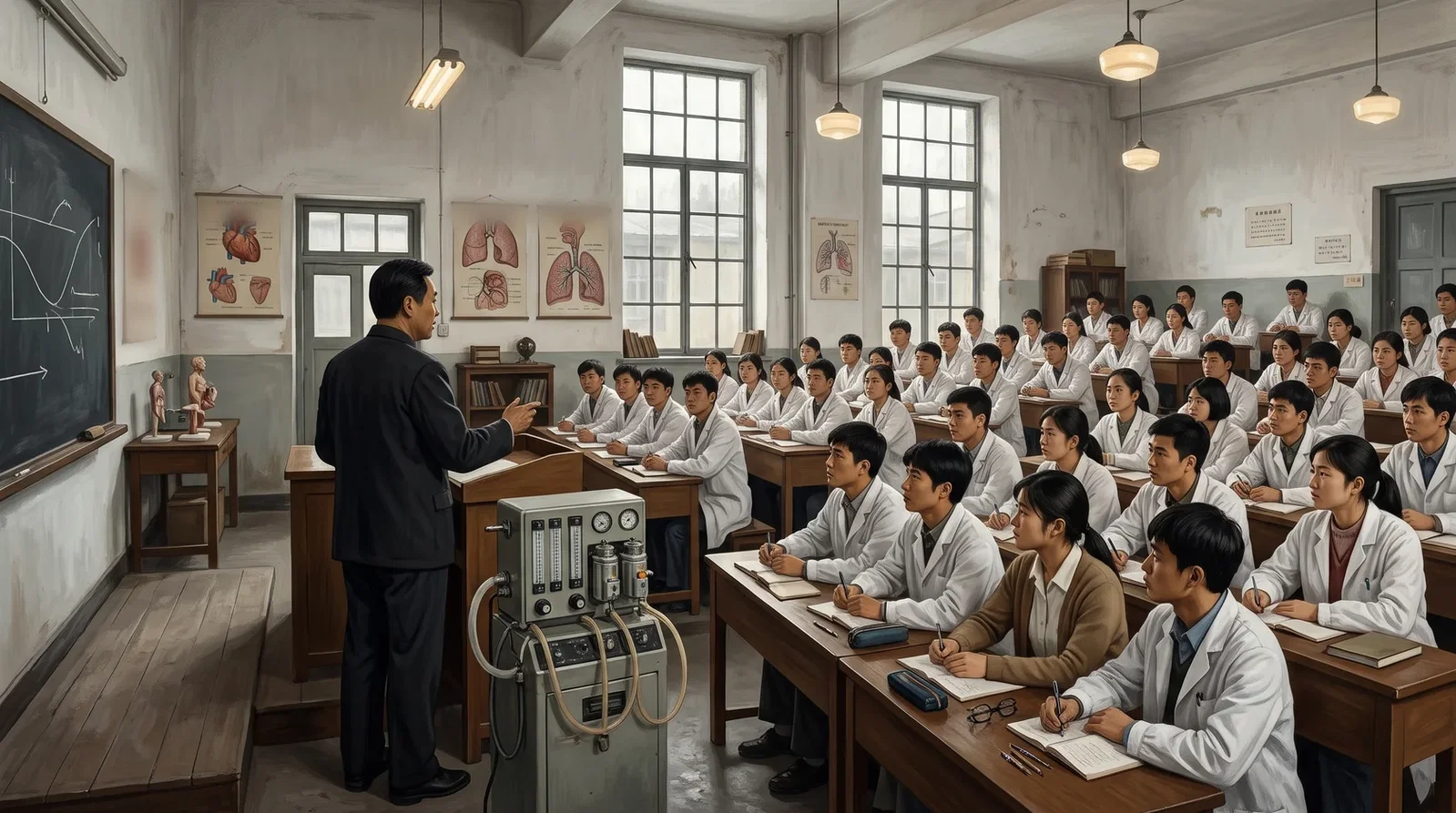
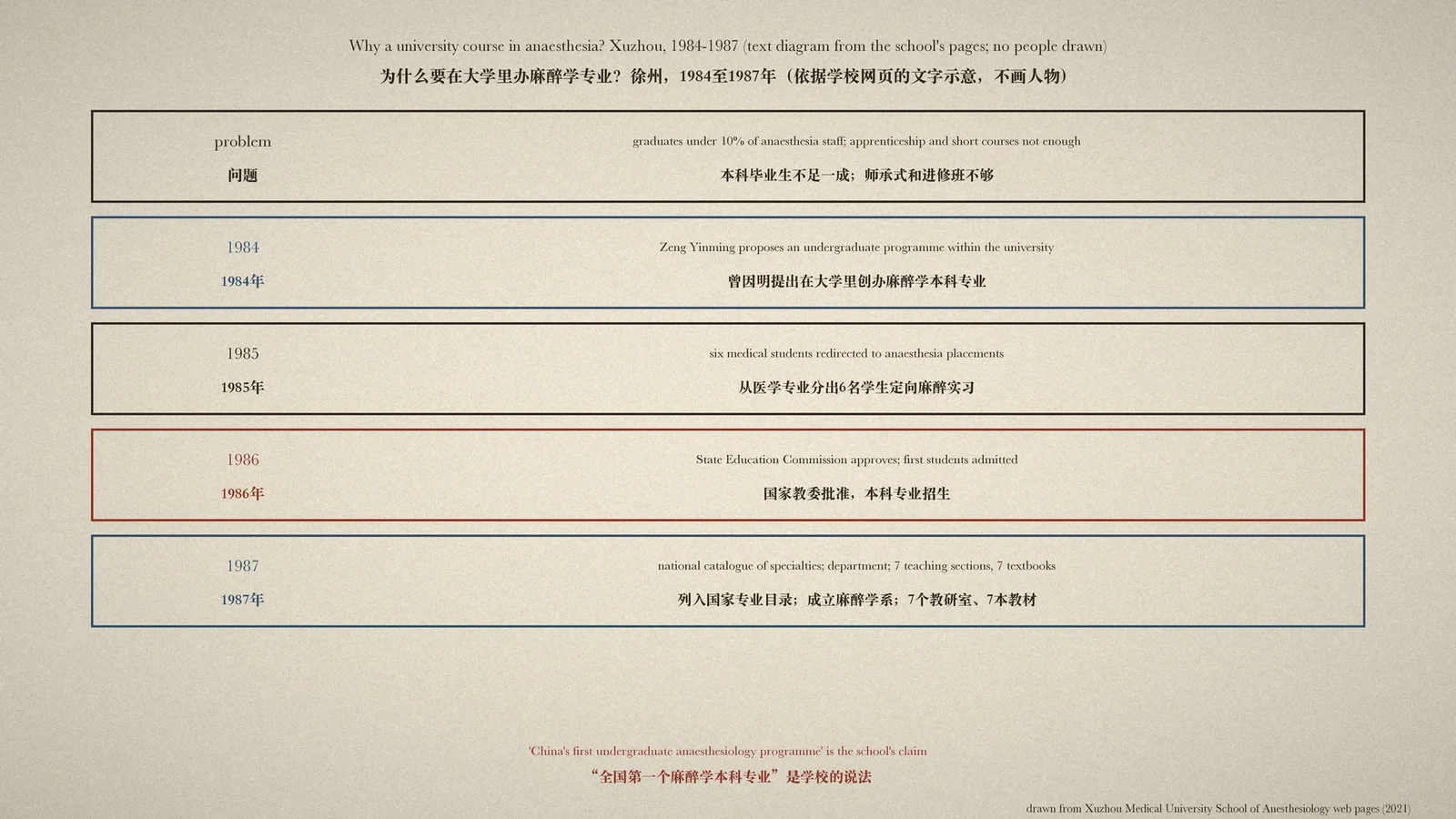
Two 2021 pages on the website of the School of Anesthesiology of Xuzhou Medical University, a profile of Zeng Yinming and the school's chronicle, recount that Zeng graduated from Beijing Medical College in 1959, joined Xuzhou Medical College, and in 1960 went to Beijing to study anaesthesia under Xie Rong; that, because fewer than one in ten of China's anaesthesia staff were university graduates and apprenticeship and short courses could not meet the need, Zeng proposed in 1984 a university undergraduate programme in anaesthesiology; that in 1985 six medical students were redirected to anaesthesia placements; that in 1986, with State Education Commission approval, the programme admitted students; and that in 1987 anaesthesiology entered the national catalogue of specialties, a department was formed, seven teaching sections were set up and seven textbooks were planned. The school calls it China's first undergraduate anaesthesiology programme; that is the school's claim.
Reading Library · Anesthesia Epochs · 中文版
Watch the education video (for clinicians)
1986: Xuzhou's First Anaesthesiology Undergraduates · Anesthesia Epochs Education Series
Where do anaesthetists come from? For a long time most of China's anaesthetists had moved over from surgery or medicine or learned on the job beside a teacher. In 1986 Xuzhou Medical College opened a new undergraduate course: anaesthesiology. This article rests on two 2021 pages from the website of Xuzhou Medical University's School of Anesthesiology, a profile and a chronicle; both are the school's own records. [1][2]
A surgeon turns to anaesthesia
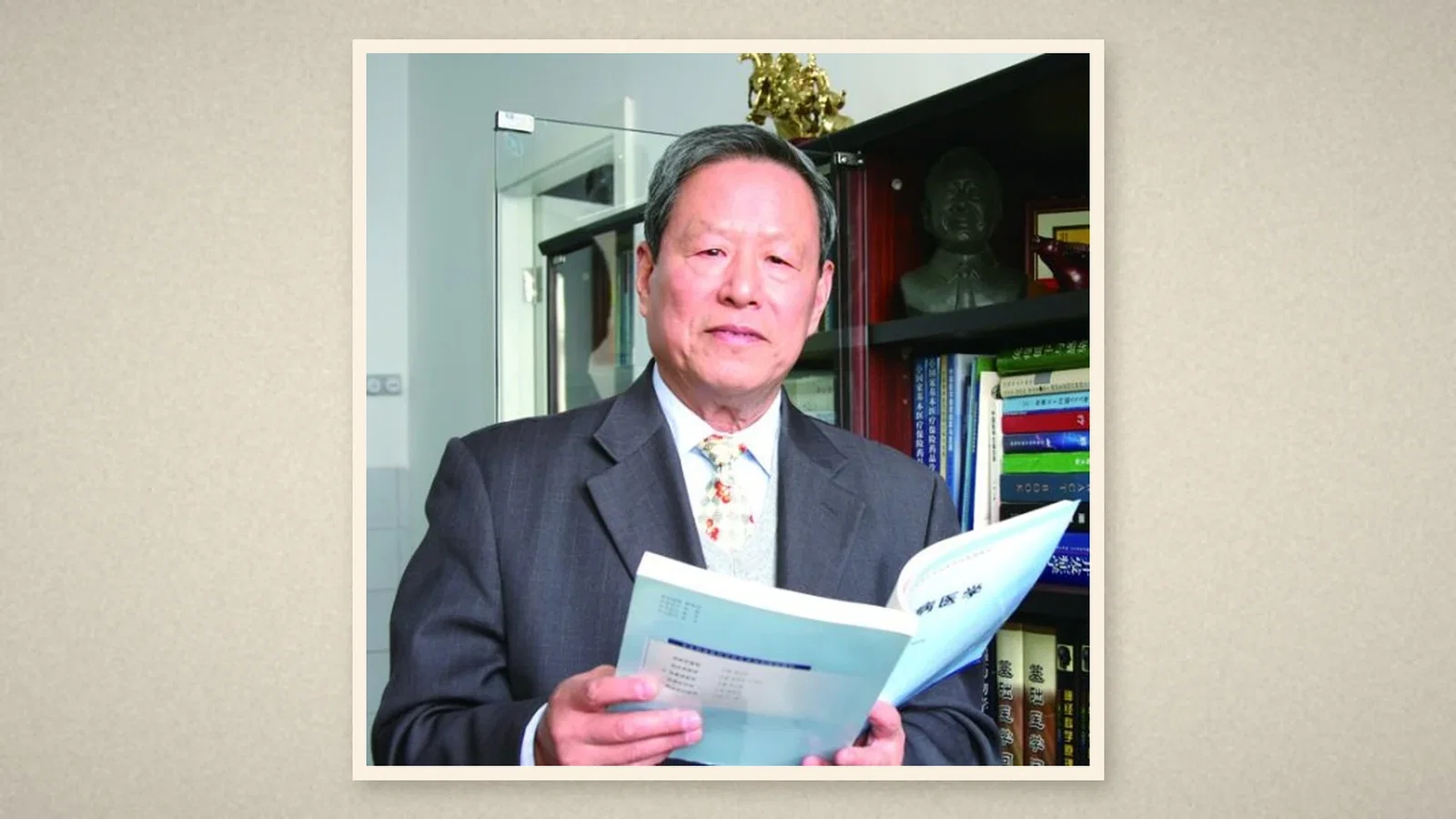
According to the profile, Zeng Yinming graduated from Beijing Medical College in 1959, came to teach at Xuzhou Medical College and worked as a surgeon in its hospital; in 1960 Zeng went to Beijing to study anaesthesia under Professor Xie Rong, and in 1964 presented a paper at a national anaesthesia meeting on anaesthesia for patients in toxic shock. [1]
The proposal of 1984
At the time, the profile says, university graduates made up less than a tenth of China's anaesthesia workforce; apprenticeship-style teaching and short refresher courses fell far short of the demand, and standardised residency training was not yet possible. So in 1984 Zeng proposed creating an undergraduate programme in anaesthesiology within the university, saying that Xuzhou was running it "not just for Xuzhou but for all of China". [1]
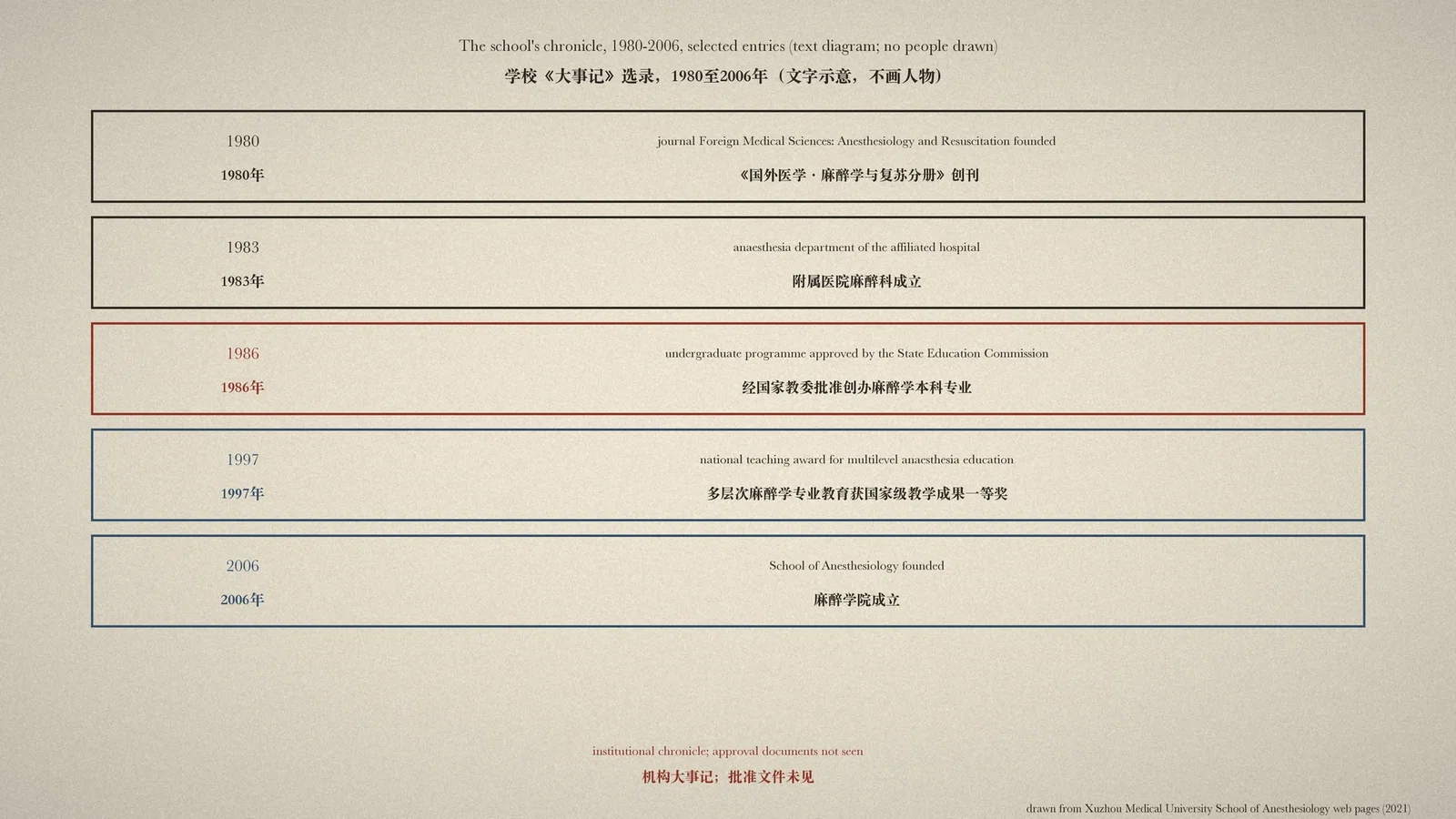
The school's chronicle fills in the steps around it: in 1980 the journal Foreign Medical Sciences: Anesthesiology and Resuscitation was founded; in 1983 the affiliated hospital's anaesthesia department was set up; and in 1985 six medical students were redirected to anaesthesia placements, the same year the school gained the right to award master's degrees in anaesthesiology. [2]
1986: the first students
In 1986, with the approval of the State Education Commission, Xuzhou Medical College's undergraduate anaesthesiology programme admitted students; in 1987 anaesthesiology entered the national catalogue of specialties and the college formed a department of anaesthesiology. In the early years, the profile says, space and conditions were poor; in 1987 seven teaching sections were formed and seven textbooks planned. A "two-step" training system suited to China's conditions took shape, and undergraduate anaesthesia education went from "almost nothing" to programmes "blossoming everywhere". [1][2]
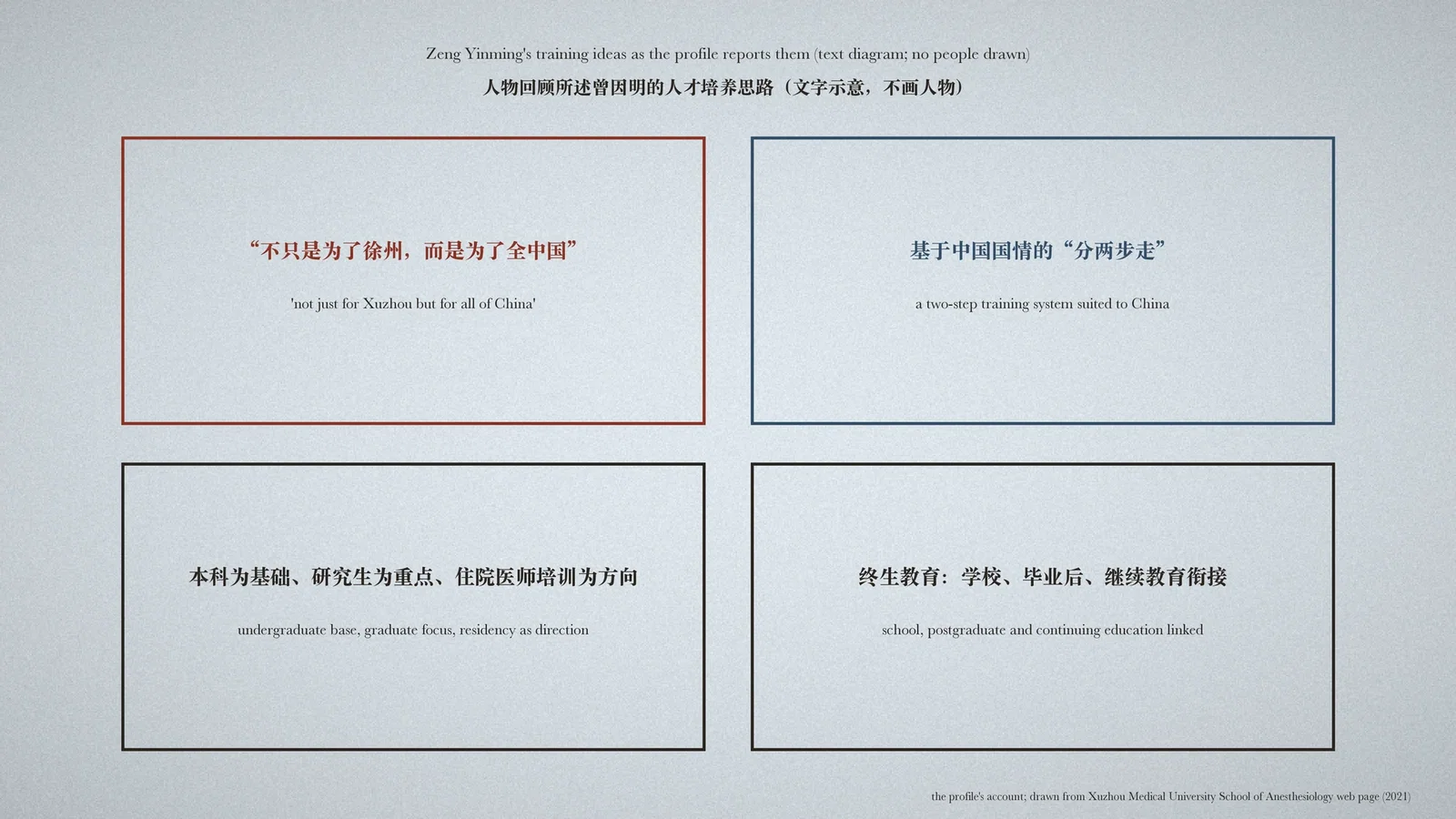
Later Zeng advocated taking "undergraduate education as the base, graduate education as the focus and standardised residency training as the direction", and then a lifelong education system for anaesthesiology linking university, postgraduate and continuing education. The chronicle records that in 1997 a project on multilevel anaesthesiology education with Chinese characteristics won a national first-class teaching award, and that the School of Anesthesiology was founded in 2006. [1][2]
What the record shows
A specialty needs not only departments in hospitals but courses and textbooks in universities. Xuzhou's answer, at a time when residency training could not yet be organised, was to start with undergraduate education.
Sources and reading limits
Read: the profile "Zeng Yinming: one task, one lifetime, leading the development of anaesthesiology in China" (1 October 2021) and the "Chronicle of the School of Anesthesiology" (16 March 2021) on the website of Xuzhou Medical University's School of Anesthesiology, in full, with the profile's photograph.
Not covered: the State Education Commission's approval of 1986 and the 1987 national catalogue of specialties; enrolment records of the first class; Zeng Yinming's own writings on anaesthesia education, including the report of the 1997 award-winning project; independent histories of anaesthesia education in China.
Limits: both pages are the school's commemorative material; "China's first undergraduate anaesthesiology programme" is the school's claim, and it was not checked against other universities' records. Figures such as "less than a tenth" are the profile's. The photograph shows Zeng Yinming, not a patient; no doses are involved.
Of four illustrations, one is the photograph from the school's profile; three are text diagrams drawn from the two pages, with no people drawn.
- School of Anesthesiology, Xuzhou Medical University. Zeng Yinming: one task, one lifetime, leading the development of anaesthesiology in China [in Chinese]. 1 October 2021. Xuzhou Medical University
- School of Anesthesiology, Xuzhou Medical University. Chronicle of the School of Anesthesiology [in Chinese]. 16 March 2021. Xuzhou Medical University
Continue exploring
Related reading connects shared questions and contexts; it does not by itself establish historical influence.
Anesthesia Epochs · The Source Room · About & Editorial Method
Published November 4, 2026. Sources and reading limits are stated above. Illustrations are labelled as original source images or AI-made. Historical accounts are educational; they are not current treatment instructions.