
The Report of a Confidential Enquiry into Perioperative Deaths (Buck, Devlin and Lunn; Nuffield Provincial Hospitals Trust and King's Fund, 1987) describes how, after Lunn and Mushin's anaesthetists-only study of 1982, the Associations of Surgeons and of Anaesthetists of Great Britain and Ireland jointly reviewed all deaths within 30 days of an operation in three English regions in 1986, protecting confidentiality with scissors and correction fluid, cross-regional anonymous assessment and destruction of the data; of 4,034 perioperative deaths, with an overall mortality of about 0.7%, anaesthesia played some part in 410 (14.1%) but was judged the only factor in three; the report criticised poor anaesthetic records, failure to use appropriate monitoring in about 45% of cases judged suboptimal, juniors not consulting seniors and undue haste to operate, and called for national assessment of clinical practice.
Reading Library · Anesthesia Epochs · 中文版
Watch the education video (for clinicians)
1987: CEPOD — A Profession Audits Its Own Deaths · Anesthesia Epochs Education Series
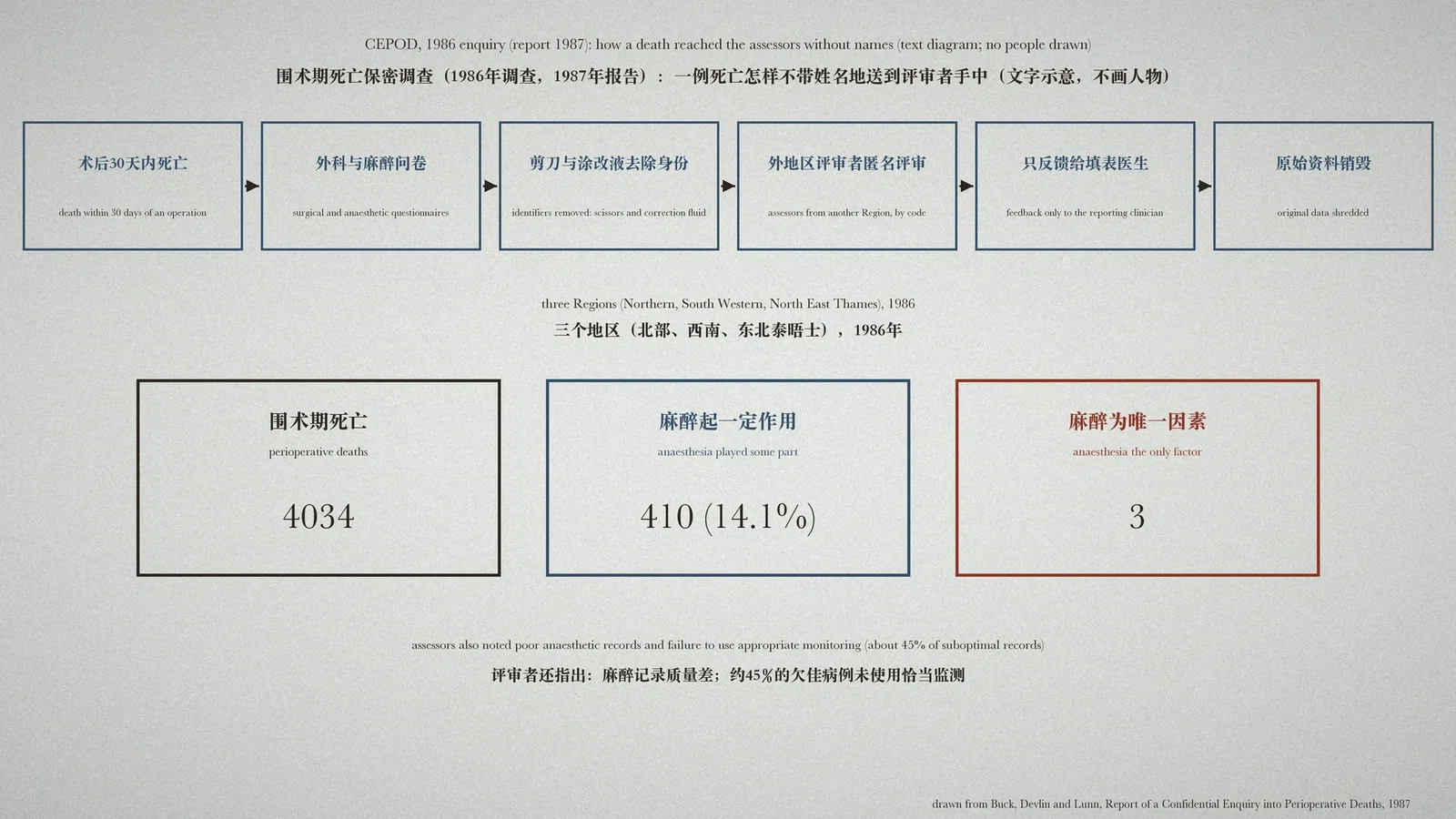
When a patient dies after an operation, was it the disease, the surgery or the anaesthetic? Answering means that someone must be willing to hand over the full story of every death. The Report of a Confidential Enquiry into Perioperative Deaths, published in 1987, was an attempt by British surgeons and anaesthetists together: in three regions, every death within 30 days of an operation during one year was reviewed anonymously. This article reads the report's method, its anaesthesia section and its conclusions. [1, cover][1, p. 3]
One report, two disciplines
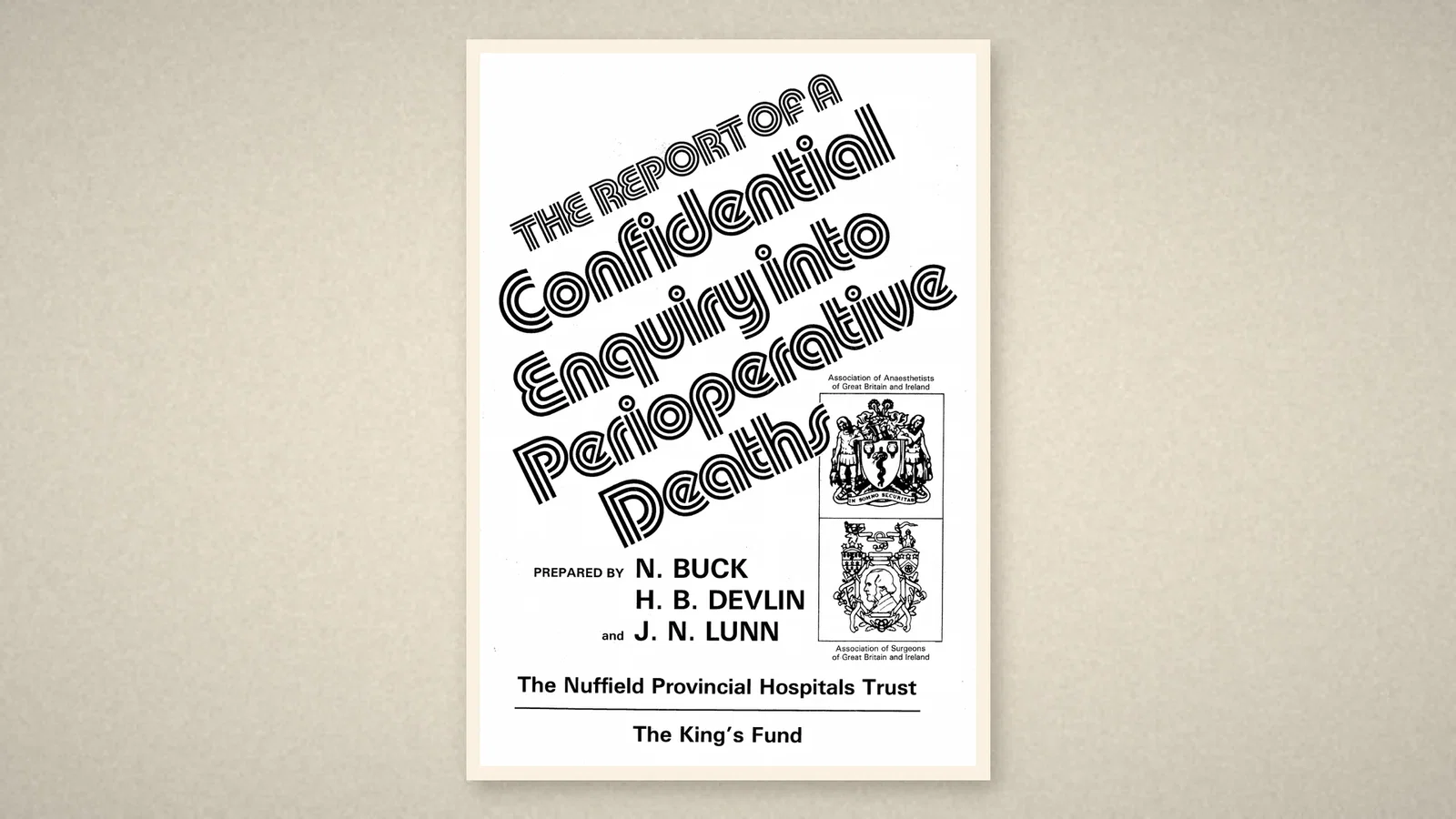
The report was prepared by N. Buck, H. B. Devlin and J. N. Lunn, overseen by a joint working party chaired by M. D. Vickers, and published by the Nuffield Provincial Hospitals Trust and the King's Fund. Its foreword recalls that Lunn and Mushin's 1982 study of deaths associated with anaesthesia had not been able to secure the collaboration of surgeons; aware of how hard it is to assign a postoperative death to the anaesthetic or the operation, its authors had recommended that future studies involve both disciplines. This time the Association of Surgeons of Great Britain and Ireland agreed to collaborate with the Association of Anaesthetists in a Confidential Enquiry into Perioperative Deaths (CEPOD). [1, p. vi]
The introduction says that discussions began in 1982 and that in 1983 the Nuffield Provincial Hospitals Trust and the King Edward's Hospital Fund for London agreed to provide funding. The Enquiry investigated all deaths within 30 days of an operative procedure in three Regional Health Authorities in England, the Northern, South Western and North East Thames regions, in 1986. It quotes the protocol: the medical profession has a responsibility to the public and to itself to assess its own standards, and accurate audit establishes current standards and directs future developments, teaching and training. [1, p. 3]
Scissors and correction fluid
Confidentiality was the precondition. On arrival at the office, the report says, every identifiable feature was removed from the questionnaires and attached papers with scissors and correction fluid, leaving only a code number whose key was held by two staff; assessors reviewed cases from outside their own region and could not identify places or persons; only the clinician who completed a questionnaire could receive feedback; and the original data were shredded before any medicolegal action could begin. The data pertaining to the report, it states, "has now been destroyed", so that clinicians, patients, hospitals and districts cannot be identified. [1, p. 3][1, p. 8]
Of 4,110 deaths reported in the three regions, 4,034 were perioperative deaths within the protocol, and by the closing date of 16 February 1987 the office had received 2,784 surgical and 2,928 anaesthetic questionnaires. Not everyone took part: at the start, 6 of 459 consultant anaesthetists and 31 of 937 consultant surgeons declined, and by the end 11 anaesthetists and 68 surgeons had declined, so that about 500 cases could not be investigated. [1, pp. 13-14]
Conclusions
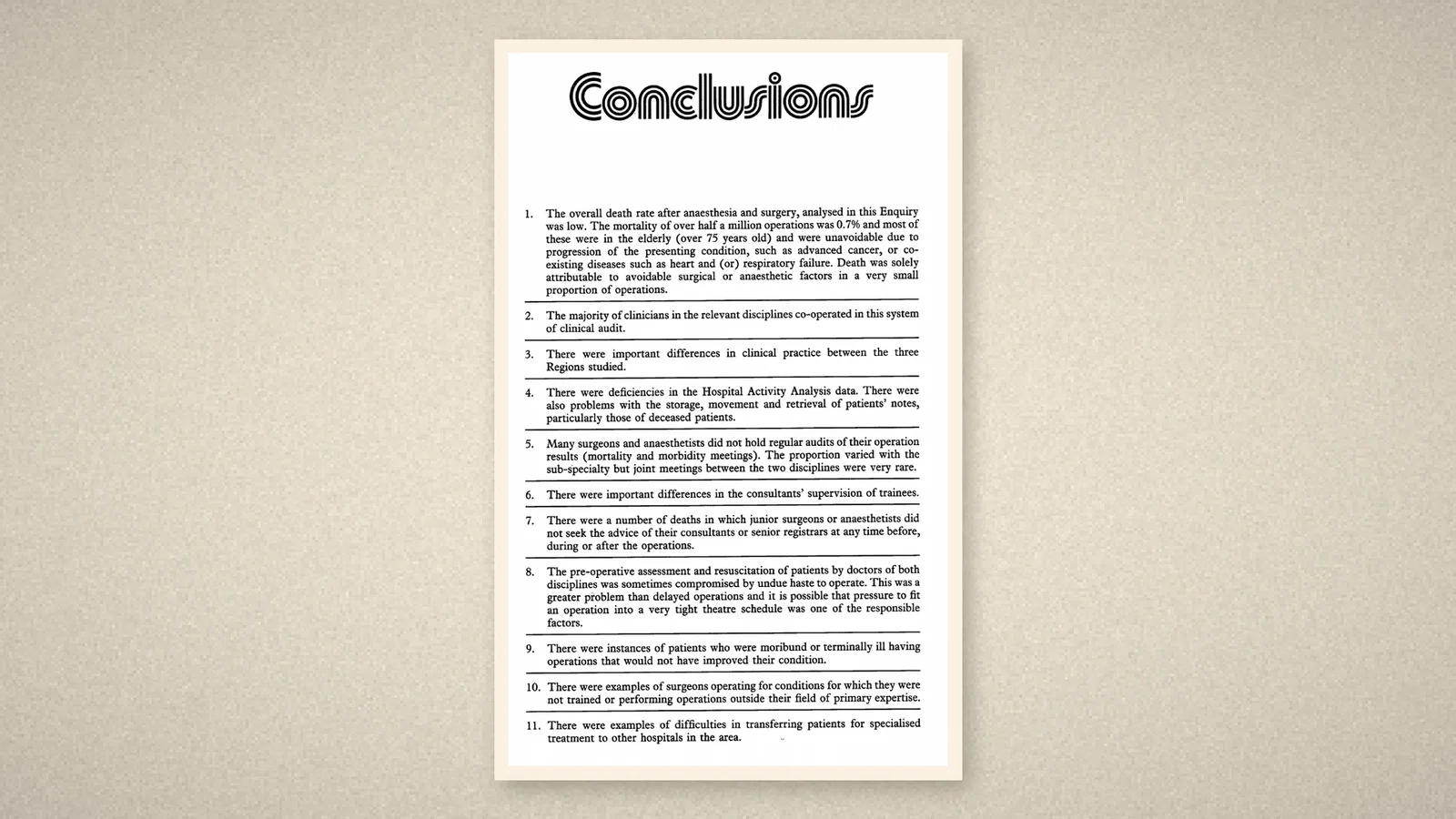
The overall death rate after anaesthesia and surgery was low, the report concluded: 0.7% of over half a million operations, mostly in patients over 75 and unavoidable because of the progression of the presenting condition, such as advanced cancer, or of coexisting disease such as heart or respiratory failure; death was solely attributable to avoidable surgical or anaesthetic factors in a very small proportion. But it also listed problems: many surgeons and anaesthetists held no regular mortality and morbidity meetings, and joint meetings between the two disciplines were very rare; supervision of trainees differed widely; in a number of deaths junior surgeons or anaesthetists did not seek the advice of their consultants or senior registrars at any time; and preoperative assessment and resuscitation were sometimes compromised by undue haste to operate, a greater problem, the report thought, than delayed operations. [1, p. vii]
The anaesthesia section: 410 and 3
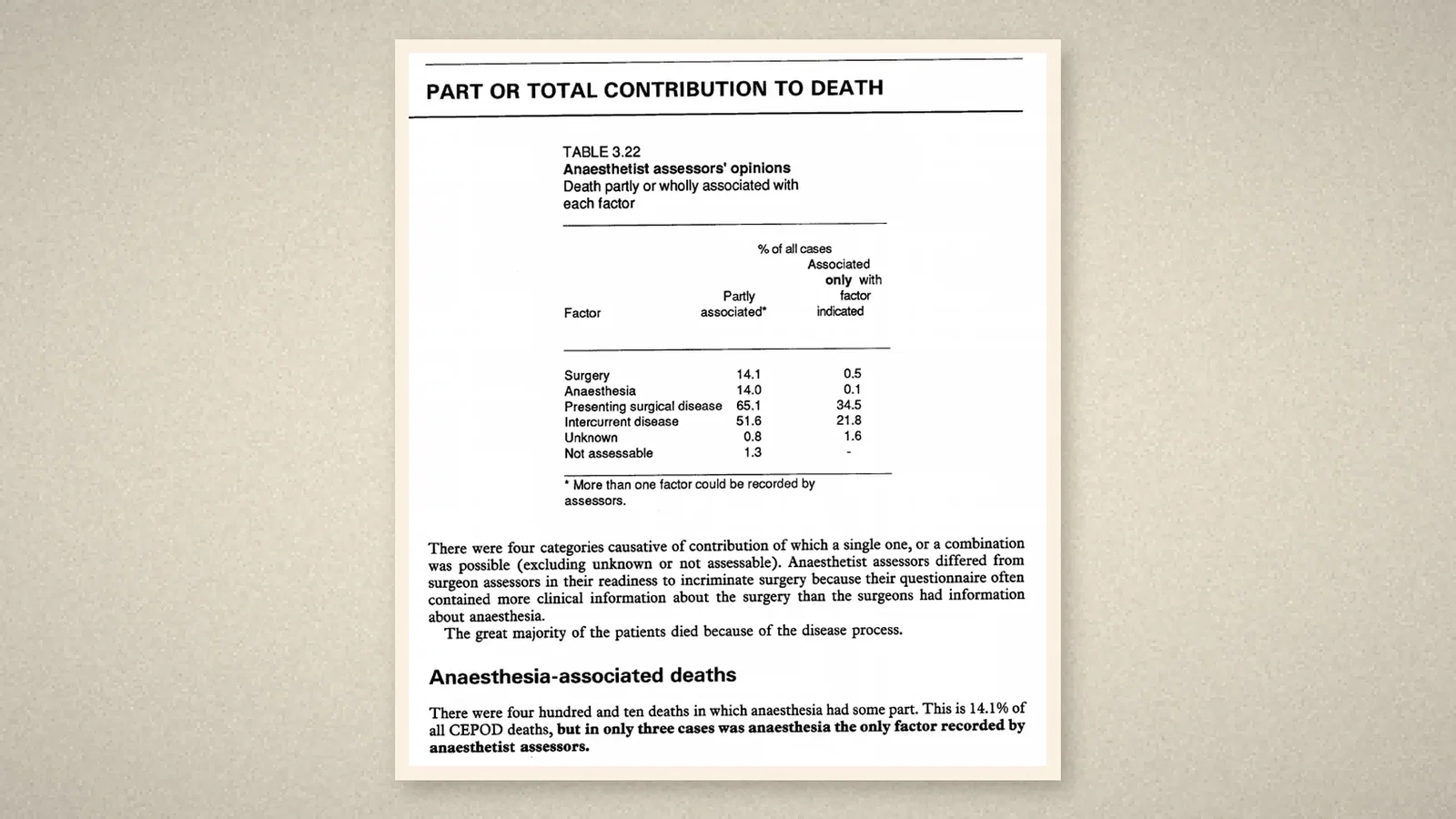
In the view of the anaesthetist assessors, anaesthesia had some part in 410 deaths, 14.1% of all CEPOD deaths, but in only three was it the only factor recorded. The report warned readers against comparing this with the customary figure from other studies that anaesthesia is totally responsible for one death in 10,000 operations: surgeons took part in this Enquiry, and its 80 anaesthetist assessors could also select surgical care as a cause of death, so very few cases ended up attributed solely to anaesthesia. [1, p. 76]
The assessors also found anaesthetic records often of very poor quality, sparse and hard to read; in about 45% of the records judged suboptimal, a reason was failure to use appropriate monitoring; and the absence of consultation between anaesthetists was frequently noted. The contributing factors they listed included failure of organisation, equipment failure, drug effect, lack of knowledge, failure to apply knowledge, lack of care and lack of experience. [1, p. 76][1, p. 78]
Recommendations
The report called for an assessment of clinical practice on a national basis; accurate coding and information systems in every district; time for clinicians to assess themselves through autopsies, mortality and morbidity meetings and joint clinical review; a review in every department of anaesthesia and surgery of consultants' supervision of trainees, with no senior house officer or registrar undertaking emergency anaesthesia or surgery without consulting a consultant or senior registrar; and the concentration of out-of-hours anaesthetic, surgical and nursing resources. [1, pp. viii-ix]
What the record shows
CEPOD carried the logic of the confidential maternal-death enquiries into the operating theatre: no blame on individuals, only the question of what could be done better, and the more thorough the confidentiality, the more candid the doctors. For anaesthesia, it also showed that anaesthetic safety cannot be judged inside the anaesthetic department alone, but has to be examined together with surgery.
Sources and reading limits
Read (the scanned full report on the NCEPOD website): the cover, title page and working party, the foreword, the conclusions and recommendations (pp. vii-ix), the introduction, confidentiality, case selection and general results to the return of forms (Part 1, pp. 3-14), and the anaesthesia sections on part or total contribution to death and anaesthesia-associated deaths (Part 3, pp. 76-78); the surgical part and appendix tables were skimmed only. The NCEPOD one-page summary was also read. [2]
Not covered: Lunn and Mushin's 1982 report; the later national NCEPOD reports. The History of Anaesthesia Society timeline entry was used only as the lead.
Limits: individual case details, doses and blood pressures are not repeated.
Three illustrations are taken from the 1987 report (cover, p. vii, p. 76). One is a diagram of the process and figures drawn from the report, with no people drawn.
- Buck N, Devlin HB, Lunn JN. The Report of a Confidential Enquiry into Perioperative Deaths. London: Nuffield Provincial Hospitals Trust and King's Fund; 1987. PDF
- National Confidential Enquiry into Patient Outcome and Death. 1987 report summary. PDF
Continue exploring
Related reading connects shared questions and contexts; it does not by itself establish historical influence.
Anesthesia Epochs · The Source Room · About & Editorial Method
Published November 4, 2026. Sources and reading limits are stated above. Illustrations are labelled as original source images or AI-made. Historical accounts are educational; they are not current treatment instructions.