
In 1992 the British Journal of Anaesthesia published Supplement 1 to vol. 69, devoted to postoperative nausea and vomiting. Its editors, Rowbotham and Smith, wrote that one stimulus to recent interest was the introduction of the 5-HT3 antagonists and their astounding efficacy against vomiting from cancer chemotherapy, and thanked Glaxo Group Research, which financed the whole supplement. In it Bunce and Tyers of Glaxo's pharmacology division explained the role of 5-HT3 receptors in the vomiting reflex and said these properties led to the clinical evaluation of ondansetron in postoperative nausea and vomiting; Russell and Kenny of Glasgow reviewed the trials, judged ondansetron effective and safe compared with placebo, and noted that a UK product licence had recently been issued for this indication. In May of the same year Kenny and colleagues had reported an oral dose comparison in 995 gynaecological patients in 31 hospitals.
Reading Library · Anesthesia Epochs · 中文版
Watch the education video (for clinicians)
1992: Ondansetron for PONV — The 1992 BJA Supplement · Anesthesia Epochs Education Series
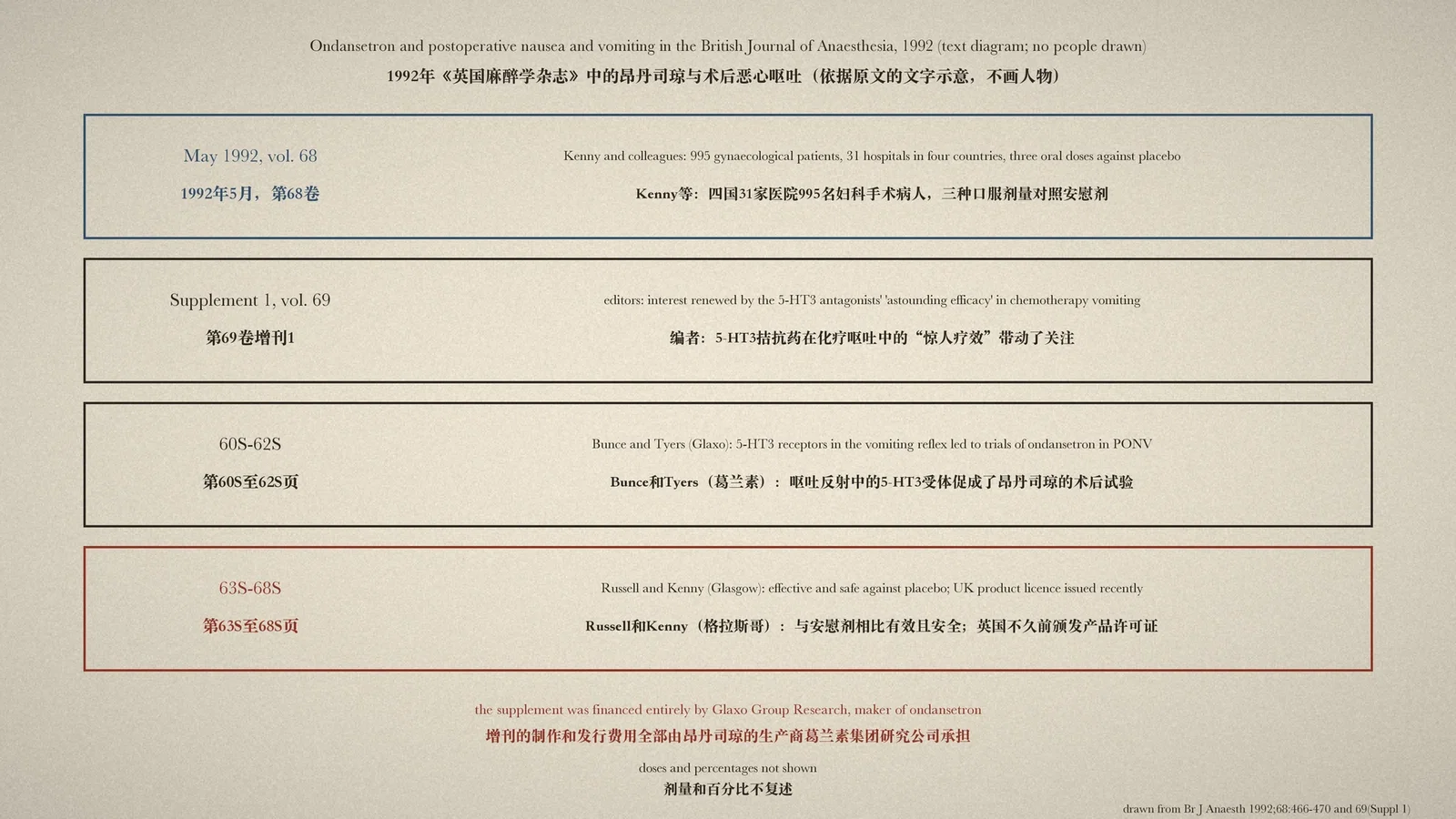
After an operation, what troubles patients most besides pain is often nausea and vomiting. In 1992 the British Journal of Anaesthesia devoted a whole supplement to postoperative nausea and vomiting. Its last two articles dealt with one new class of drugs, the 5-HT3 receptor antagonists, and above all with ondansetron. At the end of their introduction the editors said plainly that the entire cost of producing and distributing the supplement had been met by Glaxo Group Research, the maker of ondansetron. [1, p. 1S]
A supplement on nausea and vomiting
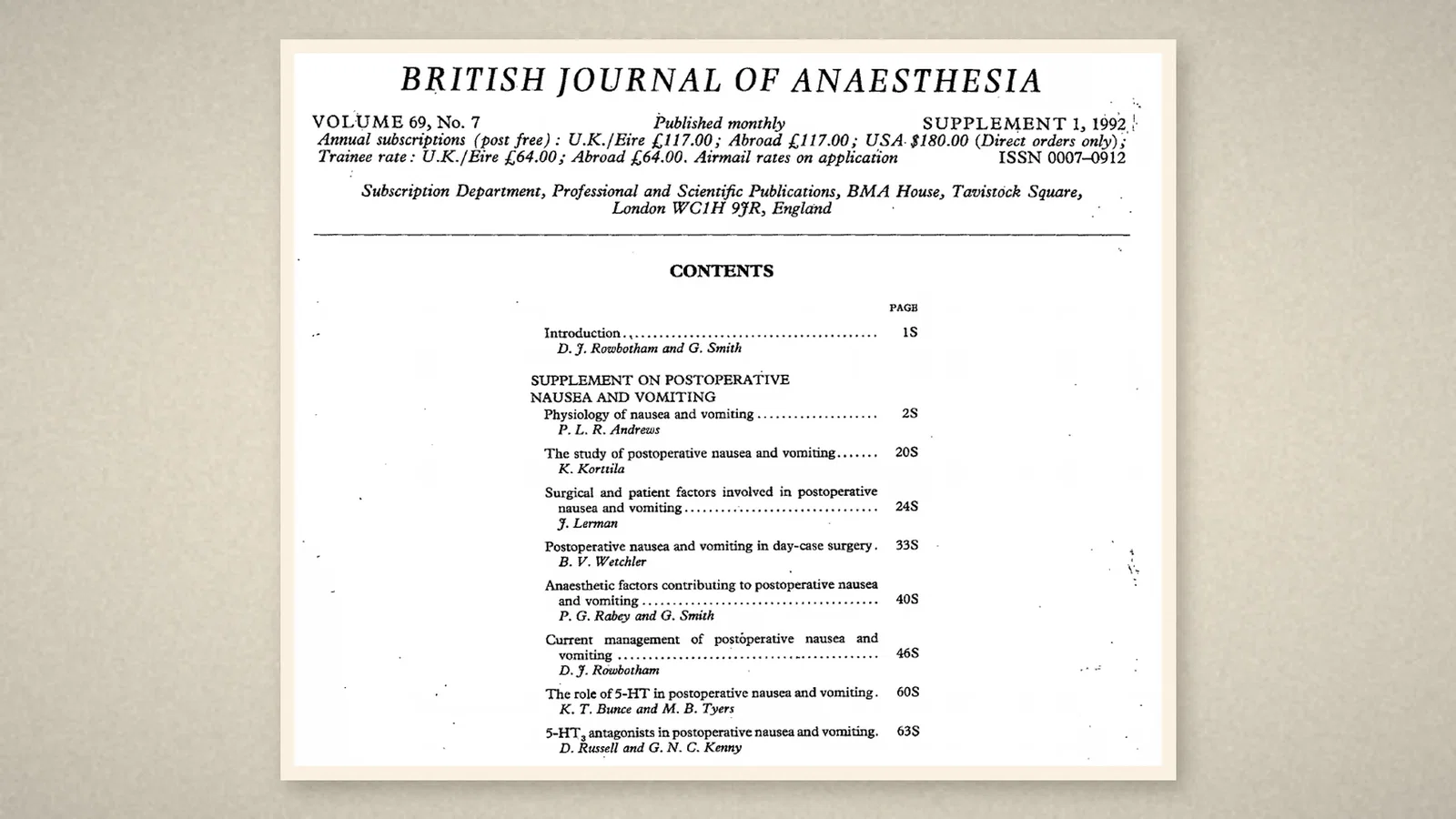
The supplement, vol. 69 Supplement 1, was edited by D. J. Rowbotham and G. Smith and held eight articles: on the physiology of nausea and vomiting, the study of postoperative nausea and vomiting, surgical and patient factors, day-case surgery, anaesthetic factors and current management, and finally on the role of 5-HT and on the 5-HT3 antagonists. [1, p. 1S]
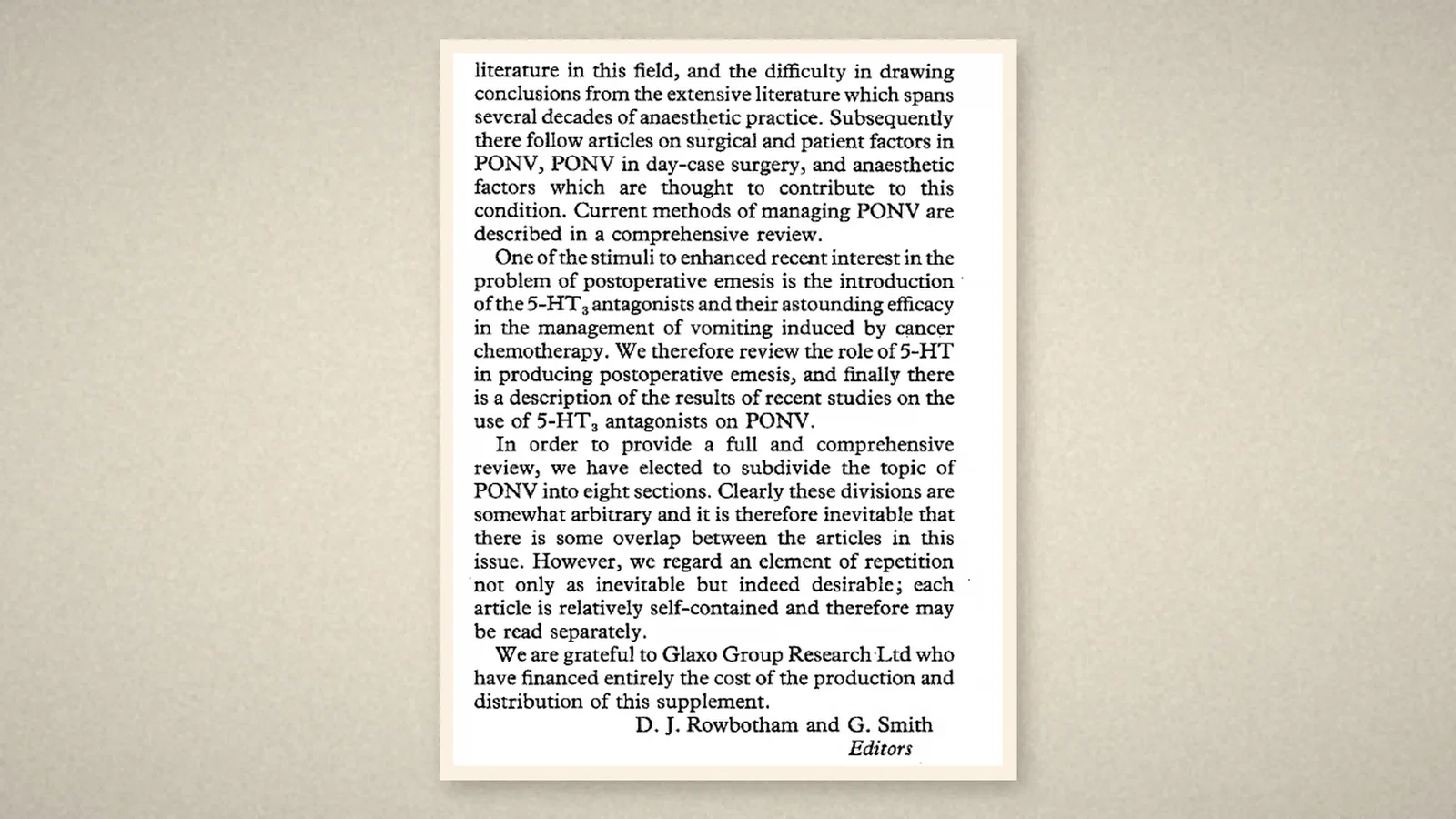
The commonest and most distressing symptoms after anaesthesia and surgery, the editors wrote, were pain and emetic problems; pain had been studied enormously, with papers on it often outnumbering all other areas in the anaesthetic journals, whereas postoperative nausea and vomiting "have received less attention". One stimulus to the recent interest in postoperative emesis was "the introduction of the 5-HT3 antagonists and their astounding efficacy" in vomiting induced by cancer chemotherapy. [1, p. 1S]
Glaxo's pharmacologists explain
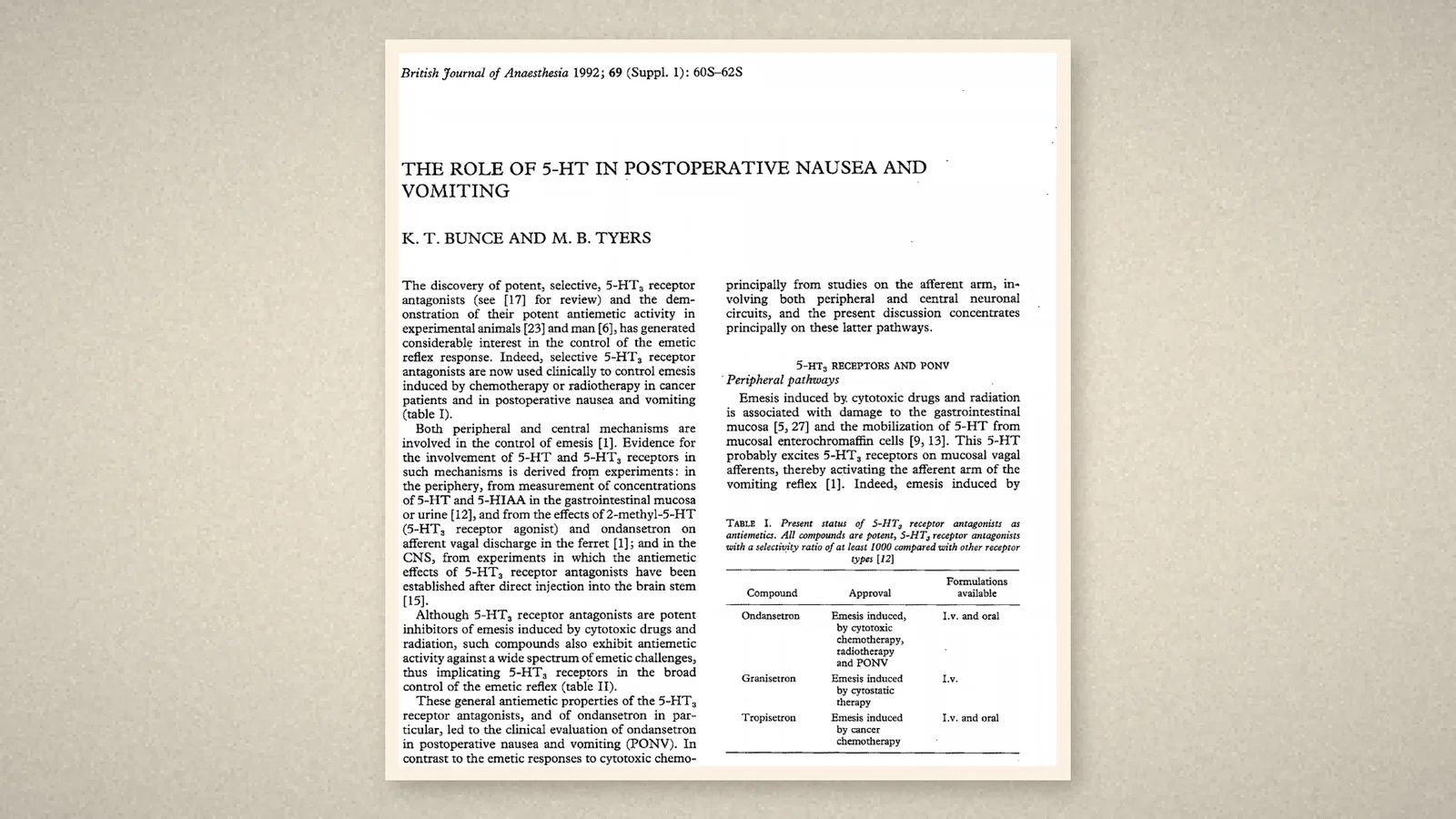
The authors of pp. 60S-62S, K. T. Bunce and M. B. Tyers, worked in the Pharmacology Division of Glaxo Group Research at Ware, Hertfordshire. The discovery of potent, selective 5-HT3 receptor antagonists and of their antiemetic activity in animals and man, they began, had generated considerable interest in the control of the emetic reflex; such drugs were "now used clinically" against emesis from chemotherapy and radiotherapy and in postoperative nausea and vomiting. A table listed ondansetron as approved for emesis from cytotoxic chemotherapy, radiotherapy and PONV, in intravenous and oral forms, while granisetron and tropisetron in the same table were listed for emesis from cancer treatment only. [2, p. 60S]
The general antiemetic properties of the class, "and of ondansetron in particular", they wrote, led to the clinical evaluation of ondansetron in PONV. Yet relatively little was known about the mechanisms of postoperative vomiting compared with chemotherapy-induced vomiting, and discussion was "necessarily speculative". They suggested that the anaesthetic, handling of the gut, head and neck surgery and pain might act through vagal, splanchnic and trigeminal afferents and 5-HT3 receptors in the area postrema and nucleus tractus solitarius, and concluded that PONV was multifactorial and that the involvement of 5-HT and 5-HT3 receptors was demonstrated by the antiemetic effect of ondansetron. [2, p. 60S][2, p. 61S][2, p. 62S]
The Glasgow review: a licence just issued
The supplement's last article came from D. Russell and G. N. C. Kenny of the University Department of Anaesthesia at the Royal Infirmary, Glasgow. Of the antiemetics then available, droperidol appeared the most effective, they wrote, yet many patients still vomited after it; the search for more effective drugs without sedative or extrapyramidal effects had led to "a relatively new class of drugs", such as ondansetron, granisetron, tropisetron and dolasetron. These act by highly selective antagonism of 5-HT3 receptors, which are dense in the area postrema and the nucleus tractus solitarius. The 5-HT3 antagonists were unique among antiemetics, the authors stressed, in having no effect at histaminergic, dopaminergic or cholinergic receptors, and so could be expected to be free of drowsiness, dry mouth or extrapyramidal effects; the extrapyramidal effects occasionally seen with metoclopramide had not occurred with ondansetron, whose main side effects were constipation, headache and a warm sensation or flushing on intravenous injection. [3, p. 63S][3, p. 64S]
After reviewing placebo-controlled studies in anaesthesia and surgery, they concluded that ondansetron had clearly been shown to be effective and safe in the prophylaxis and treatment of postoperative nausea and vomiting compared with placebo; that the results of comparisons with other antiemetics were awaited; and that "a product licence has been issued recently" in the United Kingdom for this indication. [3, p. 67S]
A multicentre trial that May
In May of the same year the journal (vol. 68) had printed an international multicentre trial by Kenny and eight colleagues, one of them C. G. Haigh of Glaxo Group Research. It was carried out in 31 hospitals in the UK, the Netherlands, Germany and Norway, enrolled 995 patients having major gynaecological surgery, and compared three oral doses of ondansetron with placebo, double-blind. The paper had been accepted on 2 December 1991. Three doses of ondansetron given eight-hourly significantly reduced the frequency and severity of postoperative nausea and the frequency and number of episodes of vomiting; the two higher doses were better than the lowest dose and placebo, and the highest was no more effective than the middle one; side effects overall did not differ from placebo, and recovery time after anaesthesia was unaffected, which the authors thought important for day-case patients who need to recover quickly. [4, p. 466][4, p. 469]
What the record shows
These papers record the moment a drug for chemotherapy vomiting walked into the anaesthetic recovery room: from receptor to trial to licence. They also print the name of the sponsor, a reminder that half of this history was told by the company that made the drug.
Sources and reading limits
Read: the masthead, contents and editors' introduction (p. 1S) of Br J Anaesth 1992;69 Supplement 1; Bunce and Tyers, "The role of 5-HT in postoperative nausea and vomiting" (pp. 60S-62S); Russell and Kenny, "5-HT3 antagonists in postoperative nausea and vomiting" (pp. 63S-68S); and Kenny and colleagues' oral dose comparison, Br J Anaesth 1992;68:466-70; all in full, from the open Internet Archive scan, with page images checked, and the PubMed records of the three indexed papers. The other six articles in the supplement were not read for this article.
Not covered: the society timeline entry dating the "clinical introduction of ondansetron" to 1990; the UK product licence or data sheet itself; Glaxo's discovery papers on ondansetron (GR38032F) and the record of its first approval for chemotherapy-induced emesis; the earlier clinical studies cited by Russell and Kenny.
Limits: the 1990 date given in some timelines was not verified; the article is dated to 1992, when Russell and Kenny call the UK licence for postoperative nausea and vomiting recent, without giving a date. The supplement was financed entirely by Glaxo, the maker of ondansetron, two of its authors were Glaxo employees, and the Kenny trial had a Glaxo author; the papers are favourable to the drug and should be read in that light. Doses, regimens, percentages, pharmacokinetic values and data-sheet recommendations are not repeated, and page crops stop before them. Patients are not identified.
Three illustrations are crops of the British Journal of Anaesthesia 1992, vol. 69 Supplement 1 (masthead and contents, the editors' introduction on p. 1S, and the first page of Bunce and Tyers on p. 60S). One is a text diagram drawn from the papers, with no people drawn and no doses.
- Rowbotham DJ, Smith G. Introduction. Br J Anaesth. 1992;69(Suppl 1):1S. Internet Archive
- Bunce KT, Tyers MB. The role of 5-HT in postoperative nausea and vomiting. Br J Anaesth. 1992;69(Suppl 1):60S-62S. DOI
- Russell D, Kenny GNC. 5-HT3 antagonists in postoperative nausea and vomiting. Br J Anaesth. 1992;69(Suppl 1):63S-68S. DOI
- Kenny GNC, Oates JDL, Leeser J, Rowbotham DJ, Lip H, Rust M, Saur P, Onsrud M, Haigh CG. Efficacy of orally administered ondansetron in the prevention of postoperative nausea and vomiting: a dose ranging study. Br J Anaesth. 1992;68(5):466-70. DOI
Continue exploring
Related reading connects shared questions and contexts; it does not by itself establish historical influence.
Anesthesia Epochs · The Source Room · About & Editorial Method
Published November 3, 2026. Sources and reading limits are stated above. Illustrations are labelled as original source images or AI-made. Historical accounts are educational; they are not current treatment instructions.