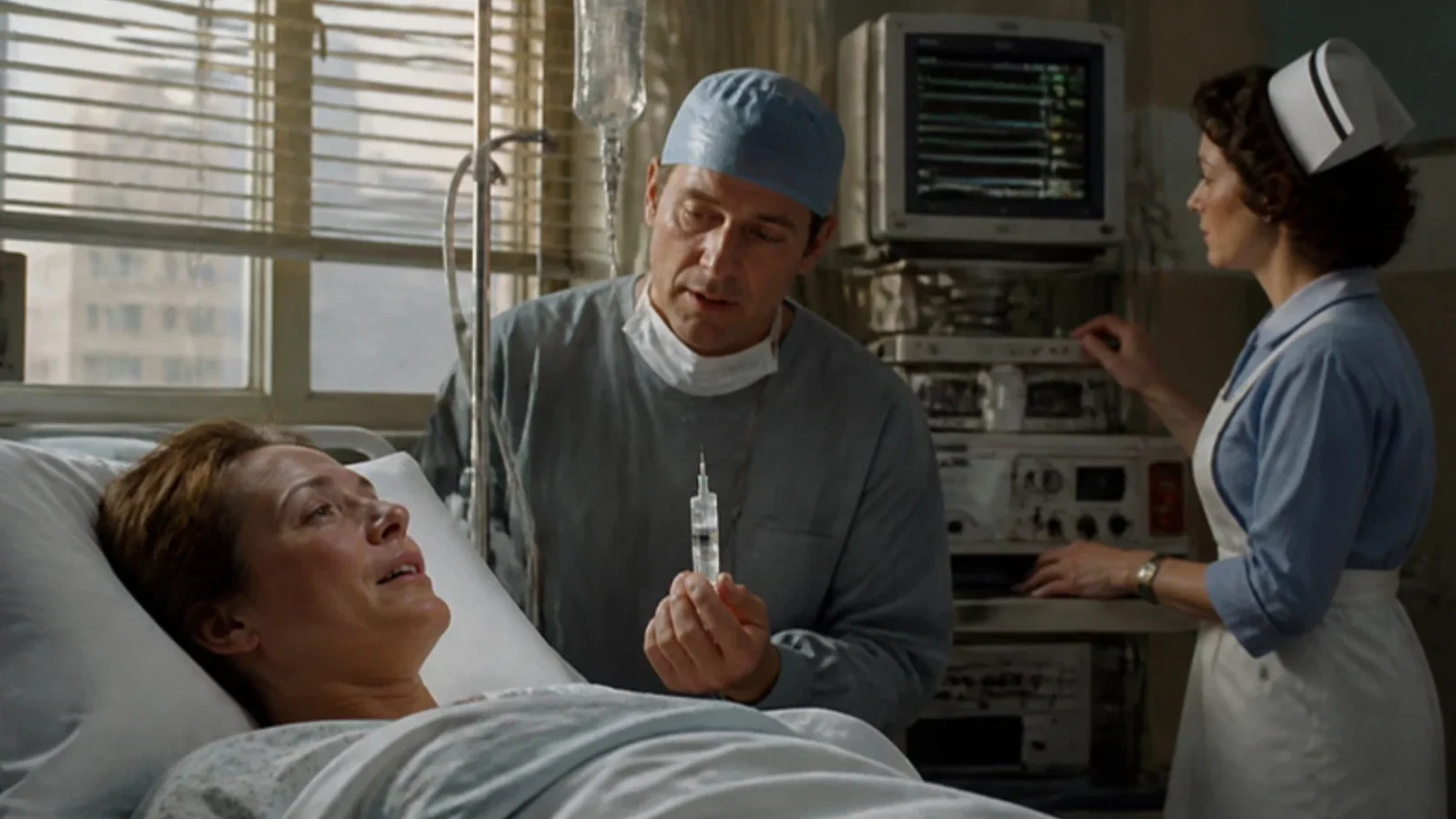
In April 1987 the British Journal of Anaesthesia (vol. 59, no. 4) printed two consecutive randomised, double-blind, placebo-controlled trials of the benzodiazepine antagonist Ro 15-1788. At the University Hospital of Zurich, Alon, Baitella and Hossli gave it after midazolam-based general anaesthesia to sixty women having laparoscopy: it reversed the hypnotic effect of midazolam within a few minutes, leaving patients alert, co-operative, oriented and with good recall, better than placebo for up to 30 min, with stable arterial pressure and heart rate and only more nausea. At Auckland Hospital, Sage, Close and Boas gave Anexate from coded ampoules to sixty-five men sedated with midazolam during prostatic surgery under subarachnoid anaesthesia and recorded the 'dramatic awakening' of deeply sedated patients, better than placebo for 60 min; sedation then crept back, and they warned that reversal of long-acting or larger doses might be temporary. Roche supplied the drug for both. PubMed indexes the substance as flumazenil.
Reading Library · Anesthesia Epochs · 中文版
Watch the education video (for clinicians)
1987: Flumazenil (Anexate) — Awakening and Re-sedation · Anesthesia Epochs Education Series
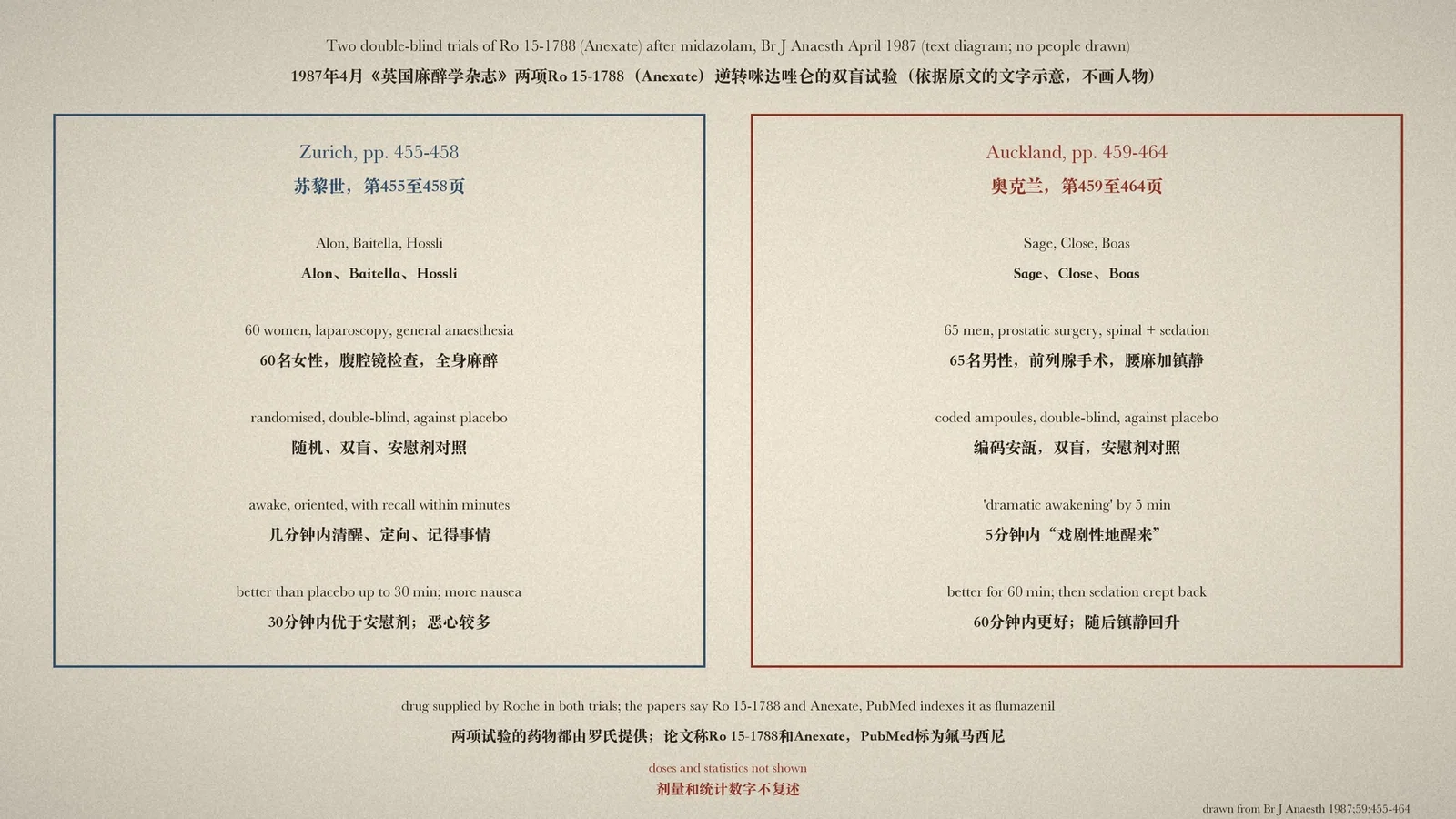
Anaesthetists use benzodiazepines to calm patients, put them to sleep and spare them unpleasant memories, but once the operation is over the effect often lasts longer than anyone needs. What if a drug could switch it off? In April 1987 the British Journal of Anaesthesia (vol. 59, no. 4) printed two clinical trials one after the other, one from Zurich and one from Auckland, both testing Roche's benzodiazepine antagonist Ro 15-1788, sold as Anexate, in patients who had received midazolam. [1, p. 455][2, p. 459]
An antagonist
The Auckland authors explained the background. The imidazobenzodiazepine, they wrote, had been first described by Hunkeler and colleagues in 1981; studies in animals and volunteers showed it to be a specific antagonist of the behavioural, neurological and electrophysiological effects of benzodiazepines, while in man it was devoid of the typical behavioural effects of agonist benzodiazepines. The Zurich authors added that animal studies showed it antagonised the central effects of benzodiazepines by competitive inhibition, and that studies in volunteers and patients showed it could reverse sedation without toxic side effects. Both papers call the drug only Ro 15-1788 or Anexate; PubMed today indexes both under the substance Flumazenil. [2, p. 459][1, p. 455][3]
Zurich: sixty women
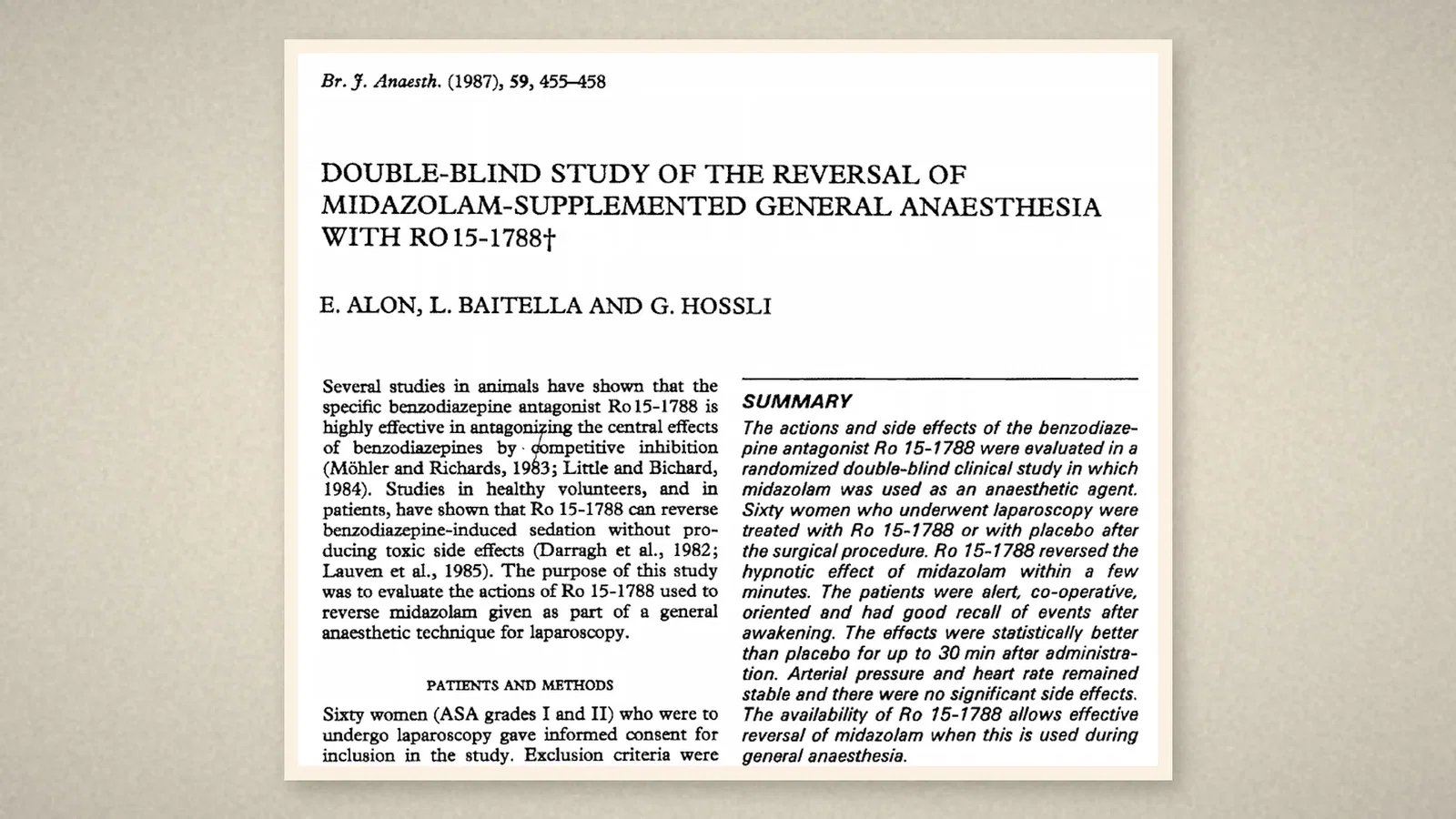
E. Alon, L. Baitella and G. Hossli of the Institute of Anaesthesiology at the University Hospital of Zurich studied sixty women having laparoscopy, whose general anaesthesia was based on midazolam. After surgery and extubation the patients were randomly and double-blindly given Ro 15-1788 or placebo, in increments until awake, and sedation, co-operation and comprehension, orientation and amnesia were scored before injection and at 5, 15, 30, 60 and 120 minutes. The paper was accepted on 11 February 1986, after presentation to the Scandinavian Society of Anaesthesiologists in Reykjavik in June 1985 and to the Central European Congress of Anaesthesiology in Graz in September 1985. [1, p. 455]
Before injection every patient in both groups was asleep, unrousable and unco-operative. Five minutes after injection the groups differed significantly, and at 15 and 30 minutes the treated patients were fully awake, co-operative, oriented in time and space and without amnesia, while those given placebo "remained sleepy, unco-operative and disoriented", with slight to moderate amnesia. By two hours performance was similar and all patients were awake. Arterial pressure and heart rate stayed stable and did not differ between groups; pain at the injection site did not differ significantly, no thrombophlebitis was seen, and only nausea was significantly more frequent with the drug. All patients described their awakening as good to excellent. [1, p. 456][1, p. 457]
In the discussion the authors noted that recovery was much faster and that there were no rebound effects, probably because the amount of benzodiazepine given was small, while reports on patients in coma from benzodiazepine intoxication showed that repeated doses might be needed. Their conclusion was measured: Ro 15-1788 "may be a useful addition to the armamentarium of any anaesthetist using benzodiazepines". F. Hoffmann-La Roche provided the agents. [1, p. 457]
Auckland: sixty-five men
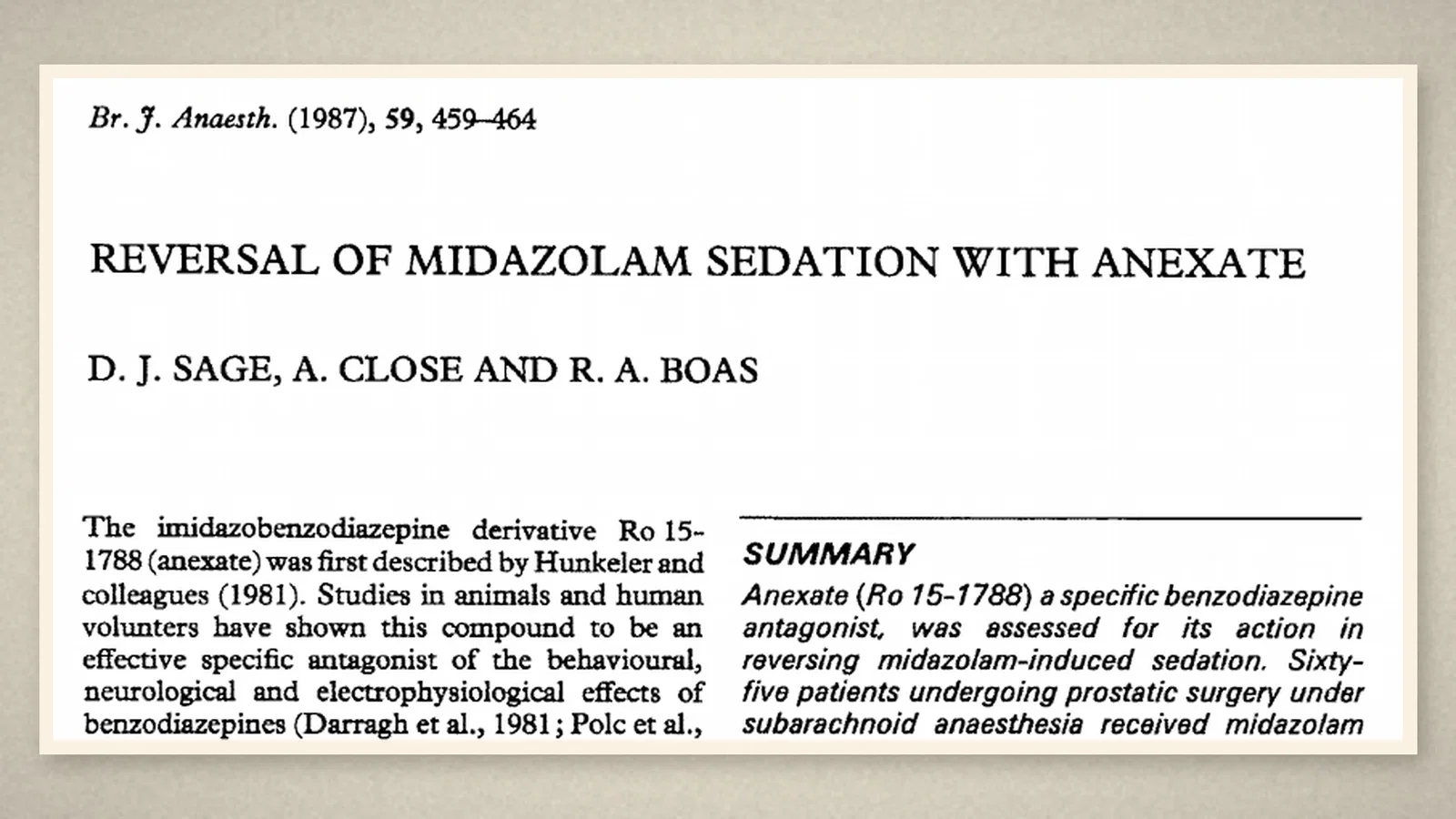
The next paper came from D. J. Sage of the Department of Anaesthesia, Auckland Hospital, and A. Close and R. A. Boas of the Department of Pharmacology and Clinical Pharmacology, University of Auckland, and was accepted on 6 May 1986. The setting was different: men scheduled for transurethral resection of the prostate, operated on under subarachnoid anaesthesia and kept lightly to moderately sedated with midazolam. Seventy were entered and five withdrawn, one of them a treated patient who died eight hours after surgery of non-drug-related acute valvular heart disease; sixty-five were analysed. On arrival in the recovery ward each patient was scored, then given Anexate or a vehicle-only placebo double-blind from coded ampoules. [2, p. 459][2, p. 460]
The scoring was simple. Sedation was graded; comprehension and collaboration were judged by whether the patient could blow into a hand-held Wright's respirometer unaided; orientation was tested by asking the date and the place; and anterograde amnesia was tested with a board of five pictured items, which the patient later had to pick out from a group of ten. Observation lasted four hours. [2, p. 460]
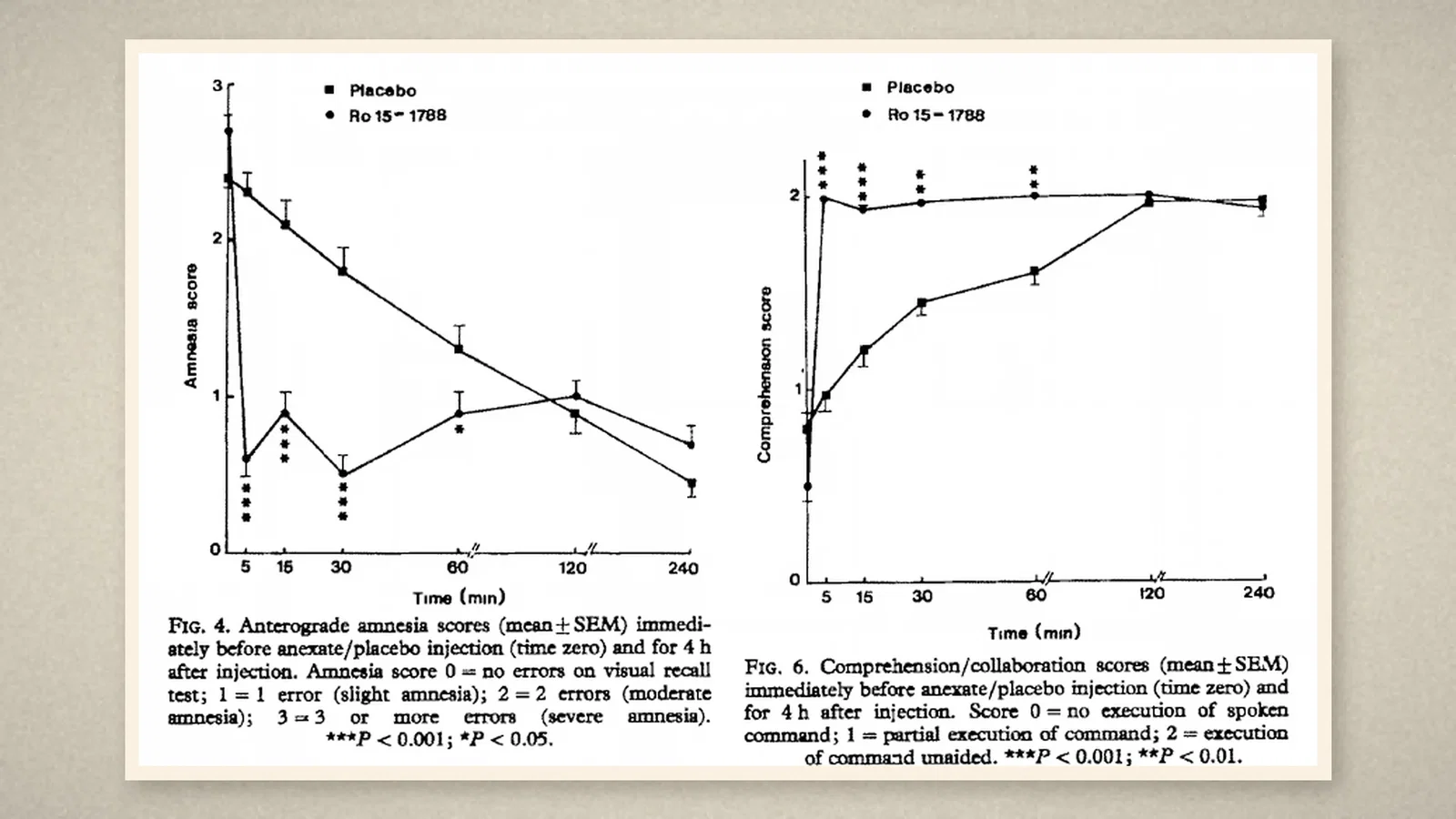
What followed, in the authors' words, was the "dramatic awakening of many previously deeply comatose patients". Reversal of sedation was apparent by five minutes, without anxiety; comprehension, orientation and memory improved at once and stayed significantly better than with placebo for 60 minutes; arterial pressure, heart rate and ventilatory rate were unaffected. The placebo group took about two hours to reach comparable memory. [2, p. 459][2, p. 461][2, p. 462]
Sedation returns
The Auckland authors also recorded the other side. Patients given placebo grew gradually less sedated as midazolam wore off, but "exactly the opposite was true" of the treated patients: after reversal they slowly became more sedated again, with a small but significant rise by four hours. This fitted the antagonist's shorter action compared with midazolam, they wrote, and suggested that reversal of long-acting or larger doses of benzodiazepines "may be temporary or incomplete"; further investigation was needed to confirm the drug's safety and clinical usefulness. Roche Products (NZ) provided Anexate. [2, p. 463][2, p. 464]
What the record shows
One issue, two hemispheres, two kinds of anaesthesia, and the same answer: the effects of midazolam could be undone within minutes. The slowly rising curve from Auckland is the reminder that an antagonist that acts quickly can also fade quickly.
Sources and reading limits
Read: Alon, Baitella and Hossli, "Double-blind study of the reversal of midazolam-supplemented general anaesthesia with Ro 15-1788", Br J Anaesth 1987;59:455-8, and Sage, Close and Boas, "Reversal of midazolam sedation with Anexate", Br J Anaesth 1987;59:459-64 (both papers in full, including tables, figures, discussion, acknowledgements and references, from the open Internet Archive scan of the volume; page images checked), with the PubMed records of both papers.
Not covered: the society timeline entry dating the "introduction of flumazenil" to 1987; any regulatory or company record of the launch of flumazenil (Anexate); Hunkeler and colleagues' original 1981 paper; the volunteer studies of Darragh and colleagues and of Lauven and colleagues; later trials.
Limits: the papers call the drug only Ro 15-1788 and Anexate; the name flumazenil comes from the PubMed index, not from the papers. The 1987 launch date given in some timelines was not verified; the article is dated to the April 1987 publication of these two trials, both accepted in 1986. Roche supplied the drug in both trials. Doses, concentrations, binding constants, half-lives and statistics are not repeated, and page crops stop before them. Patients are not identified. "First described by Hunkeler" is the Auckland authors' statement.
Three illustrations are crops of the British Journal of Anaesthesia 1987, vol. 59, pp. 455, 459 and 462 (titles and summaries of the two papers, and Figs 4 and 6 of Sage and colleagues). One is a text diagram drawn from the papers, with no people drawn and no doses.
- Alon E, Baitella L, Hossli G. Double-blind study of the reversal of midazolam-supplemented general anaesthesia with Ro 15-1788. Br J Anaesth. 1987;59(4):455-8. DOI
- Sage DJ, Close A, Boas RA. Reversal of midazolam sedation with Anexate. Br J Anaesth. 1987;59(4):459-64. DOI
- PubMed records PMID 3105565 and 3105566 (substance: Flumazenil). PubMed
Continue exploring
Related reading connects shared questions and contexts; it does not by itself establish historical influence.
- 1965: Stovner and Endresen Induce Anaesthesia with Intravenous Diazepam
- 1974: Roche Patents the Compounds That Include Midazolam
Anesthesia Epochs · The Source Room · About & Editorial Method
Published November 3, 2026. Sources and reading limits are stated above. Illustrations are labelled as original source images or AI-made. Historical accounts are educational; they are not current treatment instructions.