
US Patent 4,280,957, 'Imidazodiazepines and processes therefor', names Armin Walser and Rodney I. Fryer of New Jersey as inventors and Hoffmann-La Roche as assignee. Filed on 15 May 1978, it traces back through a continuation-in-part of 7 August 1975 to an application of 11 September 1974, and it was granted on 28 July 1981. The compounds were anticonvulsants, muscle relaxants, anxiolytics and sedatives, and their acid addition salts were particularly useful for intravenous and intramuscular preparations because they dissolve in water; claim 2 is 8-chloro-6-(2-fluorophenyl)-1-methyl-4H-imidazo[1,5-a][1,4]benzodiazepine maleate. In 1982 Hans Strobl's thesis from Doenicke's department in Munich drew the formula of RO 21-3981, midazolam, which matches. Earlier benzodiazepines, the thesis noted, were insoluble in water, painful to inject and often followed by thrombophlebitis; water-soluble midazolam promised better tolerance. In 60 patients induced with it, blood pressure did not change significantly, but unpremedicated patients reacted more to intubation, and some patients were awake or moving during surgery.
Reading Library · Anesthesia Epochs · 中文版
Watch the education video (for clinicians)
1974: Midazolam — Read the Group Definitions · Anesthesia Epochs Education Series
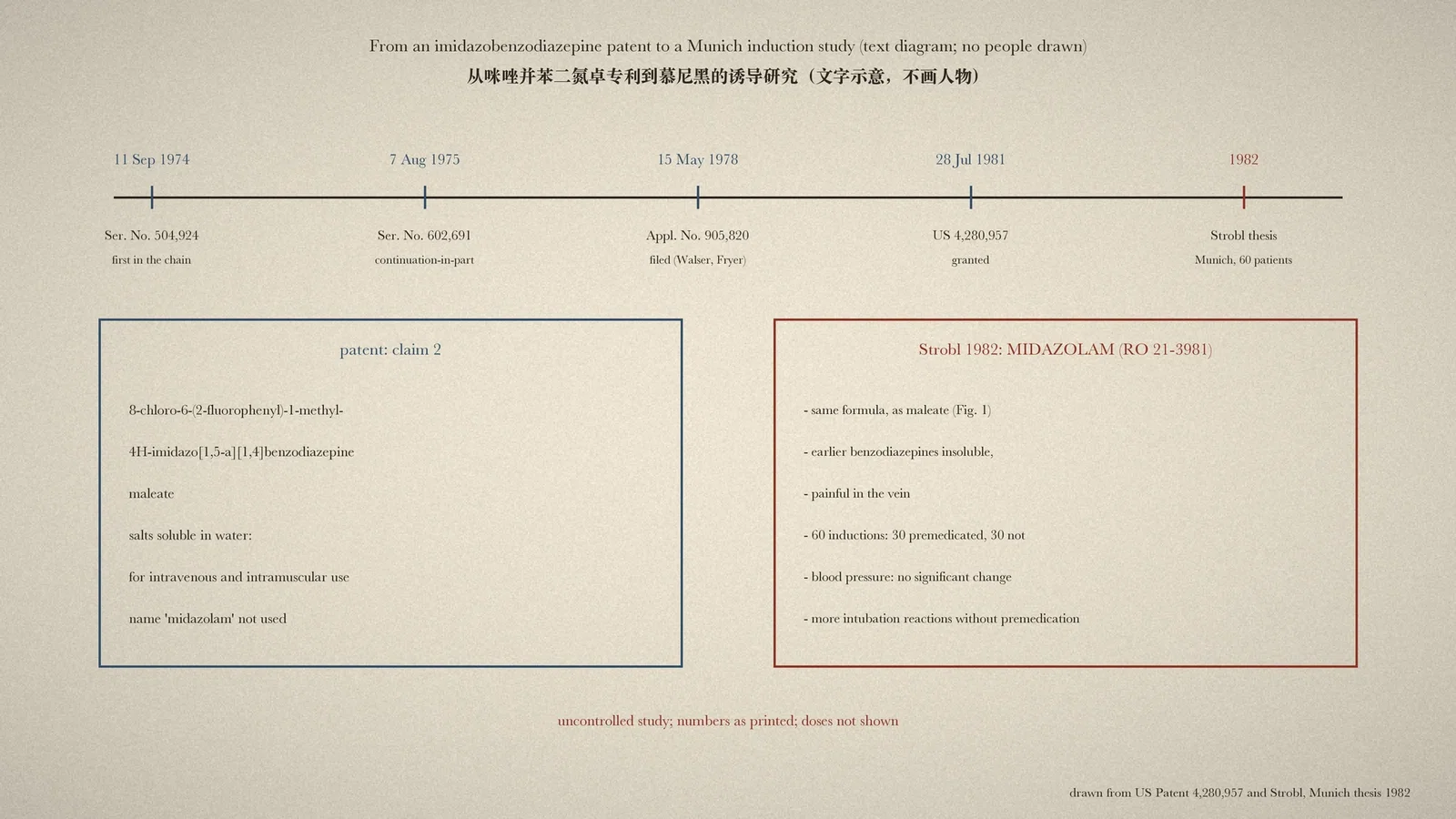
Benzodiazepines used in anaesthesia had a practical problem: they did not dissolve in water, so they came in solvents that hurt in the vein. A patent from Hoffmann-La Roche, traced back to an application of September 1974, offered a family of related compounds whose salts did dissolve in water. One of those salts is the drug later called midazolam. A Munich thesis of 1982 shows what using it to induce anaesthesia looked like. [1, PDF p. 19][2, p. 5]
The patent
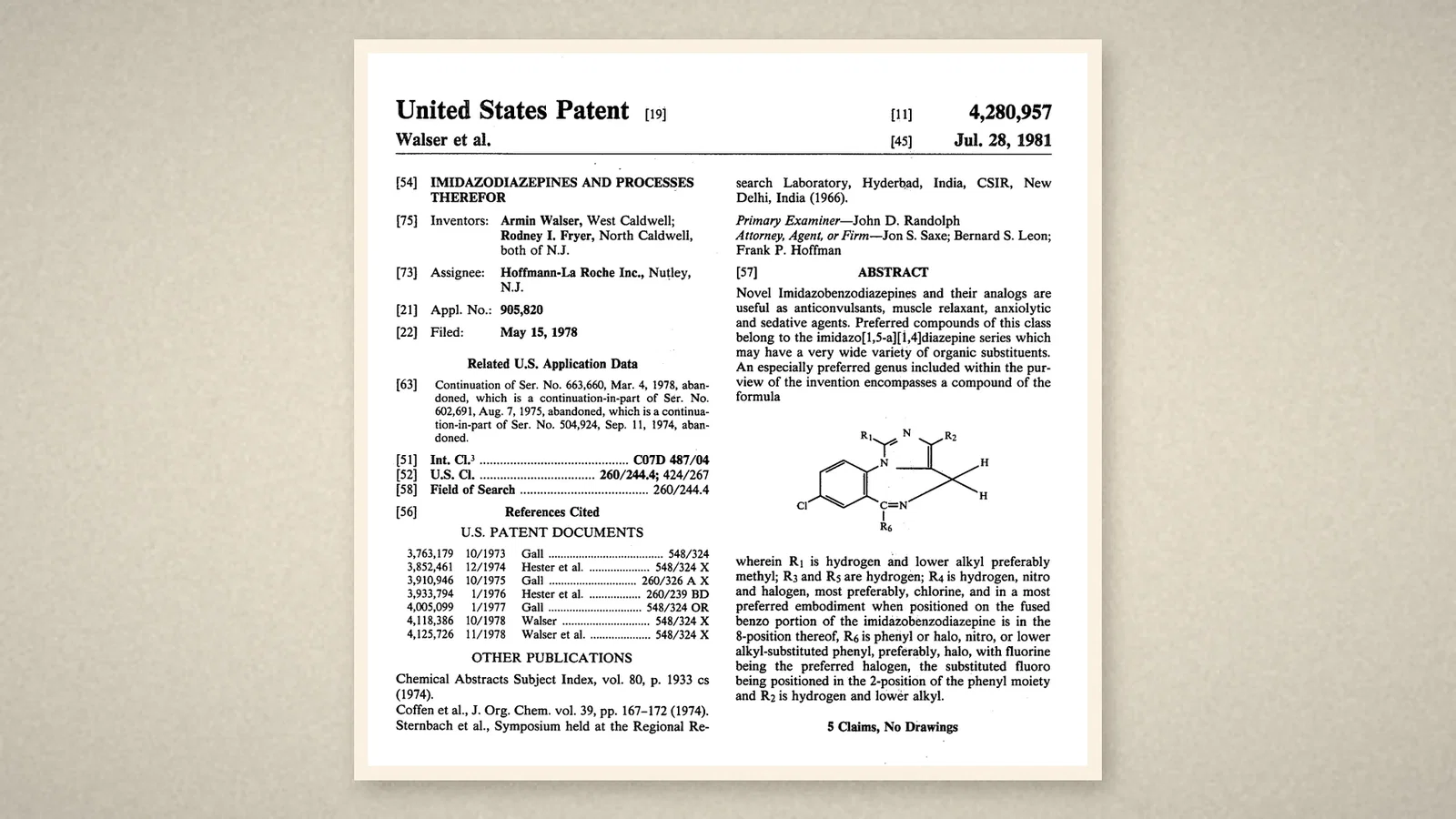
US Patent 4,280,957, "Imidazodiazepines and processes therefor", names as inventors Armin Walser of West Caldwell and Rodney I. Fryer of North Caldwell, New Jersey. The assignee is Hoffmann-La Roche Inc. of Nutley. The application was filed on 15 May 1978, and the patent was granted on 28 July 1981. [1, front page]
The front page also records an earlier history. This application continued an earlier one, Ser. No. 663,660, which was a continuation-in-part of Ser. No. 602,691 of 7 August 1975. That application was in turn a continuation-in-part of Ser. No. 504,924, filed on 11 September 1974. All three had been abandoned. The date of Ser. No. 663,660 is printed as 4 March 1978. [1, front page][1, col. 1]
According to the abstract, the new imidazobenzodiazepines are "useful as anticonvulsants, muscle relaxant, anxiolytic and sedative agents". [1, front page] The description adds the point that mattered for the operating theatre. The compounds and their acid addition salts are useful as muscle relaxants, sedatives and anticonvulsants, and many are "particularly useful when utilized in intravenous and intramuscular preparations because of the acid addition salts' solubility in aqueous solution". [1, PDF p. 19]
Claim 2 names one salt: 8-chloro-6-(2-fluorophenyl)-1-methyl-4H-imidazo[1,5-a][1,4]benzodiazepine maleate. The patent does not use the name midazolam. [1, claims]
The formula, named
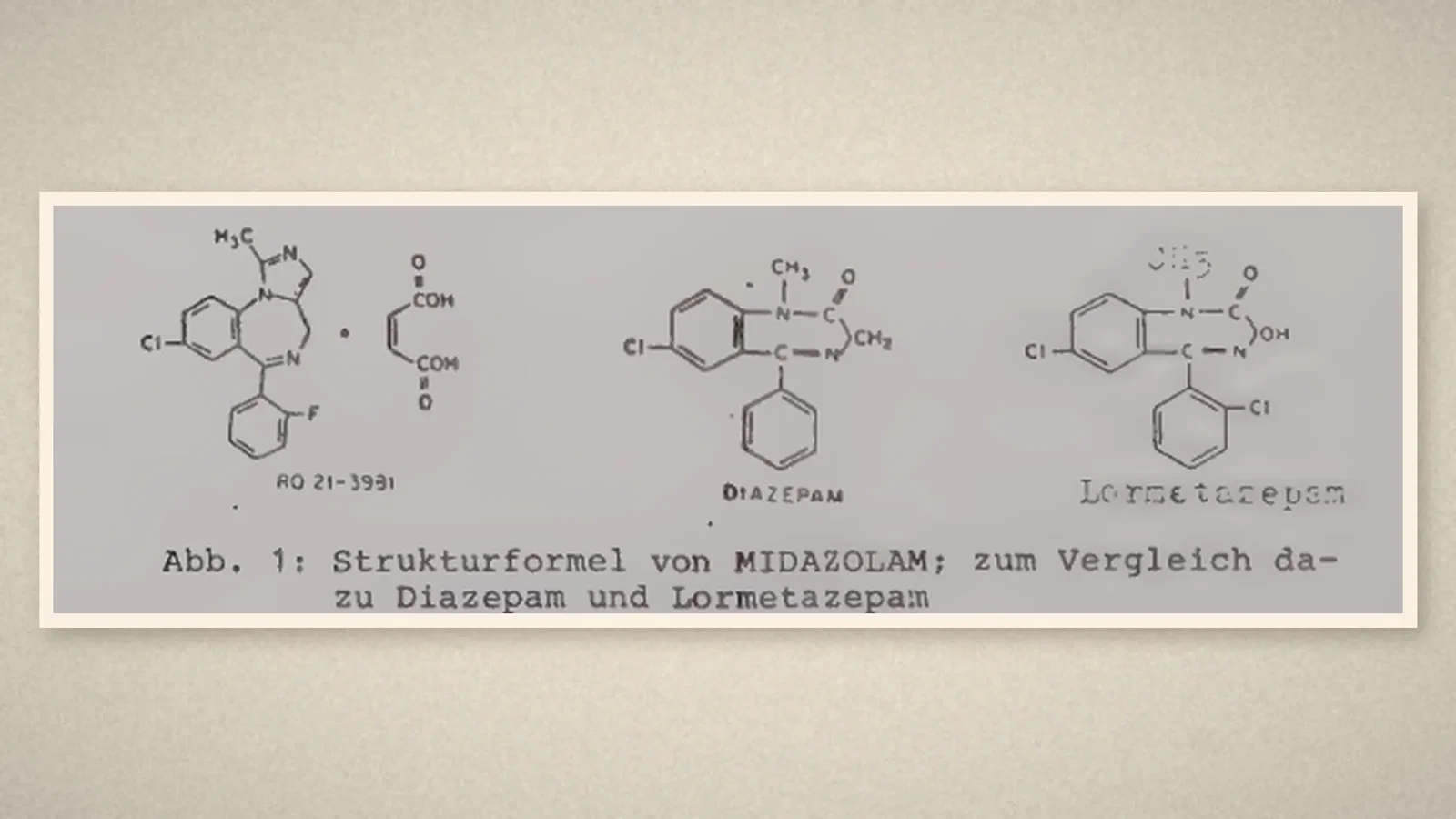
In 1982 Hans Strobl submitted a medical thesis, "Midazolam zur Narkoseeinleitung: Klinische Studie", from the anaesthesia department of A. Doenicke at the surgical outpatient clinic of the University of Munich. [2, title page] Its Figure 1 draws "MIDAZOLAM", labelled RO 21-3981, next to diazepam and lormetazepam. The drawing shows a chlorinated benzo ring, a 2-fluorophenyl group and a methylated imidazole ring, with maleic acid alongside. This is the compound of claim 2. [2, p. 2]
The thesis explains why water solubility mattered. The benzodiazepines used in anaesthesia until then were all insoluble in water and needed special solvents. Diazepam and flunitrazepam, for example, came in benzyl alcohol and propylene glycol, and intravenous injection was often painful and not rarely followed by thrombophlebitis. Midazolam, "as a water-soluble benzodiazepine", was therefore expected to be much better tolerated in the vein. [2, p. 5]
Sixty inductions
Sixty patients had anaesthesia induced with midazolam: 30 had been premedicated and 30 had not. No premedication scheme was imposed. That choice was deliberate, so as to test the drug "in routine work", and outpatients were also induced without premedication. [2, p. 19]
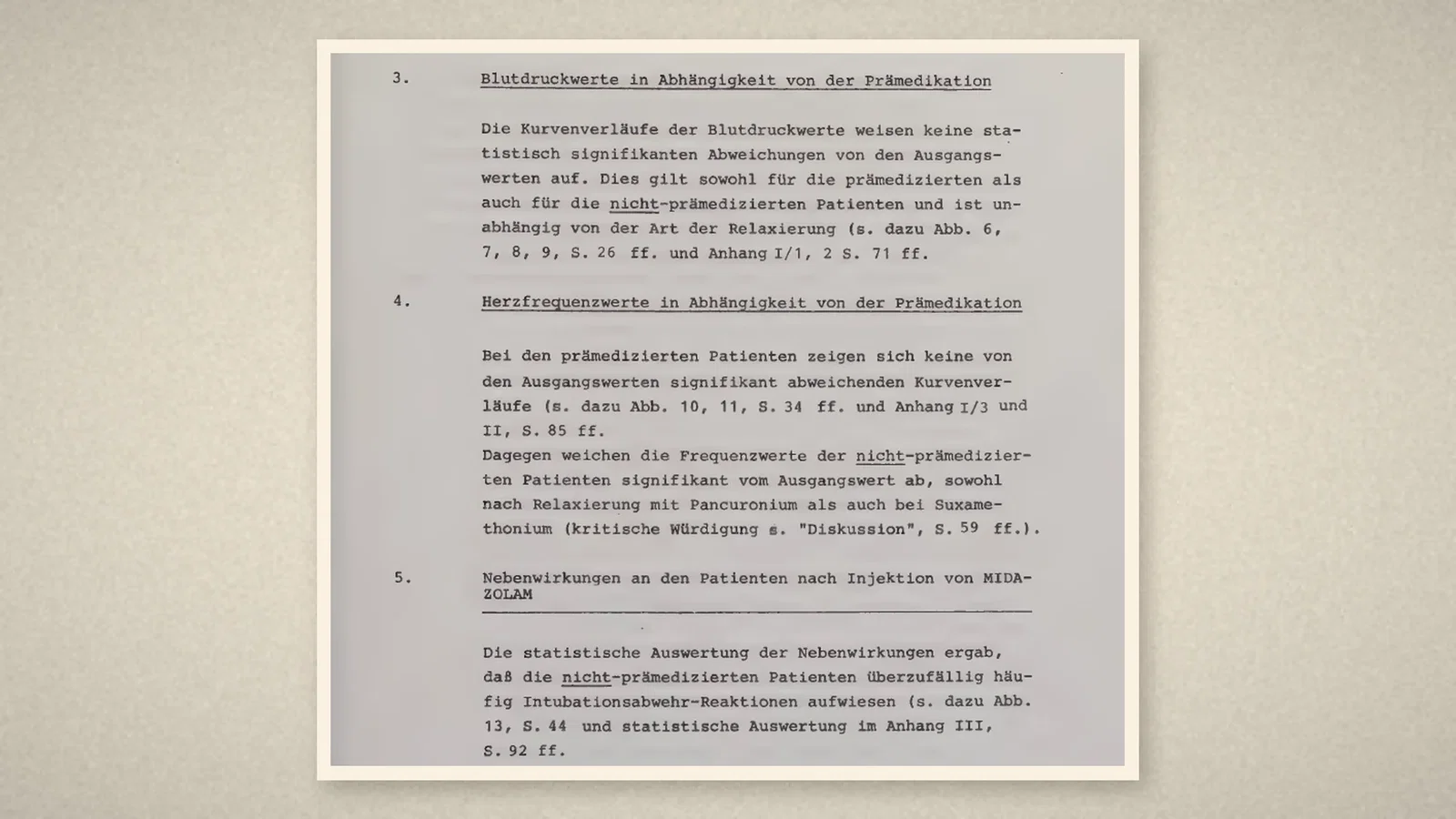
The summary gives the results. Blood pressure curves showed no statistically significant departure from baseline, with or without premedication. Patients who had no premedication showed significantly more defensive reactions to intubation. [2, p. 67] During surgery, 2 premedicated patients were awake and 7 moved; without premedication, 6 were awake and 6 moved. Even so, all said they had slept well during the anaesthetic. [2, p. 67]
What the record shows
The idea behind the drug is written into the patent in one clause: salts that dissolve in water can be injected without a harsh solvent. Eight years after the first application in the chain, a Munich study showed both sides of the drug in use. The circulation stayed steady, but premedication made a clear difference to how well the induction held.
Sources and reading limits
Read: US Patent 4,280,957. This covered the front page and related-application data, the opening of the description, the statement of uses and solubility (PDF p. 19) and the claims (PDF pp. 62-63). The examples were skimmed only for the compound's name. Also read: Hans Strobl's Munich thesis of 1982, including the title page, pp. 2-5, p. 19 and the summary (pp. 66-67); the rest was skimmed.
Not covered: Walser and colleagues' chemistry paper of 1978; the abandoned earlier applications; Roche's pharmacology; the early clinical papers of 1978 cited in later theses; and any approval record.
Limits: some timelines give 1976-1978, but the documents read here give an application chain from 11 September 1974 and a grant in 1981. The date of the third application is printed as 4 March 1978 and is reported as printed. The patent does not name midazolam; the identification rests on the matching formula labelled MIDAZOLAM (RO 21-3981) in Strobl's thesis. Strobl's study is uncontrolled, the dates of its anaesthetics are not given, and its numbers are as printed. Doses in the patent and the thesis are not repeated, and page crops stop before them. Patients are not identified. German quotations are translated for this article.
Three illustrations are crops of the patent's front page and of the thesis (pp. 2 and 67). One is a text diagram drawn from both, with no people drawn and no doses shown.
- Walser A, Fryer RI, inventors; Hoffmann-La Roche Inc., assignee. Imidazodiazepines and processes therefor. US patent 4,280,957. Filed 1978 May 15; granted 1981 Jul 28. Google Patents
- Strobl H. Midazolam zur Narkoseeinleitung: klinische Studie [dissertation]. München: Ludwig-Maximilians-Universität; 1982. Internet Archive
Continue exploring
Related reading connects shared questions and contexts; it does not by itself establish historical influence.
- 1972: Munich Alternates Etomidate and Propanidid for Induction
- 1961: Janssen Files the Patent That Contains Fentanyl
Anesthesia Epochs · The Source Room · About & Editorial Method
Published November 3, 2026. Sources and reading limits are stated above. Illustrations are labelled as original source images or AI-made. Historical accounts are educational; they are not current treatment instructions.