Günther Buchner's medical thesis at the University of Munich (supervised by A. Doenicke; degree awarded 23 December 1974) reports inductions of general anaesthesia given between 15 May and 31 October 1972, alternating day by day between propanidid (Epontol) and a new hypnotic, etomidate (R 16659): 106 and 99 anaesthetics. Etomidate had until then been tried only in rats and in 25 patients; the thesis says it was first given to humans in March 1972 under continuous ECG and EEG. After etomidate there was no initial fall in blood pressure and no generalised erythema, but 27.84% of patients felt burning or pain in the vein, which the author blamed on the citric acid solvent, and the maker later changed it; 25.52% made muscle movements, a sign that it alone gave too light an anaesthetic, with little analgesia. The thesis judged it equal to the hypnotics then in use for tolerance, depth and duration of sleep. The compound belongs to the imidazole carboxylates of US Patent 3,354,173, filed by Godefroi and van der Eijcken of Janssen Pharmaceutica on 16 April 1964 and described there as short-acting hypnotics.
Reading Library · Anesthesia Epochs · 中文版
Watch the education video (for clinicians)
1972: Etomidate — Hypnosis Is Not Analgesia · Anesthesia Epochs Education Series
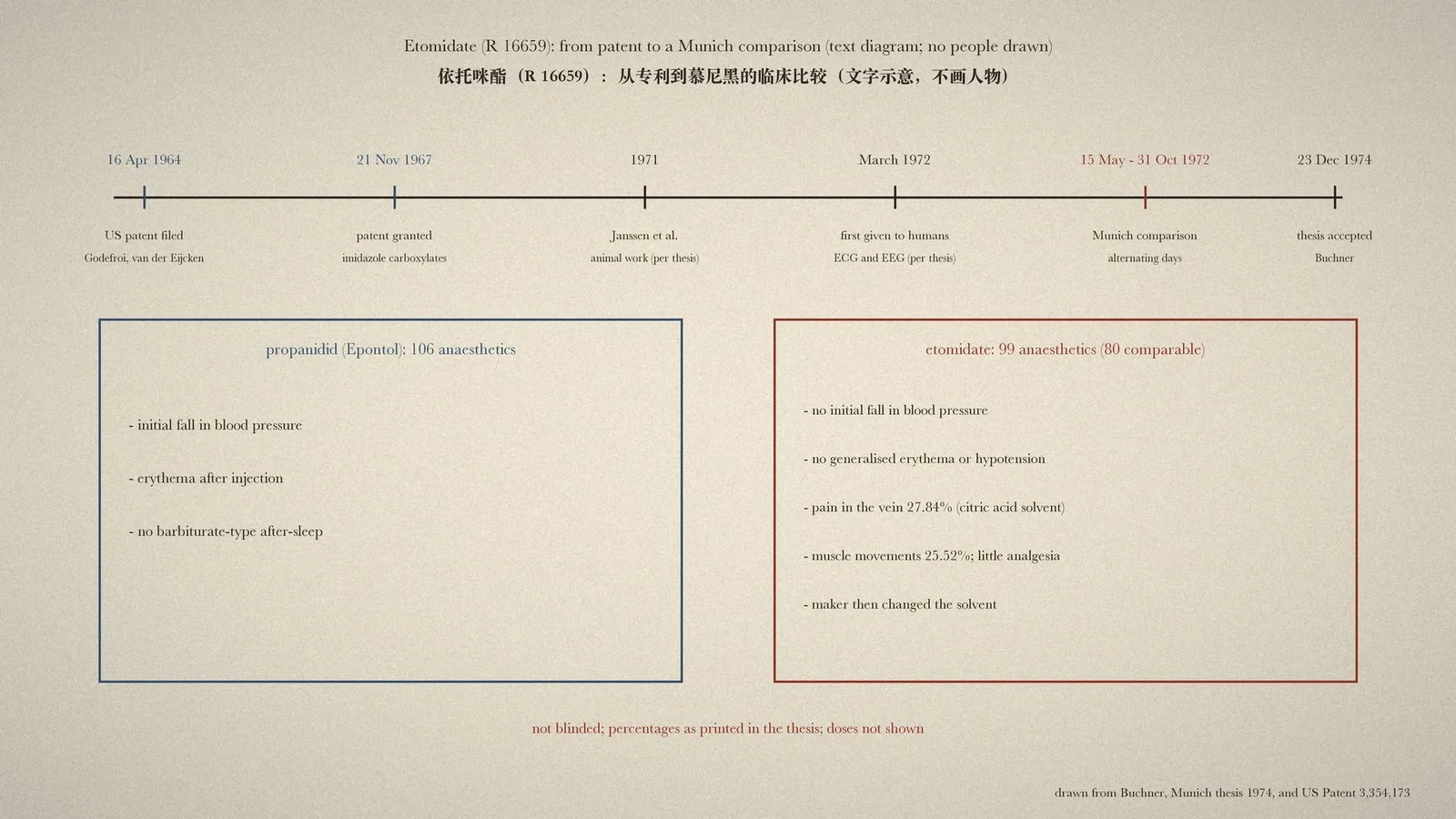
In 1972 a new intravenous hypnotic, still known by its code number R 16659, was tried on surgical patients in Munich. On any given day, every patient in the trial was induced with the same drug, and the drug changed the next day. The results became a doctoral thesis, which records what anaesthetists noticed in the drug's early months: the blood pressure stayed up, the vein hurt, and the limbs moved. [1, p. 2][1, p. 35]
The thesis
Günther Buchner's thesis, "Einleitung der Allgemeinanaesthesie mit Propanidid oder Etomidate", was accepted by the medical faculty of the Ludwig-Maximilians-Universität in Munich on 23 December 1974. The referee was A. Doenicke, head of anaesthesia at the surgical outpatient clinic. [1, title page]
Two short-acting agents were to be compared under clinical conditions. One was Epontol (propanidid), a non-barbiturate already in use. The other was etomidate, "a new, hypnotically acting substance". Before this clinical trial it had been tested in rats and in 25 unselected patients. The thesis reports 106 anaesthetics induced with propanidid and 99 with etomidate. [1, p. 1]
The design
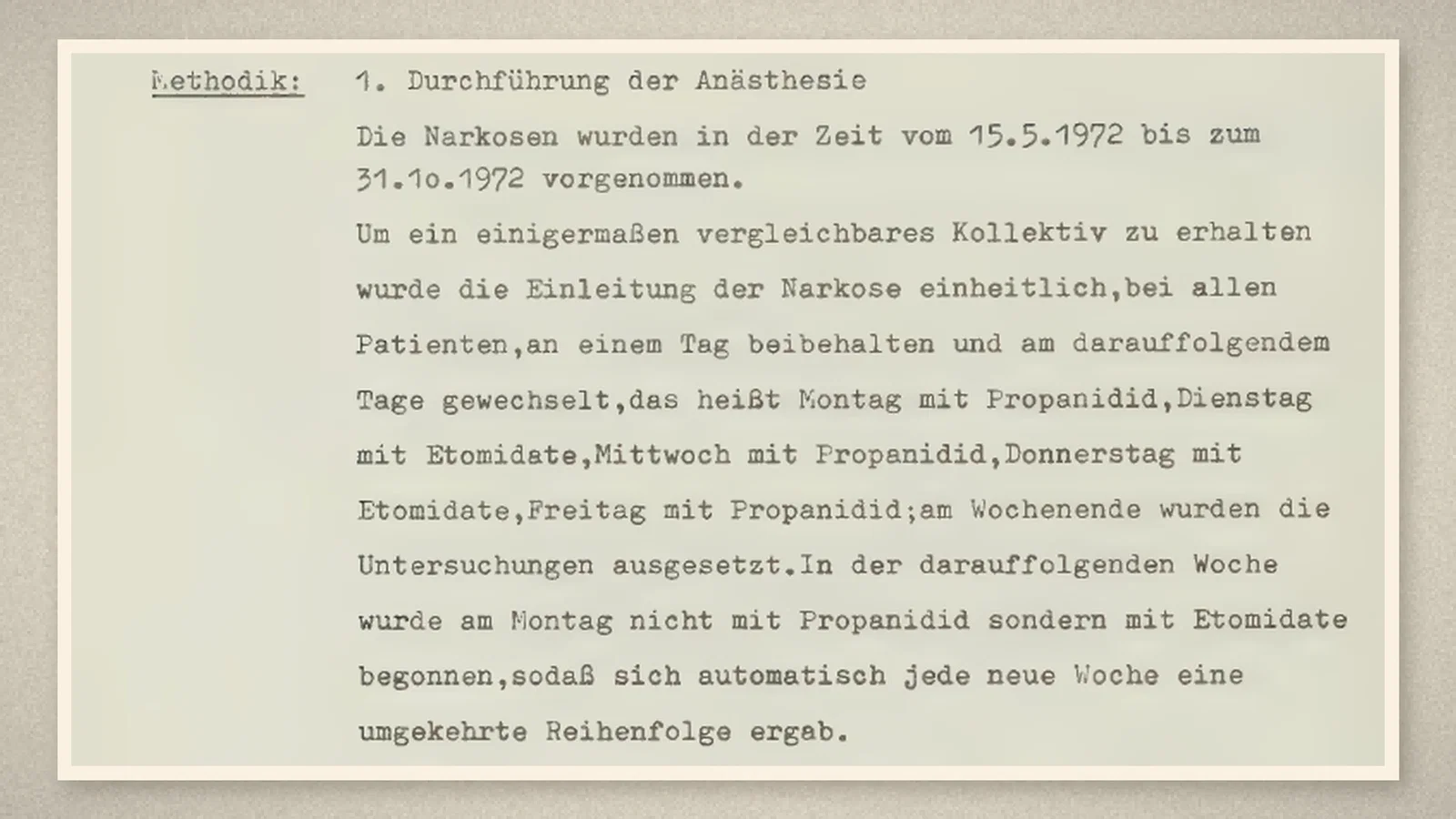
The anaesthetics were given between 15 May and 31 October 1972. To get roughly comparable groups, every patient on a given day was induced the same way, and the agent was switched the following day. Monday was propanidid, Tuesday etomidate, and so on, with no studies at weekends. The next week began with etomidate, so the order reversed every week. [1, p. 2]
Etomidate is described as R-(+)-ethyl-1-(alpha-methylbenzyl)imidazole-5-carboxylate, code R 16659, dissolved in citric acid. The thesis calls this study the first time etomidate underwent an intensive clinical trial. [1, p. 5] The observers recorded muscle movements ("defence, cramp or tremor"), hiccup, flushing, redness at the injection site and "pain during the injection". A day later they asked each patient whether falling asleep had been pleasant and whether the injection site still hurt. [1, p. 7]
Of the 99 etomidate anaesthetics, 80 fitted the comparable pattern of combined anaesthesia. Forty-three of these were injected over 10 seconds and 37 over 60 seconds. The other 19 were used in neuroleptanalgesia, as the sole agent, or with a mask. [1, p. 11]
What the observers saw
In the 10-second group, 27.84% of patients complained of burning in the vein or pain at the injection site. In 25.52%, muscle movements of various kinds appeared. The author read these movements as a sign that the anaesthetic was too light. [1, p. 16]
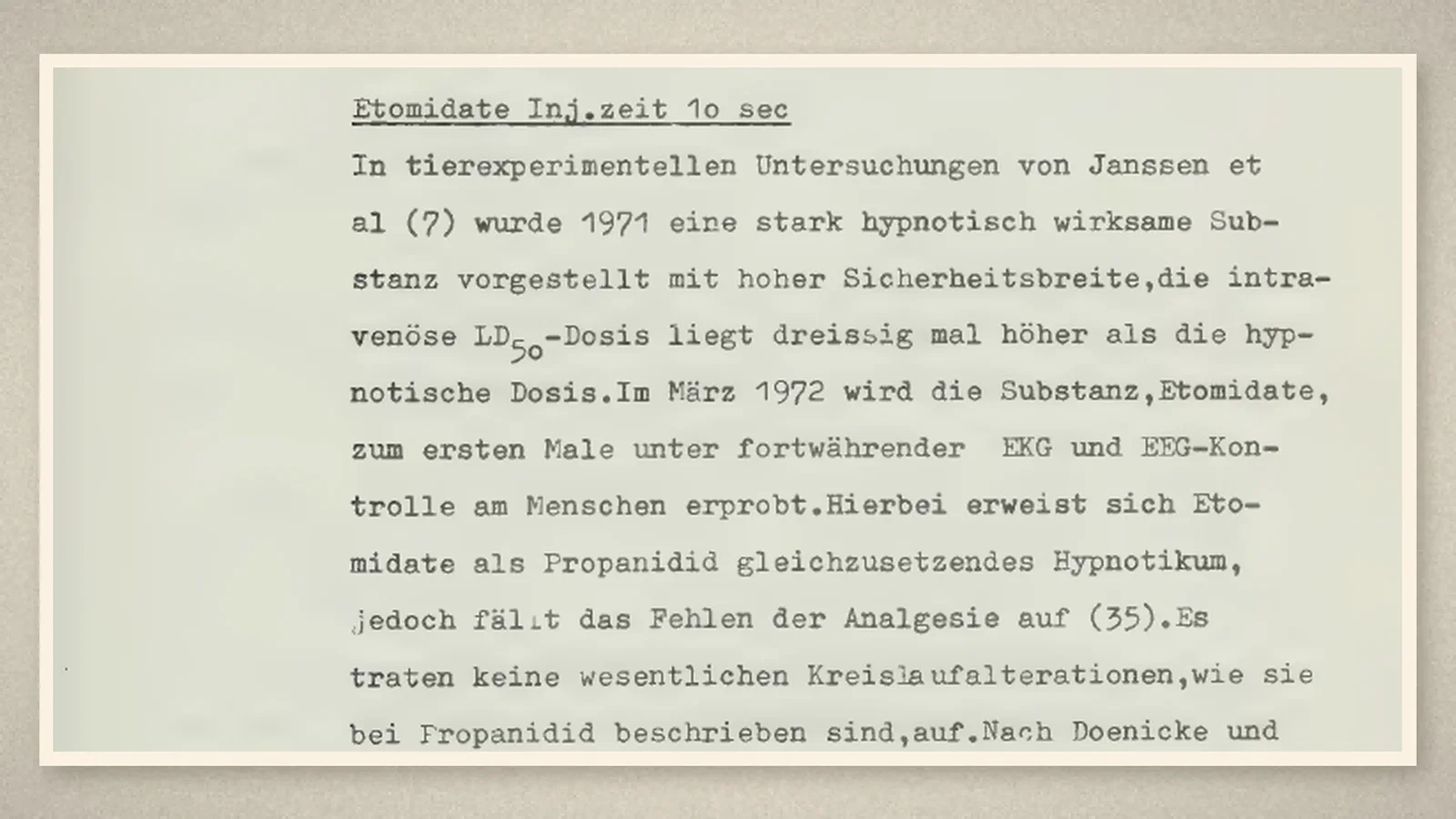
The discussion looks back. In animal studies, Janssen and colleagues had presented in 1971 a strongly hypnotic substance with a wide safety margin. "In March 1972", the thesis says, etomidate was tried in man "for the first time" under continuous ECG and EEG control. [1, p. 29]
The thesis also explains the side effects. The pain was attributed to the citric acid solvent, but no thrombophlebitis occurred. This experience led the manufacturer to use a non-irritant solvent. Erythema of the head, neck and chest appeared in 23.2% of patients. That seemed to contradict the finding that etomidate releases no histamine, and the author suggested suxamethonium as the more likely cause. The myoclonus showed that etomidate alone, without an analgesic, was too little for intubation. Doenicke and colleagues had been able to abolish it by doubling the dose or by giving diazepam beforehand. [1, p. 31]
The verdict
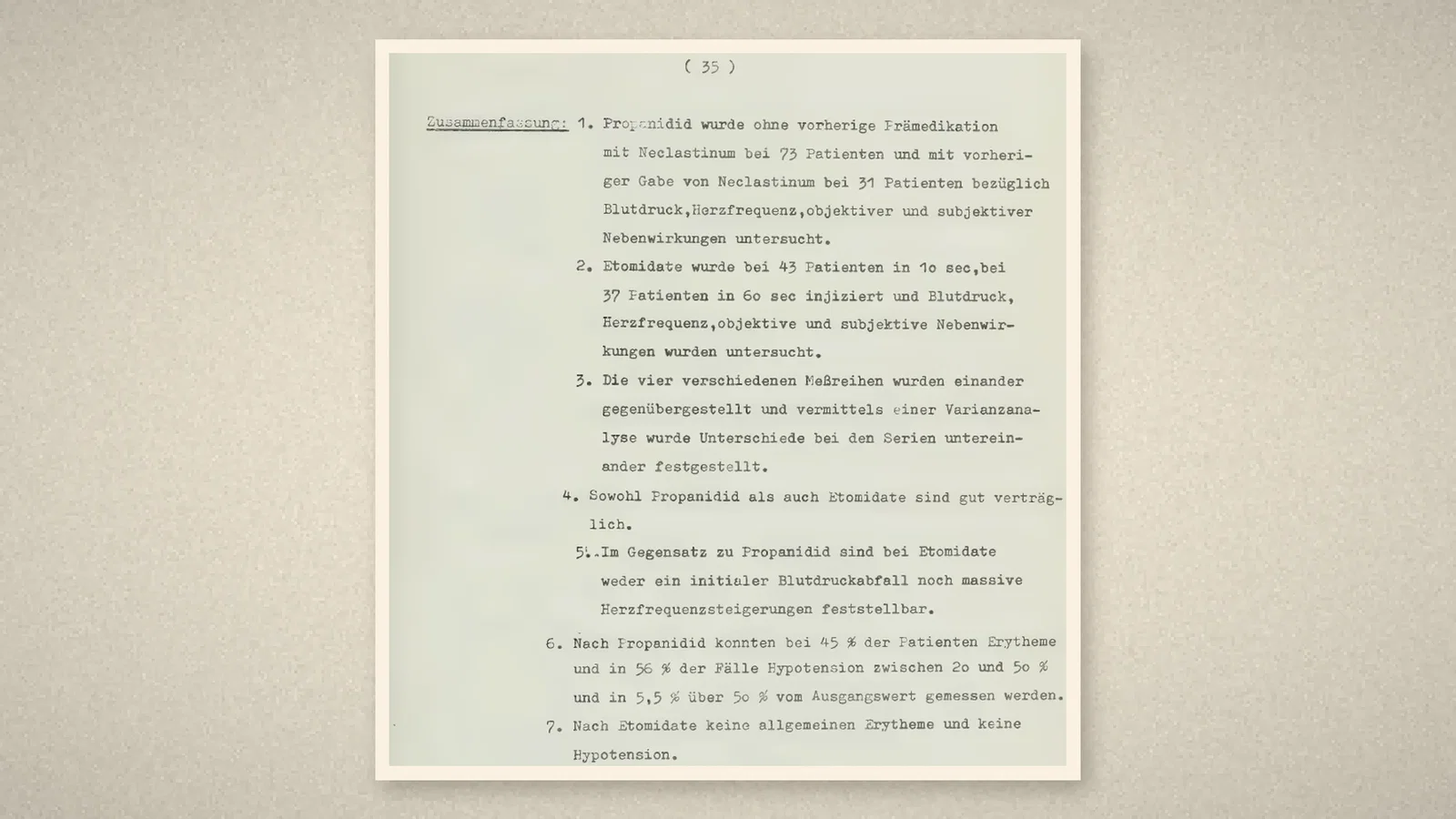
The summary sets the two drugs side by side. Unlike propanidid, etomidate caused "neither an initial fall in blood pressure nor massive rises in heart rate". After etomidate there was no generalised erythema and no hypotension. It had only slight analgesic action, which showed itself in anaesthesia that was too light. [1, p. 35] Etomidate, "a novel narcotic", could be put on a level with the hypnotics already in use for tolerance, depth of sleep and duration of action. [1, p. 36]
The patent behind it
The compound came from Janssen Pharmaceutica in Belgium. US Patent 3,354,173, "Imidazole carboxylates", names Erik Fred Godefroi and Cyriel Alphons Maria van der Eijcken as inventors. It was filed on 16 April 1964 and granted on 21 November 1967. [2, col. 1][2, front-page header] The patent describes the compounds as "short-acting hypnotics". In many animal species they abolish the righting reflex, while at the same dose level "respiration is virtually unaffected". [2, col. 1] Claim 5 is 1-(1-phenylethyl)-5-(ethoxycarbonyl)imidazole. The examples prepare it as the racemate, and etomidate, as the thesis names it, is the R-(+) isomer. [2, claims][1, p. 5]
What the record shows
An induction agent is judged first by what happens in the minute after the injection. In 1972 the Munich observers found a steadier circulation than with the drug it was compared against, together with a painful vein, moving limbs and almost no analgesia. One of those problems, the pain, was traced to the solvent and changed by the maker. The others were left for later work.
Sources and reading limits
Read: Günther Buchner, "Einleitung der Allgemeinanaesthesie mit Propanidid oder Etomidate", medical thesis, Ludwig-Maximilians-Universität München, 1974. The title page, introduction, methods, case numbers, etomidate results, discussion (pp. 29-31) and summary (pp. 35-36) were read closely and the rest skimmed. Also read: US Patent 3,354,173, front page, statement of properties and claims (Google Patents scan).
Not covered: Janssen and colleagues' animal papers of 1971; Doenicke's own clinical papers cited in the thesis; later reports, including those on adrenocortical suppression; and any record of licensing.
Limits: some timelines date this topic to 1972-1974. This article covers one Munich comparison, reported in a thesis two years later, and the patent. The study was not blinded, and the percentages are as printed. Statements about the first human use and the first intensive trial are the thesis's. The patent does not use the name etomidate. Doses, injection volumes and the patent's animal dose levels are not repeated, and page crops stop before them. Patients are not identified. German quotations are translated for this article.
Three illustrations are crops of the thesis (pp. 2, 29 and 35). One is a text diagram drawn from the thesis and the patent, with no people drawn and no doses shown.
- Buchner G. Einleitung der Allgemeinanaesthesie mit Propanidid oder Etomidate [dissertation]. München: Ludwig-Maximilians-Universität; 1974. Internet Archive
- Godefroi EF, van der Eijcken CAM, inventors; Janssen Pharmaceutica N.V., assignee. Imidazole carboxylates. US patent 3,354,173. Filed 1964 Apr 16; granted 1967 Nov 21. Google Patents
Continue exploring
Related reading connects shared questions and contexts; it does not by itself establish historical influence.
- 1960: The Cleveland Clinic Reports Methoxyflurane in 206 Patients
- 1961: Janssen Files the Patent That Contains Fentanyl
- 1951: Thesleff Brings Succinylcholine into the Operating Room
Anesthesia Epochs · The Source Room · About & Editorial Method
Published November 3, 2026. Sources and reading limits are stated above. Illustrations are labelled as original source images or AI-made. Historical accounts are educational; they are not current treatment instructions.