US Patent 3,164,600, '1-Aralkyl-4-(N-aryl-carbonyl amino)-piperidines and related compounds', was filed on 10 October 1961 by Paul A. J. Janssen of Vosselaar, Belgium, assigned to Research Laboratorium Dr. C. Janssen of Beerse, and granted on 5 January 1965. It covered a broad family of N-aralkyl-4-piperidyl-N-arylalkanamides, described as potent analgesics and appetite inhibitors, also mydriatic and cholinergic. Its Example 17 reacted beta-phenylethyl chloride with N-(4-piperidyl)propionanilide to give N-[1-(beta-phenylethyl)-4-piperidyl]propionanilide, which claim 3 names on its own. The patent never uses the word fentanyl and gives no pharmacological data. Two Paris medical theses of 1972 and 1973 identify R 4263, fentanyl, as the citrate of this compound, say Janssen synthesised it (preliminary report 1962), and report that De Castro and Mundeleer presented its clinical use at the first European Congress of Anaesthesiology in Vienna in 1962.
Reading Library · Anesthesia Epochs · 中文版
Watch the education video (for clinicians)
1961: Fentanyl — What a Patent Can Establish · Anesthesia Epochs Education Series
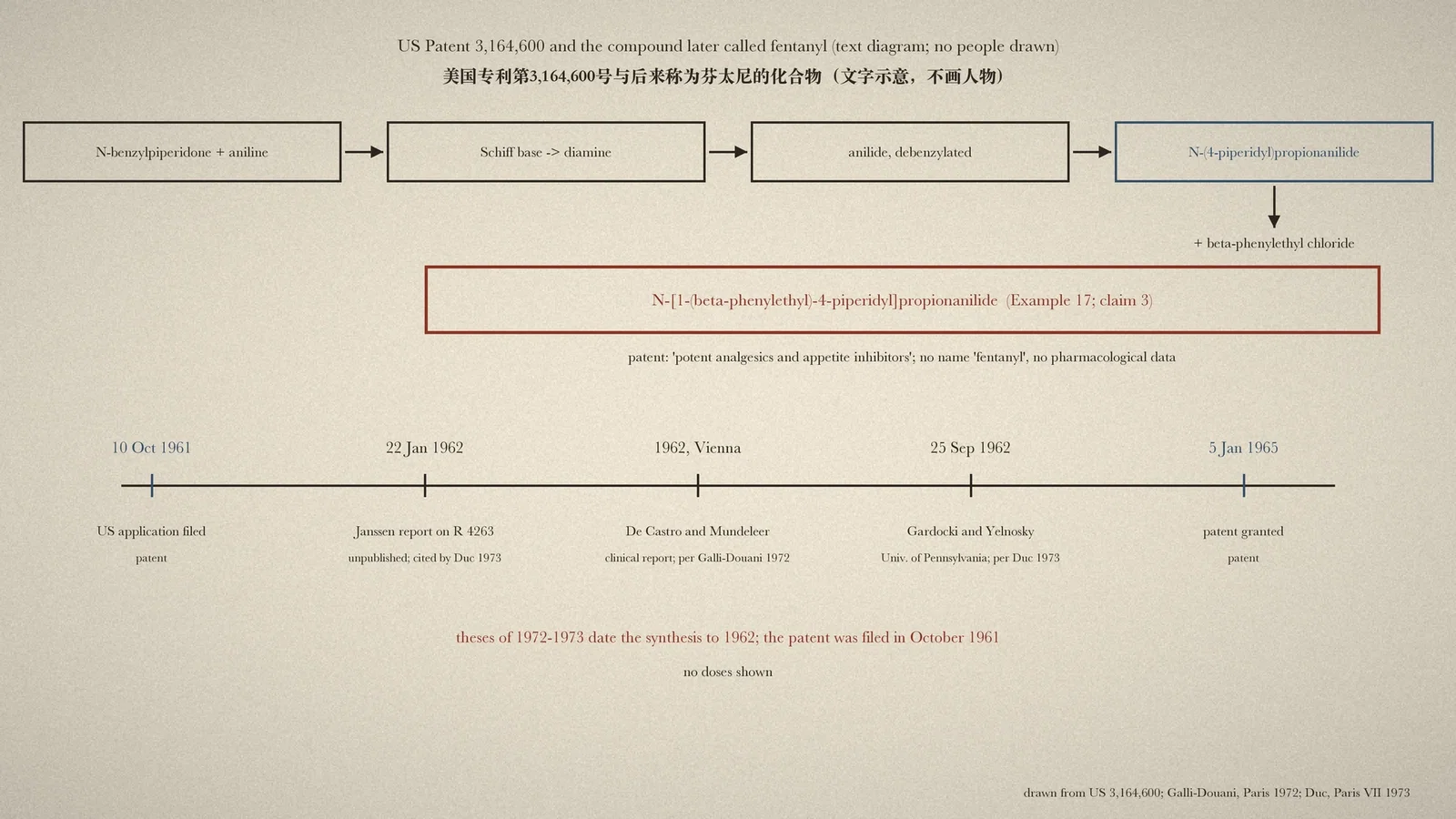
The earliest document read for this article is a chemical patent, and in it fentanyl is not yet a drug but one line. The application, filed in the United States on 10 October 1961, never uses the word fentanyl and gives no pharmacological figures. It describes a large family of piperidine compounds as "potent analgesics", and in one example it makes the compound that anaesthetists would later know by that name. [1, col. 1][1, col. 7]
The patent
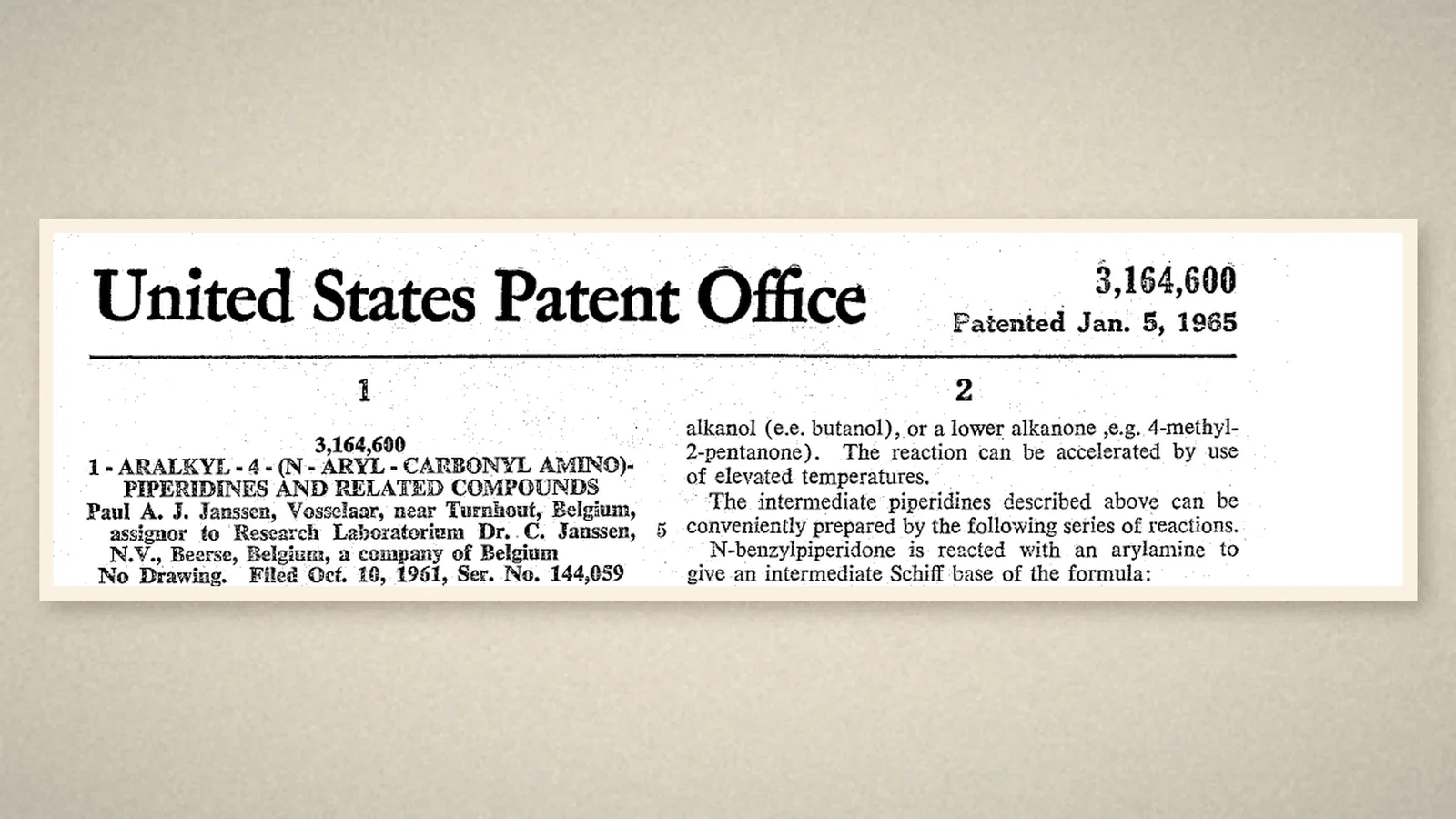
US Patent 3,164,600, "1-Aralkyl-4-(N-aryl-carbonyl amino)-piperidines and related compounds", names as inventor Paul A. J. Janssen of Vosselaar, near Turnhout, Belgium, assignor to Research Laboratorium Dr. C. Janssen N.V. of Beerse. It was filed on 10 October 1961 with 16 claims, and it was granted on 5 January 1965. [1, col. 1][1, col. 2]
The invention, the patent says, "relates to a novel group of N-aralkyl-4-piperidyl-N-arylalkanamides". The general formula leaves room for many variations. The aryl group may be phenyl, a halophenyl, methoxyphenyl, pyridyl, furyl or thienyl, among others, and the acyl group may be one of several short chains. The compounds are "useful because of their valuable pharmacological properties. In particular, they are potent analgesics and appetite inhibitors". They are also "mydriatic and cholinergic in their action". That sentence is the whole of the pharmacology. No animal, no measurement and no comparison with morphine appears anywhere in the patent. [1, col. 1]
The route and Example 17
The patent sets out a route in several steps. N-benzylpiperidone and an arylamine form a Schiff base, which is reduced with lithium aluminium hydride. The resulting amine is acylated with an anhydride, and the benzyl group is then removed by hydrogenation over palladium on charcoal. This leaves an N-(4-piperidyl) amide, which is finally joined to an aralkyl halide. [1, col. 2]
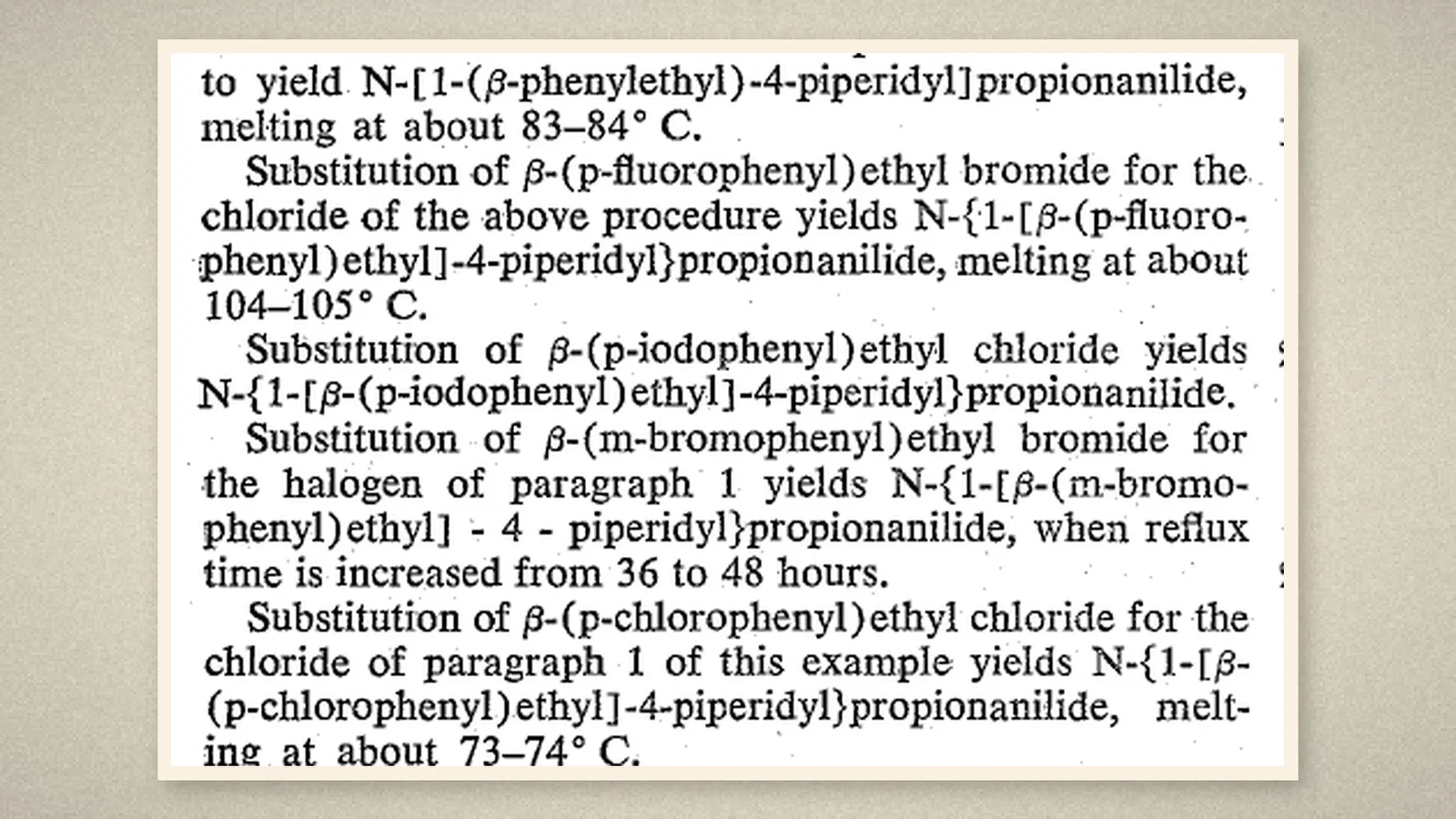
Example 17 does this with N-(4-piperidyl)propionanilide and beta-phenylethyl chloride, "to yield N-[1-(beta-phenylethyl)-4-piperidyl]propionanilide". The same example then swaps in other halides to give fluoro-, iodo-, bromo- and chlorophenyl versions, a methoxyphenyl version and a 2-thienyl version. Claim 3 names N-[1-(beta-phenylethyl)-4-piperidyl]propionanilide on its own. Claim 10 names a thienylethyl analogue, and claim 12 a furylethyl one. [1, col. 7][1, col. 10]
The patent cites earlier US patents by Elpern and by Cutler and colleagues, and two of Janssen's own from 1961. A certificate of correction, signed on 14 September 1965, fixed several printing errors. [1, col. 12][1, cert. of correction]
Putting a name to the compound
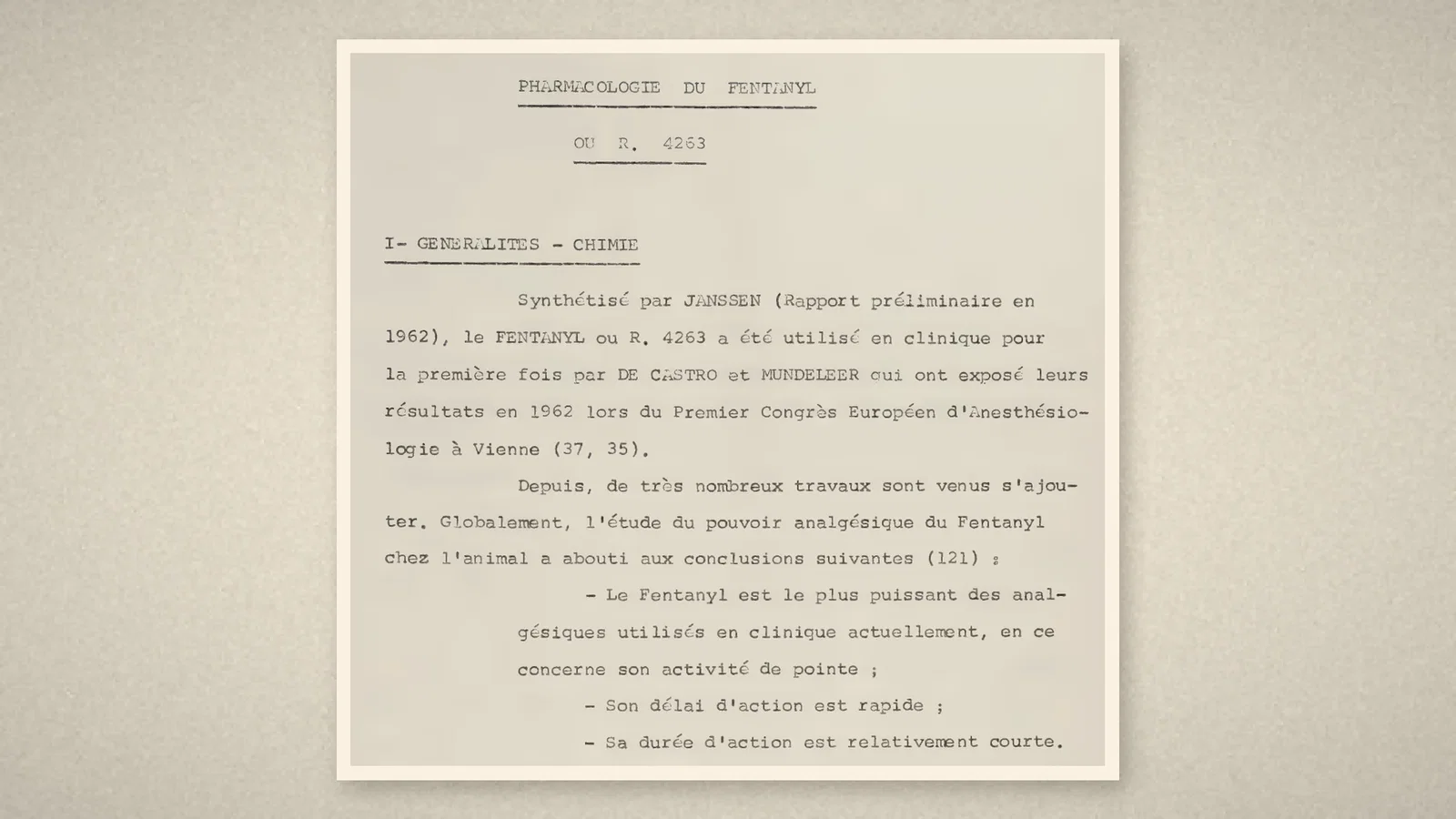
The patent does not tie its Example 17 to a drug name. Two Paris medical theses do. Pierrette Galli-Douani's thesis, from the Faculty of Medicine of Paris in 1972, states that R 4263 "is the citrate" of N-(1-phenethyl-4-piperidyl)propionanilide. That is the Example 17 compound as a salt. [2, p. 6]
The thesis gives a brief history. Fentanyl, or R 4263, was "synthesised by Janssen (preliminary report in 1962)". It was used in the clinic "pour la première fois" by De Castro and Mundeleer, who presented their results in 1962 at the first European Congress of Anaesthesiology in Vienna. Animal work had concluded that it was the most potent analgesic then in clinical use in its peak effect, that its onset was rapid, and that its action was relatively short. [2, p. 5]
Brigitte Duc's thesis, from Paris VII in 1973, describes fentanyl as phenethyl propionyl anilino piperidine, a synthetic morphine-like drug that produces habituation and dependence. It also states that the synthesis was carried out "pour la première fois par Janssen en 1962". [3, p. 19][3, p. 20] Its bibliography lists an unpublished report from Beerse, "Pharmacology du R4263 (fentanyl)", dated 22 January 1962, which described a potent short-acting analgesic for intravenous use in anaesthesiology. It also lists a paper by Gardocki and Yelnosky on the pharmacology of fentanyl citrate, given at a conference on fentanyl and droperidol at the University of Pennsylvania on 25 September 1962. [3, p. 39][3, bibliography]
Two dates
The theses put the synthesis in 1962. The patent containing the compound was filed in October 1961. Some timelines date this topic to about 1959-1960, and none of the three sources supports those years. What the documents do allow is a sequence. The compound was described in a patent application in October 1961, before any clinical report. Janssen's report on it is dated January 1962, and clinical reports from Belgium and a conference in the United States followed in the same year.
What the record shows
In the earliest document read here, a drug that became central to anaesthesia is a legal text, with no data and no name. One sentence calls the whole family "potent analgesics", and one example makes the compound. Its name, its code and its clinical history come from other documents, written a decade later.
Sources and reading limits
Read: US Patent 3,164,600 in full (front matter and uses, col. 1; synthesis route, col. 2; Example 17, col. 7; claims 1-16, cols. 10-12; references cited; certificate of correction). The remaining examples were skimmed. Also read: Pierrette Galli-Douani, Paris thesis 1972, title page and pp. 5-6; and Brigitte Duc, Paris VII thesis 1973, title page, pp. 19-20 and the bibliography entries for Janssen and for Gardocki and Yelnosky.
Not covered: Janssen's review in the British Journal of Anaesthesia 1962, which is in the publisher's open archive but could not be obtained here. Also not covered: Janssen's unpublished report of 22 January 1962; Janssen, Niemegeers and Dony in Arzneimittelforschung 1963; De Castro and Mundeleer's Vienna report; Gardocki and Yelnosky's published paper; Holderness, Chase and Dripps in Anesthesiology 1963; and the Belgian and British applications in the same patent family.
Limits: no source read here says when the compound was first made in the laboratory. October 1961 is the patent's filing date, and 1962 is the theses' date. The link between Example 17 and fentanyl rests on the chemical name in the 1972 thesis. The theses are secondary for this history, and their "first" statements are theirs. Reagent amounts in the patent and doses in the theses are not repeated, and the page crops stop before them. No patients are involved. French quotations are translated for this article.
Three illustrations are crops of the patent (front page and column 7) and of the 1972 thesis (p. 5). One is a text diagram drawn from the three sources, with no people drawn and no doses shown.
- Janssen PAJ, inventor; Research Laboratorium Dr. C. Janssen N.V., assignee. 1-Aralkyl-4-(N-aryl-carbonyl amino)-piperidines and related compounds. US patent 3,164,600. Filed 1961 Oct 10; granted 1965 Jan 5. Google Patents
- Galli-Douani P. Contribution à l'étude de l'emploi du fentanyl à fortes doses en neuro-chirurgie [thesis]. Paris: Faculté de Médecine de Paris; 1972. Internet Archive
- Duc B. Pharmacologie du fentanyl (présentation audio-visuelle) [thesis]. Paris: Université Paris VII; 1973. Internet Archive
Continue exploring
Related reading connects shared questions and contexts; it does not by itself establish historical influence.
- 1916: Freund and Speyer Make Oxycodone from Thebaine
- 1974: Sufentanil's Developers Consider the Length of Surgery
- 1996: Remifentanil Brings Rapid Offset to Analgesia
Anesthesia Epochs · The Source Room · About & Editorial Method
Published November 3, 2026. Sources and reading limits are stated above. Illustrations are labelled as original source images or AI-made. Historical accounts are educational; they are not current treatment instructions.