
In the Journal für praktische Chemie, vol. 94 (1916), Martin Freund and Edmund Speyer of the chemical laboratory of the University of Frankfurt described turning the opium alkaloid thebaine into 'oxycodeinone' and, by reduction, into a base 'named Dihydrooxycodeinon', the compound now called oxycodone; the paper is pure chemistry. In the Münchener Medizinische Wochenschrift of 20 March 1917 they announced its hydrochloride under the trademark 'Eukodal', and Edmund Falk reported its first clinical use: pharmacology by Heinz at Erlangen, animal tests, a self-trial, then about 2000 injections in more than 300 patients for pain, including after operations, with no habituation seen over seven months. Given before ether it brought smooth narcoses without excitement and with less ether; with chloroform, larger doses depressed breathing, and in labour it weakened contractions.
Reading Library · Anesthesia Epochs · 中文版
Watch the education video (for clinicians)
1916–1917: Eukodal — Less Ether, but What About Breathing? · Anesthesia Epochs Education Series
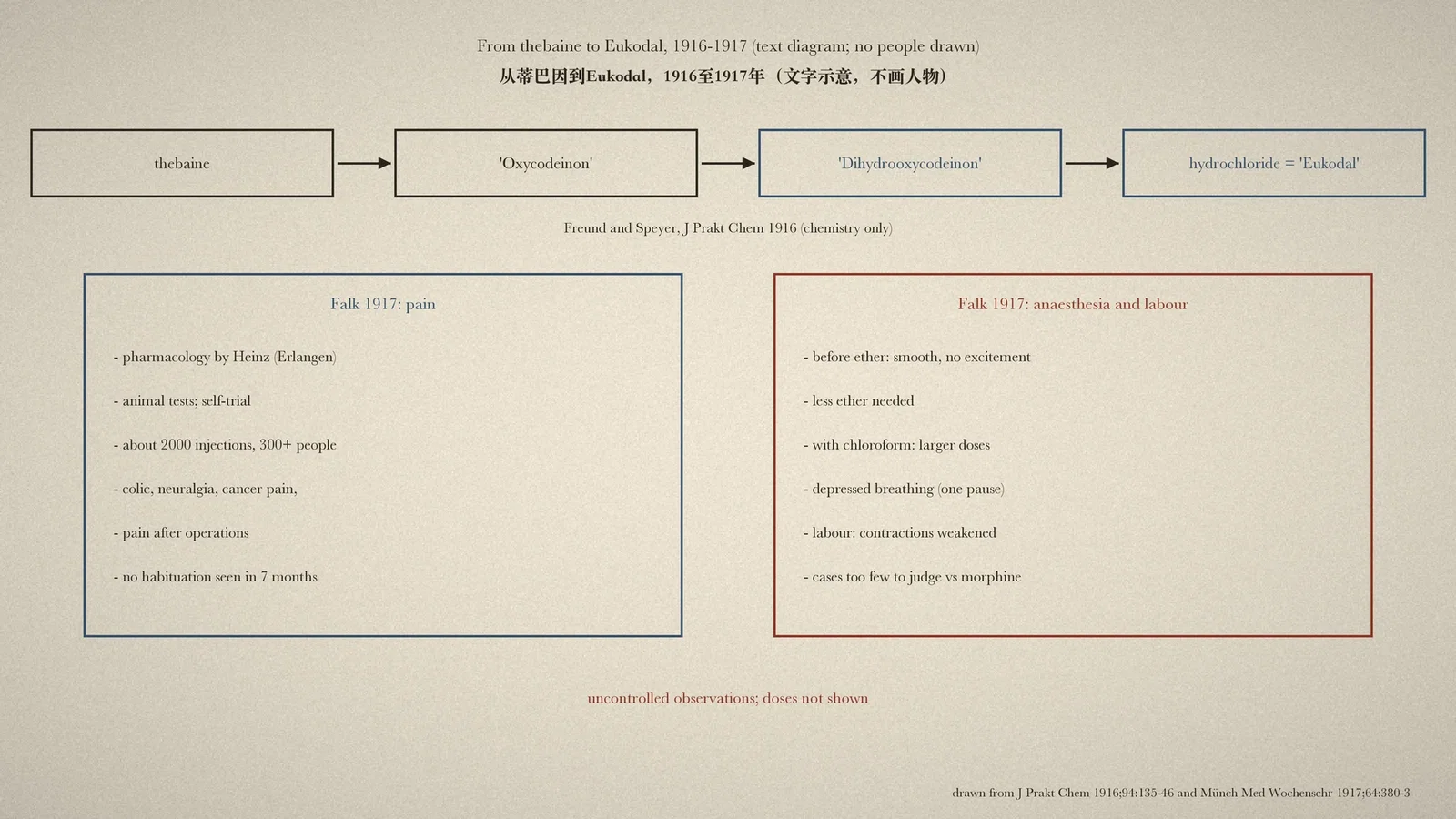
Oxycodone began as a line in a chemistry paper written during the First World War, and by early 1917 it was in clinical use under a trade name. Its first clinical report already used it before ether anaesthesia, and already noted what it did to breathing. [1, p. 146][2, p. 381][2, p. 382]
The chemistry
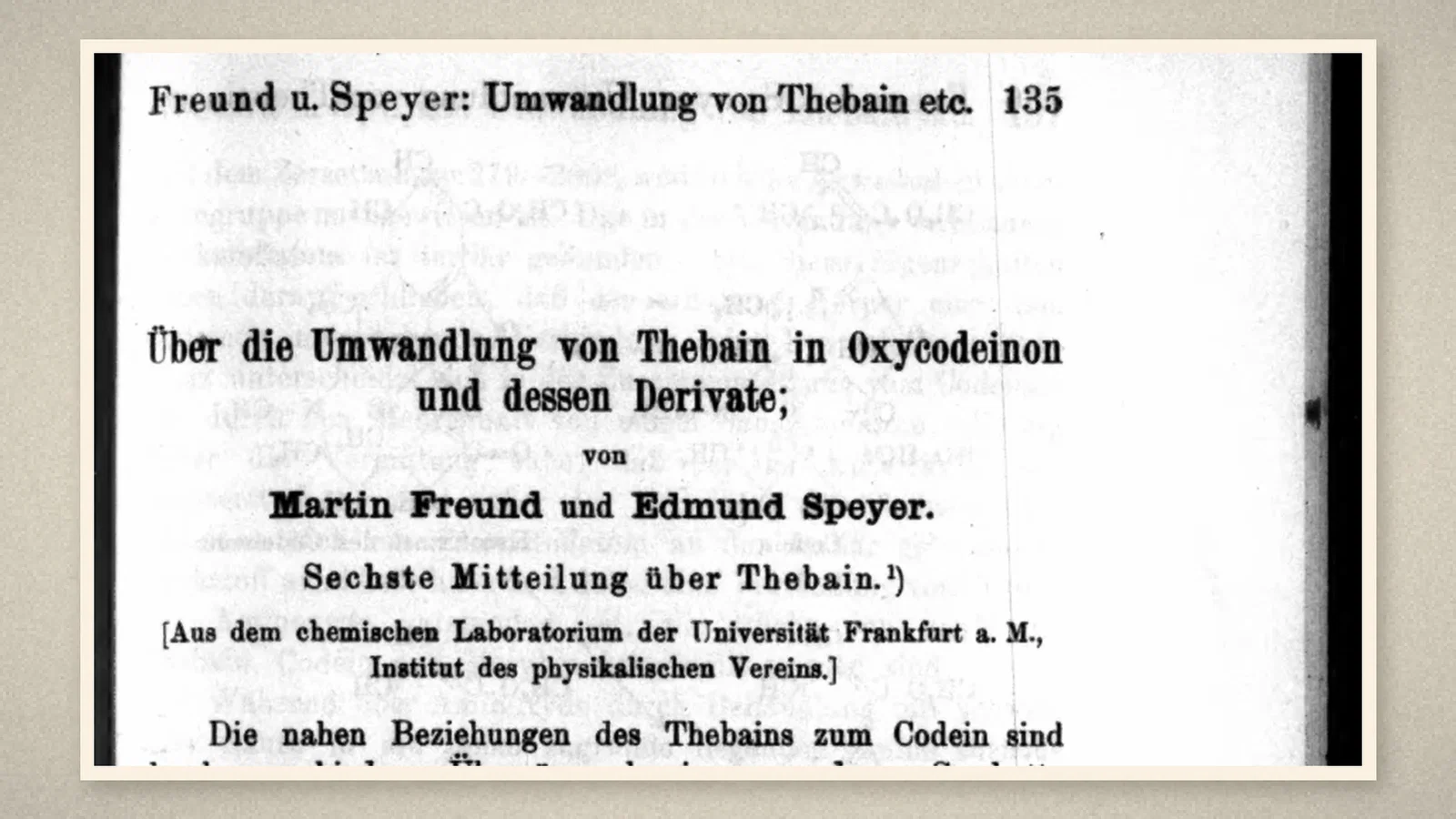
In the Journal für praktische Chemie, vol. 94 (1916), Martin Freund and Edmund Speyer of the chemical laboratory of the University of Frankfurt published their sixth report on thebaine, an alkaloid of opium: "Über die Umwandlung von Thebain in Oxycodeinon und dessen Derivate". [1, p. 135]
Treating thebaine with hydrogen peroxide, or with dichromate in acid, gave a new compound with a ketone group, "closely related to codeinone"; they proposed to call it "Hydroxycodeinon, or for short Oxycodeinon". Reduced with hydrogen over platinum or palladium, it gave a base that "was named Dihydrooxycodeinon". That is the compound known today as oxycodone. The rest of the paper is structures and analyses. It says nothing about effects in animals or people. [1, p. 137][1, p. 146]
A trade name
In the Münchener Medizinische Wochenschrift of 20 March 1917, Freund and Speyer added a short note: the hydrochloride of dihydrooxycodeinone was protected under the name "Eukodal", and its therapeutic use was reported in the article that followed. [2, p. 380]
Falk's report
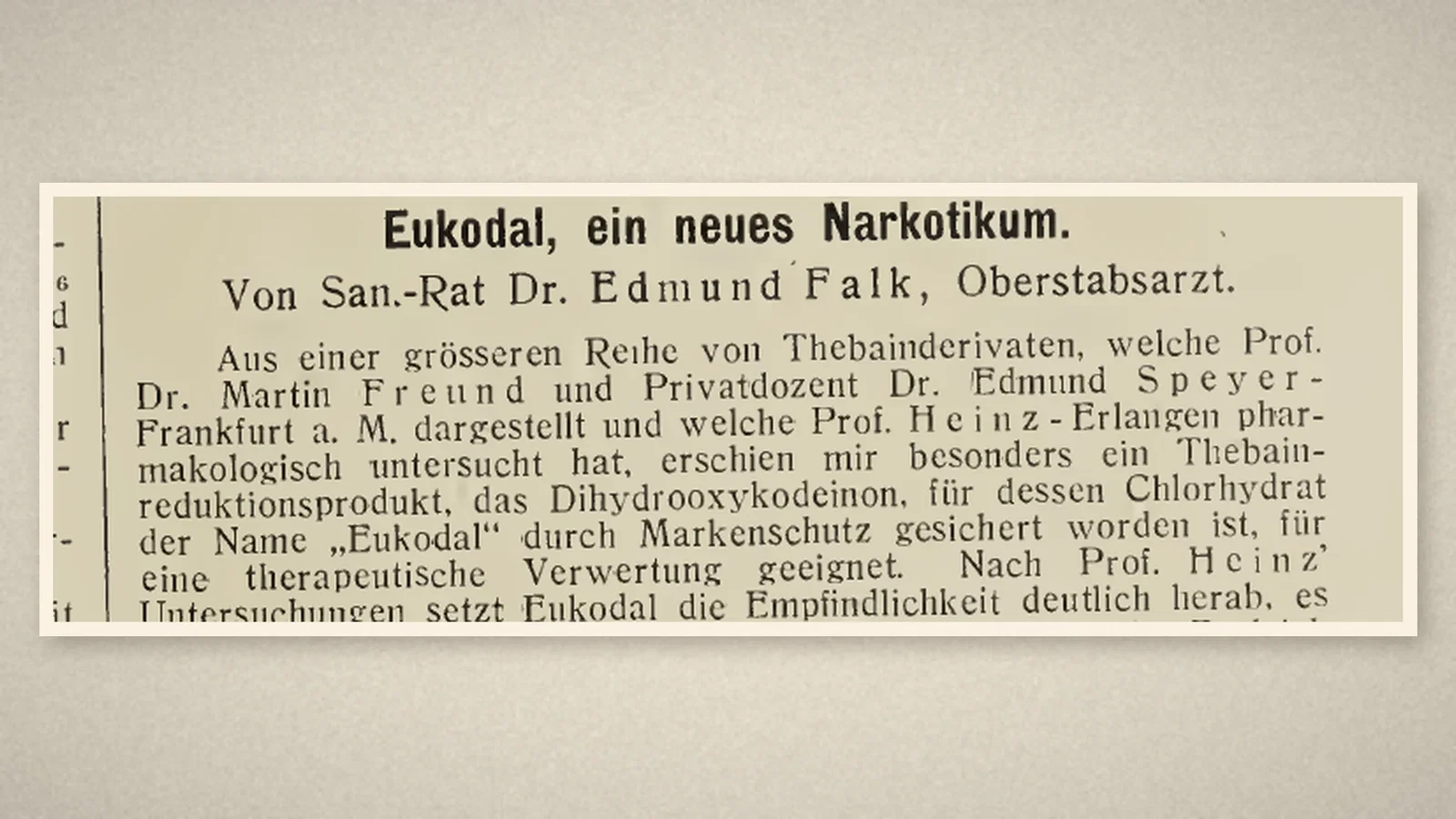
The article was "Eukodal, ein neues Narkotikum" by Edmund Falk, a senior army surgeon. Of the thebaine derivatives made by Freund and Speyer and tested pharmacologically by Professor Heinz at Erlangen, Falk wrote, dihydrooxycodeinone seemed best for therapeutic use. In Heinz's tests it clearly lowered sensibility and "does not provoke cramps, but rather stupefies", while slowing breathing. [2, p. 381]
Falk tested it on animals, finding no harm to the heart, and then on Falk's own body: heaviness in the limbs, tiredness, narrowed pupils and no unpleasant after-effects. Falk noted being very sensitive to morphine, having once collapsed after a morphine injection. Over the next seven months Falk gave about two thousand single injections to more than 300 people. Pain relief came quickly, in colic, neuralgia, cancer pain and pain after operations, and "habituation to the drug did not occur in the 7 months". [2, p. 381][2, p. 382]
Before the anaesthetic
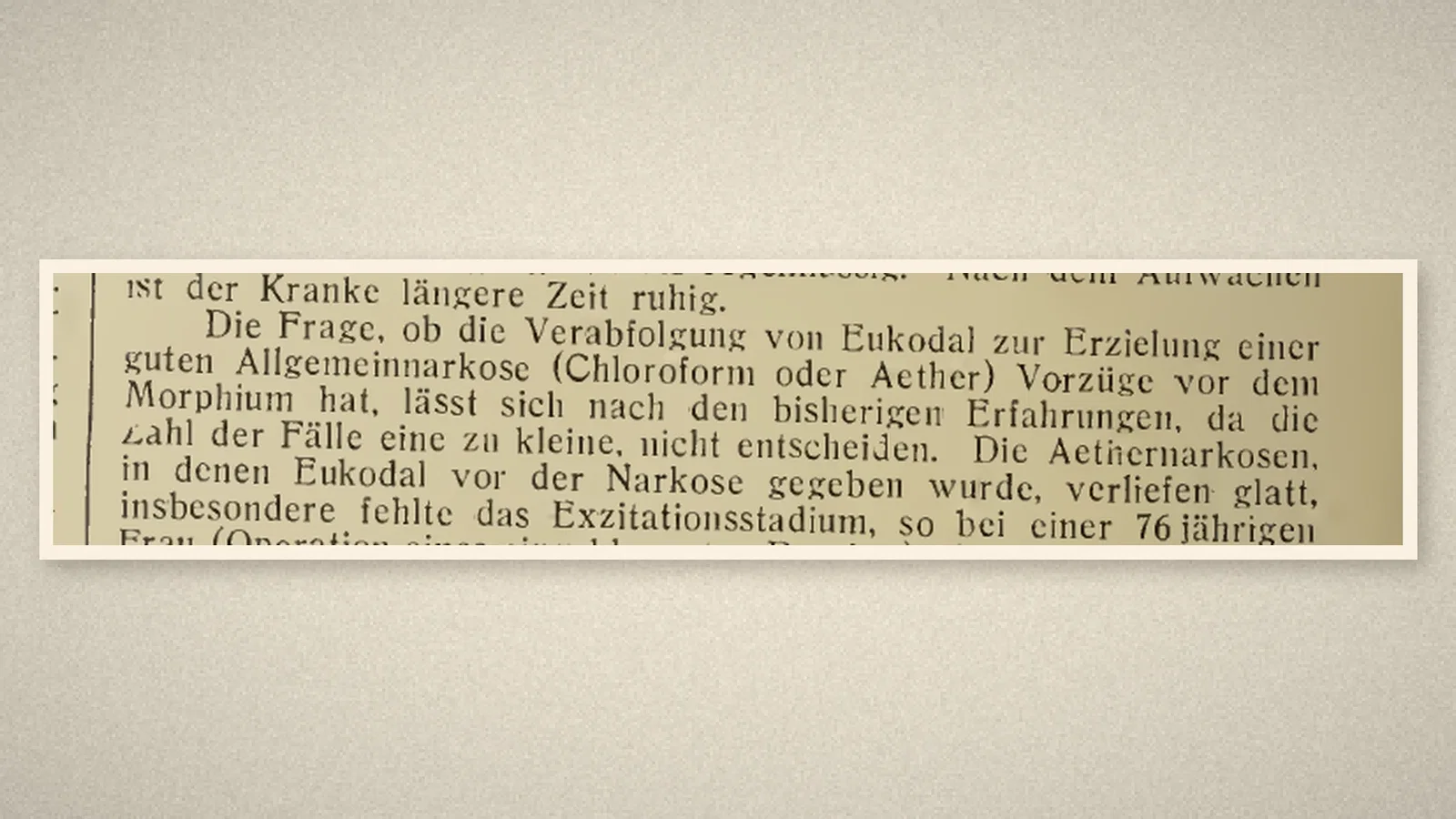
Then Falk turned to anaesthesia. Whether Eukodal before general anaesthesia, with chloroform or ether, had advantages over morphine could not yet be decided, "the number of cases being too small". But "the ether narcoses in which Eukodal was given before the narcosis went smoothly, in particular the stage of excitement was absent", and less ether was needed; a child needed only a little ether for a good narcosis. [2, p. 382]
There was a warning too. "Alongside a series of very good narcoses", with chloroform larger doses of Eukodal affected breathing, and in one uterine operation breathing stopped while the pulse stayed good. In labour, Eukodal almost abolished the pain of contractions but clearly weakened them and could favour bleeding afterwards, so Falk would use it in obstetrics only for persistent spasmodic contractions. [2, p. 382]
What the record shows
A new opioid as its first clinical user saw it. Within months of the chemistry, Eukodal was being given for pain, before ether and in labour. The same report already showed both sides: it smoothed the induction and saved anaesthetic, but it could also stop the breathing. What later became of it is not in these pages.
Sources and reading limits
Read: Martin Freund and Edmund Speyer, "Über die Umwandlung von Thebain in Oxycodeinon und dessen Derivate", Journal für praktische Chemie 1916;94: the opening (pp. 135-138) and the naming of dihydrooxycodeinone (p. 146), the rest skimmed; Freund and Speyer's note on the hydrochloride, Münchener Medizinische Wochenschrift 20 March 1917, pp. 380-381; Edmund Falk, "Eukodal, ein neues Narkotikum", same issue, pp. 381-383 read closely, p. 384 skimmed.
Not covered: the patent; Heinz's own pharmacological report; later papers on Eukodal habituation and addiction; methadone and the later opioids, which belong to other articles.
Limits: the wider story runs from 1916 to 1998; this article covers only the synthesis and first clinical report of oxycodone. Falk's observations are uncontrolled, and the absence of habituation over seven months is Falk's statement. Patients are not identified. Doses and amounts of ether are not repeated, and the page crops stop before the dose figures. Heinz's first name was not read. German quotations are translated for this article.
Three illustrations are crops of the Journal für praktische Chemie 1916 (p. 135) and the Münchener Medizinische Wochenschrift of 20 March 1917 (pp. 381 and 382); one is a text diagram drawn from them, with no people drawn and no doses shown.
- Freund M, Speyer E. Über die Umwandlung von Thebain in Oxycodeinon und dessen Derivate. J Prakt Chem. 1916;94:135-78. Internet Archive
- Freund M, Speyer E. Ueber Dihydrooxykodeinonchlorhydrat; Falk E. Eukodal, ein neues Narkotikum. Münch Med Wochenschr. 1917;64(12):380-4. Internet Archive
Continue exploring
Related reading connects shared questions and contexts; it does not by itself establish historical influence.
- 1914: The Harrison Act Brings Opium and Coca Under Control
- 1898: Dreser Presents Heroin as a Respiratory Sedative
- 1817: Sertürner Publishes 'Ueber das Morphium'
Anesthesia Epochs · The Source Room · About & Editorial Method
Published November 3, 2026. Sources and reading limits are stated above. Illustrations are labelled as original source images or AI-made. Historical accounts are educational; they are not current treatment instructions.