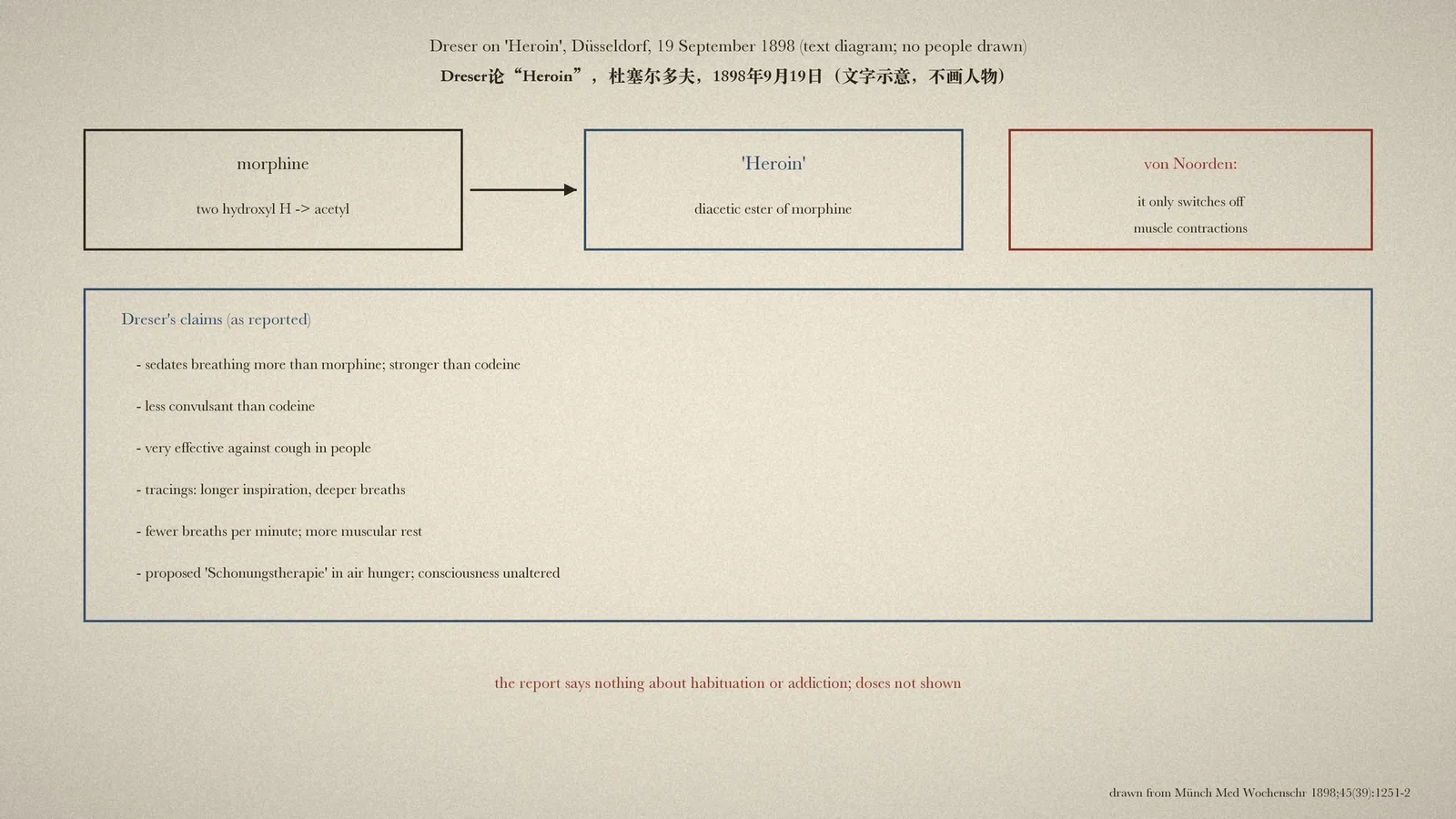
On 19 September 1898, at the Düsseldorf congress of German naturalists and physicians, Dreser of Elberfeld presented Heroin, the diacetyl ester of morphine, as a respiratory sedative that stilled cough and deepened each breath, and von Noorden objected that it merely switched off muscle contractions.
Reading Library · Anesthesia Epochs · 中文版
Watch the education video (for clinicians)
1898: Dreser Presents Heroin — A Respiratory Sedative? · Anesthesia Epochs Education Series
In an afternoon session at a large scientific congress, a speaker from Elberfeld described a new morphine compound with a short, memorable name. It calmed breathing, stopped coughs, and, the speaker claimed, made each breath deeper and better. One listener objected at once. Nobody in the report mentions what the drug would later be known for. [1, p. 1252]
The meeting
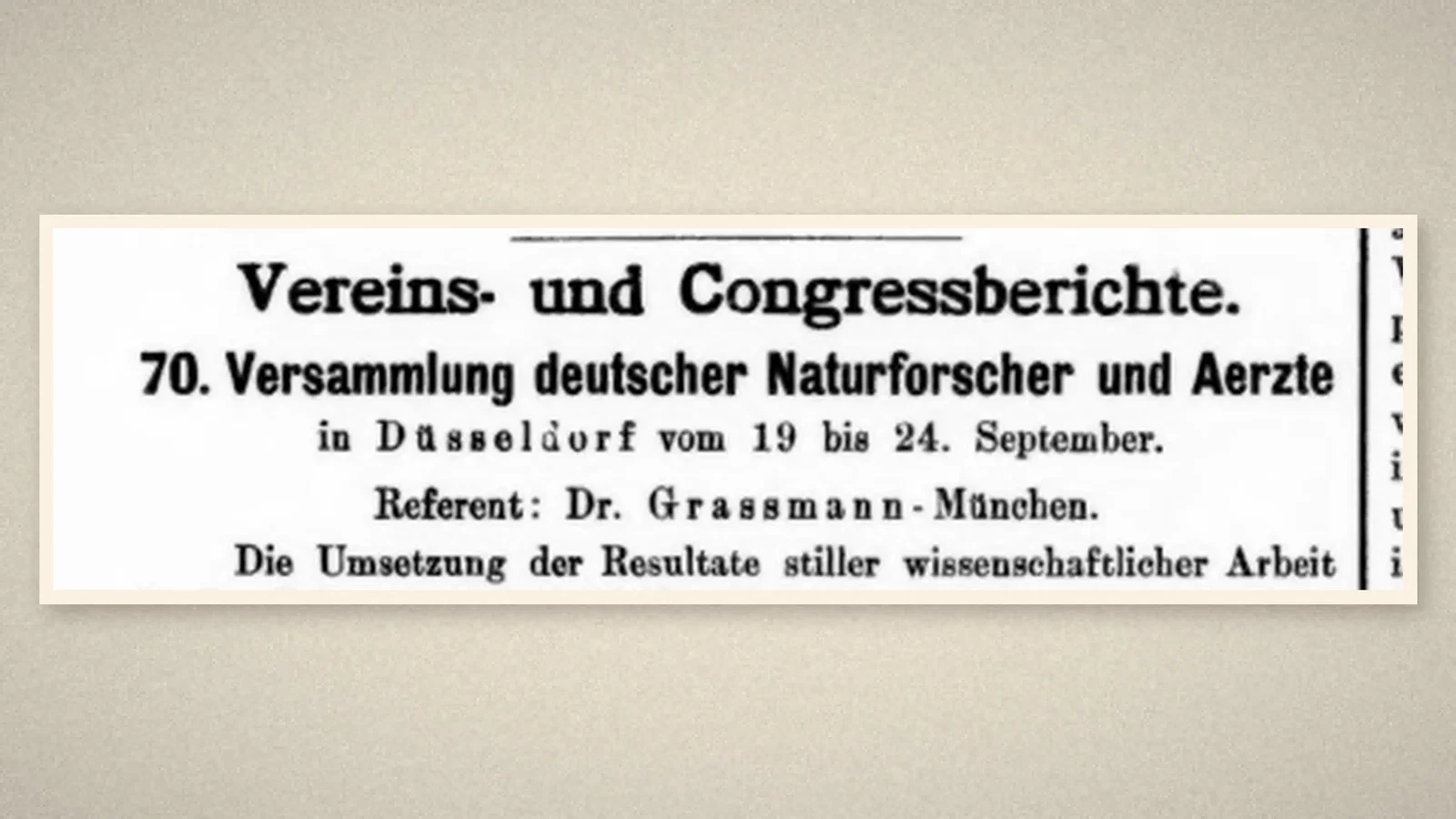
The Münchener Medicinische Wochenschrift of 27 September 1898 reported the 70th Versammlung deutscher Naturforscher und Aerzte, held "in Düsseldorf vom 19 bis 24. September". In the section for internal medicine, the first session met on the afternoon of 19 September; its third paper was "Herr Dreser-Elberfeld: Pharmakologisches über einige Morphinderivate" (Pharmacology of some morphine derivatives). [1, p. 1249][1, p. 1251][1, p. 1252]
A new ester
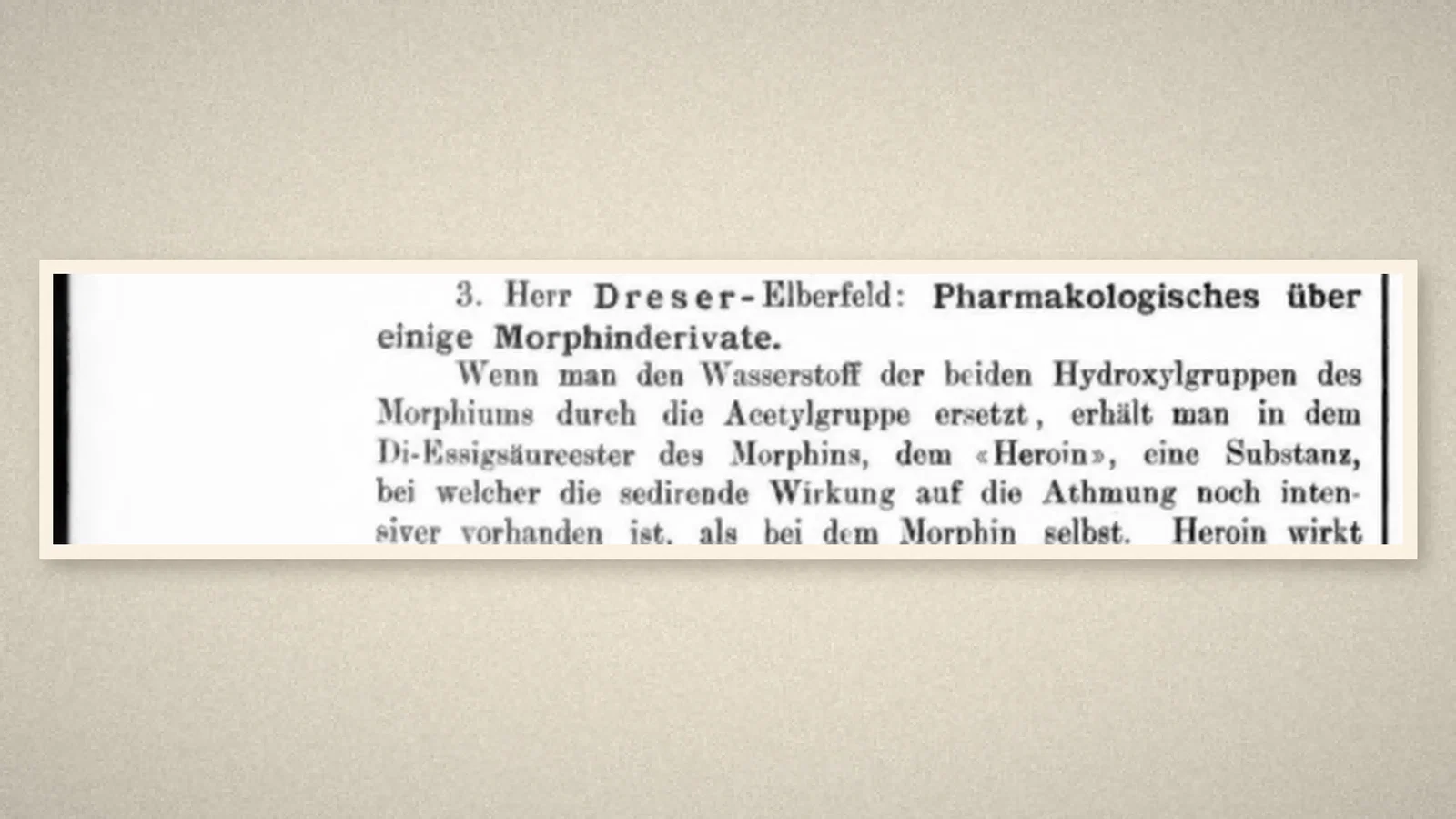
If the hydrogen of morphine's two hydroxyl groups is replaced by acetyl groups, the summary reads, one obtains "the diacetic ester of morphine, 'Heroin'", a substance whose sedative effect on breathing is even more intense than morphine's. It also acted more strongly than codeine. In rabbits a very small amount clearly slowed breathing, and the gap between the effective and the lethal dose was far wider than with codeine. [1, p. 1252]
Dreser explained the difference by codeine's stronger power to cause convulsions. Muscles in spasm demand more gas exchange than weakened breathing can provide. With the less convulsant Heroin, even greatly reduced breathing was still enough to keep the animal alive until the drug had left the body. As a medicine, Heroin had proved "very effective" against cough in people. [1, p. 1252]
Deeper breaths
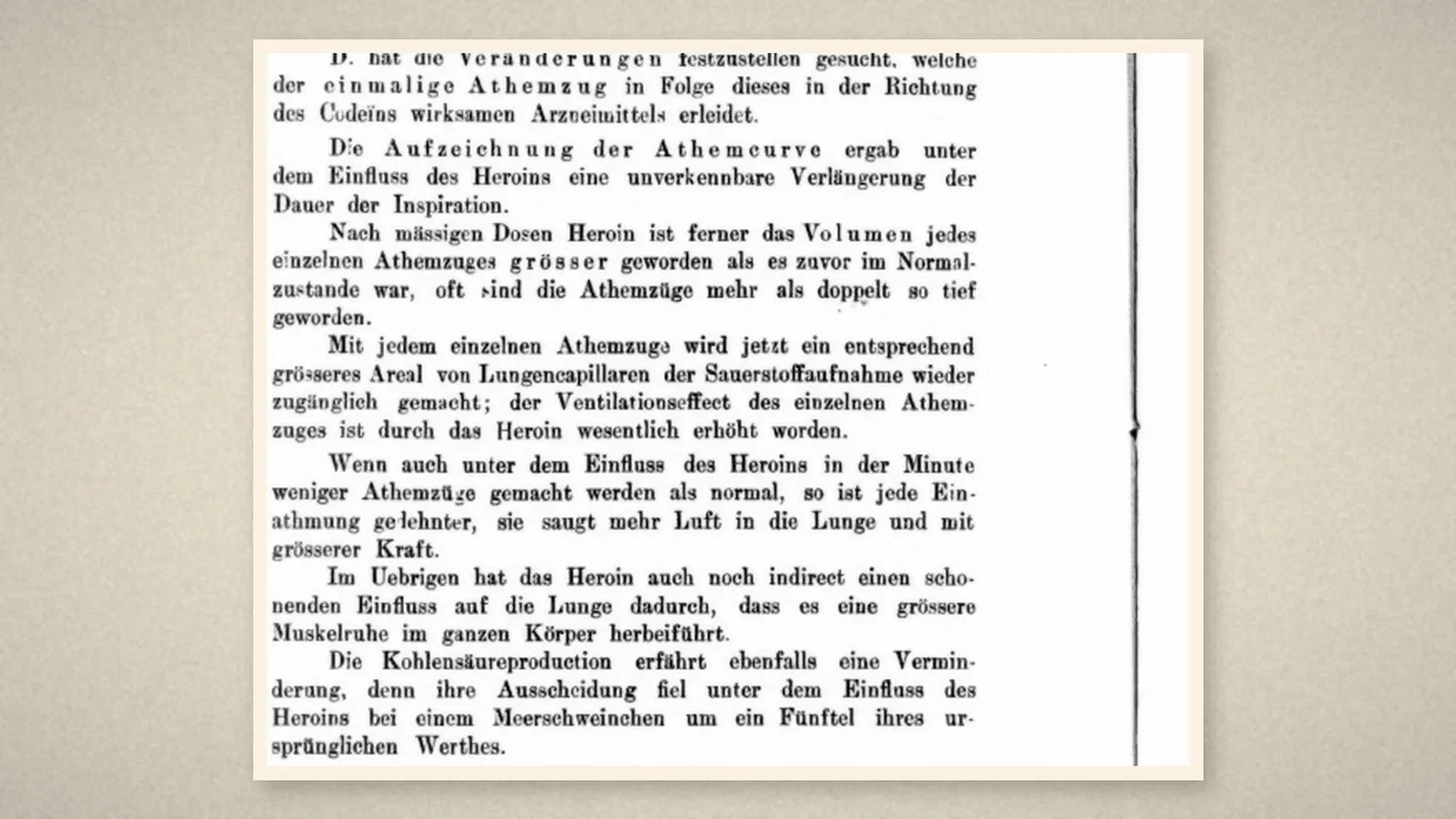
Dreser then looked at single breaths. Breathing tracings showed "an unmistakable lengthening of the inspiration". After moderate doses each breath was larger than before, "often more than twice as deep". Fewer breaths were taken each minute, but each one was longer and drew in more air with more force, so that, Dreser argued, the ventilating effect of every breath was much increased. Heroin also brought "greater muscular rest in the whole body", and in one guinea pig the output of carbon dioxide fell by a fifth. [1, p. 1252]
From this Dreser drew a clinical idea. In the air hunger of kyphoscoliosis, pneumonia, fresh pneumothorax and perhaps heart disease, physicians might use Heroin's power to lower oxygen demand as a "Schonungstherapie", a sparing therapy, "especially as no alteration of consciousness" came with it, as it did with hypnotics. By reducing oxygen use, and so heat production, it might even fight fever more economically than ordinary antipyretics. [1, p. 1252]
An objection
Von Noorden of Frankfurt answered in the discussion. There could be no talk of a direct lowering of oxidation in the body, von Noorden said: the substance merely switched off muscle contractions, and the effect followed from that. [1, p. 1252]
What the record shows
A drug as it was presented to physicians at this meeting: as a gentle sedative for the lungs. The arguments were about the depth of breaths and carbon dioxide, and the only challenge was a physiological one. Nothing in this report raises habituation or addiction. Later knowledge should not be read back into it.
Sources and reading limits
Read: the Münchener Medicinische Wochenschrift of 27 September 1898 (vol. 45, no. 39), report on the 70th Versammlung deutscher Naturforscher und Aerzte at Düsseldorf: the opening, p. 1249; the head of the section for internal medicine, p. 1251; and the summary of Dreser’s talk with von Noorden’s reply, p. 1252, with page images.
Not covered: Dreser’s full papers in Therapeutische Monatshefte and Pflüger’s Archiv; the manufacturer’s announcements; the first clinical reports; later reports of habituation and addiction and the drug’s withdrawal. The report is a reporter’s summary of a spoken talk, not Dreser’s own text, and gives no numbers of subjects or controls.
- [Report] 70. Versammlung deutscher Naturforscher und Aerzte: Dreser. Pharmakologisches über einige Morphinderivate. Münch Med Wochenschr. 1898;45(39):1249-52. Internet Archive
Continue exploring
Related reading connects shared questions and contexts; it does not by itself establish historical influence.
- 1817: Sertürner Publishes 'Ueber das Morphium'
- 1893: von Mering Tests Paracetamol and Prefers Phenacetin
Anesthesia Epochs · The Source Room · About & Editorial Method
Published November 3, 2026. Sources and reading limits are stated above. Illustrations are labelled as original source images or AI-made. Historical accounts are educational; they are not current treatment instructions.