In December 1893 J. von Mering reported that acetyl-p-aminophenol, the compound now called paracetamol, acted promptly against fever and neuralgia but caused the same side effects as p-aminophenol, if weaker, so that it could not be recommended and phenacetin was to be preferred.
Reading Library · Anesthesia Epochs · 中文版
Watch the education video (for clinicians)
1893: Von Mering's Paracetamol — Set Aside for Phenacetin · Anesthesia Epochs Education Series
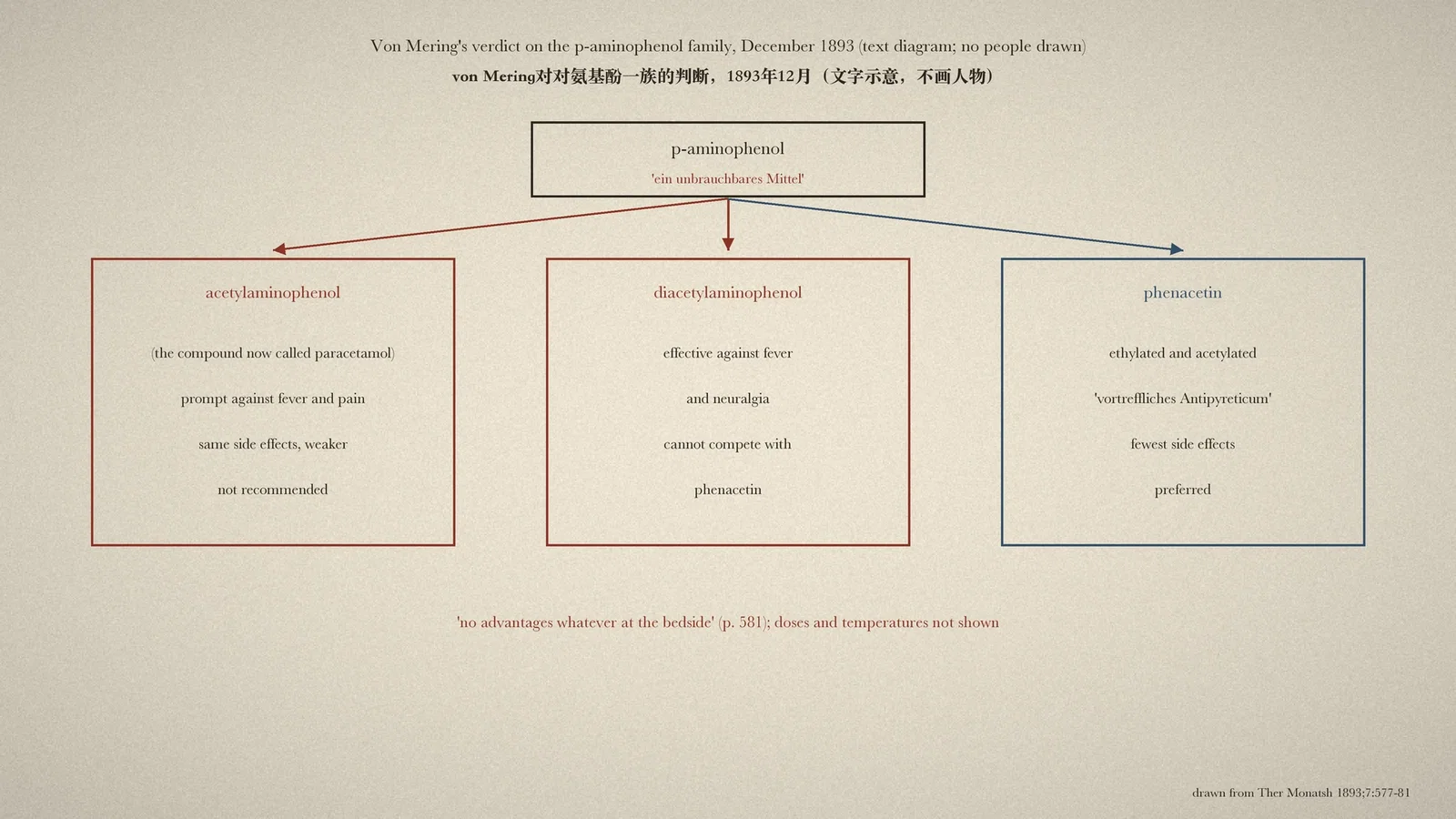
The drug now known as paracetamol or acetaminophen appears in this paper under a plainer name, "Acetylamidophenol". It is tried and found to work, and then set aside. The physician who reasoned toward it, J. von Mering, preferred its better-known relative, phenacetin. [1, p. 580][1, p. 581]
A crowded field
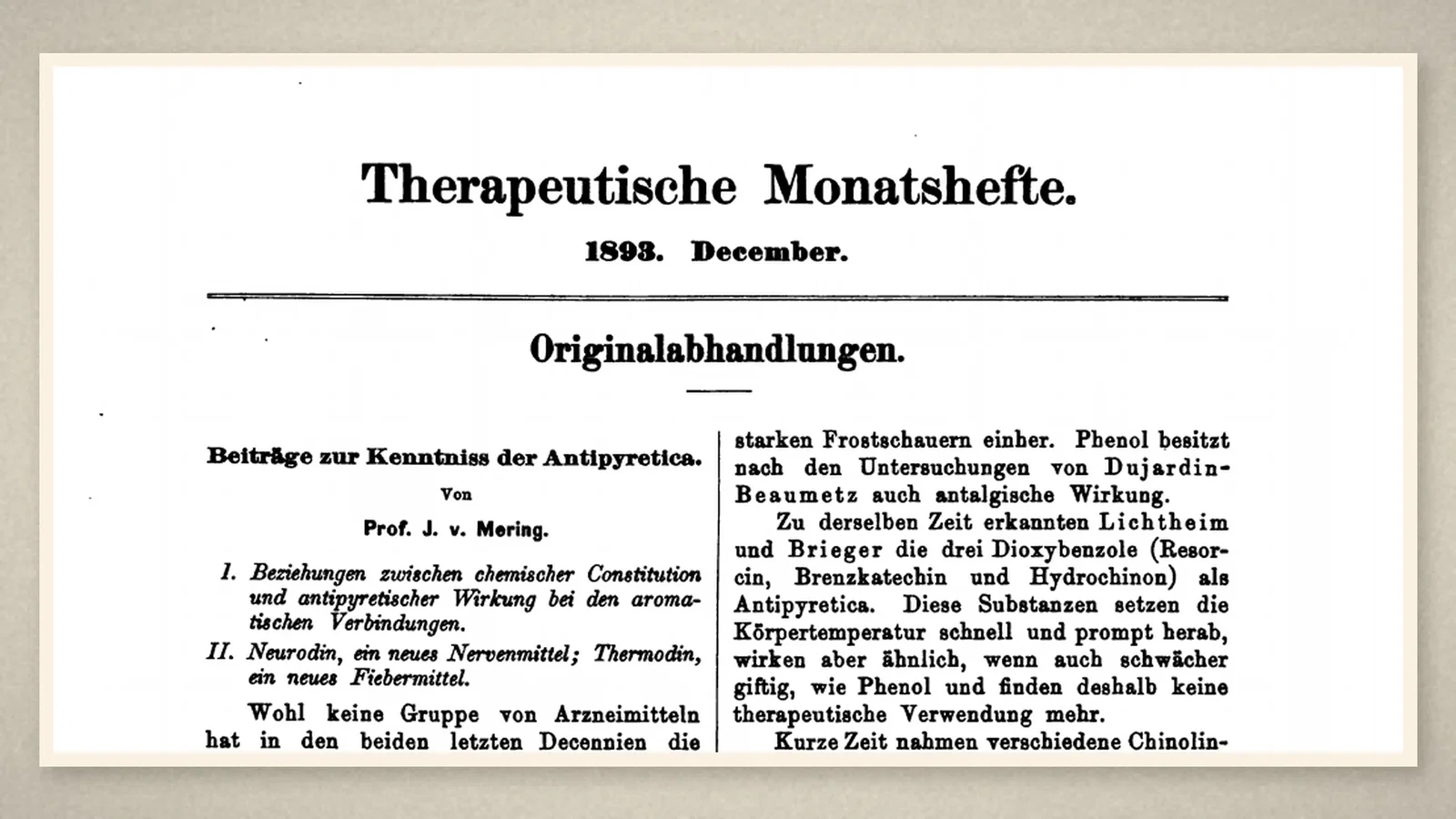
The December 1893 issue of Therapeutische Monatshefte, vol. 7, opened with "Beiträge zur Kenntniss der Antipyretica" (Contributions to the knowledge of antipyretics) by Prof. J. von Mering. It had two parts: the relation between chemical structure and fever-lowering action in aromatic compounds, and two new drugs, Neurodin, "a new nerve remedy", and Thermodin, "a new fever remedy". [1, p. 577]
Probably no group of drugs, the paper begins, had drawn so much attention from physicians and chemists over the previous two decades. For a long time quinine had been the only general fever remedy. Phenol, the dihydroxybenzenes, quinoline and kairine followed, and most were dropped for their toxicity. Ludwig Knorr's antipyrine proved both a good antipyretic and an excellent remedy for neuralgia. Acetanilide was found by chance in Strasbourg to lower fever and entered practice as "antifebrin"; its "accidental discovery" caused a sensation. [1, p. 577][1, p. 578]
Then came a detail that mattered. In the human body, von Mering noted, acetanilide is partly oxidised, like aniline, "to (acetyl-)paramidophenol" and excreted as a sulphuric ester. Phenacetin, made from p-aminophenol by adding an ethyl and an acetyl group, was in von Mering's judgement "an excellent antipyretic and antineuralgic" with the fewest side effects of all. [1, p. 578][1, p. 579]
Looking for the parent
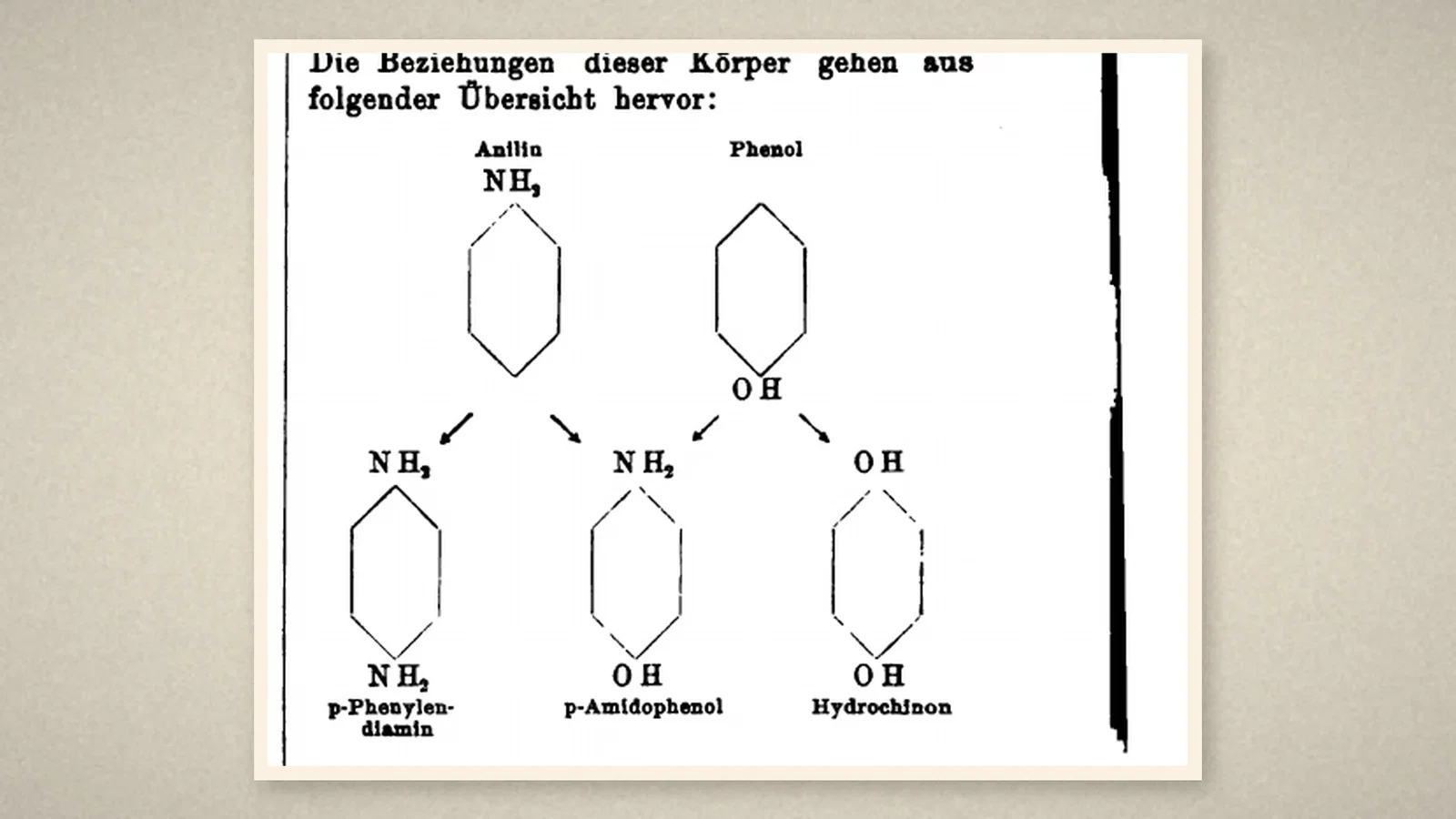
Surveying the whole series, von Mering concluded that everything, including the way aniline leaves the body, pointed to p-aminophenol as "an important parent substance" for fever-lowering and pain-relieving action. Yet, strangely, nothing at all had been published on what p-aminophenol did. A printed scheme set out its family: aniline and phenol above, p-phenylenediamine, p-aminophenol and hydroquinone below. [1, p. 580]
Mixed with blood, p-aminophenol soon turns it chocolate-brown by forming methaemoglobin. Von Mering took p-aminophenol several times "without harm" and then gave it to two patients, one with typhoid and one with pneumonia. Their temperatures fell quickly, with heavy sweating, but soon climbed back with shivering; once there was marked cyanosis. Because of these strong side effects, p-aminophenol was "a useless remedy". [1, p. 580]
The acetyl compound
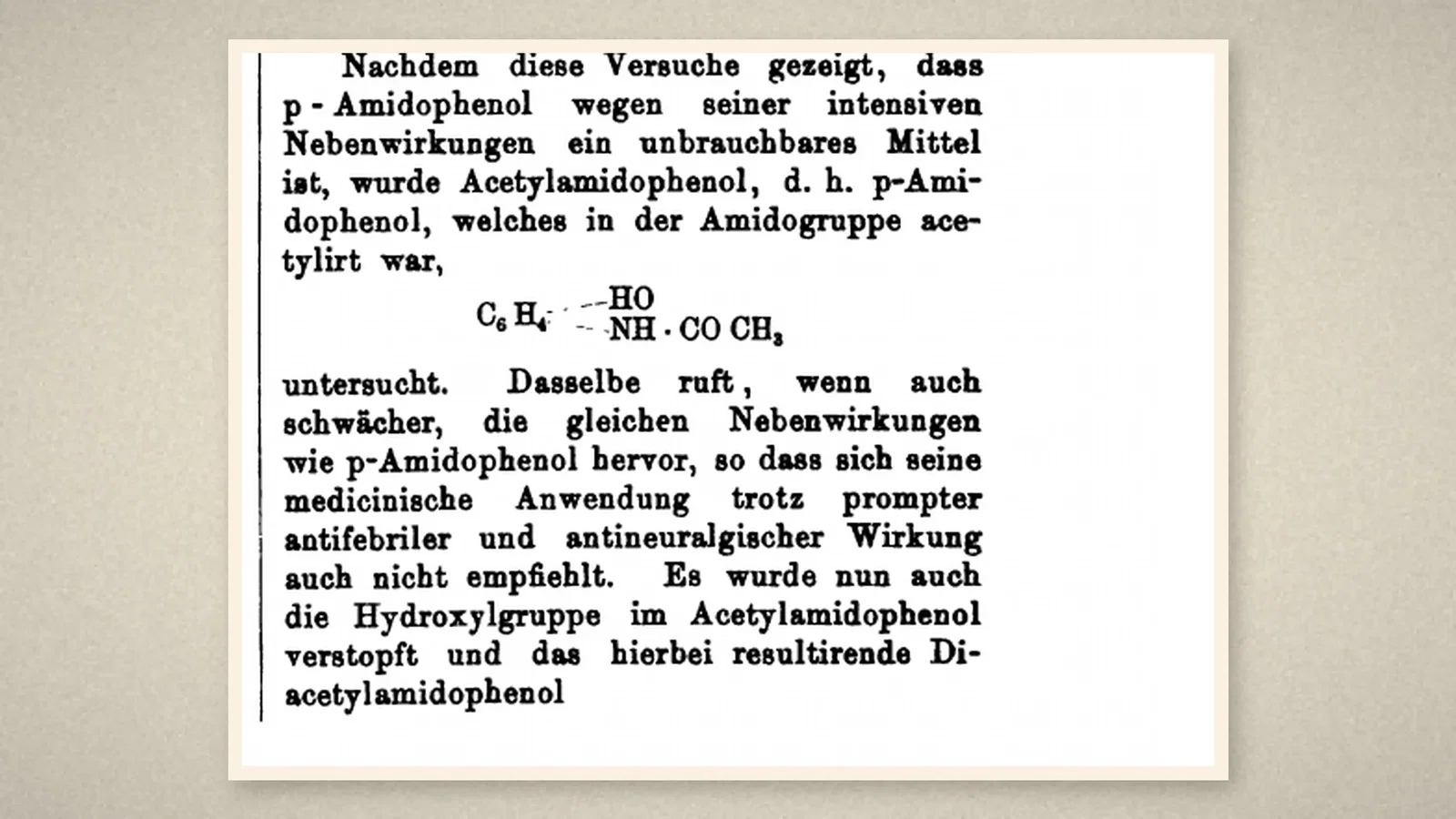
Next came "Acetylamidophenol", p-aminophenol with an acetyl group on its amino group. This is the compound later known as paracetamol. In von Mering's words it produced "the same side effects as p-aminophenol, if weaker", so that "despite prompt antifebrile and antineuralgic action" its medical use "also could not be recommended". [1, p. 580]
Von Mering then blocked the hydroxyl group as well, giving diacetylaminophenol. Animals tolerated it, and it lowered fever and eased neuralgias of various kinds. But phenacetin caused fewer side effects overall, so diacetylaminophenol "cannot compete" with it. Propionyl and butyryl derivatives often caused chills and mild cyanosis in patients whose fever phenacetin and Thermodin brought down without them. [1, p. 580][1, p. 581]
The conclusion was flat: p-aminophenol and its acid derivatives had "no advantages whatever at the bedside". The interesting question was now why phenacetin, p-aminophenol both ethylated and acetylated, should be better, and von Mering turned to phenetidine derivatives and to Neurodin and Thermodin. [1, p. 581]
What the record shows
A rejection, written down with its reasons. The chemistry was sound: von Mering found the right parent molecule and tried the right derivative, and it worked against fever and pain. What decided its fate was a clinical judgement made on a few patients. Its side effects were described only as the same as those of p-aminophenol but weaker, and the drug was set aside in favour of phenacetin.
Sources and reading limits
Read: J. von Mering, “Beiträge zur Kenntniss der Antipyretica”, Therapeutische Monatshefte 1893;7, December issue: part I (pp. 577–581) in full, with its page images, and part II on Neurodin and Thermodin for context. German quotations are translated here.
Not covered: Morse’s paper in the Berichte der deutschen chemischen Gesellschaft on preparing the acetylaminophenols; the original papers on antifebrin and phenacetin that von Mering cites; the later work on paracetamol as a breakdown product of acetanilide and phenacetin. Some timelines date this topic to 1877; the paper described here is of 1893. It does not use the names paracetamol or acetaminophen, describes the side effects of acetylaminophenol only as those of p-aminophenol but weaker, and rests on a few uncontrolled patients; doses and temperatures are not repeated.
- von Mering J. Beiträge zur Kenntniss der Antipyretica. Ther Monatsh. 1893;7:577-87. Internet Archive
Continue exploring
Related reading connects shared questions and contexts; it does not by itself establish historical influence.
- 1903: Fischer and von Mering Name Diethylmalonylurea Veronal
- 1817: Sertürner Publishes 'Ueber das Morphium'
Anesthesia Epochs · The Source Room · About & Editorial Method
Published November 3, 2026. Sources and reading limits are stated above. Illustrations are labelled as original source images or AI-made. Historical accounts are educational; they are not current treatment instructions.