In March 1903 Emil Fischer and J. von Mering reported a new class of hypnotics derived from urea, tested in dogs and then in people, and named the strongest practical member, diethylmalonylurea, Veronal; its parent compound, barbituric acid, had been described by Adolf Baeyer in 1864.
Reading Library · Anesthesia Epochs · 中文版
Watch the education video (for clinicians)
1903: Veronal — Small Molecular Changes, Different Effects · Anesthesia Epochs Education Series
Two papers, nearly forty years apart, tell this story. In one, a chemist in Berlin works out the place of an obscure compound of urea and malonic acid in the chemistry of uric acid. In the other, two researchers hang two ethyl groups on that compound, put dogs to sleep with it, and give it a name chosen simply because the chemical one was too awkward. [2, p. 129][1, p. 97][1, p. 100]
The question
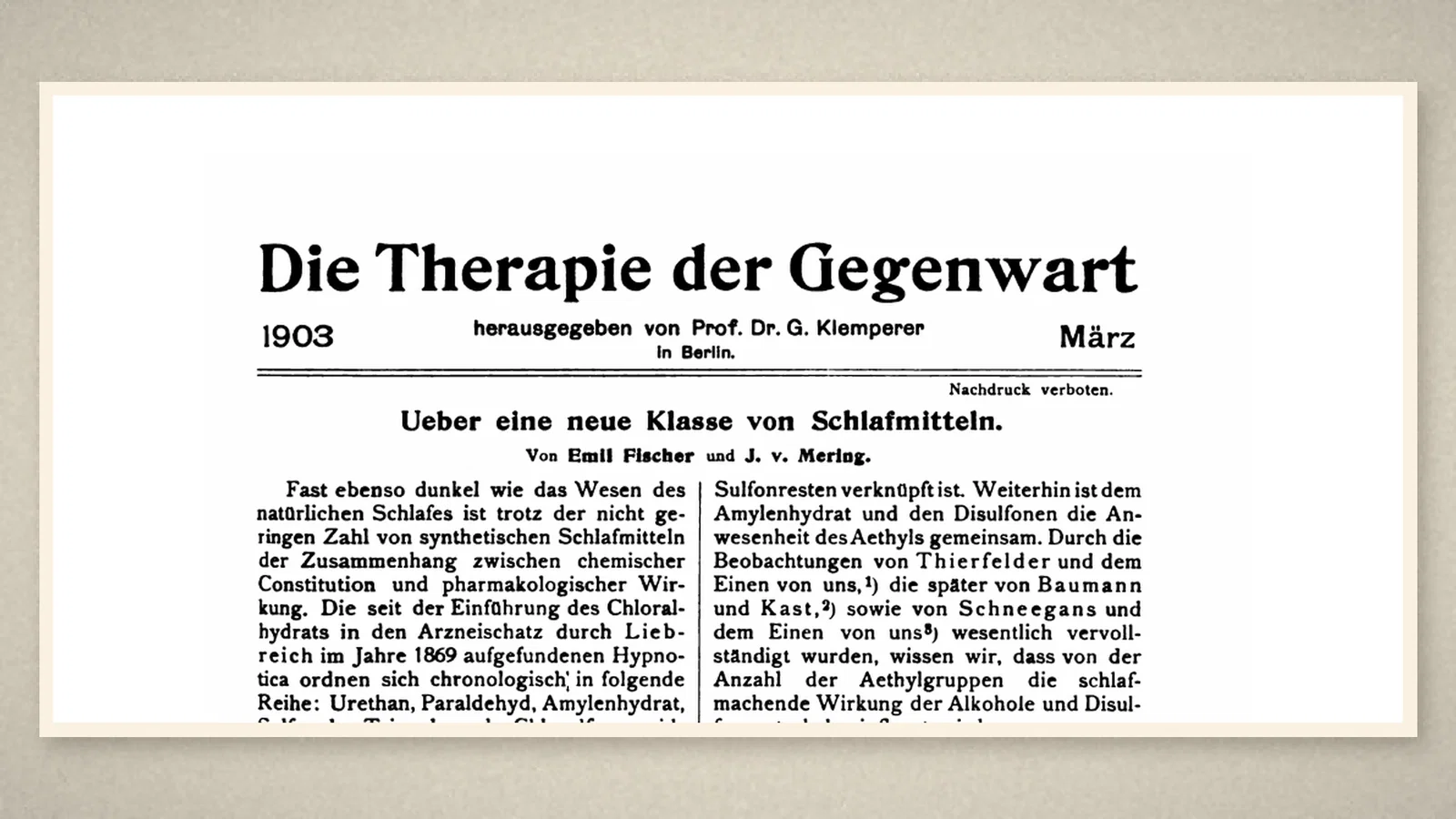
The March 1903 issue of Die Therapie der Gegenwart, vol. 44, pp. 97-101, printed "Ueber eine neue Klasse von Schlafmitteln" (On a new class of hypnotics) by Emil Fischer and J. von Mering. [1, p. 97]
Despite the many synthetic hypnotics, they began, the link between chemical structure and pharmacological action was "almost as obscure as the nature of natural sleep". After chloral hydrate had come urethane, paraldehyde, amylene hydrate, sulfonal, trional and chloralformamide, and more recently Dormiol and Hedonal, so different in structure that they fell into four classes. Amylene hydrate and the disulfones, however, shared a central carbon atom bound to several alkyl groups, and both carried ethyl groups. Earlier work had shown that the number of ethyl groups strongly affected how well alcohols and disulfones caused sleep. [1, p. 97]
So the authors looked for other substances with a carbon atom "laden with several ethyl groups", and found what they called "a new large class of hypnotics". All were derivatives of urea. One group came from dialkylacetic acids, such as diethylacetylurea; the other from diethylmalonic acid, with its nitrogen-containing part closed in a ring. The most important of these they named diethylmalonylurea. [1, p. 97]
What the dogs showed
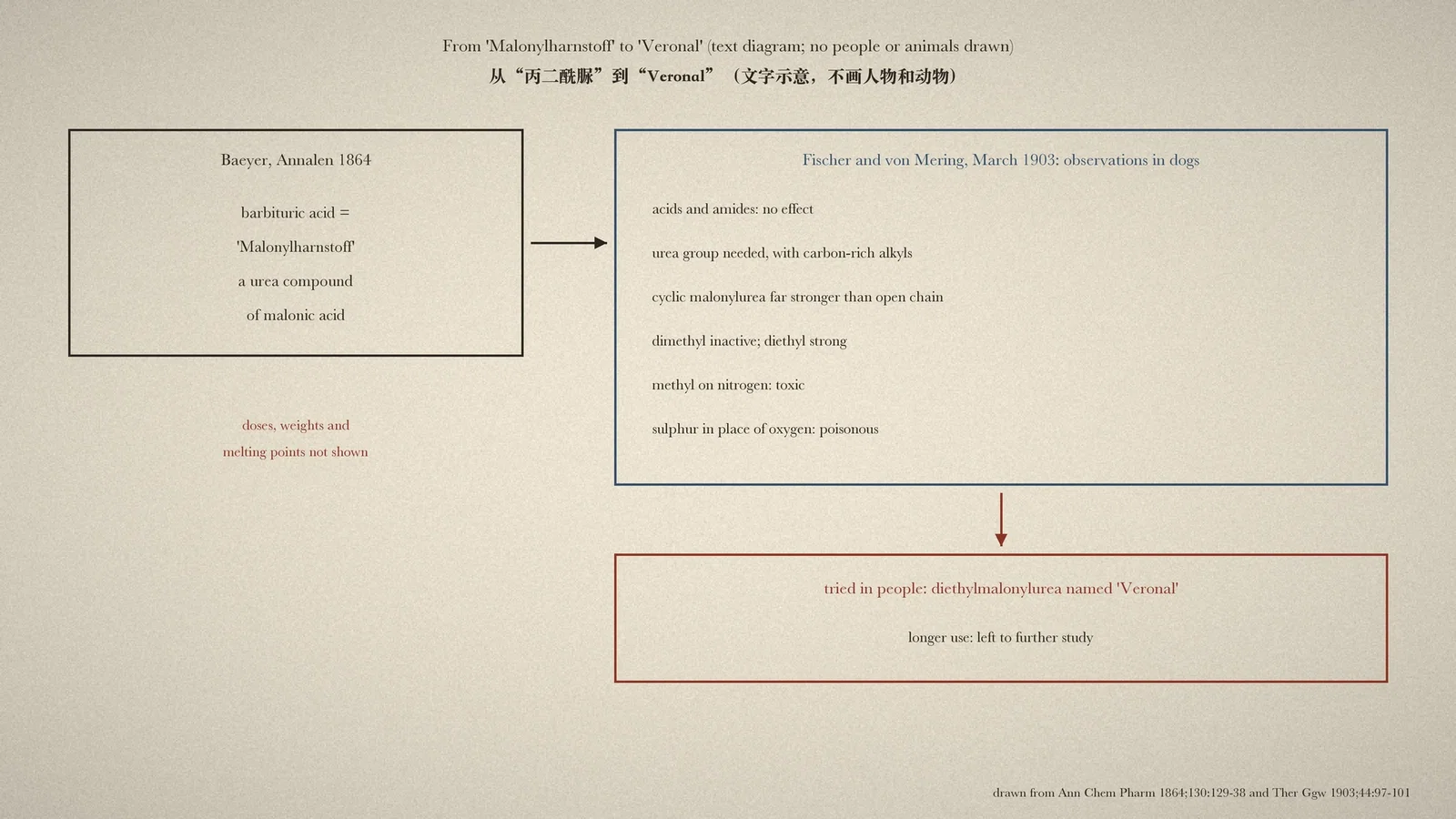
Better synthetic methods let them prepare many members of both groups, and they set out their observations on dogs in order of chemical structure. Acids and amides were inactive. Sleep needed the urea group, but that alone was not enough; it had to be combined with a residue carrying several carbon-rich alkyl groups. The ring form was far stronger than the open chain. Then the alkyl group itself mattered: the dimethyl compound did nothing, activity rose with larger groups and fell again with some of the largest. [1, p. 97][1, p. 100]
Small changes could undo everything. An extra methyl group on a nitrogen made the compound strikingly toxic. Opening the ring abolished the effect, and so did replacing the oxygen of the urea with an imino group. With sulphur in place of oxygen the substance became poisonous, and a dog given it died. These examples showed, the authors wrote, "how much even small changes to the molecule" can alter pharmacological activity. [1, p. 100]
A name
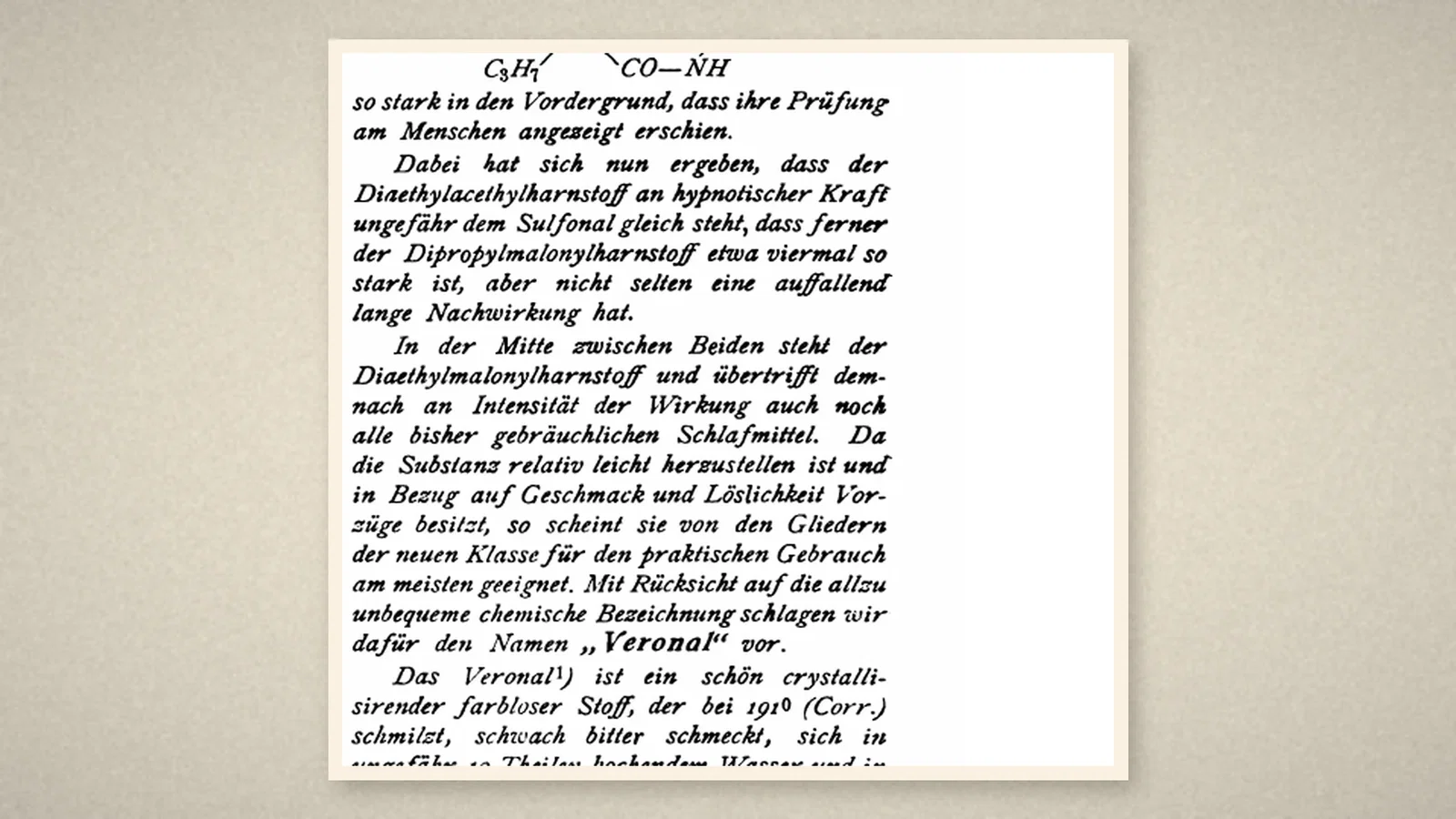
Three compounds stood out so clearly that "a trial in people seemed indicated". In people, diethylmalonylurea proved stronger than all the hypnotics then in use. It was relatively easy to make and had advantages in taste and solubility, so it seemed the best of the new class for practical use; "in view of the all too awkward chemical name", the authors proposed calling it "Veronal". A footnote says it was being put on the market by E. Merck of Darmstadt. [1, p. 100]
The paper ends cautiously. In the clinical observations so far, unpleasant side effects had not appeared; whether they would with longer use "further therapeutic study must show". The authors offered Veronal to clinicians to test its value in sleeplessness. [1, p. 101]
The parent compound
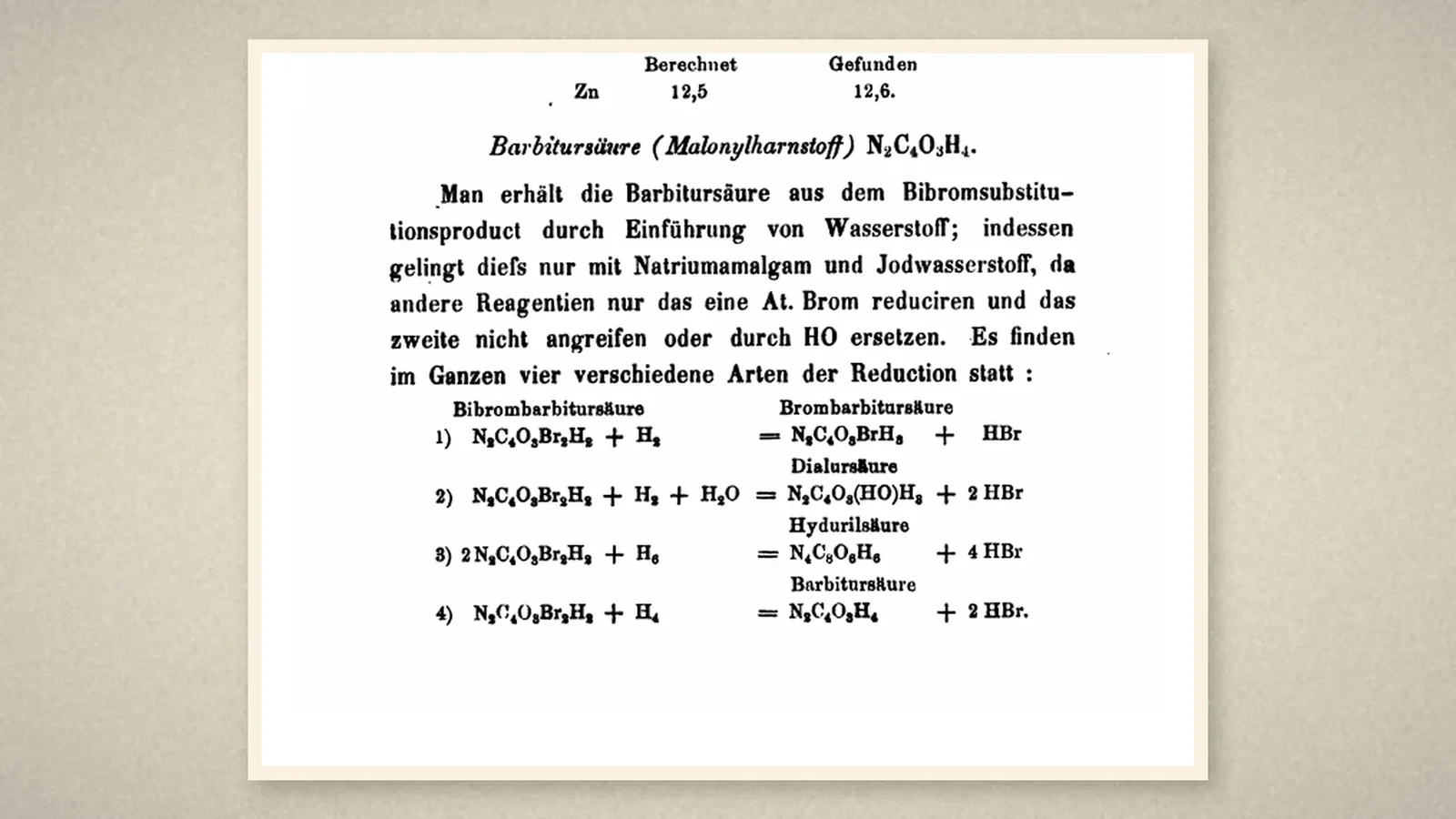
The ring at the centre of Veronal has a much older name. In the Annalen der Chemie und Pharmacie, vol. 130 (1864), Adolf Baeyer, writing from the organic laboratory of the Gewerbeinstitut in Berlin, published a second paper on the uric acid group. Baeyer recalled that the first paper had shown barbituric acid to be, by its composition, "the natural centre of this whole group", and explained that barbituric acid "is a urea compound of malonic acid". [2, p. 129]
On p. 136, under the heading "Barbitursäure (Malonylharnstoff)", Baeyer described obtaining it from dibromobarbituric acid by bringing in hydrogen, which worked only with sodium amalgam and hydriodic acid. Baeyer's interest was in how the members of the alloxan series were related, step by step, not in sleep. [2, p. 136][2, p. 138]
What the record shows
The way a class of drugs was found. Fischer and von Mering did not stumble on Veronal; they reasoned from the structures of existing hypnotics to a guess, made a family of related molecules, and let dogs show which parts of the molecule mattered. The result rested on a compound that Baeyer had studied for its chemistry alone. The paper's own last word was caution: no ill effects had been seen yet, and longer use was still to be tested.
Sources and reading limits
Read: Emil Fischer and J. von Mering, "Ueber eine neue Klasse von Schlafmitteln", Die Therapie der Gegenwart 1903;44:97–101; Adolf Baeyer, "Untersuchungen über die Harnsäuregruppe", second paper, Annalen der Chemie und Pharmacie 1864;130, the introduction (p. 129) and the section on barbituric acid (pp. 136–138).
Not covered: Baeyer's first paper on the uric acid group; Fischer's purely chemical papers on the synthesis; the later barbiturates. The dog observations and the human trials are reported without numbers of subjects or controls, and "no unpleasant side effects" is the authors' statement about their observations so far. Von Mering's first name is not printed in the paper and is not given here. Doses, animal weights, melting points and solubilities are not repeated. German quotations are translated.
- Fischer E, von Mering J. Ueber eine neue Klasse von Schlafmitteln. Ther Ggw. 1903;44:97-101. Internet Archive
- Baeyer A. Untersuchungen über die Harnsäuregruppe [Zweite Abhandlung]. Ann Chem Pharm. 1864;130:129-75. Internet Archive
Continue exploring
Related reading connects shared questions and contexts; it does not by itself establish historical influence.
- 1860: Niemann Extracts Cocaine from Coca Leaves
- 1817: Sertürner Publishes 'Ueber das Morphium'
- 1934: Lundy Uses and Observes Thiopental at the Mayo Clinic
Anesthesia Epochs · The Source Room · About & Editorial Method
Published November 3, 2026. Sources and reading limits are stated above. Illustrations are labelled as original source images or AI-made. Historical accounts are educational; they are not current treatment instructions.