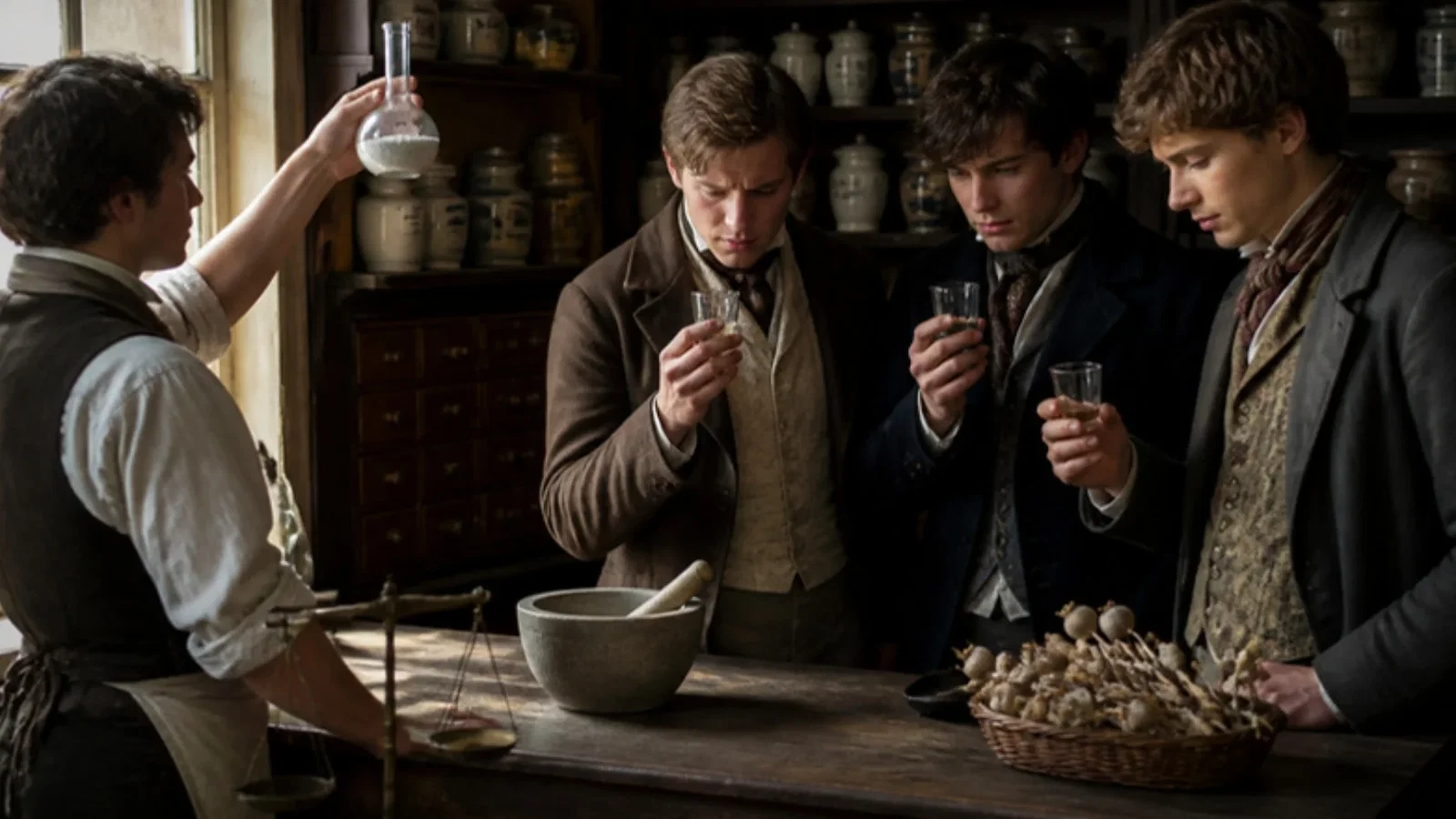
Sertürner of Einbeck called opium's active principle a salt-forming base, and recorded that Sertürner and three youths nearly fainted after taking it.
Reading Library · Anesthesia Epochs · 中文版
Watch the education video (for clinicians)
1817: Sertürner's Morphium — A Salt-Forming Base from Opium · Anesthesia Epochs Education Series
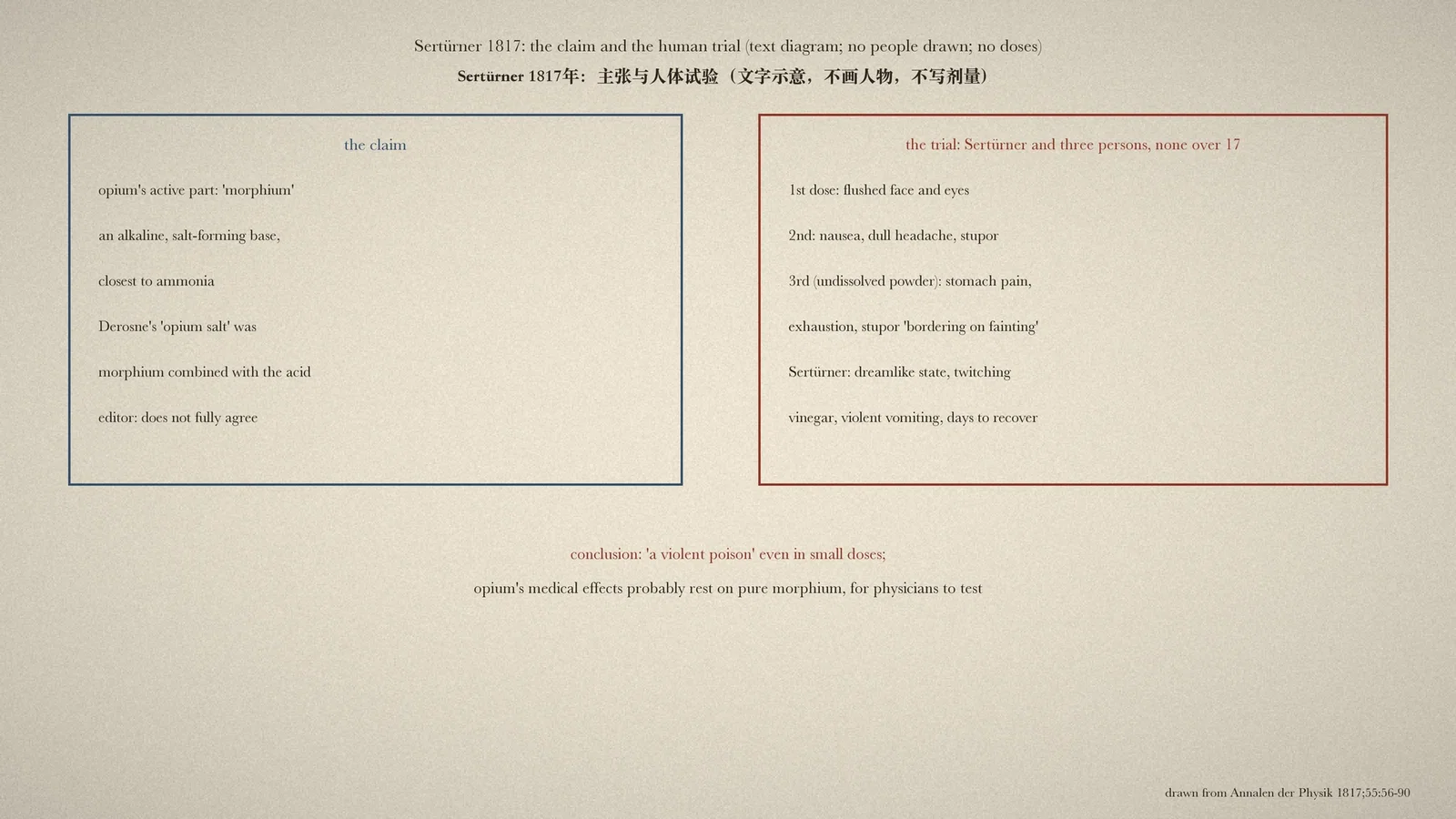
Opium had been used for thousands of years without anyone knowing what in it did the work. In 1817 a pharmacist in a small German town announced in a physics journal that it was a substance that combined with acids to form salts, like an alkali, and named it "morphium". To show how strong it was, the author and three youths swallowed it together, and nearly fainted. [1, p. 56][1, p. 69]
The paper
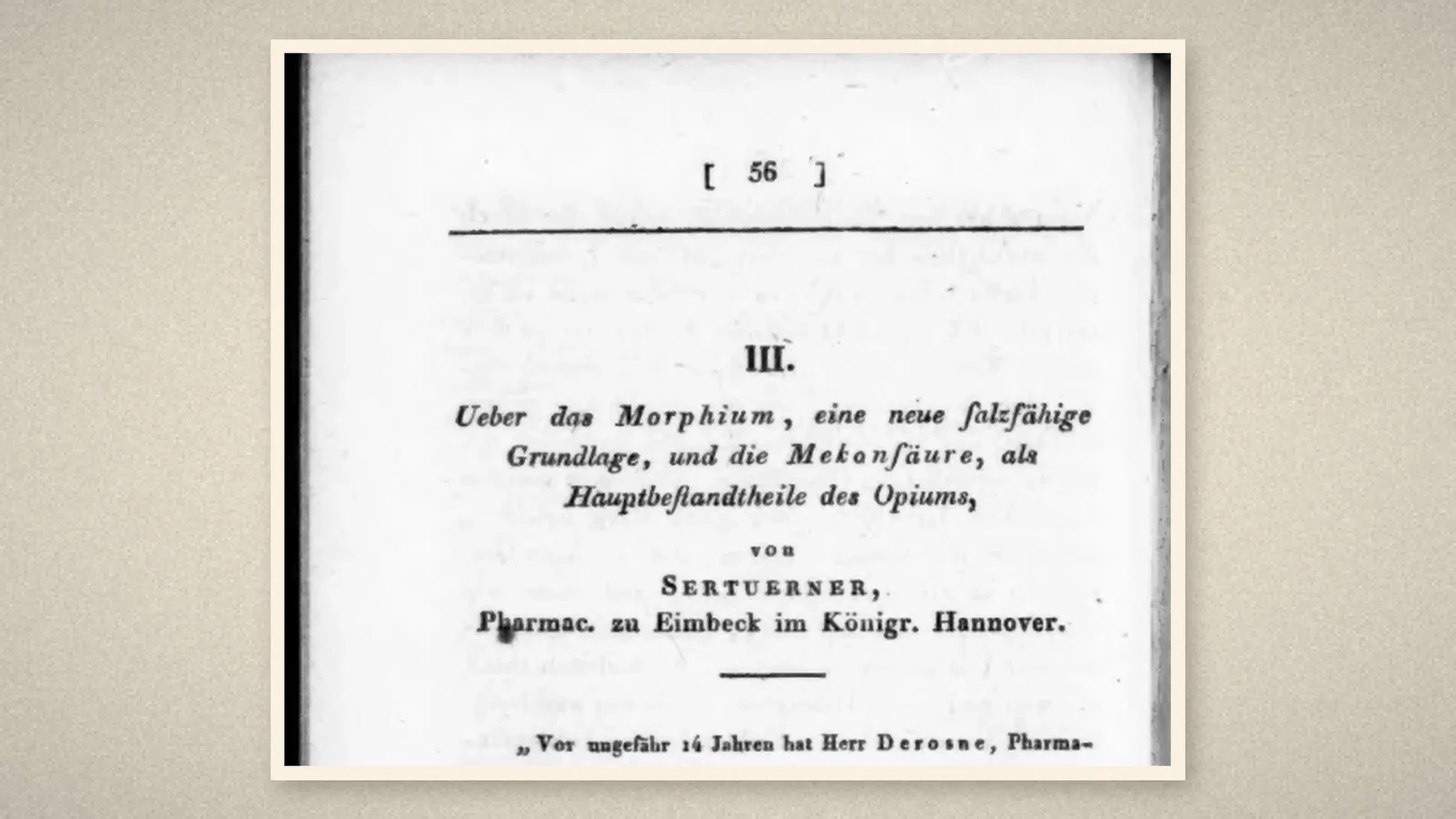
Annalen der Physik, vol. 55 (1817), pp. 56-90, carried "Ueber das Morphium, eine neue salzfähige Grundlage, und die Mekonsäure, als Hauptbestandtheile des Opiums" ("On morphium, a new salt-forming base, and meconic acid, as the principal constituents of opium") by Sertürner, pharmacist at Einbeck in the Kingdom of Hanover. [1, p. 56]
About fourteen years earlier, Sertürner begins, Derosne, a pharmacist in Paris, had analysed opium almost at the same time as Sertürner, but their results were so different and contradictory that the matter stayed obscure; Sertürner's own paper had been hastily written, based on small quantities, and some said its experiments could not be repeated, so it had been little regarded. A second analysis had now confirmed almost all the earlier observations, and showed, Sertürner wrote, that Derosne's method and observations were wrong: what Derosne had taken for the active part of opium was a compound of this substance with the acid of opium. The work brought science a new vegetable acid and a new alkaline, salt-forming base, "morphium", which seemed to stand nearest to ammonia. [1, p. 56][1, p. 57]
The editor's reservations
Before the main text the journal's editor added a preface. The editor was glad to publish work that tried to raise pharmaceutical analysis into physical chemistry, but explained why the author's view could not be fully accepted, pointing to Thenard's and Chevreul's studies of how plant substances combine with acids, which Sertürner seemed not to know. [1, p. 57][1, p. 58]
Taking it
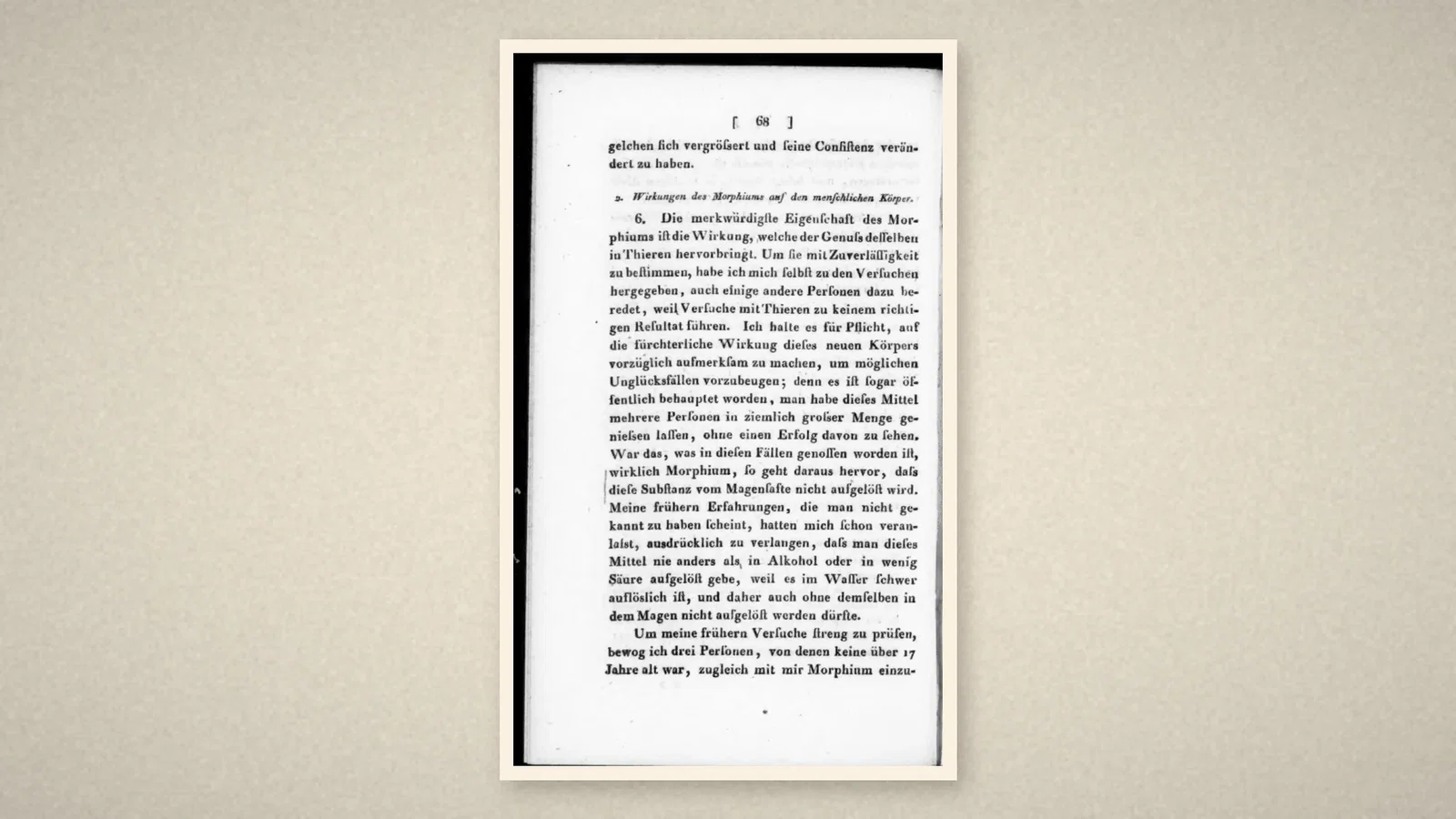
The second part of the paper is headed "Effects of morphium on the human body". Its most remarkable property, Sertürner wrote, was its effect when taken; to determine it reliably Sertürner had taken part in the experiments personally and persuaded several others, "because experiments with animals lead to no correct result". Sertürner felt bound to warn of the "terrible effect" of the new substance, to prevent accidents, since it had been publicly claimed that several people had swallowed a good deal of it without effect, which Sertürner put down to its not dissolving in the stomach. [1, p. 68]
To test the earlier trials strictly, Sertürner persuaded three persons, "none of whom was over 17 years old", to take morphium at the same time. After the first dose a general redness covered their faces, even showing in the eyes, and vital activity seemed raised; a second dose, some time later, strengthened this, with passing nausea, a dull headache and stupor; a third time they swallowed it as undissolved coarse powder. [1, p. 68][1, p. 69]
"A stupor bordering on fainting"
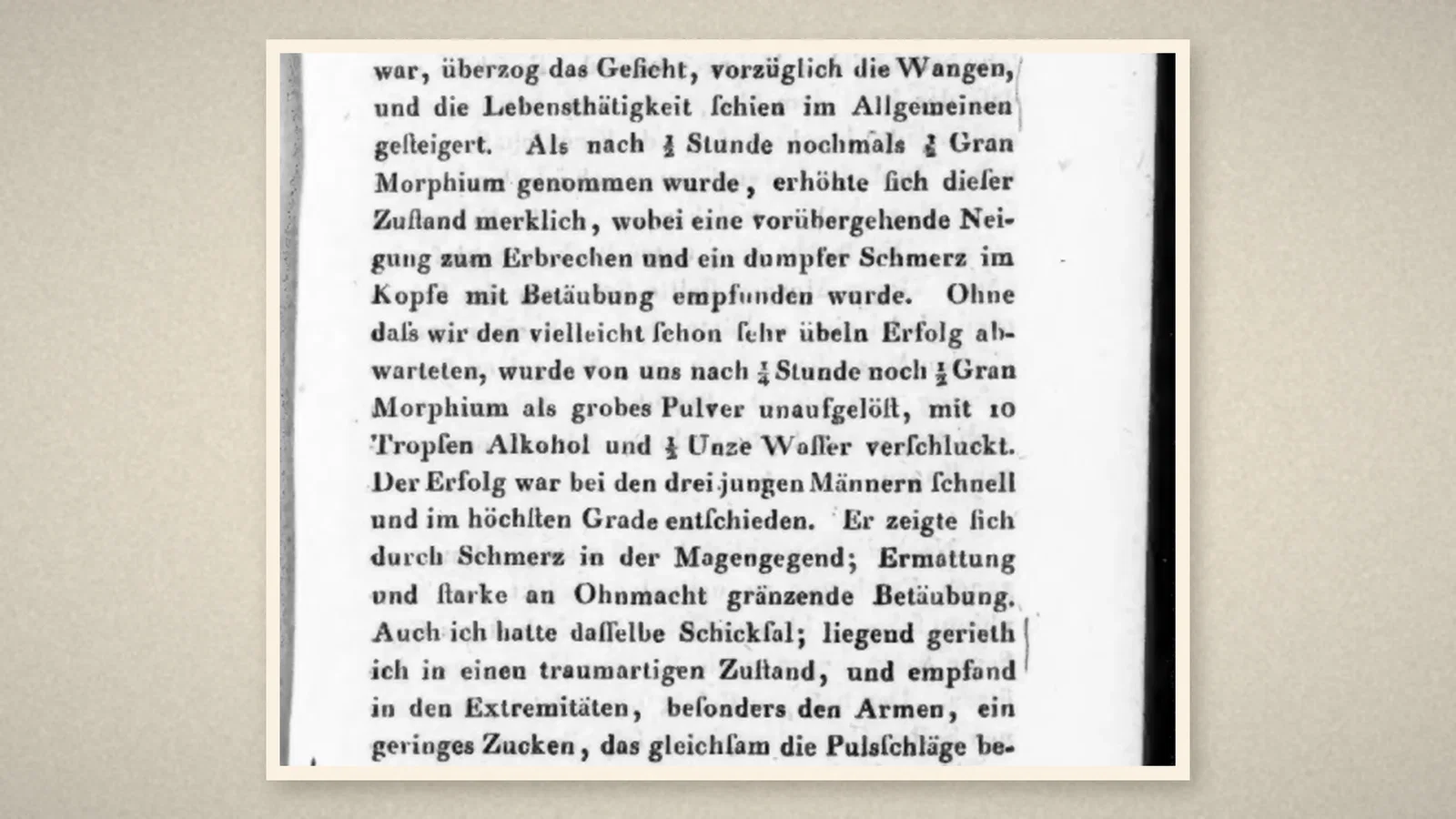
This time, Sertürner wrote, the effect on the three young men was rapid and of the highest degree: pain in the stomach, exhaustion and "a strong stupor bordering on fainting". Sertürner fared the same: lying down, Sertürner fell into a dreamlike state, with slight twitching in the limbs, especially the arms, keeping time with the pulse. [1, p. 69]
These signs of real poisoning, above all the collapsed state of the three young men, alarmed Sertürner so much that, half conscious, Sertürner drank a large quantity of strong vinegar and had the others do the same. Violent vomiting followed; one youth of very delicate constitution, the stomach already empty, went on retching painfully until given magnesium carbonate. The night passed in deep sleep; in the morning the vomiting returned and stopped after more magnesia; constipation, loss of appetite, stupor and pains in head and belly lasted several days. [1, p. 69][1, p. 70]
The conclusion
Judging from this "truly most unpleasant" experience, Sertürner wrote, morphium acts even in small doses as a violent poison; its salts may act more strongly still, and it must be well diluted. Since no other constituent of opium had such effects, opium's important medical effects probably rested on those of pure morphium, which Sertürner left to physicians to test. Sertürner added that a very violent toothache which opium had not relieved had yielded at once to a solution of morphium in alcohol. [1, p. 70][1, p. 71]
The article ends with a further letter from Sertürner, dated "Einbeck, 10 December 1816", reporting that morphium crystallises regularly. [1, p. 90]
What the record shows
A drug taken out of a mixture and presented as a thing: one component of opium, with definite properties, said to be the part that does the work. The proof was given in a way that is disturbing today: the author had three people no older than seventeen take it alongside the author, to the point of near-fainting. The paper itself turned the trial into a warning.
Sources and reading limits
Read: Sertürner, "Ueber das Morphium, eine neue salzfähige Grundlage, und die Mekonsäure, als Hauptbestandtheile des Opiums", Annalen der Physik 1817;55:56-90: the introduction, the editor's preface and the section on effects on the human body closely, the chemical sections in outline, and the closing letter.
Not seen: Sertürner's earlier notes of 1805 and 1806 in Trommsdorff's Journal der Pharmacie; any independent account of the self-experiment. Derosne's 1803 memoir is discussed in 1803: Derosne's Opium Memoir Calls the Crystals a Salt.
Limits: the human trial is known only from Sertürner's account; the three participants, none older than seventeen, are not identified, and nothing is said about how they agreed. The editor openly disagreed with parts of Sertürner's theory. All doses in the paper are left out. Sertürner's priority claims against Derosne are reported as Sertürner's own.
Three illustrations are crops of Annalen der Physik, vol. 55 (pp. 56, 68 and 69); one is a text diagram drawn from the paper, with no people drawn and no doses given.
- Sertürner. Ueber das Morphium, eine neue salzfähige Grundlage, und die Mekonsäure, als Hauptbestandtheile des Opiums. Ann Phys. 1817;55:56-90. Internet Archive
Continue exploring
Related reading connects shared questions and contexts; it does not by itself establish historical influence.
- 1803: Derosne's Opium Memoir Calls the Crystals a Salt
- 1836: Lafargue's Morphine Inoculation and Martin-Solon's Caution
- 1858: Charles Hunter Injects Morphine Away from the Pain
Anesthesia Epochs · The Source Room · About & Editorial Method
Published November 3, 2026. Sources and reading limits are stated above. Illustrations are labelled as original source images or AI-made. Historical accounts are educational; they are not current treatment instructions.