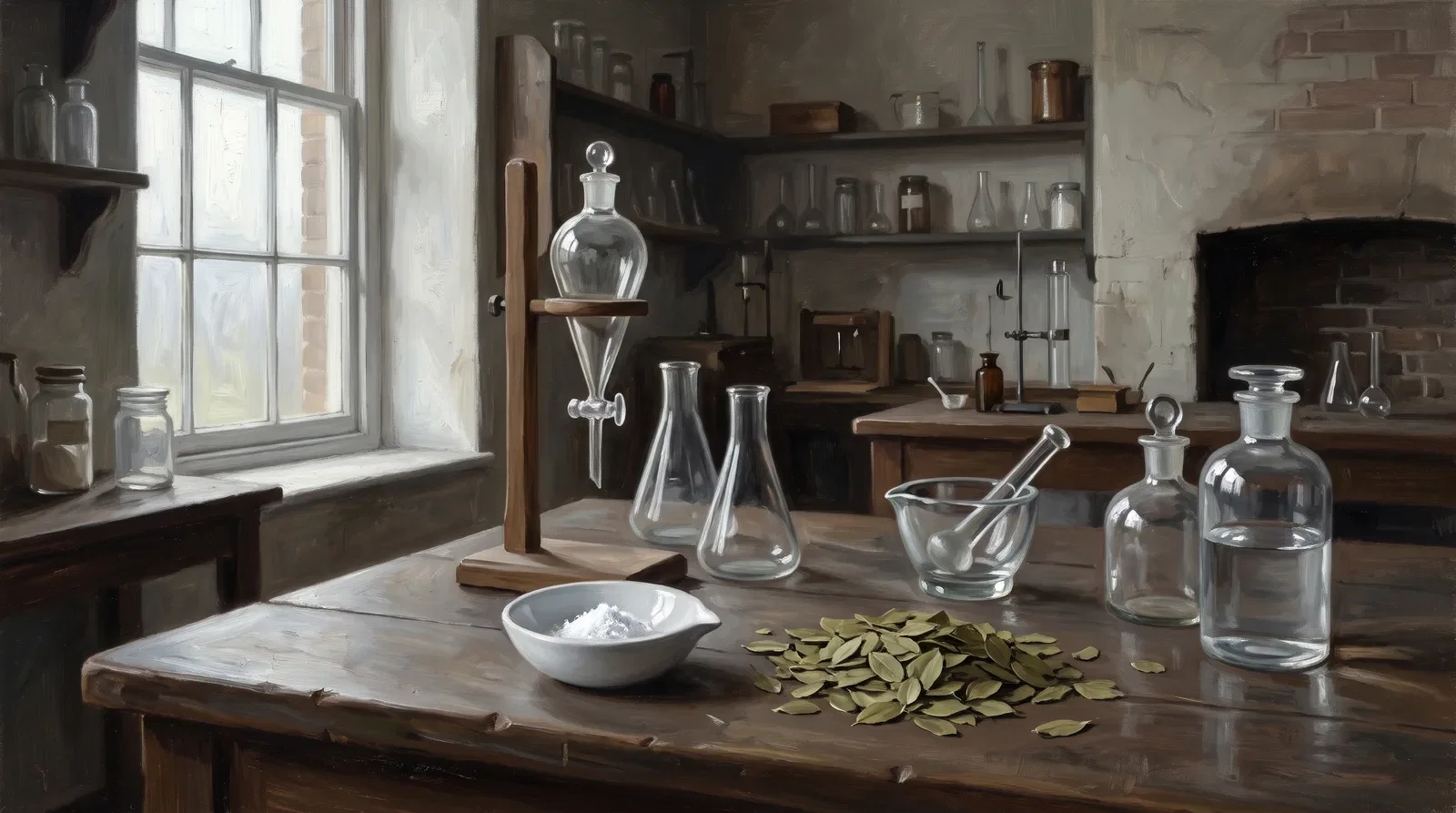
In Wöhler's Göttingen laboratory, Albert Niemann extracted a crystalline base from coca leaves brought on the Novara and named it 'cocain'; it numbed the tongue.
Reading Library · Anesthesia Epochs · 中文版
Watch the education video (for clinicians)
1860: Niemann Names Cocaine — Tongue Numb, Pupil Unchanged · Anesthesia Epochs Education Series
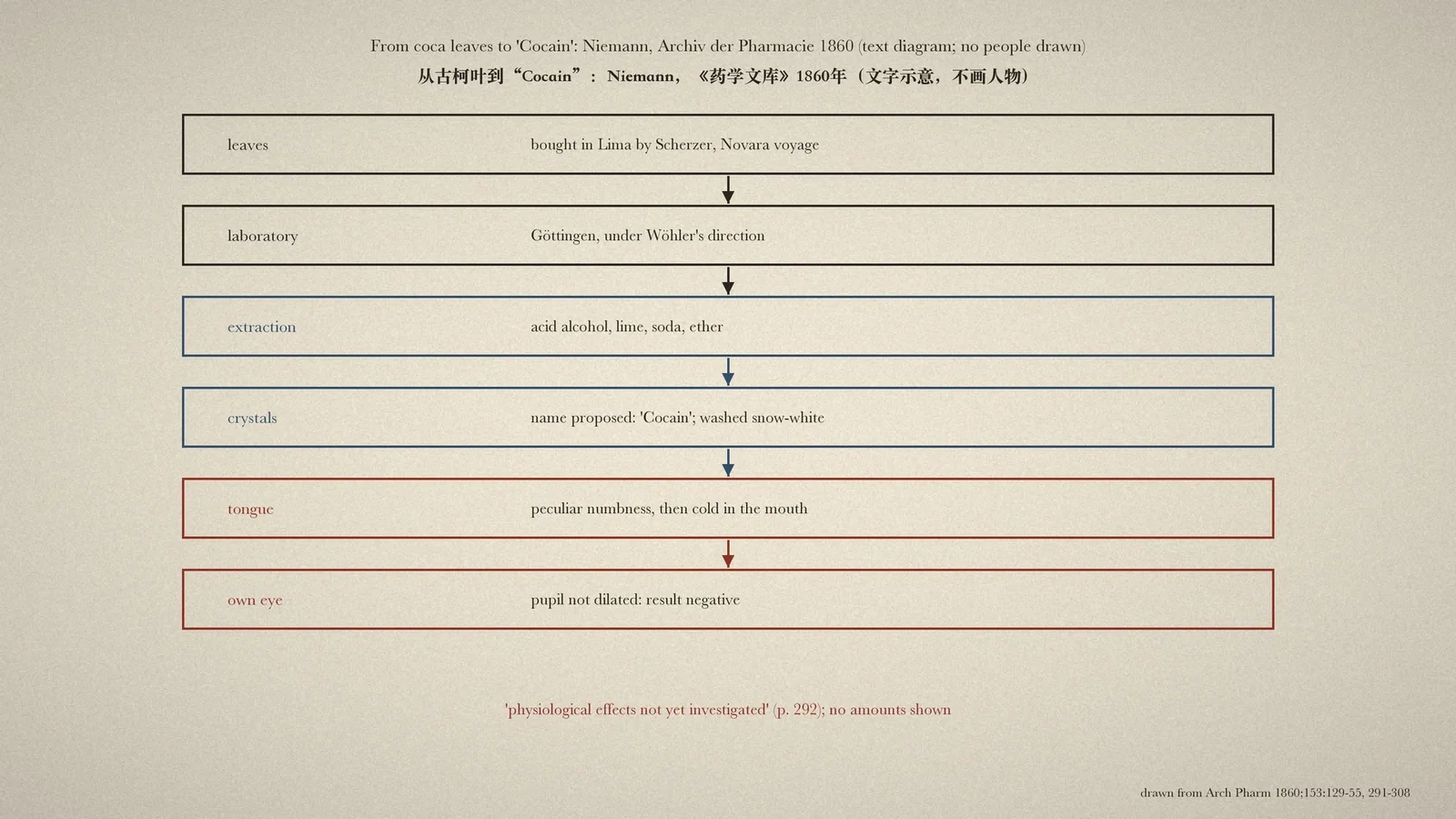
A chemist in Göttingen received a bundle of leaves that had crossed the world on an Austrian warship, and drew from them a white crystal. Niemann gave it a name, tasted it, and noticed that it numbed the tongue. Niemann did not think of surgery. The question was a chemist's: what in these leaves made the people of the Andes chew them? [1, p. 132][1, p. 153][1, p. 292]
The paper
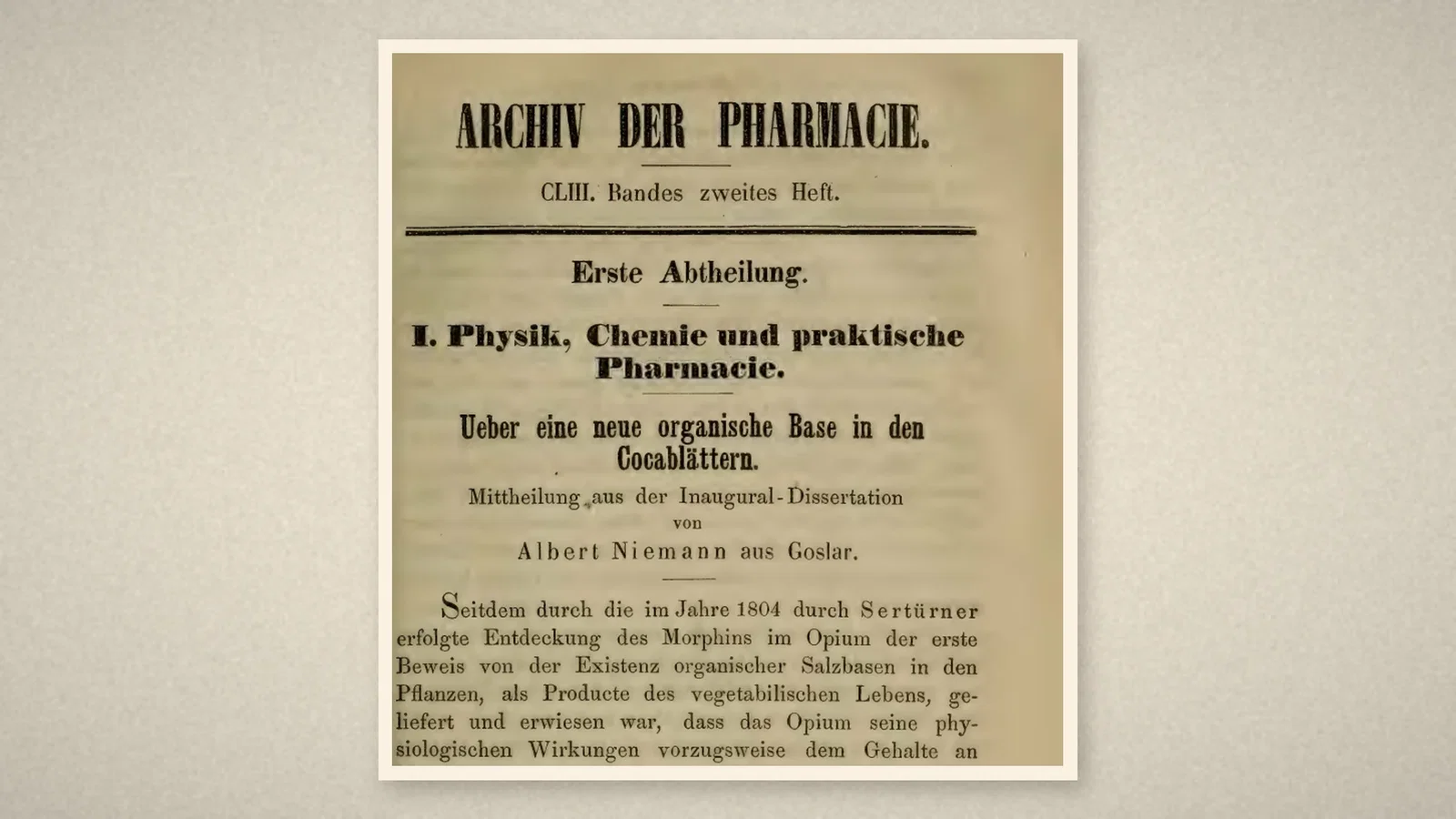
The Archiv der Pharmacie, published in Hannover in 1860 (second series vol. 103, whole series vol. 153), printed "Ueber eine neue organische Base in den Cocablättern" (On a new organic base in coca leaves) in two instalments, pp. 129-155 and 291-308. It is described as an extract from the inaugural dissertation of "Albert Niemann aus Goslar". [1, p. 129][1, p. 291]
Niemann placed the work in a line of research. Ever since Sertürner found morphine in opium, showing that plants contain organic bases, chemists had searched other strongly acting plants for similar substances, and the alkaloids they isolated had given medicine "a series of the most valuable remedies", acting with a certainty that dried drugs could not match. [1, p. 129][1, p. 130]
Leaves from Lima
The leaves of coca, Niemann wrote, were chewed generally by the natives of Peru and Bolivia, and travellers told so many wonderful things about them that a chemical study had to be worthwhile. Wöhler invited Niemann to do it and provided a large supply of genuine, unspoilt leaves. At Wöhler's request, and through Haidinger in Vienna, these had been bought in Lima and brought to Europe by Dr Scherzer during the world voyage of the Austrian frigate Novara. Niemann did the work in Wöhler's laboratory and under Wöhler's direction. [1, p. 132][1, p. 133]
Others had tried before. Maclagan had obtained an oily, alkaline body that was not bitter but caused "a slight numbness" on the tongue, without ever getting crystals. An alkaloid said to have been found by an apothecary named Pizzi in La Paz turned out, on Niemann's analysis, to be what Wöhler had suspected: gypsum. [1, p. 149][1, p. 150]
A crystal and a name
Niemann soaked the cut leaves in alcohol containing sulphuric acid, treated the extract with lime, neutralised it, distilled off the alcohol, separated a dark resin with water, made the solution alkaline with soda and shook it with ether. The ether left a yellowish varnish that after a day had turned largely into crystals. In this impure state the mass had a repellent, almost stupefying smell. [1, p. 151][1, p. 152][1, p. 153]
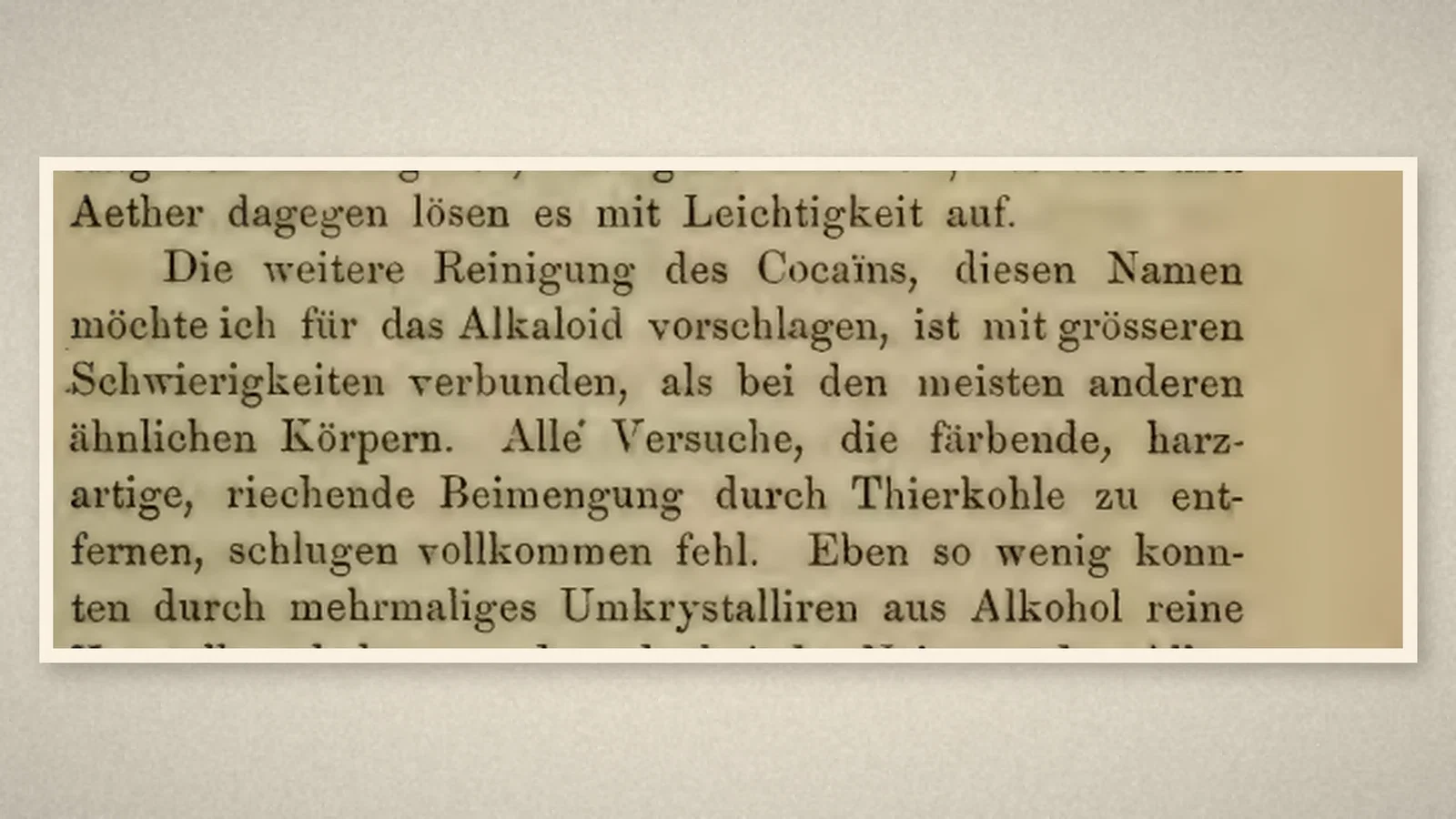
Then came the name. "The further purification of the Cocain, as I would propose to call the alkaloid," Niemann wrote, was harder than for most such substances. Charcoal failed, and so did repeated crystallisation. In the end, washing with cold alcohol removed the colouring and left the residue "snow-white". Slow crystallisation from watery alcohol gave clear, colourless prisms. [1, p. 153][1, p. 154]
Numbness on the tongue
The continuation set out its properties. Cocaine dissolves only slightly in water but readily in alcohol and ether. Its solutions are alkaline and a little bitter, increase the flow of saliva, and leave on the part of the tongue where they are placed "a peculiar numbness", which slowly fades into "a feeling of cold in the mouth". Its salts tasted more bitter and numbed the tongue much more strongly. [1, p. 291][1, p. 292][1, p. 294]
A drop in one eye
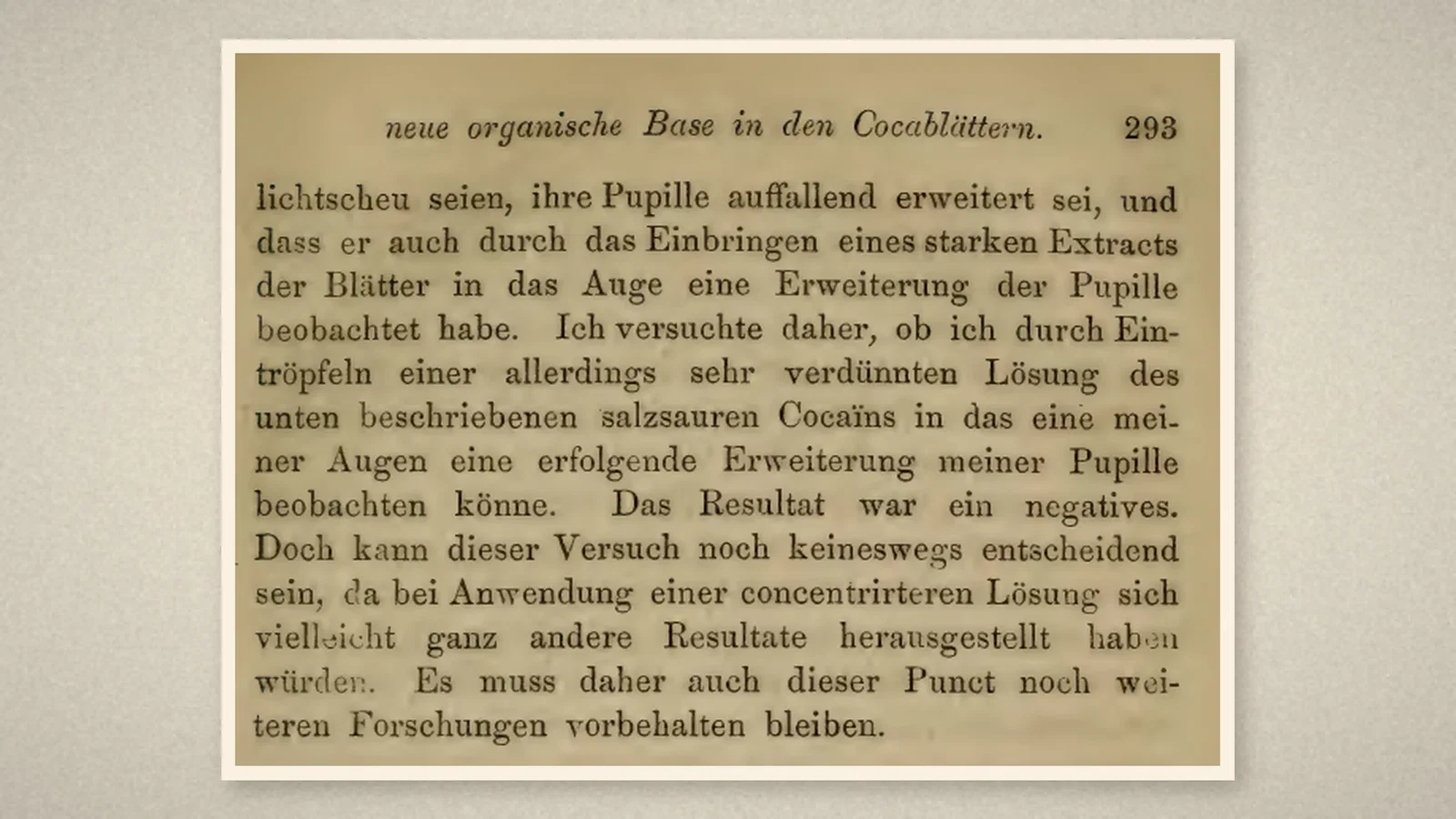
"Investigations of the physiological effects of cocaine have not yet been made," Niemann wrote. One question seemed of preliminary interest. Von Tschudi had described Indians who used too much of the leaves as shy of light, with markedly dilated pupils. So Niemann dropped a very dilute solution of cocaine hydrochloride into one of Niemann's own eyes, to see whether the pupil would widen. "The result was negative." The test was far from decisive, Niemann added; a stronger solution might have given quite different results, and the point was left for further research. [1, p. 292][1, p. 293]
What the record shows
A substance that was later used to numb the eye and the nerves appears in this paper as a chemist's crystal, judged by its taste and its effect on the tongue. Its discoverer looked into one eye for a dilated pupil and found nothing. The numbness was recorded as a property among others, and its use was left to others.
Sources and reading limits
Read: Albert Niemann, "Ueber eine neue organische Base in den Cocablättern", Archiv der Pharmacie 1860;153:129-55 and 291-308. The introduction, origin of the leaves, earlier work, preparation and naming, properties, eye trial and salts were read closely; the analysis and the later sections on coca tannic acid and the odorous principle were skimmed.
Not covered: the dissertation as separately printed at Göttingen; Wöhler's notes on the work; the papers of Maclagan, Gaedcke and von Tschudi cited by Niemann; later work on the formula.
Limits: the paper does not give first names for Wöhler or Scherzer, and none are given here. The tongue numbness and the eye trial are Niemann's own observations, with no number of trials and no controls, and Niemann called the eye trial far from decisive. The paper says physiological studies had not yet been made and says nothing about pain or surgery, so no such use is claimed. Quantities, concentrations, yields, melting points and analytical figures are not repeated. German quotations are translated for this article.
Three illustrations are crops of the Archiv der Pharmacie 153 (pp. 129, 153 and 293); one is a text diagram drawn from the paper, with no people drawn and no amounts shown.
- Niemann A. Ueber eine neue organische Base in den Cocablättern. Arch Pharm. 1860;153:129-55, 291-308. Internet Archive
Continue exploring
Related reading connects shared questions and contexts; it does not by itself establish historical influence.
- 1817: Sertürner Publishes 'Ueber das Morphium'
- 1859: Scherzer and the Journey of Coca to the Laboratory
- 1884: Knapp Injects Cocaine Behind the Eye
Anesthesia Epochs · The Source Room · About & Editorial Method
Published November 3, 2026. Sources and reading limits are stated above. Illustrations are labelled as original source images or AI-made. Historical accounts are educational; they are not current treatment instructions.