In 1859 Scherzer carried coca leaves from South America to Vienna; Niemann isolated cocaine, but the 1860 report left its effects on animals and people still to be studied.
Reading Library · Anesthesia Epochs · 中文版
Watch the education video (for clinicians)
1859: Scherzer's Coca Leaves — From South America to the Laboratory · Anesthesia Epochs Education Series
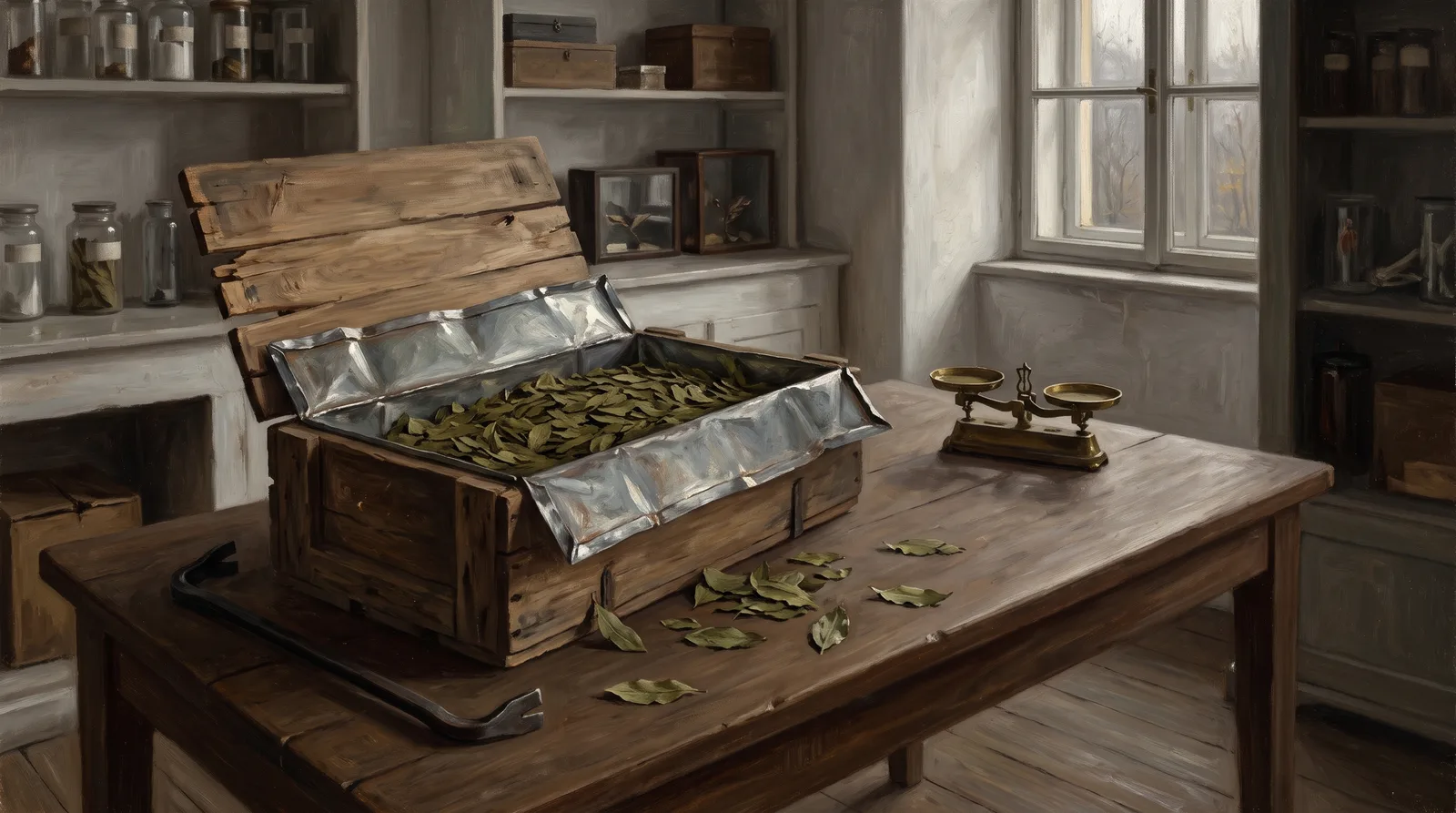
On 13 September 1859, Wilhelm Haidinger collected Karl Scherzer in Vienna, and the two took a case of coca to the geological institute. In Haidinger's later account, the outer wooden box and an inner soldered tinplate container were opened. Some material was set aside for researchers in Vienna; the remainder was sent to Friedrich Wöhler in Göttingen.[1, pp. 7–8]
The unpacking restores people and separate tasks to a story often compressed into a single sentence. Obtaining material, carrying it, distributing it and investigating it were different kinds of work.
A journey in 1859, a report in 1860, a book in 1863
Scherzer was a member of the Novara expedition, but in May 1859 Scherzer left Valparaiso and travelled towards Europe through Lima and Panama instead of accompanying the frigate around Cape Horn. Haidinger makes that distinction explicit. Scherzer’s later English narrative dates the corresponding journey chapter from 16 May to 1 August 1859.[1, p. 8; 2, p. 337]
This article therefore uses 1859 as the transport year. Wöhler’s letter is dated 28 February 1860; the English third volume read here was published in 1863. The dates identify an action, a scientific report and a subsequent account.[1, p. 9; 2, title page]
The leaves did not all travel in one piece of luggage
Scherzer wrote that Wöhler had requested enough coca leaves for chemical investigation before Scherzer left Europe. Scherzer described a total of 60 pounds: half carried among Scherzer's own effects, with the remainder forwarded later by C. Eggert and N. Linnich in Lima.[2, p. 403]
Haidinger described a later distribution after the case reached Vienna. Material went to Schroff, Redtenbacher and others, with the remainder sent to Wöhler. Haidinger did not empty out and weigh the leaves, and only estimated that the part sent on was somewhat more than half of the whole.[1, p. 8] These accounts concern different stages of movement. Their quantities and references to a half cannot be assembled into a precise, error-free cargo ledger.
Nor can arrival in Europe become the moment coca was first known. Scherzer also described established uses in Peru and Bolivia and referred to earlier travellers. Nearby, Scherzer also expressed explicit racial hierarchies and colonial assumptions. Scherzer's account can help trace the material while remaining a document whose perspective needs to be recognized.[2, pp. 402–404]

Material for experiments was not yet a clinical answer
In the 1860 letter, Wöhler explained that other duties had made it impossible to do the investigation in person, and assigned it to a laboratory assistant, Albert Niemann. The letter reported a crystallizable organic base and used the name Cocain. It also explicitly described the work as unfinished, with the intended physiological observations still to be made.[1, p. 9]
The following page recorded an observation worth pursuing: the point of contact on the tongue could temporarily become almost insensible.[1, p. 10] Established uses of coca, chemical separation, this sensory observation and surgical anesthesia were related questions, but they were not interchangeable findings. The passage does not establish a clinical anesthetic method in 1859.
Koller’s later report offers a concrete comparison. In Bettman’s English translation, published in 1885, Koller recalled Niemann’s observation of altered tongue sensation and asked whether an agent affecting that mucosa might also act on the cornea and conjunctiva.[3, pp. 91–92] The connection shows an earlier observation becoming part of a later research question. It does not establish that the same shipment supplied the 1884 work, or make its transporter the practitioner of ocular anesthesia.

Sources and reading limits
Read: the printed Haidinger preface and Wöhler letter (pp. 7–11); the title page and pp. 337, 402–409 and 455 of the third volume of Scherzer's English narrative; pp. 91–92 of the English translation of Koller's report.
Not covered: the German narrative, Niemann's dissertation and manuscript correspondence; historical preparation and administration procedures. The three illustrations are AI-made modern displays, not reconstructions of the case or the room.
[1] Wöhler F. Über das Cocain, eine organische Base in der Coca. Letter to W. Haidinger, with Haidinger’s preface. Sitzungsberichte der Kaiserlichen Akademie der Wissenschaften, mathematisch-naturwissenschaftliche Classe. 1860;40:7–11. Original printed pages (archived copy). Pages 7–8 are the preface; 9–11 are the letter.
[2] Scherzer K. Narrative of the Circumnavigation of the Globe by the Austrian Frigate Novara. Vol. III. London: Saunders, Otley & Co.; 1863. Library scan. The volume’s own title page establishes 1863.
[3] Koller K. The Application of Cocaine to the Eye as an Anæsthetic. Translated by Boerne Bettman. Chicago Medical Journal and Examiner. 1885;50(2):91–100. Original journal pages. The 1884 report and 1885 translation are distinct. Its retrospective dating of the earlier observation to 1859 is not treated as an independently established experiment date here.
Continue exploring
Related reading connects shared questions and contexts; it does not by itself establish historical influence.
Anesthesia Epochs · The Source Room · About & Editorial Method
Updated October 30, 2026. Sources and reading limits are stated above. Illustrations are labelled as original source images or AI-made. Historical accounts are educational; they are not current treatment instructions.