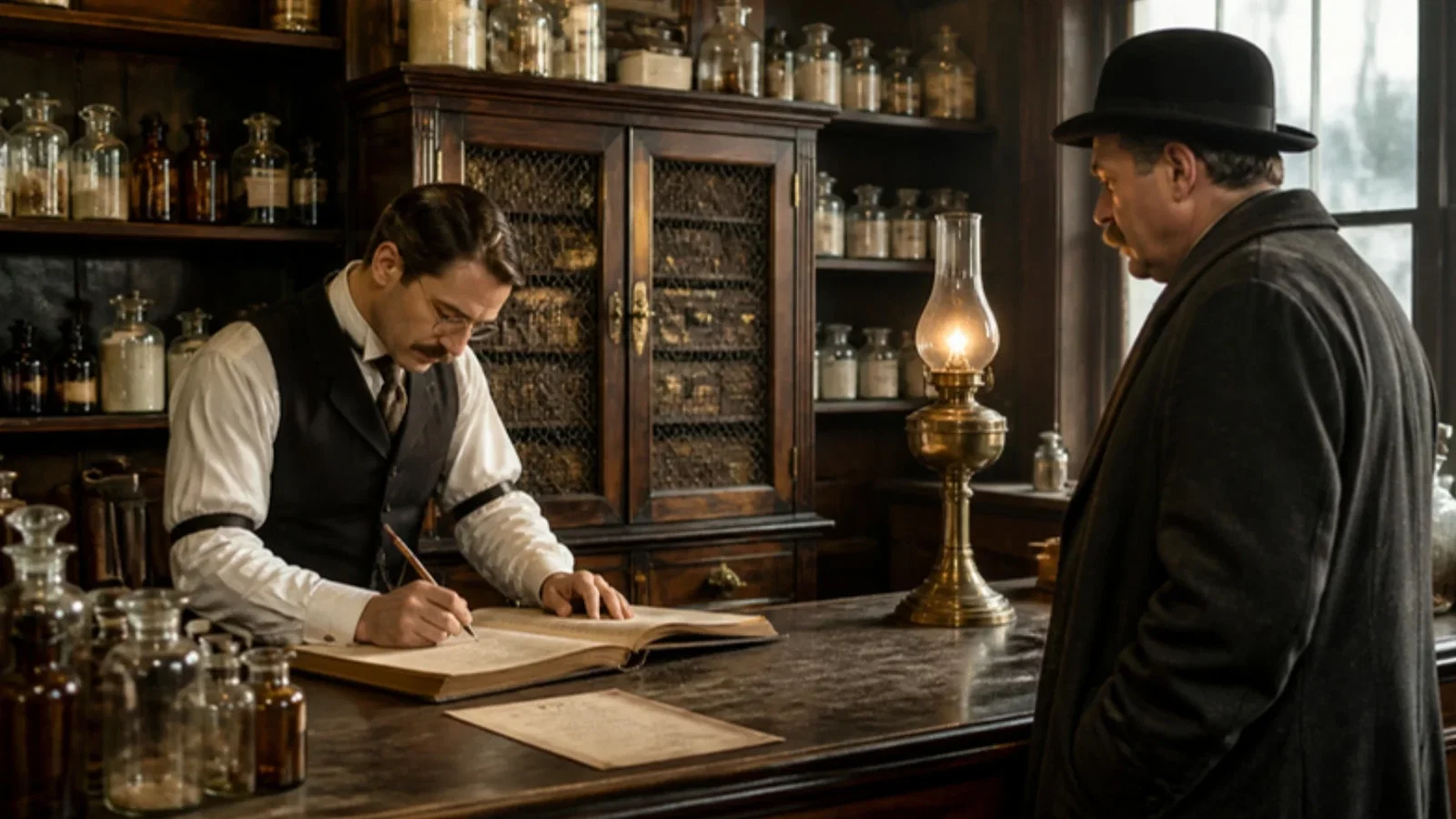
The Act of Congress of 17 December 1914 required everyone who produced, imported, compounded, dealt in, dispensed, sold, distributed or gave away opium or coca leaves, or any derivative or preparation of them, to register with the collector of internal revenue from 1 March 1915 and pay a special tax; sales required official order forms. Public Health Reports printed the Act in full on 19 February 1915 and warned physicians that, although dispensing to patients in practice needed no order form, a record of date, drug, quantity and the patient's name and address had to be kept for two years, except for patients personally attended. Cocaine, a coca derivative, was then a common local anaesthetic. In 1918 the Dental Outlook carried advertisements announcing that Novocain 'does not come under the Harrison Law. No narcotic blank is required', and another local anaesthetic urged dentists not to 'waste your time filling out Harrison Narcotic Blanks'.
Reading Library · Anesthesia Epochs · 中文版
Watch the education video (for clinicians)
1914: The Harrison Act — Three Different Obligations · Anesthesia Epochs Education Series
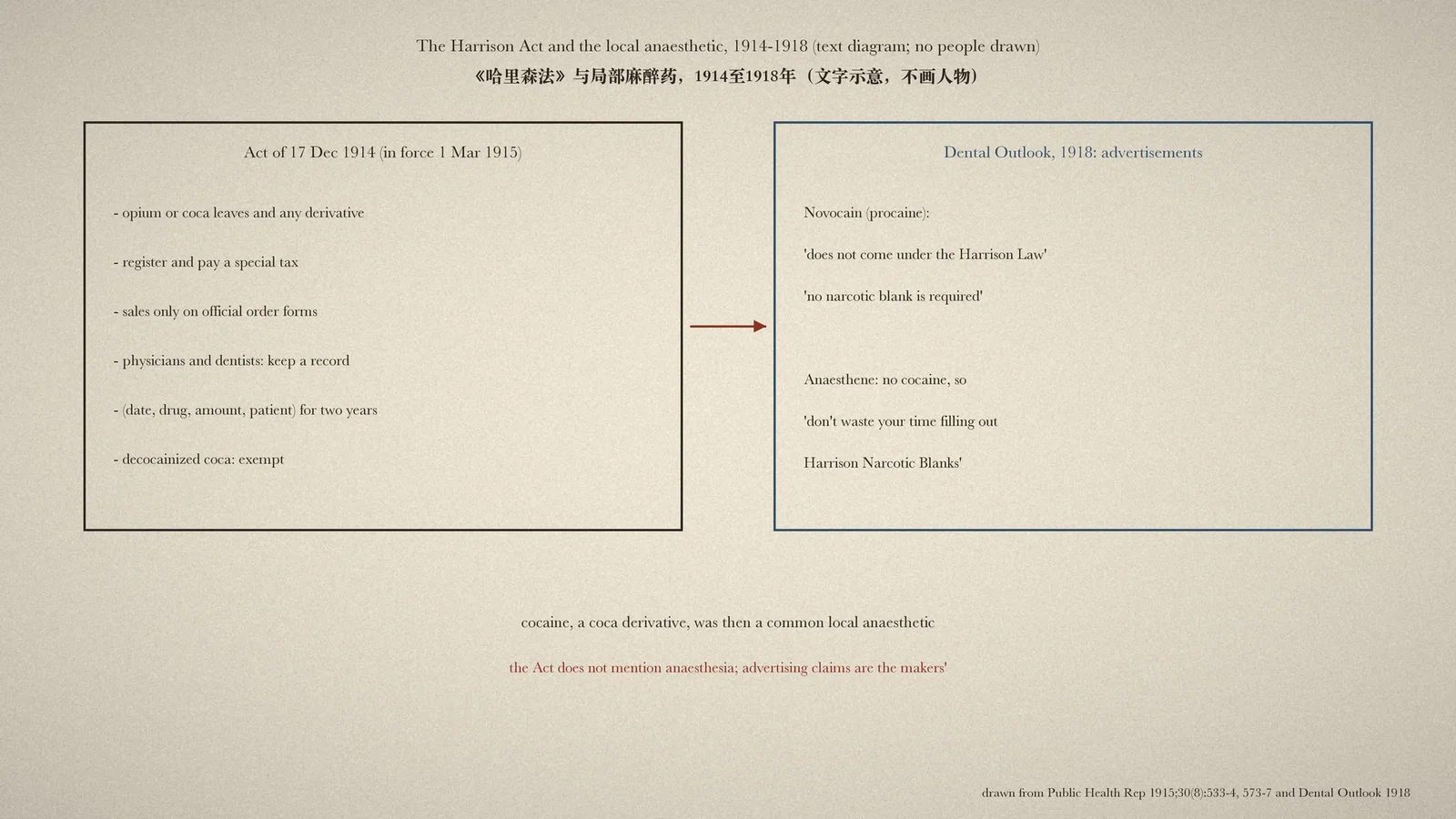
A law about narcotics does not seem to belong in a history of anaesthesia. But the Harrison Act of 1914 covered coca as well as opium, and cocaine was then a standard local anaesthetic in surgery and dentistry. Within a few years, makers of the newer, cocaine-free local anaesthetics were selling their products with the Act itself as the argument. [1, p. 573][2]
The notice
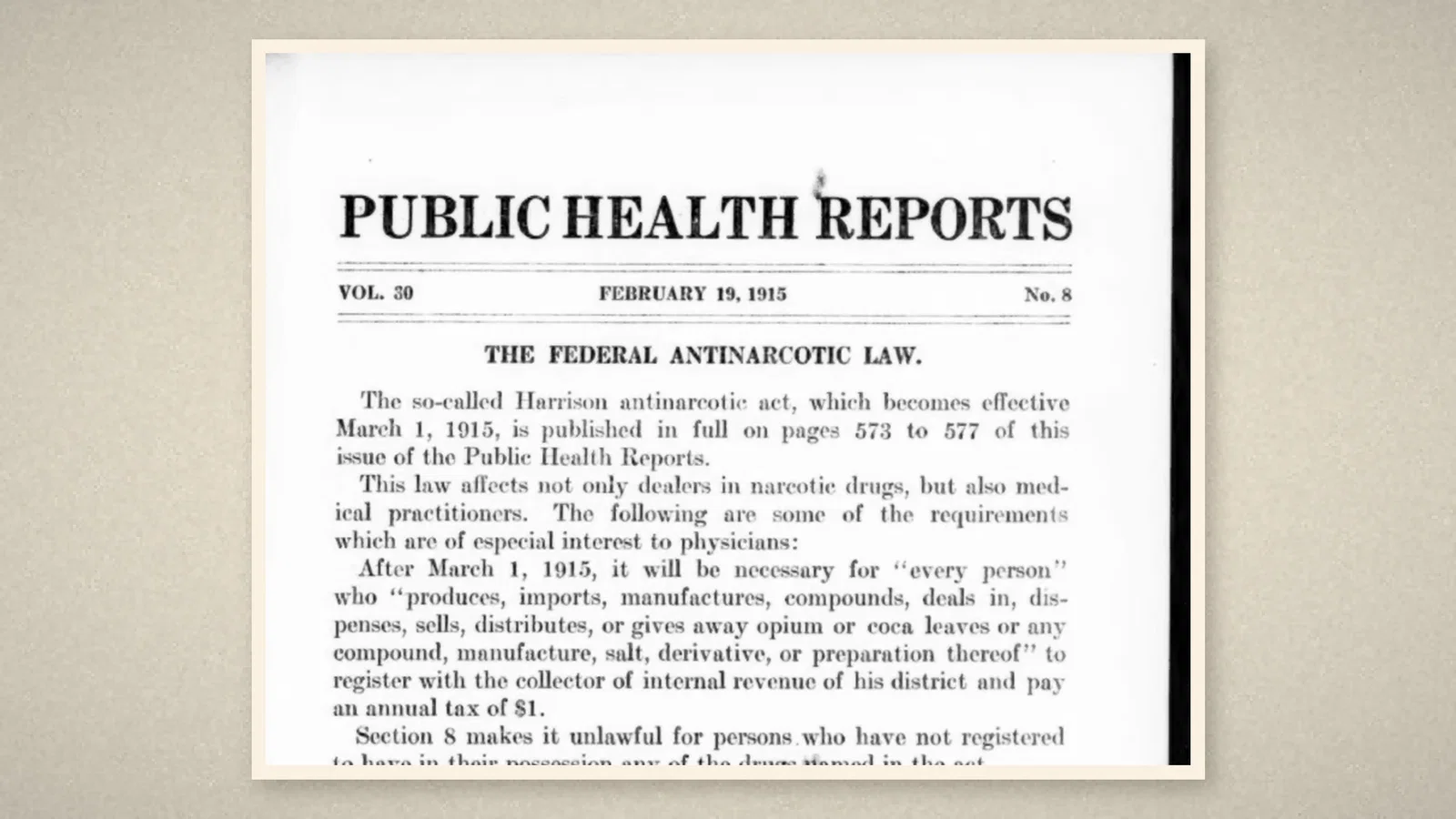
Public Health Reports for 19 February 1915 opened with "The Federal antinarcotic law". The "so-called Harrison antinarcotic act", it said, "becomes effective March 1, 1915" and was printed in full later in the issue. "This law affects not only dealers in narcotic drugs, but also medical practitioners." [1, p. 533]
What the Act required
The text is headed "Act of Congress Dec. 17, 1914". From 1 March 1915, "every person who produces, imports, manufactures, compounds, deals in, dispenses, sells, distributes, or gives away opium or coca leaves or any compound, manufacture, salt, derivative, or preparation thereof" had to register with the collector of internal revenue and pay a special annual tax. Officers buying the drugs for the armed forces, the Public Health Service, and government or municipal hospitals and prisons did not have to register. [1, p. 573]
Section 2 made it unlawful to sell or give away the drugs except on a written order on an official blank form, kept for two years for inspection. [1, p. 574]
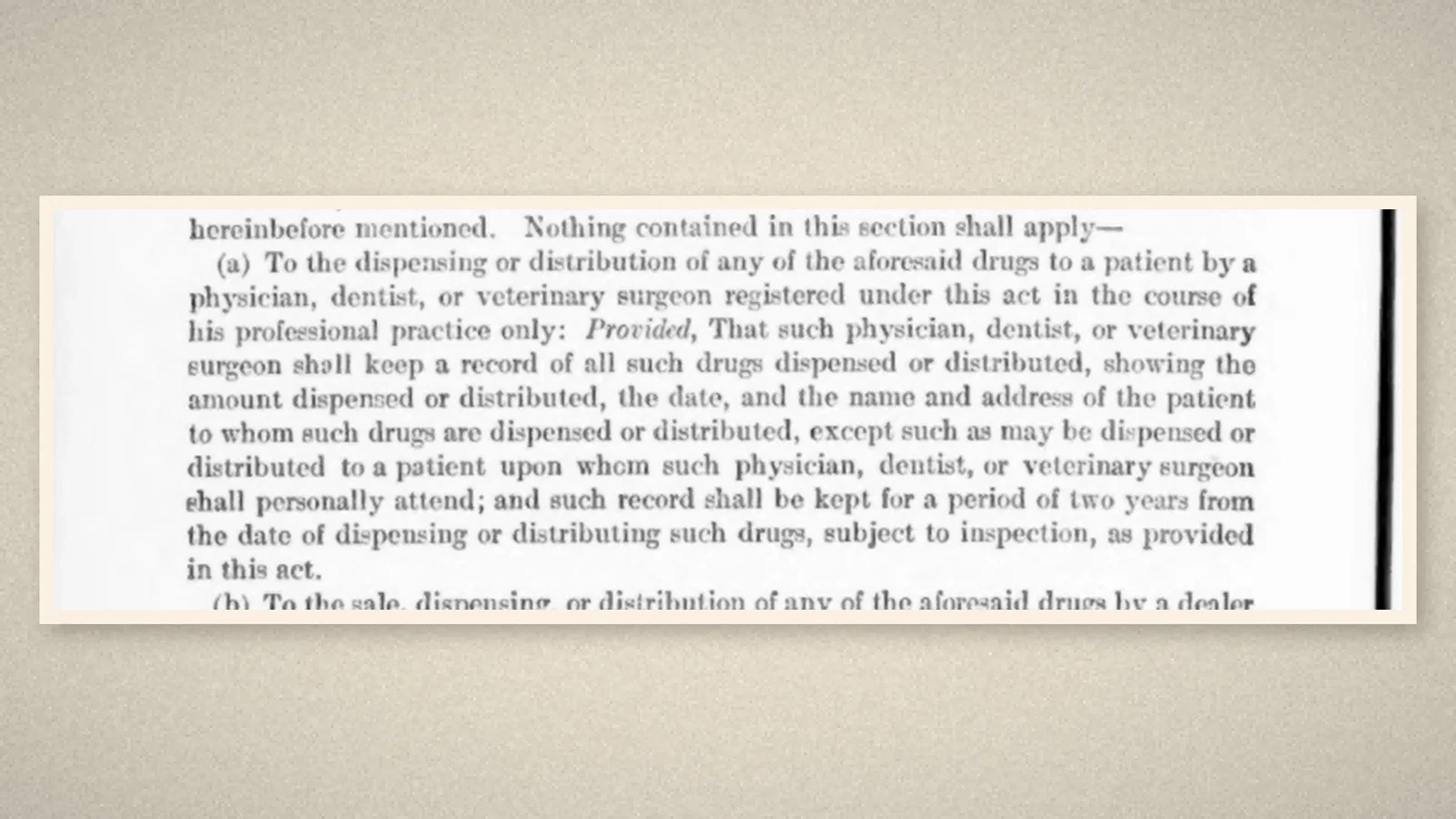
Physicians and dentists were exempted, with a condition. The order-form rule did not apply "to the dispensing or distribution of any of the aforesaid drugs to a patient by a physician, dentist, or veterinary surgeon registered under this act" in professional practice, provided a record was kept of the amount, the date, and the name and address of the patient, except for patients personally attended, for two years. Treasury regulations quoted in the notice added that each practitioner needed a blank book for the record, that prescriptions had to carry the full name, registry number and office address, and that refills were forbidden. Violation could bring a fine or imprisonment. "Decocainized coca leaves" were excluded from the Act. [1, p. 533][1, p. 534][1, p. 574][1, p. 576]
The local anaesthetic
Cocaine is a derivative of coca leaves, so a dentist or surgeon using it for local anaesthesia now had forms, records and inspections to deal with. The Act does not mention anaesthesia; the connection is in the drugs it named. [1, p. 573]
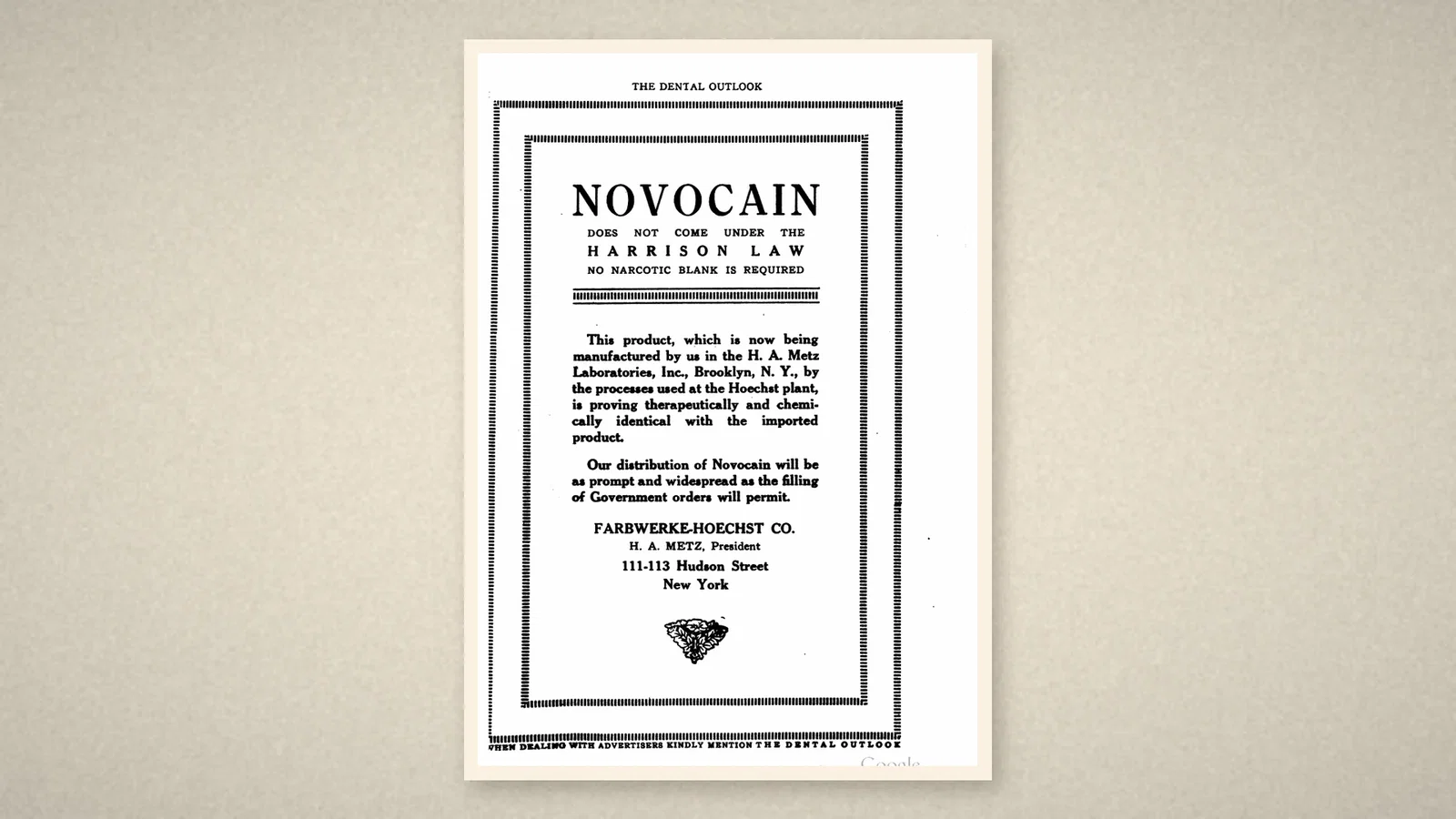
By 1918 the market had noticed. In The Dental Outlook, a full-page advertisement announced in capitals: "Novocain does not come under the Harrison Law. No narcotic blank is required." Novocain was procaine, made in Brooklyn by the H. A. Metz Laboratories "under license of the Federal Trade Commission for Procaine". Another local anaesthetic, Anaesthene, was advertised as containing no cocaine, "therefore, don't waste your time filling out Harrison Narcotic Blanks", and a news note in the same volume repeated that no Harrison narcotic blank was required for it, along with the maker's claim that it would probably supplant cocaine in dentistry. [2]
What the record shows
A regulation that changed a choice in practice without saying a word about it. The Act set out to control opium and coca. One of its quiet effects was to give the synthetic local anaesthetics, which needed no forms, an extra selling point over cocaine, and their makers used it.
Sources and reading limits
Read: Public Health Reports, 19 February 1915: the notice "The Federal antinarcotic law" (pp. 533-534), with extracts from the Treasury regulations, and the text of the Act of 17 December 1914 (pp. 573-577; sections 1-6 read closely, the rest skimmed); The Dental Outlook, 1918 volume: two Novocain advertisements, an Anaesthene advertisement and a news note on Anaesthene.
Not covered: the Act in the Statutes at Large; the full Treasury regulations; the court decisions that later shaped prescribing; 1915 hospital or anaesthesia sources on keeping records of cocaine and morphine in operating rooms.
Limits: some timelines file this under opioid regulation and anaesthesia, but the Act itself does not mention anaesthesia; the link here rests on its coverage of cocaine and opium preparations and on the dental advertisements. The advertisements are commercial claims, and Anaesthene's claims of safety and effect are not repeated as fact. The exact 1918 issues are not pinned down. Tax and penalty amounts are not repeated beyond what is needed, and no doses are given. The Act's sponsor is not named because no first name was read.
Three illustrations are crops of Public Health Reports, 19 February 1915 (pp. 533 and 574), and a Dental Outlook advertisement of 1918; one is a text diagram drawn from both, with no people drawn.
- [Act of Congress Dec. 17, 1914] Opium, coca leaves, and preparations thereof—registration of persons selling, dispensing, or giving away required; and The Federal antinarcotic law. Public Health Rep. 1915;30(8):533-4, 573-7. Internet Archive
- [Advertisements and news note on Novocain and Anaesthene]. Dental Outlook. 1918;5. Internet Archive
Continue exploring
Related reading connects shared questions and contexts; it does not by itself establish historical influence.
- 1898: Dreser Presents Heroin as a Respiratory Sedative
- 1904: Reclus Says Stovaine Will Replace Cocaine
- 1860: Niemann Extracts Cocaine from Coca Leaves
Anesthesia Epochs · The Source Room · About & Editorial Method
Published November 3, 2026. Sources and reading limits are stated above. Illustrations are labelled as original source images or AI-made. Historical accounts are educational; they are not current treatment instructions.