On 5 July 1904 Paul Reclus told the Paris Académie de médecine that stovaine, a synthetic local analgesic made by the chemist Fourneau, had matched cocaine in patients who compared the two halves of one incision, and predicted that it would increasingly replace cocaine.
Reading Library · Anesthesia Epochs · 中文版
Watch the education video (for clinicians)
1904: Stovaine — The Patient Compares · Anesthesia Epochs Education Series
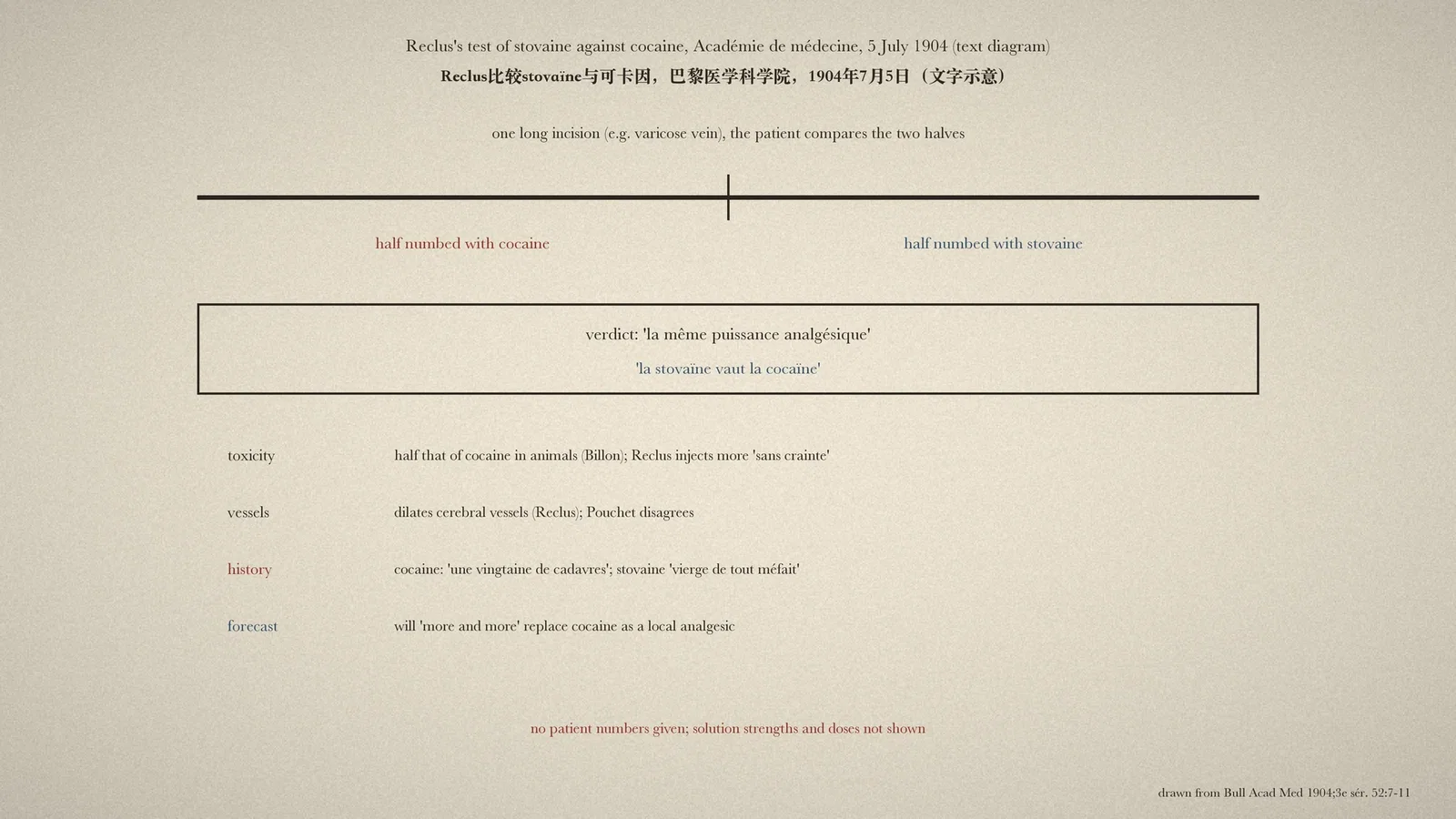
Twenty years after cocaine came into surgery, French surgeons had tried every rival and gone back to cocaine each time. Then a French chemist made a new synthetic one. In the summer of 1904 Paul Reclus brought the Académie de médecine nine months of experience with it, and an unusual way of measuring pain: one incision, two drugs. [1, p. 7][1, p. 8]
The session
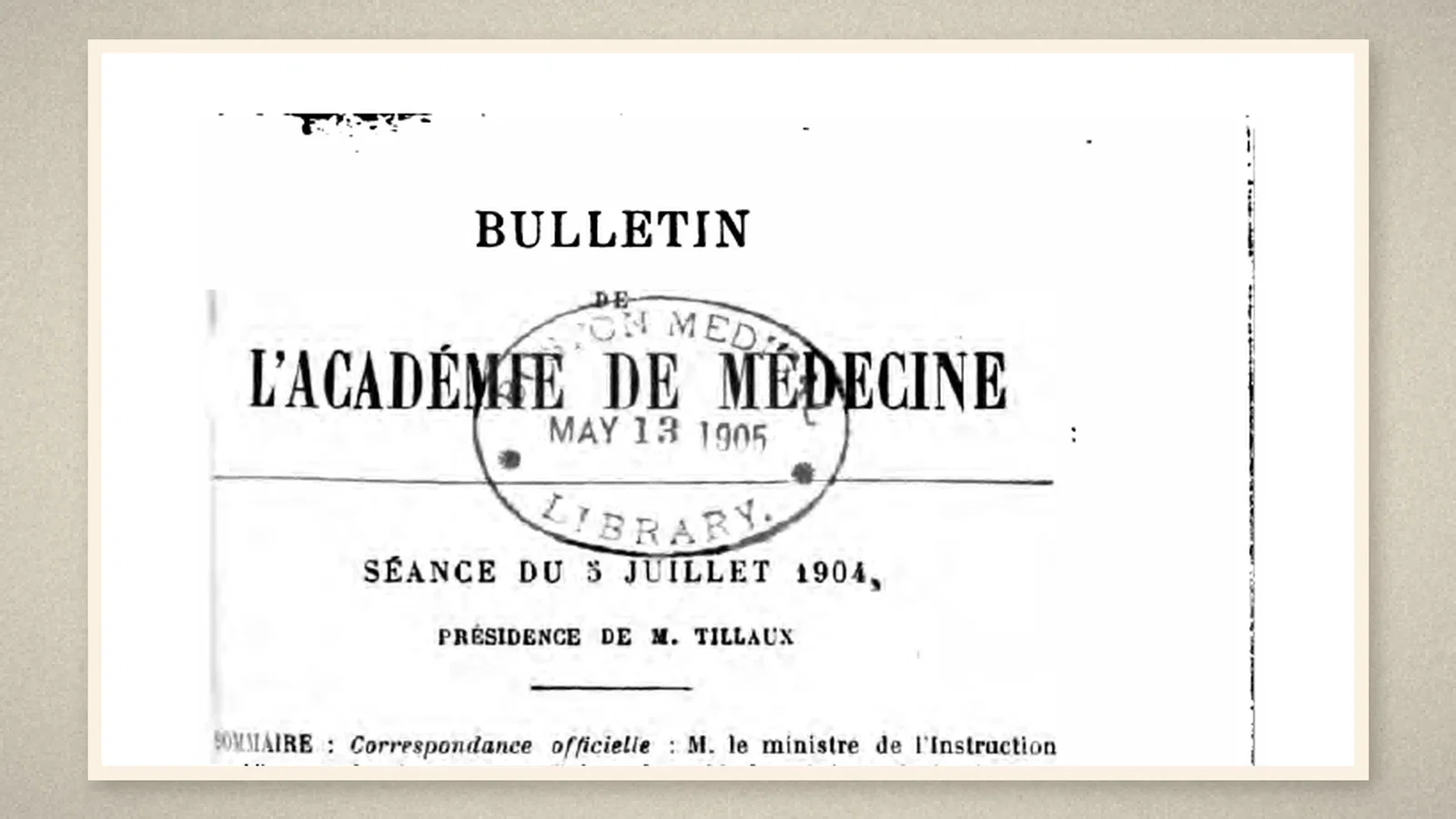
The Bulletin de l'Académie de médecine, third series, vol. 52, records the session of 5 July 1904. The first report of the day, pp. 7-11, was "L'analgésie locale par la stovaïne" (Local analgesia with stovaine) by Paul Reclus. [1, p. 1][1, p. 7]
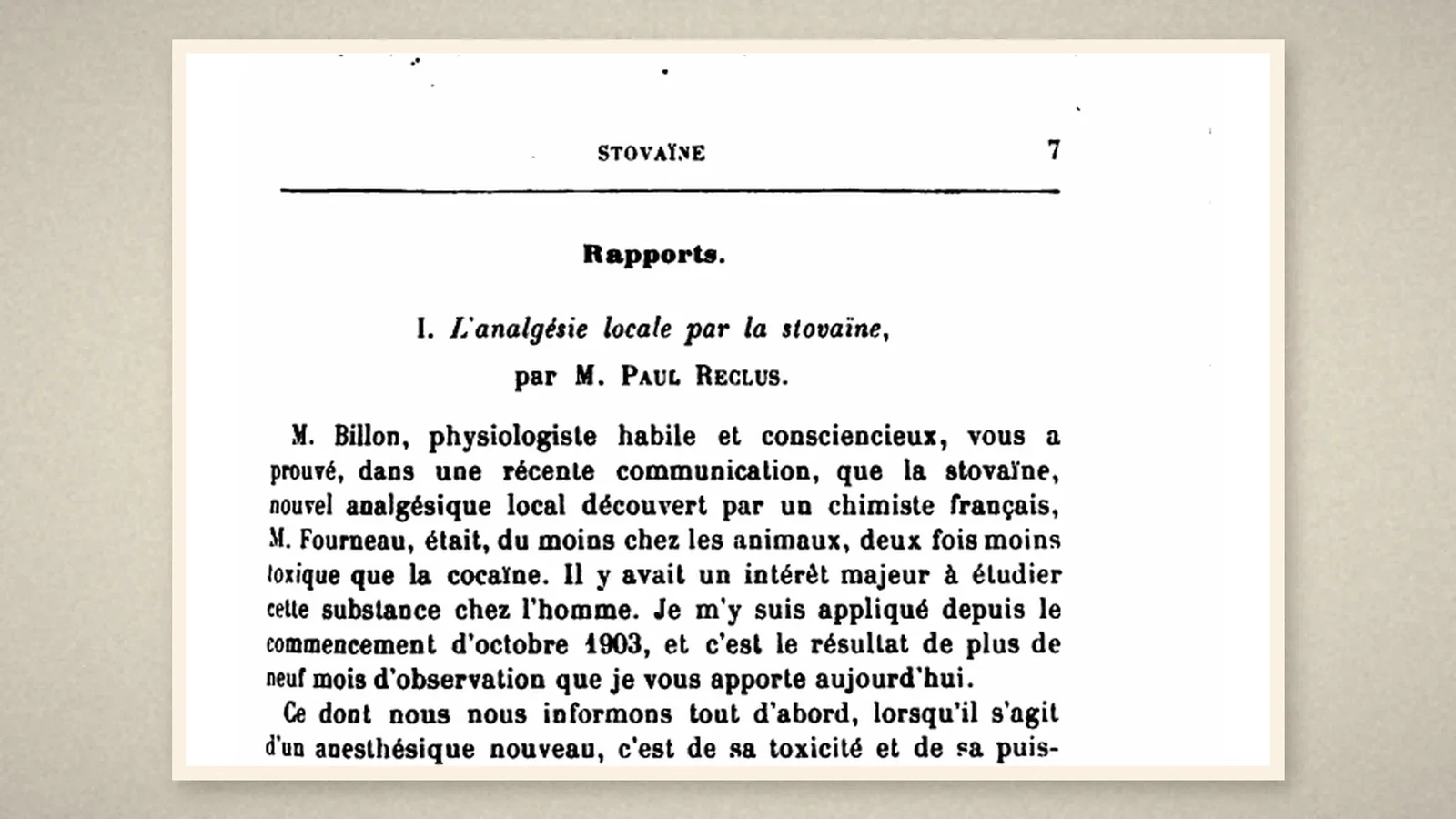
Billon, "a skilful and conscientious physiologist", had recently shown the Academy that stovaine, "a new local analgesic discovered by a French chemist, M. Fourneau", was at least in animals half as toxic as cocaine. It mattered greatly to study it in people. Reclus had done so "since the beginning of October 1903", and brought "more than nine months of observation". [1, p. 7]
Measuring pain without an instrument
A new anaesthetic, Reclus said, can only replace an old one if it relieves pain better or is less toxic. But analgesic power is hard to prove: "we have no instrument to measure pain", and patients differ, some crying out where others stay stoic. [1, p. 7]
One could perform two similar operations on the same intelligent, self-observant patient, one with each drug. Better, Reclus thought, was an operation needing one long incision, such as removing a long stretch of varicose vein. Half of the future incision was numbed with the old drug and half with the new, and the patient could easily say where the knife hurt more. [1, p. 7]
The verdict
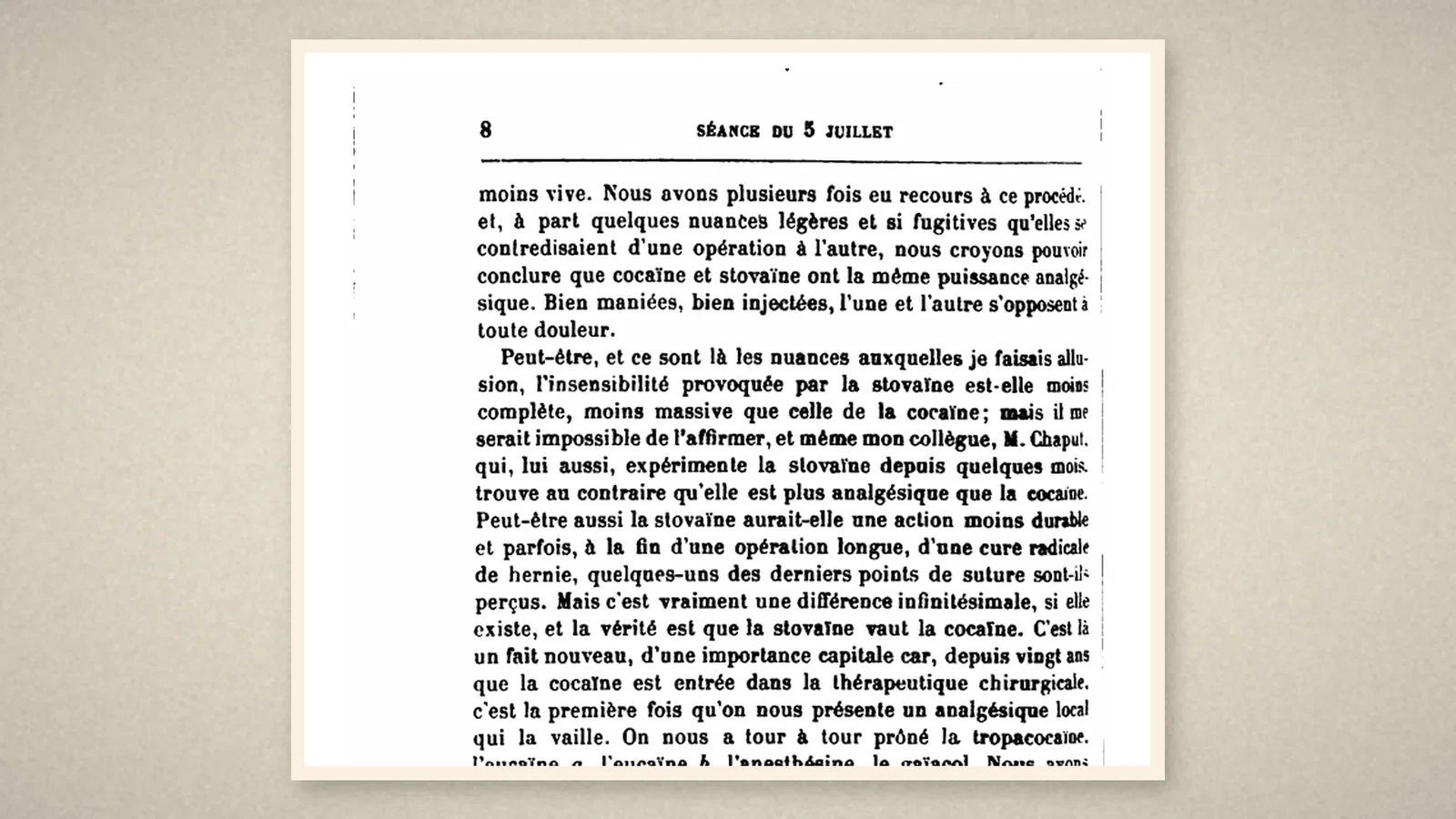
After using this method several times, Reclus concluded "that cocaine and stovaine have the same analgesic power". Stovaine's numbness might be slightly less complete or shorter, so that the last stitches of a long hernia repair were sometimes felt; yet Reclus's colleague Chaput, also trying it, found it more analgesic than cocaine. "The truth is that stovaine is as good as cocaine." [1, p. 8]
That, Reclus said, was a new fact of capital importance. In the twenty years since cocaine entered surgery, "this is the first time a local analgesic equal to it has been presented to us". Tropacocaine, the eucaines, anaesthesine and guaiacol had all been tried, and "we always came back to cocaine". This time, since October 1903, they had chosen to keep using stovaine. The claim is Reclus's. [1, p. 8]
Less toxic, and bolder surgery
With weaker cocaine solutions, Reclus said, accidents had already become rare, so having none with stovaine proved little. Still, Reclus accepted Billon's result and now injected more stovaine "without fear", attempting operations not tried before, such as removing four large varicose bundles from both legs of one patient in a single sitting, without pain or disturbance. A very anxious German man of letters had brief pallor and precordial anxiety, but was "absolutely happy to have been operated on without general anaesthesia". [1, p. 8][1, p. 9]
Reclus also thought stovaine dilated "the cerebral vessels". Cocaine's vasoconstriction made lying flat compulsory, and with stovaine it might one day be possible to operate on patients sitting up, though for now Reclus still advised the horizontal position. It was synthetic, cheaper, and free of the few countries where coca grows. Above all, cocaine, misused by "ignorant and reckless empirics", had left "about twenty corpses" on its road, while stovaine arrived with a precise technique ready-made. Reclus expected it "more and more" to replace cocaine as a local analgesic. [1, p. 10]
Two replies
Pouchet supported the conclusions and added that in animals stovaine had a clear tonic action on the heart muscle. But Pouchet did not accept the vasodilatation: in dogs given it intravenously, blood pressure dipped and then recovered, so there was neither cocaine's constriction nor marked dilatation. Huchard had used it for two months, under the skin and epidurally, in stubborn neuralgias and sciatica, with very satisfactory results so far. [1, p. 10][1, p. 11]
What the record shows
A clinical test designed around the patient's own judgement. Reclus could not measure pain, so the patient compared the two halves of one incision. On that basis a synthetic drug was declared equal to cocaine and safer. Even in the room, the details were disputed.
Sources and reading limits
Read: the Bulletin de l'Académie de médecine, 3rd series vol. 52, session of 5 July 1904: the opening page and Paul Reclus, "L'analgésie locale par la stovaïne", pp. 7–11, with the remarks of Pouchet and Huchard.
Not covered: Fourneau's chemical paper in the Comptes rendus of the Académie des sciences; Billon's communication on toxicity; Pouchet's promised study; stovaine in spinal anaesthesia. Some timelines file this under Fourneau and 1903; Reclus's report of July 1904 names Fourneau without a first name, and none is given here. "The first time" is Reclus's judgement. The half-incision comparisons are given without numbers of patients or controls; lower toxicity in people is Reclus's belief, resting on Billon's animal work; Pouchet disputed the vasodilatation. Solution strengths and doses are not repeated. French quotations are translated.
- Reclus P. L'analgésie locale par la stovaïne. Bull Acad Med (Paris). 1904;3e sér. 52:7-11. Internet Archive
Continue exploring
Related reading connects shared questions and contexts; it does not by itself establish historical influence.
- 1882: Anrep Injects Cocaine into Anrep's Own Arm
- 1867: Jolyet and Moreno y Maïz Inject Cocaine into Frogs
- 1860: Niemann Extracts Cocaine from Coca Leaves
- 1884: Koller Brings Cocaine to the Surface of the Eye
Anesthesia Epochs · The Source Room · About & Editorial Method
Published November 3, 2026. Sources and reading limits are stated above. Illustrations are labelled as original source images or AI-made. Historical accounts are educational; they are not current treatment instructions.