In Rossbach's Würzburg laboratory, von Anrep injected dilute cocaine under the skin, felt no needle pricks, and recommended testing cocaine as a 'local anaesthetic'.
Reading Library · Anesthesia Epochs · 中文版
Watch the education video (for clinicians)
1882: Von Anrep's Cocaine Self-Trial — A 'Local Anaesthetic' · Anesthesia Epochs Education Series
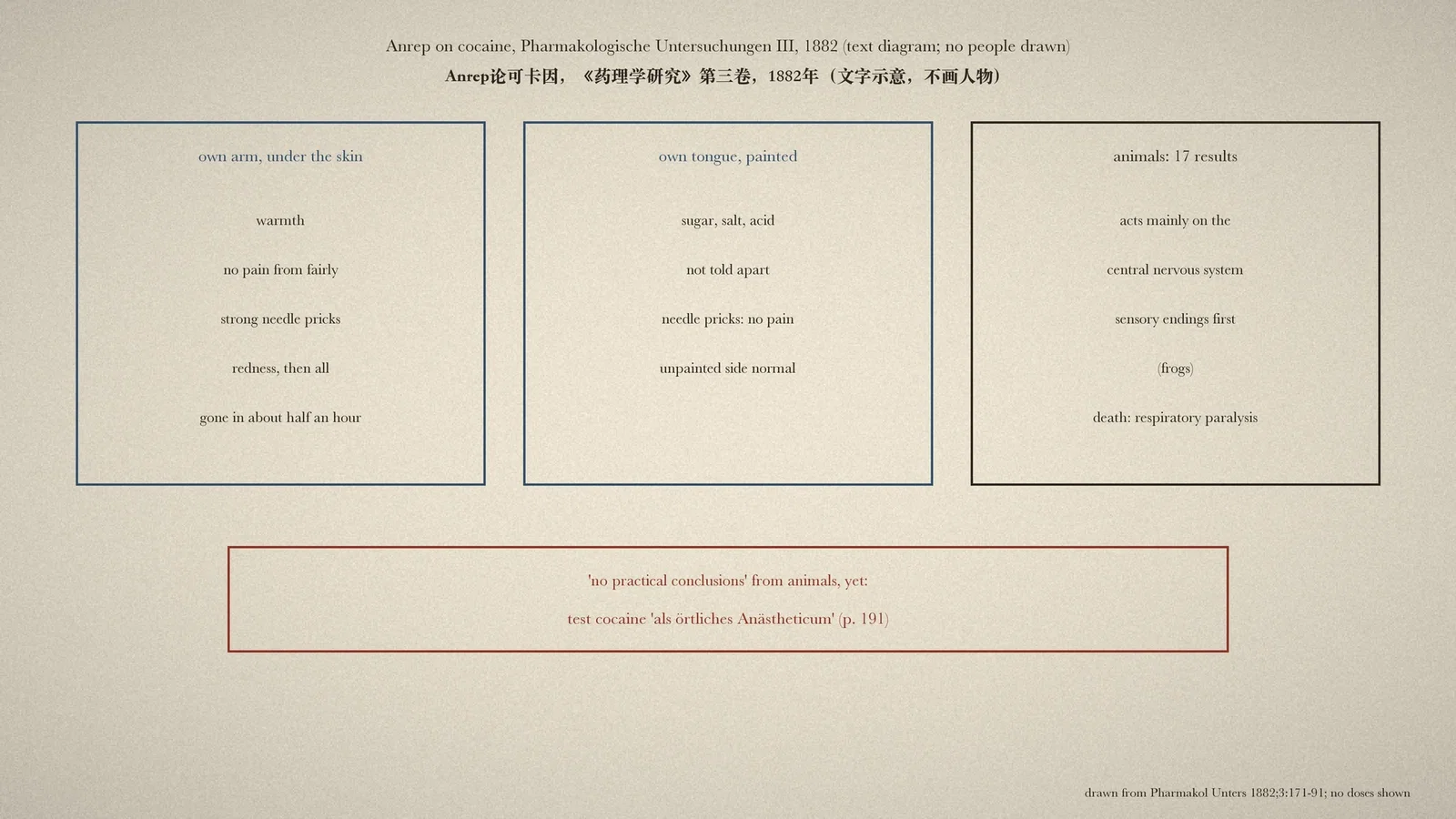
A researcher in a German pharmacology institute put a weak cocaine solution under the skin of an arm, the researcher's own, and then pricked the spot with a needle. Nothing hurt. The researcher painted cocaine on one side of the tongue, and that side lost both taste and pain. The paper ends with one sentence that looks beyond the laboratory. [1, p. 171][1, p. 191]
The volume
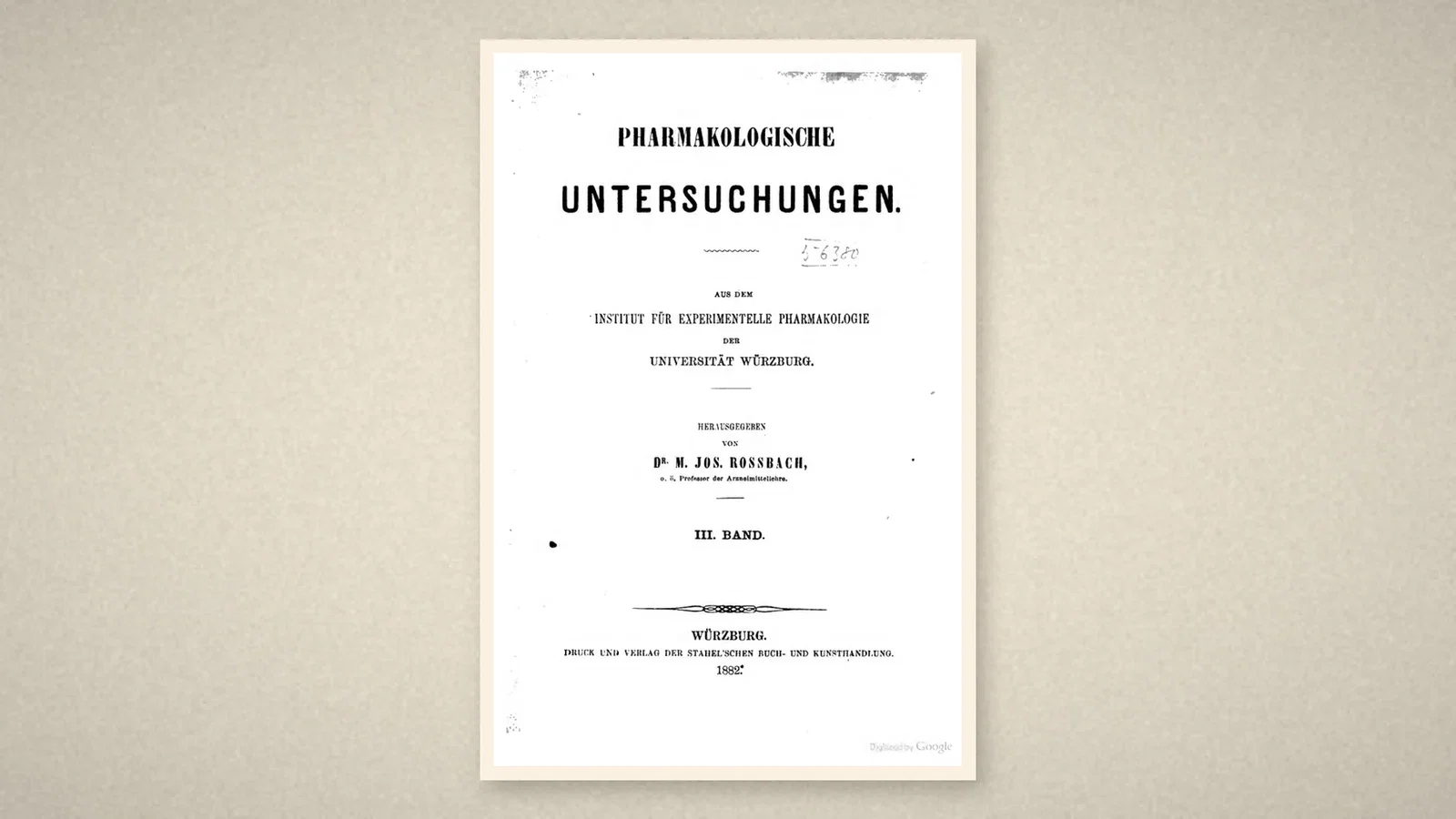
Pharmakologische Untersuchungen was the publication of the institute of experimental pharmacology of the University of Würzburg, edited by M. Jos. Rossbach. Its third volume, printed in Würzburg in 1882, contains "Ueber die physiologische Wirkung des Cocaïn" (On the physiological action of cocaine) by Dr B. von Anrep, pp. 171-191. A footnote calls it an extract from a fuller paper in Pflüger's Archiv, vol. 21, p. 38. [1, p. 171]
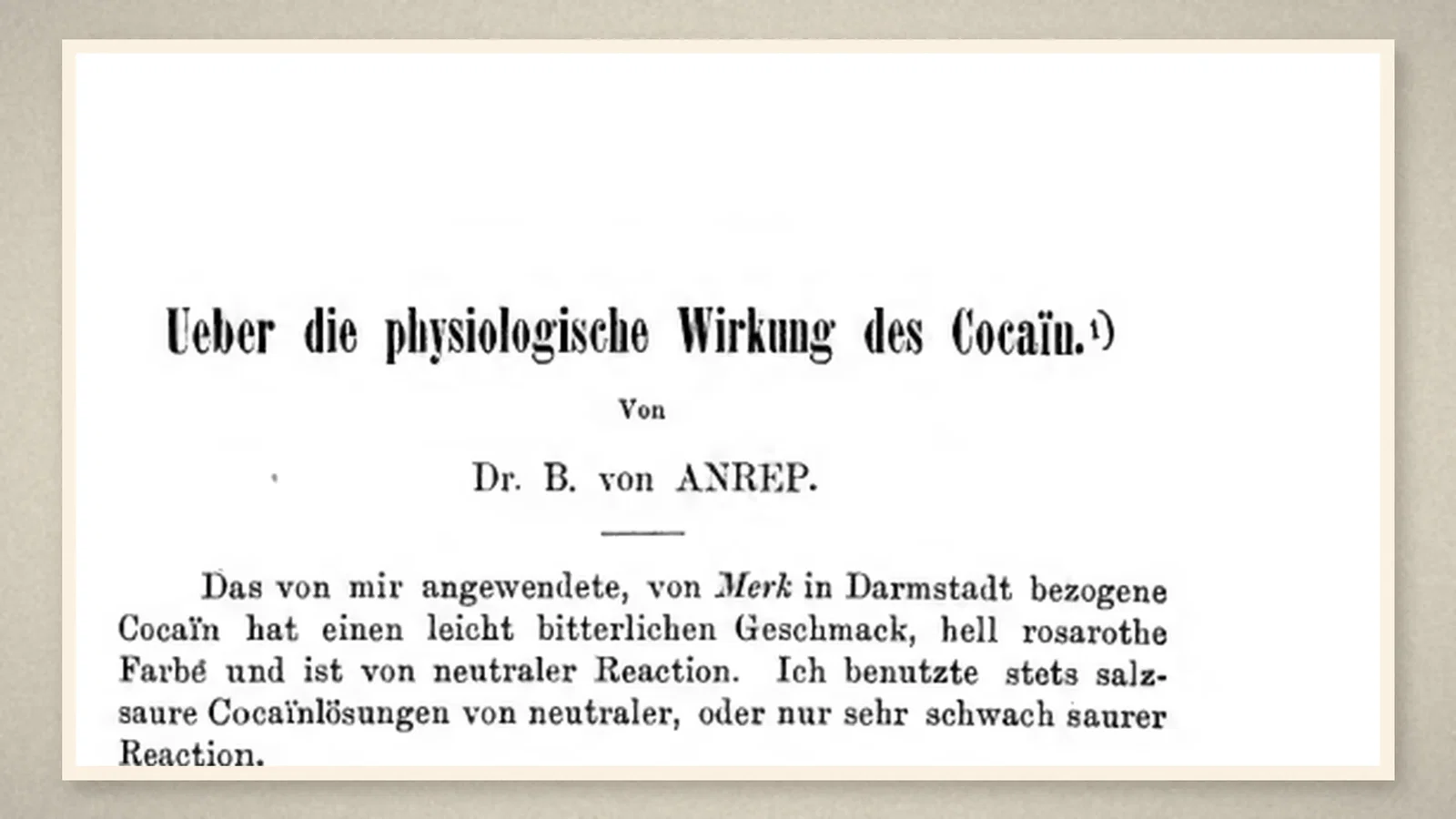
The cocaine, Anrep wrote, came from Merck of Darmstadt. It was slightly bitter and pale rose in colour, and was always used as neutral or barely acid solutions of the hydrochloride. [1, p. 171]
On the skin, on the tongue
The paper begins with local effects, and with Anrep's own body. "Ich habe mir selbst" (I myself) injected a weak solution "unter die Haut des Armes" (under the skin of the arm), Anrep wrote. First came a feeling of warmth. Then the spot became insensible to "fairly strong needle pricks". The skin there soon reddened, and within about half an hour everything had passed off. [1, p. 171]
Painting the tongue with a slightly stronger solution numbed the nerves of taste. A quarter of an hour later, on the painted spot, Anrep could not tell solutions of sugar, salt and acid apart, and "after needle pricks no feeling of pain followed", while the unpainted side of the tongue reacted normally. One painting lasted under half an hour; repeated painting could keep the effect for hours, with no after-effects. [1, p. 171]
Applied to the eye, cocaine always dilated the pupil in warm-blooded animals but not reliably in frogs; the dilatation was never maximal and did not last, and atropine could widen the pupil further still. [1, p. 172]
In animals
The rest of the paper reports systematic experiments on frogs and on rabbits, dogs, cats and pigeons, summed up in seventeen results. Cocaine's action was directed above all at the central nervous system. In frogs it paralysed nerve endings and nerve centres, and the endings of the sensory nerves were affected first. In warm-blooded animals it first strongly excited the nerve centres and only later weakened them. Breathing stopped early in cold-blooded animals, but in warm-blooded animals only after large, lethal doses. Death from cocaine in warm-blooded animals came from final paralysis of breathing. [1, p. 190][1, p. 191]
One sentence
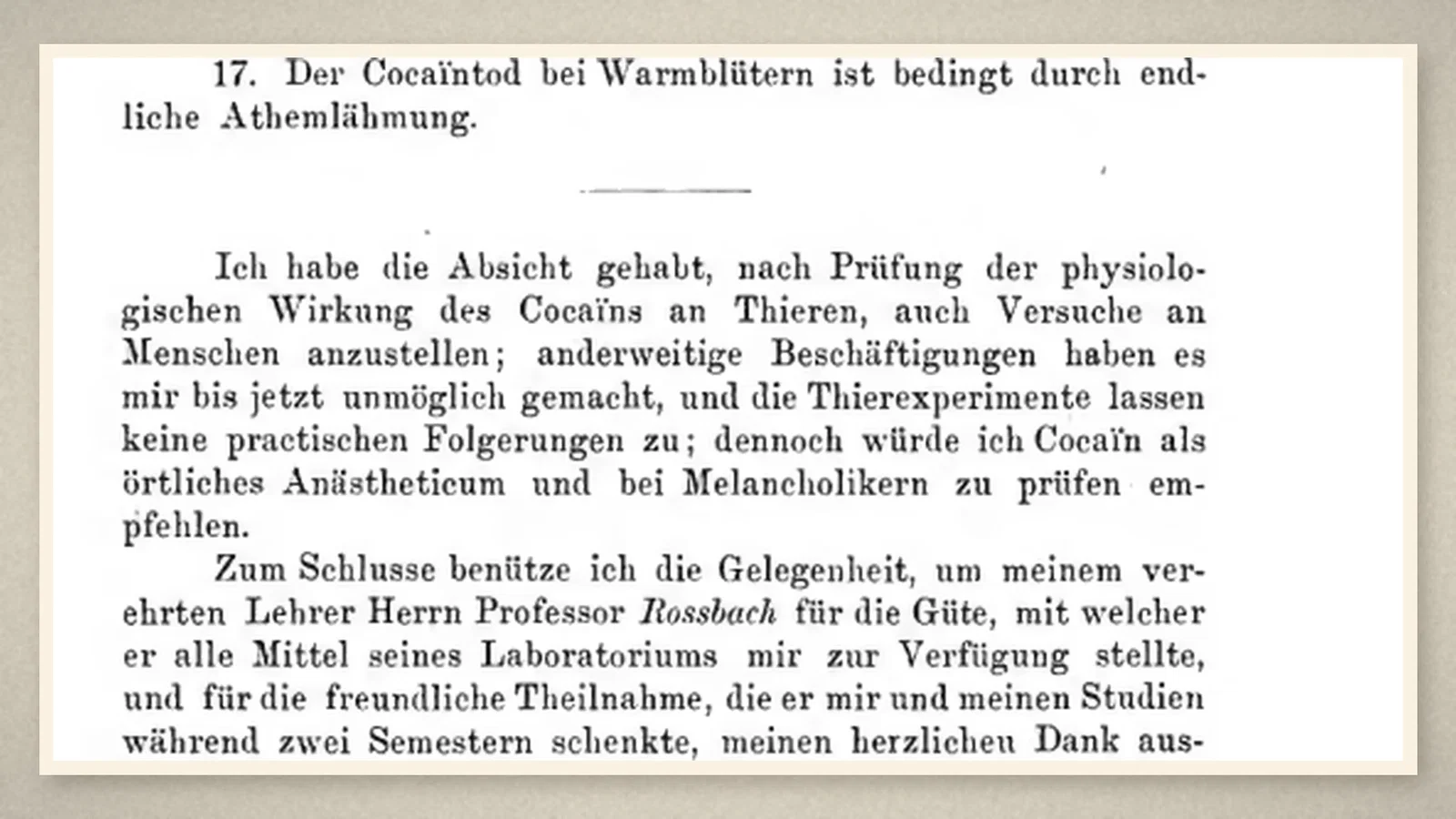
Anrep had meant to go on to experiments on people, but "other occupations" had so far made that impossible, and the animal experiments "allow no practical conclusions". Then came the sentence: "dennoch würde ich Cocain als örtliches Anästheticum und bei Melancholikern zu prüfen empfehlen", that is, "nevertheless I would recommend testing cocaine as a local anaesthetic and in melancholic patients". Anrep closed by thanking Professor Rossbach for two semesters in the laboratory. [1, p. 191]
What the record shows
A finding that was in print and pointed in the right direction, yet stayed a suggestion. Anrep felt no pain where cocaine had gone in, said so, and recommended a trial as a local anaesthetic. But the trial in people was not done, the recommendation shared its sentence with melancholia, and the paper's weight lay on frogs and rabbits.
Sources and reading limits
Read: B. von Anrep, "Ueber die physiologische Wirkung des Cocaïn", Pharmakologische Untersuchungen (ed. Rossbach), vol. III, Würzburg 1882, pp. 171-191, with the local effects (pp. 171-172), the results (pp. 190-191) and the closing recommendation in detail.
Not covered: the animal protocols in detail; the fuller paper in Pflüger's Archiv, vol. 21, of which this is said to be an extract, and therefore its date; Anrep's later clinical work; the event sometimes dated to 15 November 1884.
Limits: some timelines date this topic to 15 November 1884 and call it clinical. The source read is an extract printed in 1882 and describes animal experiments and Anrep's self-experiments, ending with a recommendation, not a clinical use. The dates of the experiments and of the Pflüger's Archiv version are not established here. The self-experiments are single observations without controls. Doses and concentrations are not repeated, and the page crop stops above the first concentration figure. German quotations are translated for this article.
Three illustrations are from Pharmakologische Untersuchungen III (the title page and crops of pp. 171 and 191); one is a text diagram drawn from the paper, with no people drawn and no doses shown.
- von Anrep B. Ueber die physiologische Wirkung des Cocaïn. In: Rossbach MJ, ed. Pharmakologische Untersuchungen. Vol 3. Würzburg: Stahel; 1882:171-91. Internet Archive
Continue exploring
Related reading connects shared questions and contexts; it does not by itself establish historical influence.
- 1867: Jolyet and Moreno y Maïz Inject Cocaine into Frogs
- 1860: Niemann Extracts Cocaine from Coca Leaves
- 1884: Knapp Injects Cocaine Behind the Eye
Anesthesia Epochs · The Source Room · About & Editorial Method
Published November 3, 2026. Sources and reading limits are stated above. Illustrations are labelled as original source images or AI-made. Historical accounts are educational; they are not current treatment instructions.