
At the Société de Biologie, small doses of cocaine heightened sensibility in frogs while larger doses abolished it, without wholly abolishing movement.
Reading Library · Anesthesia Epochs · 中文版
Watch the education video (for clinicians)
1867: Cocaine in Frogs — Jolyet and Moreno y Maïz · Anesthesia Epochs Education Series

Seven years after cocaine was named, two speakers at a Paris society brought it from the chemist's bench to the physiologist's frog. Both saw the same strange split: with enough of the drug, a frog stopped feeling but could still move. Neither of them drew any conclusion about surgery from it. [1, p. 162][1, p. 164]
The report

The Comptes rendus des séances et mémoires de la Société de biologie for the year 1867 (fourth series, vol. 4) contain the secretary Bouchard's report on the Society's meetings "pendant le mois de décembre 1867" (during the month of December 1867). Two communications on cocaine follow each other on pp. 162-164. [1, p. 139][1, p. 162][1, p. 164]
Jolyet: from chemistry to experiment
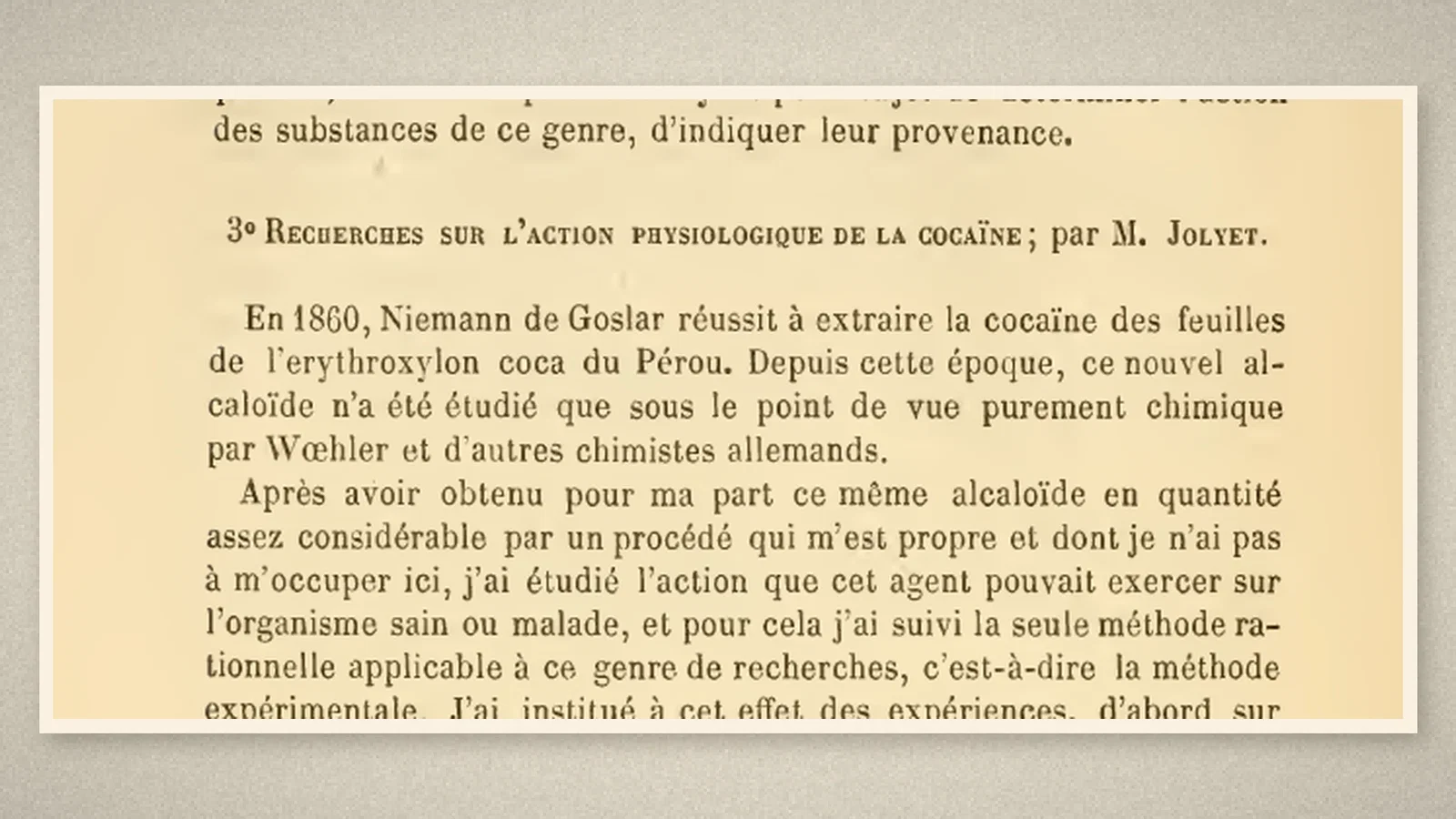
The first is Jolyet's "Recherches sur l'action physiologique de la cocaïne". In 1860, Jolyet began, Niemann of Goslar had extracted cocaine from Peruvian coca leaves, and since then the new alkaloid "had been studied only from a purely chemical point of view", by Wöhler and other German chemists. [1, p. 162]
Jolyet had made a considerable quantity by a process of Jolyet's own and set out to learn how it acted on the healthy or diseased body, using what Jolyet called the only rational method, the experimental one: experiments "first on animals, and then on healthy people". What Jolyet gave the Society was a summary. [1, p. 162]
In frogs, cocaine acetate at low doses excited sensibility, or excitability, and reduced movement. At somewhat higher doses the frogs lost the power to coordinate their movements and could not move from place to place, though they could still feel. At higher doses still, sensibility diminished and then disappeared completely, while "the excito-motor power never disappears". Divided doses brought on marked tetanus in frogs and guinea pigs; the animals recovered if the dose stayed within certain limits, and died if it did not. [1, p. 162]
Moreno y Maïz: frogs on the table
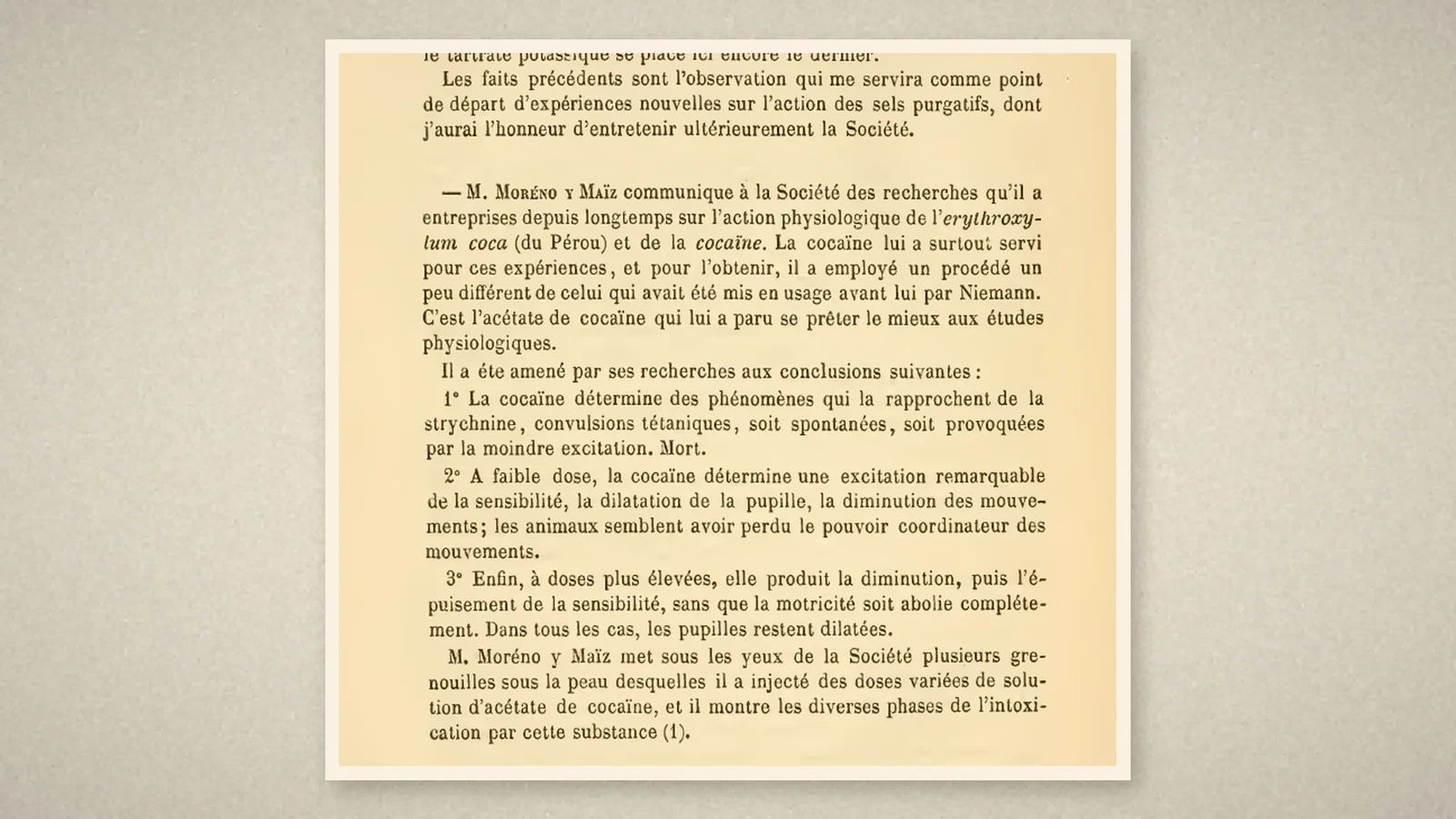
The second communication came from Moreno y Maïz, on research "undertaken long ago" into the physiological action of Peruvian coca and of cocaine. Moreno y Maïz had made cocaine by a process slightly different from Niemann's, and had found the acetate best suited to physiological work. [1, p. 164]
The report gives three conclusions. First, cocaine produced effects close to those of strychnine: tetanic convulsions, spontaneous or set off by the slightest stimulus, and death. Second, at low doses it caused a remarkable excitation of sensibility, dilated the pupil and reduced movement; the animals seemed to have lost the power to coordinate. Third, at higher doses it diminished and then exhausted sensibility, "without motor power being completely abolished". "In every case, the pupils remain dilated." [1, p. 164]
Then Moreno y Maïz put the evidence in front of the members: several frogs injected under the skin with different doses of cocaine acetate, showing the successive phases of poisoning. [1, p. 164]
A footnote adds one more fact. On 9 January 1868 Moreno y Maïz had presented to the Paris Faculty of Medicine, as an inaugural thesis, "a very extensive work" entitled "Recherches chimiques et physiologiques sur l'erythroxylum coca du Pérou et la cocaïne". [1, p. 164]
What the record shows
An observation that was made and then left alone. Two workers, in back-to-back reports, found that cocaine could abolish feeling in a frog while movement survived. But the drug was injected under the skin and acted on the whole animal; the frame of the reports is poisoning and its stages, and neither speaker turned the finding toward relieving pain.
Sources and reading limits
Read: the Société de biologie's report of its meetings during December 1867 (Comptes rendus des séances, year 1867, fourth series vol. 4), the opening page (p. 139), and in full Jolyet's paper and the report of Moreno y Maïz's communication with its footnote, pp. 162-164.
Not covered: Moreno y Maïz's thesis of 1868. A passage in that thesis is often quoted as asking whether cocaine might serve as a local anaesthetic; it is neither quoted nor claimed here. Also not covered: Jolyet's detailed experiments, which the summary promises but does not give.
Limits: some timelines list this topic as "cocaine and nerve conduction" in 1868. The pages read date from December 1867 and describe general effects after injection under the skin, loss of sensibility with movement preserved, not a local block of nerve conduction. Both reports are summaries without numbers of animals or controls; Jolyet mentions experiments on healthy people but gives no details. The first names of Jolyet and Moreno y Maïz are not printed on these pages and are not given. Doses are not repeated. French quotations are translated for this article.
Three illustrations are crops of the Comptes rendus de la Société de biologie for 1867 (pp. 139, 162 and 164); one is a text table drawn from the two reports, with no animals or people drawn and no amounts shown.
- Jolyet; Moreno y Maïz. [Communications on the physiological action of cocaine]. C R Seances Soc Biol. 1867;4th ser. 4:162-4. Internet Archive
Continue exploring
Related reading connects shared questions and contexts; it does not by itself establish historical influence.
- 1860: Niemann Extracts Cocaine from Coca Leaves
- 1884: Knapp Injects Cocaine Behind the Eye
- 1859: Scherzer and the Journey of Coca to the Laboratory
Anesthesia Epochs · The Source Room · About & Editorial Method
Published November 3, 2026. Sources and reading limits are stated above. Illustrations are labelled as original source images or AI-made. Historical accounts are educational; they are not current treatment instructions.